


06 Aug FCRA Amendment Bill 2026: Lok Sabha likely on August 12, says Amit Shah
✎ The FCRA Amendment Bill, 2026 aims to introduce interim management provisions for institutions with lapsed FCRA registration but explicitly excludes retrospective application, as assured by the Union Home Minister.
Subject Relevance — Where This Topic Fits
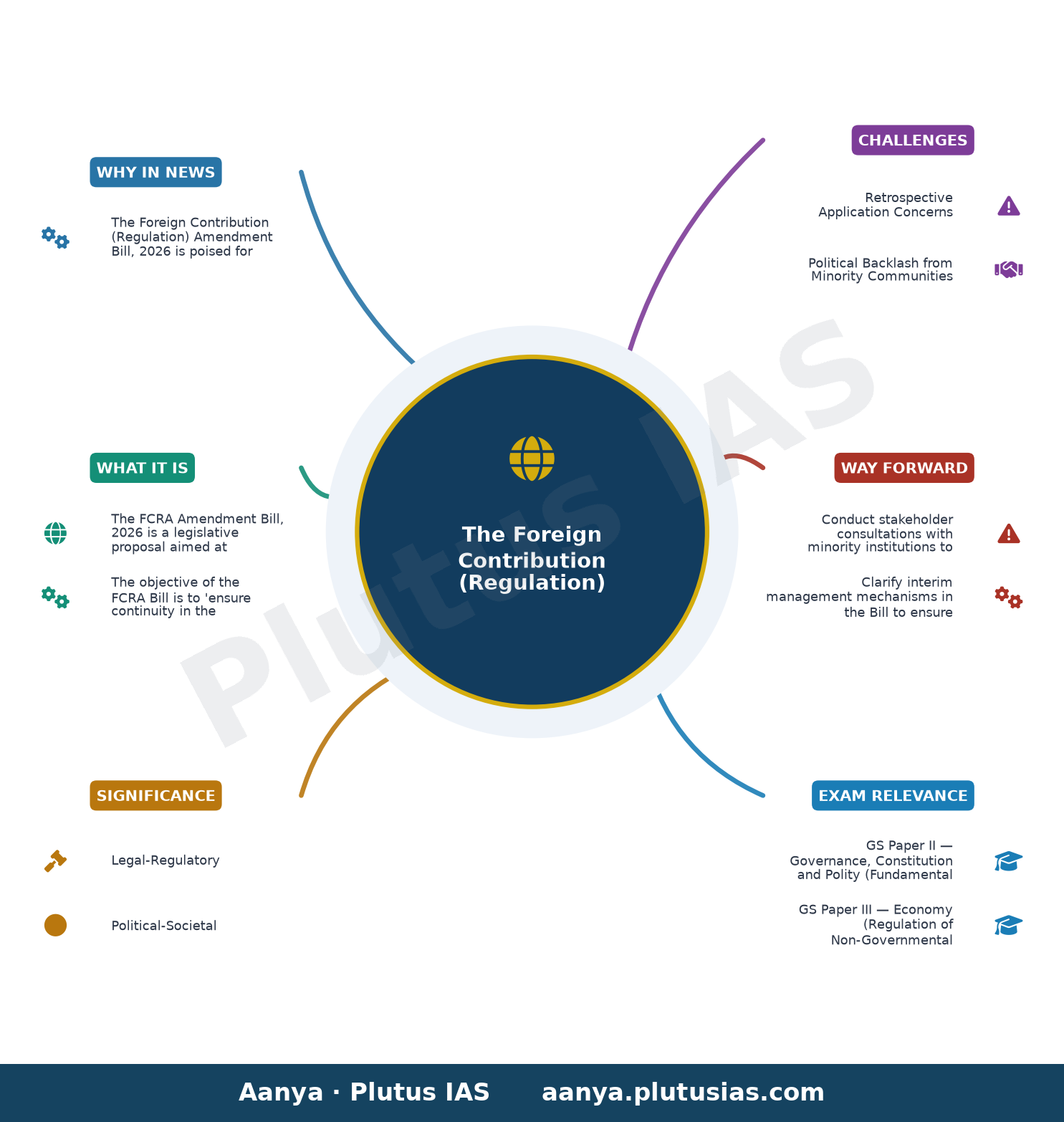
- GS Paper II — Governance, Constitution and Polity (Fundamental Rights & DPSP) | GS Paper III — Economy (Regulation of Non-Governmental Organisations and Foreign Funding)
- Prelims: Foreign Contribution (Regulation) Act, 2010, FCRA Amendment Bill 2026, Lok Sabha Monsoon Session 2026, Article 19(1)(c) — Right to form associations, Article 21 — Right to property (institutional assets), Retrospective legislation, Interim management under FCRA, Joint Parliamentary Committee (JPC), DMK MP P Wilson, Catholic Bishops’ Conference of India (CBCI)
- Essay: Balancing National Security and Civil Liberties: The Case of Foreign Contribution Regulation in India, The Role of Parliamentary Assurances in Democratic Governance: A Study of the FCRA Amendment Bill, 2026
Quick Revision: The FCRA Amendment Bill, 2026 aims to introduce interim management provisions for institutions with lapsed FCRA registration but explicitly excludes retrospective application, as assured by the Union Home Minister.
Why is this in the news?
The Foreign Contribution (Regulation) Amendment Bill, 2026 is poised for legislative consideration in the Lok Sabha on August 12, 2026, following a meeting between Mizoram Chief Minister Lalduhoma and Union Home Minister Amit Shah. The Bill has triggered significant apprehensions among Christian organisations and minority communities regarding its potential retrospective application and the imposition of interim management provisions in cases of lapsed FCRA registration. The Home Minister has publicly assured stakeholders that the Bill will not apply retrospectively, a stance reiterated by senior BJP leaders as part of the party’s outreach to minority communities. This development underscores the Bill’s political sensitivity and the government’s attempt to reconcile regulatory objectives with constitutional safeguards.
Background
- The proposed FCRA Amendment Bill, 2026 seeks to further refine the regulatory framework by addressing gaps in the management of institutions during periods of suspended or lapsed FCRA registration.
- Christian organisations and minority groups have expressed concerns that the Bill, if applied retrospectively, could expose their legitimately acquired assets to penalties for past procedural variations, despite voluntary discontinuation of foreign funding or restructuring.
- Parliamentary assurances, including the commitment to exclude retrospective provisions, have been provided to mitigate concerns, though the Bill’s final text remains the subject of ongoing deliberation.
What is the Foreign Contribution (Regulation) Amendment Bill, 2026?
- The FCRA Amendment Bill, 2026 is a legislative proposal aimed at amending the Foreign Contribution (Regulation) Act, 2010, to address regulatory gaps in the management of institutions during periods of suspended or lapsed FCRA registration.
- The objective of the FCRA Bill is to ‘ensure continuity in the management of institutions if there was a break in their FCRA registration’ and concerns about ‘a provision in the Bill that they say gives a government-designated authority the power to take over the assets and operations of an institution if its FCRA registration is suspended or revoked’.
- The Bill seeks to clarify the legal status of organisations that voluntarily discontinue foreign funding or undergo restructuring, ensuring that such decisions do not result in penalties or loss of institutional assets dedicated to public welfare.
- Concerns have been raised that the Bill, if applied retrospectively, could impose penalties on organisations for past procedural variations, despite their compliance with FCRA norms at the time of such actions.
- The government has assured stakeholders that the Bill will not apply retrospectively, a commitment reiterated by senior BJP leaders to address apprehensions among minority communities, particularly Christian organisations.
- The Bill is politically sensitive due to its potential impact on institutions that rely on foreign funding, including educational, healthcare, and social service organisations, many of which are managed by religious or minority groups.
- The proposed amendments are intended to balance the need for regulatory oversight with the protection of legitimate institutional assets and the continuity of public welfare activities.
Key Features
| Feature | Significance |
|---|---|
| Prospective application of FCRA Amendment Bill, 2026 | Ensures legal certainty for organisations by preventing penalties for past procedural variations, aligning with principles of fairness and good faith. |
| Interim management provisions for FCRA registration lapses | Safeguards institutional assets and continuity of public welfare services during regulatory transitions, preventing operational disruptions. |
| Assurance against retrospective clauses | Mitigates concerns of minority institutions, particularly Christian organisations, by eliminating retroactive penalties for past compliance decisions. |
| Government outreach to minority communities | Demonstrates political sensitivity to electoral demographics, particularly in states like Kerala, where Christian support is pivotal for BJP expansion. |
| Parliamentary scheduling (August 12, 2026) | Indicates prioritisation of the Bill in the Monsoon Session, reflecting its legislative urgency and potential electoral implications. |
Why it Matters
Legal-Regulatory
- The FCRA Amendment Bill, 2026, seeks to address ambiguities in the management of foreign-funded institutions during regulatory lapses, ensuring legal continuity and asset protection.
- By excluding retrospective provisions, the Bill aligns with constitutional principles of fairness and proportionality, reducing litigation risks for bona fide organisations.
- The emphasis on interim management mechanisms reflects a shift toward preventive governance in regulatory frameworks.
Political-Societal
- The Bill’s handling highlights the BJP’s strategic balancing act between regulatory oversight and minority outreach, particularly among Christian communities in southern states.
- Assurances to minority institutions underscore the party’s intent to counter narratives of targeted discrimination, a critical consideration in vote-bank politics.
- The Bill’s political sensitivity is amplified by its potential impact on institutions with long-standing foreign funding, such as churches and educational bodies.
Administrative
- The proposed interim management framework aims to prevent asset mismanagement or diversion during FCRA registration gaps, ensuring public welfare services remain uninterrupted.
- The Bill’s objectives reflect a broader trend of administrative reforms to enhance transparency and accountability in foreign contribution utilisation.
Challenges
1. Retrospective Application Concerns
- Christian organisations fear retrospective penalties for past procedural variations, which could undermine trust in regulatory frameworks.
- Legal uncertainty arising from retrospective clauses may deter foreign donors, impacting long-term institutional sustainability.
UPSC Link: GS2: Fundamental Rights (Article 14, 21)
2. Political Backlash from Minority Communities
- Perceived targeting of Christian institutions could alienate a significant voter base, particularly in states like Kerala and the Northeast.
- Failure to address concerns may reinforce opposition narratives of majoritarian policies, complicating BJP’s electoral strategy.
UPSC Link: GS2: Pressure Groups and Political Parties
3. Operational Disruptions in Public Welfare
- Lapses in FCRA registration could disrupt critical services (education, healthcare) provided by foreign-funded institutions, affecting marginalised communities.
- Interim management mechanisms must balance regulatory oversight with operational continuity to avoid service gaps.
UPSC Link: GS2: Functions and Responsibilities of the Union and States
4. Legislative Scrutiny and Opposition Resistance
- Opposition demands for a Joint Parliamentary Committee (JPC) may delay or dilute the Bill’s provisions, complicating its passage.
- Political polarisation over the Bill could overshadow its administrative merits, turning it into a symbolic issue.
UPSC Link: GS2: Parliament and State Legislatures
Challenges — UPSC Perspective
| Issue | Concern |
|---|---|
| Retrospective penalties | Undermines legal certainty and deters foreign donors due to fear of retroactive penalties. |
| Minority alienation | Risk of political backlash from Christian communities, particularly in Kerala and the Northeast. |
| Service disruptions | Potential gaps in public welfare services (education, healthcare) during FCRA registration lapses. |
| Legislative delays | Opposition resistance (e.g., JPC demand) may stall the Bill’s passage, complicating its implementation. |
| Administrative ambiguity | Unclear interim management mechanisms could lead to asset mismanagement or legal disputes. |
Way Forward
- Conduct stakeholder consultations with minority institutions to address concerns over retrospective clauses and asset protection.
- Clarify interim management mechanisms in the Bill to ensure transparency and prevent operational disruptions.
- Engage opposition parties proactively to mitigate resistance and expedite legislative scrutiny.
- Strengthen outreach programs to minority communities to counter misinformation and build trust in regulatory reforms.
- Monitor FCRA registration lapses in real-time to preempt service disruptions and ensure continuity of public welfare services.
- Enhance grievance redressal mechanisms for organisations facing FCRA-related challenges to reduce litigation risks.
- Align FCRA amendments with global best practices in foreign contribution regulation to maintain donor confidence.
UPSC Value Addition
Keywords for Mains Answer-Writing
Foreign Contribution (Regulation) Amendment Bill, 2026 · FCRA · Foreign Contribution (Regulation) Act, 2010 · Lok Sabha proceedings · retrospective legislation · Amit Shah · Lalduhoma · Mizoram CM · Christian organisations · Joint Parliamentary Committee · FCRA registration lapses · interim management of institutions · prospective vs retrospective application · public welfare institutions · parliamentary accountability
Concept Flow
FCRA Amendment Bill, 2026 proposed → Concerns over retrospective clauses raised by minority institutions → Political outreach by BJP to address fears → Assurance of prospective application given → Legislative scheduling (August 12, 2026) → Potential opposition resistance → Need for stakeholder consultations and administrative clarity.
Prelims Practice Questions
Q1. Consider the following statements regarding the Foreign Contribution (Regulation) Amendment Bill, 2026:
1. The Bill seeks to introduce retrospective provisions for organisations whose FCRA registration has lapsed.
2. The Bill aims to ensure continuity in the management of institutions in case of a break in their FCRA registration.
3. The Bill has been assured by the Union Home Minister to have no retrospective clause.
How many of the above statements are correct?
- Only one
- Only two
- Only three
- None
Answer: Only two — Statement 1 is incorrect as the Bill has been assured to have no retrospective clause by the Union Home Minister. Statements 2 and 3 are correct.
Q2. Assertion (A): The Foreign Contribution (Regulation) Amendment Bill, 2026, is politically sensitive for the BJP due to its potential impact on Christian institutions.
Reason (R): Many churches and Christian institutions in India have been built using foreign contributions regulated under the FCRA.
- Both A and R are true, and R is the correct explanation of A.
- Both A and R are true, but R is not the correct explanation of A.
- A is true, but R is false.
- A is false, but R is true.
Answer: Both A and R are true, and R is the correct explanation of A. — Both the Assertion and Reason are correct. The political sensitivity arises because Christian institutions rely heavily on foreign contributions regulated under the FCRA, making the Bill contentious.
Q3. Match the following provisions of the Foreign Contribution (Regulation) Act, 2010 with their correct descriptions:
Column I (Provision)
1. Section 5
2. Section 8
3. Section 12
4. Section 17
Column II (Description)
a. Prohibits acceptance of foreign contribution by candidates for election
b. Specifies the manner in which foreign contribution shall be utilised
c. Regulates the transfer of foreign contribution to other persons
d. Empowers the Central Government to prohibit receipt of foreign contribution
Answer: ? — 1-d, 2-a, 3-b, 4-c. Section 5 empowers the government to prohibit receipt of foreign contribution, Section 8 prohibits candidates from accepting foreign contributions, Section 12 specifies utilisation, and Section 17 regulates transfers.
Mains Practice Question
✍ Critically examine the constitutional and legal implications of the Foreign Contribution (Regulation) Amendment Bill, 2026, in the context of its prospective versus retrospective application. Also, analyse the political and social concerns raised by Christian organisations regarding the Bill. (15 Marks)
Approach: MODEL-ANSWER SKELETON:
1. **Introduction** (2 marks): Briefly define the FCRA, 2010, and its objectives. Mention the key changes proposed in the 2026 Amendment Bill, particularly the controversy surrounding retrospective application.
2. **Constitutional and Legal Implications** (5 marks):
– **Prospective vs Retrospective Application**: Discuss Article 20(1) of the Constitution (no retrospective penal legislation) and Article 21 (right to property). Cite relevant Supreme Court judgments (e.g., *V. Mohan Kumar v. State of Tamil Nadu*, 2023 on retrospective taxation).
– **Judicial Review and Parliamentary Sovereignty**: Examine the balance between parliamentary sovereignty (Article 105) and judicial review (Article 32/226). Reference *Kesavananda Bharati v. State of Kerala* (Basic Structure Doctrine) and *IR Coelho v. State of Tamil Nadu* (ninth schedule limitations).
– **FCRA’s Compliance Framework**: Highlight the role of the Ministry of Home Affairs, FCRA registration, and the proposed interim management mechanism. Link to *Common Cause v. Union of India* (2017) on transparency in FCRA.
3. **Political and Social Concerns** (5 marks):
– **Christian Organisations’ Perspective**: Discuss concerns over potential misuse of retrospective powers, impact on voluntary discontinuation of foreign funding, and protection of assets dedicated to public welfare. Reference the memorandum submitted by Mizoram CM Lalduhoma and the Joint Action Forum for Minorities.
– **BJP’s Outreach Strategy**: Analyse the political sensitivity of the Bill, particularly the BJP’s efforts to expand its footprint among Christian communities (e.g., in Kerala). Cite statements by BJP leaders on the Bill’s non-retrospective nature.
– **Parliamentary Accountability**: Discuss the demand for a Joint Parliamentary Committee (JPC) and the role of parliamentary debates in addressing concerns.
4. **Conclusion** (3 marks):
– Weigh the necessity of the Bill’s provisions (e.g., continuity in management) against the risks of retrospective application.
– Suggest a middle path: prospective application with safeguards for bona fide organisations.
– Emphasise the need for transparent consultations with stakeholders before finalising the Bill.
Source: The Indian Express
Generated by AanyaAi for educational purpose.

- यूपीएससी/पीसीएस के लिए दूरसंचार विनिर्माण में निवेश: ग्वालियर टीएमजेड के अवसर - September 23, 2026
- Bengaluru Investor Meet: ₹5,500 Cr Investment Proposed for Gwalior Telecom Manufacturing Zone - September 23, 2026
- एल नीनो: दुनिया के सामने जलवायु अनुकूलन की चुनौती - September 23, 2026

No Comments