


06 Aug FCRA Bill 2026: August 12 Lok Sabha Session Key Updates for UPSC Aspirants
✎ The Foreign Contribution (Regulation) Amendment Bill, 2026, introduces provisions for the management of institutions during periods of discontinuity, ensuring continuity and alignment with constitutional guarantees under Article…
Subject Relevance — Where This Topic Fits
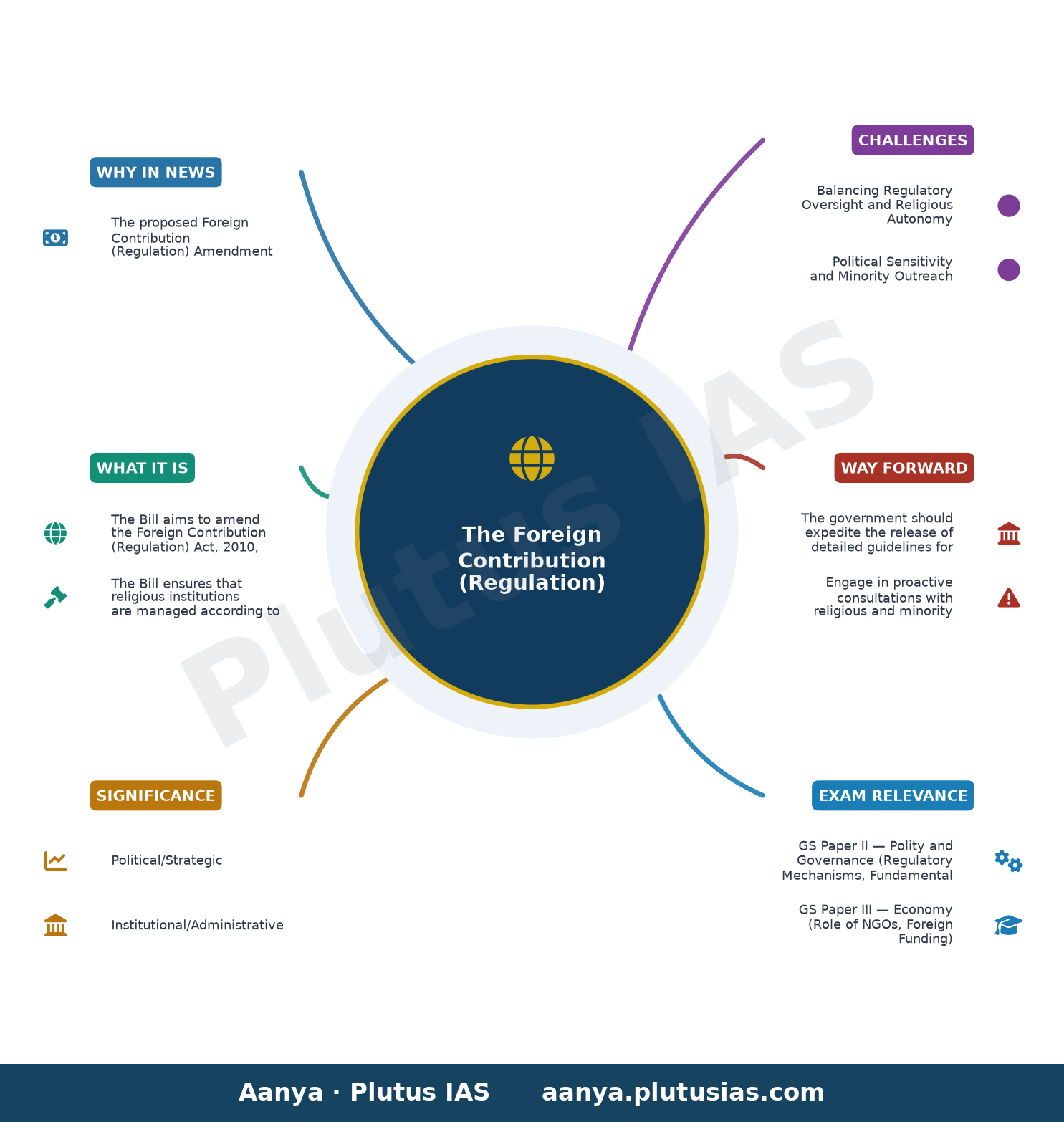
- GS Paper II — Polity and Governance (Regulatory Mechanisms, Fundamental Rights) | GS Paper III — Economy (Role of NGOs, Foreign Funding)
- Prelims: Foreign Contribution (Regulation) Act, 2010, FCRA Amendment Bill 2026, Article 26 (Fundamental Right to Manage Religious Affairs), Lok Sabha proceedings, Ministry of Home Affairs, Cessation of FCRA registration, Interim management of institutions, Retrospective legislation
- Essay: The balance between regulatory oversight and fundamental rights in governance, Ethical implications of foreign funding in religious and social institutions
Quick Revision: The Foreign Contribution (Regulation) Amendment Bill, 2026, introduces provisions for the management of institutions during periods of discontinuity, ensuring continuity and alignment with constitutional guarantees under Article 26.
Why is this in the news?
The proposed Foreign Contribution (Regulation) Amendment Bill, 2026, has gained prominence due to its potential impact on religious and social institutions dependent on foreign contributions. The Bill, expected to be introduced in the Lok Sabha on August 12, 2026, has sparked concerns among Christian organisations regarding its retrospective provisions and the management of assets created through foreign funding. The Union Home Minister’s assurance to the Mizoram Chief Minister and the Catholic Bishops’ Conference of India (CBCI) regarding the absence of retrospective clauses has added a political dimension to the debate, particularly in the context of the BJP’s outreach to minority communities.
Background
- The Foreign Contribution (Regulation) Act (FCRA), 2010, regulates the acceptance and utilisation of foreign contributions by individuals, associations, and companies in India to ensure that such contributions do not adversely affect national interest.
- The FCRA was amended in 2020 to introduce stricter provisions, including a ban on sub-granting foreign funds, reduced utilisation of foreign funds for administrative expenses, and mandatory opening of FCRA accounts in the State Bank of India, Delhi.
- The proposed 2026 Amendment Bill seeks to address gaps in the management of institutions during periods of discontinuity in FCRA registration, particularly where foreign contributions have been utilised to create assets.
- Concerns have been raised by religious and social organisations, particularly Christian institutions, over the potential impact on their autonomy and the management of assets created through foreign contributions.
- The political sensitivity of the Bill arises from the BJP’s efforts to expand its footprint among Christian communities, particularly in states like Kerala, where Christian organisations play a significant role in education and healthcare.
What is the Foreign Contribution (Regulation) Amendment Bill, 2026?
- The Bill aims to amend the Foreign Contribution (Regulation) Act, 2010, to introduce provisions for the management of institutions during periods of discontinuity in FCRA registration.
- The Bill ensures that religious institutions are managed according to the practices of the religion to which they belong, aligning with the constitutional guarantee under Article 26 (Freedom to Manage Religious Affairs).
- The Bill does not include retrospective provisions, as clarified by the Union Home Minister, addressing concerns raised by religious and social organisations.
- The government has indicated a preference for the Bill to be debated in Parliament rather than passed amid disruptions, reflecting a commitment to democratic deliberation.
- The Bill seeks to balance regulatory oversight with the autonomy of religious and social institutions, particularly those dependent on foreign contributions.
- The Bill is part of the government’s efforts to streamline the FCRA framework and address gaps in the management of institutions during periods of discontinuity.
Key Features
| Feature | Significance |
|---|---|
| Proposed Section 14B (cessation of FCRA certificate) | Introduces automatic cessation of FCRA registration if renewal is not applied for, refused, or expired, ensuring regulatory compliance and preventing indefinite foreign funding without oversight. |
| Proposed Section 16A (interim management) | Mandates interim management of institutions during discontinuity in FCRA registration to safeguard assets and ensure continuity of operations, particularly for religious and charitable institutions. |
| Assurance against retrospective application | Clarifies that the Bill will not apply retroactively, addressing concerns of Christian organisations and minority communities regarding existing assets built with foreign contributions. |
| Parliamentary debate before passage | Government intends to prioritise debate over immediate passage, reflecting a cautious approach to avoid disruptions and ensure comprehensive deliberation on provisions. |
| Focus on continuity of religious institutions | Emphasises that management of religious institutions must adhere to the practices of the respective religion, ensuring autonomy while maintaining regulatory oversight. |
Why it Matters
Political/Strategic
- The Bill’s timing and assurances reflect the BJP’s effort to balance regulatory oversight with outreach to Christian communities, particularly in states like Kerala where the party seeks electoral expansion.
- Addressing concerns of Christian organisations is critical for the BJP to mitigate perceptions of targeting minorities, especially amid electoral competition in southern states.
- The cautious approach to parliamentary passage underscores the government’s sensitivity to potential disruptions and the need for consensus on contentious legislation.
Institutional/Administrative
- The Bill aims to strengthen the regulatory framework governing foreign contributions, ensuring transparency and accountability in the utilisation of funds by NGOs and religious institutions.
- The introduction of interim management provisions seeks to prevent mismanagement or misappropriation of assets during periods of regulatory discontinuity.
- The focus on continuity aligns with the government’s broader objective of ensuring that institutions remain functional and compliant with regulatory standards.
Legal/Constitutional
- The Bill’s provisions intersect with the right to manage religious institutions under Articles 25 and 26 of the Constitution, necessitating careful balancing between regulatory oversight and religious autonomy.
- The assurance against retrospective application mitigates legal risks for organisations that have historically relied on foreign contributions, reducing potential constitutional challenges.
Challenges
1. Balancing Regulatory Oversight and Religious Autonomy
- The Bill’s provisions on interim management and cessation of FCRA certificates may be perceived as infringing on the autonomy of religious institutions, leading to potential legal and political backlash.
- Ensuring that the management of religious institutions adheres to their respective practices while maintaining regulatory compliance poses a significant administrative challenge.
UPSC Link: GS-II: Fundamental Rights (Articles 25-28)
2. Political Sensitivity and Minority Outreach
- The Bill’s focus on foreign contributions has sparked concerns among Christian organisations, particularly in states like Mizoram and Kerala, where the BJP seeks to expand its electoral base.
- The government’s assurances to minority communities highlight the political sensitivity of the Bill, requiring careful navigation to avoid alienating key voter segments.
UPSC Link: GS-II: Government Policies and Interventions
3. Parliamentary Disruptions and Legislative Process
- The government’s intent to prioritise debate over immediate passage risks delays or disruptions in Parliament, particularly if opposition parties oppose the Bill on ideological or procedural grounds.
- Ensuring a conducive legislative environment for debate and passage requires strategic coordination with political stakeholders and opposition parties.
UPSC Link: GS-II: Parliament and State Legislatures
4. Implementation and Enforcement Challenges
- The proposed interim management provisions may face practical challenges in identifying suitable interim managers and ensuring seamless transition during discontinuity in FCRA registration.
- The Bill’s effectiveness in achieving its objectives depends on robust enforcement mechanisms and clear guidelines for regulatory authorities.
UPSC Link: GS-II: Statutory Bodies and Regulatory Authorities
Challenges — UPSC Perspective
| Issue | Concern |
|---|---|
| Retrospective application | Potential legal challenges and backlash from organisations that have historically relied on foreign contributions for institutional assets. |
| Interim management provisions | Risk of mismanagement or misappropriation of assets during periods of regulatory discontinuity, particularly for religious institutions. |
| Religious autonomy vs. regulatory oversight | Tension between ensuring compliance with FCRA and respecting the autonomy of religious institutions under constitutional provisions. |
| Political backlash from minority communities | Perception of targeting Christian organisations may alienate minority voters, particularly in states like Kerala and Mizoram. |
| Parliamentary disruptions | Risk of delays or opposition-led disruptions during the legislative process, particularly if the Bill is perceived as contentious. |
Way Forward
- The government should expedite the release of detailed guidelines for the implementation of interim management provisions to ensure clarity and prevent administrative bottlenecks.
- Engage in proactive consultations with religious and minority organisations to address concerns and build consensus on the Bill’s provisions.
- Strengthen parliamentary outreach to opposition parties to facilitate a smooth debate and passage of the Bill, minimising the risk of disruptions.
- Conduct a comprehensive review of the FCRA framework to identify gaps and ensure that the Bill’s provisions align with broader regulatory objectives.
- Enhance transparency in the utilisation of foreign contributions by mandating stricter reporting and audit mechanisms for registered organisations.
- Establish a dedicated grievance redressal mechanism to address concerns raised by organisations affected by the Bill’s provisions.
- Monitor the implementation of the Bill post-enactment to assess its effectiveness and identify areas for further reform.
UPSC Value Addition
Keywords for Mains Answer-Writing
Foreign Contribution (Regulation) Amendment Bill, 2026 · FCRA · Lok Sabha proceedings · retrospective legislation · religious institutions management · foreign funding governance · Parliamentary debate on FCRA · Amit Shah assurance on FCRA · Mizoram CM Lalduhoma · Christian organisations FCRA concerns · cessation of FCRA registration · interim management provisions · continuity in institutional governance
Constitutional & Policy Linkages
- Article 25: Freedom of conscience and free profession, practice, and propagation of religion.
- Article 26: Freedom to manage religious affairs and administer religious institutions.
Concept Flow
Foreign Contributions (Regulation) Act (FCRA) → Concerns over misuse of foreign funds → Proposed amendments to strengthen oversight → Introduction of cessation and interim management provisions → Political sensitivity among minority communities → Assurance against retrospective application → Parliamentary debate and cautious passage → Implementation challenges and enforcement → Impact on religious institutions and constitutional rights.
Prelims Practice Questions
Q1. Consider the following statements regarding the Foreign Contribution (Regulation) Amendment Bill, 2026:
1. The Bill proposes to introduce a retrospective clause to annul past foreign contributions.
2. Section 14B of the Bill introduces the concept of ‘cessation’ of an FCRA certificate.
3. The Bill aims to ensure continuity in the management of institutions if there is a break in their FCRA registration.
4. The Bill seeks to empower the government to take over religious institutions managed by foreign-funded bodies.
How many of the above statements are correct?
- Only one
- Only two
- Only three
- All four
Answer: Only three — Statements 2 and 3 are correct. Statement 1 is incorrect as the Bill does not propose a retrospective clause. Statement 4 is incorrect as the Bill does not empower the government to take over religious institutions but ensures their management aligns with religious practices.
Q2. Assertion (A): The Foreign Contribution (Regulation) Amendment Bill, 2026, seeks to ensure that religious institutions are managed according to the practices of the religion to which they belong.
Reason (R): The Bill introduces provisions for interim management in case of discontinuity in FCRA registration to maintain institutional continuity.
Options:
A. Both A and R are true, and R is the correct explanation of A.
B. Both A and R are true, but R is not the correct explanation of A.
C. A is true, but R is false.
D. A is false, but R is true.
Answer: ? — Both A and R are true, and R correctly explains A. The Bill explicitly states that religious institutions should be managed according to their religious practices, and the interim management provisions aim to ensure continuity in such cases.
Q3. Match the following provisions of the Foreign Contribution (Regulation) Amendment Bill, 2026 with their respective objectives:
Column I (Provision) | Column II (Objective)
———————————————–|————————————
1. Section 14B (Cessation of FCRA certificate) | a. Ensure continuity in institutional governance
2. Interim management provisions | b. Regulate foreign contributions to religious institutions
3. Management aligned with religious practices | c. Deem FCRA registration as ceased under specified conditions
4. Debate in Parliament before passage | d. Facilitate democratic scrutiny of the legislation
Options:
A. 1-c, 2-a, 3-b, 4-d
B. 1-b, 2-d, 3-a, 4-c
C. 1-a, 2-c, 3-d, 4-b
D. 1-d, 2-b, 3-c, 4-a
Answer: ? — Correct matches: 1-c (Section 14B introduces cessation of FCRA certificate under specific conditions), 2-a (Interim management provisions ensure continuity), 3-b (Management aligned with religious practices is a stated objective), 4-d (Debate in Parliament is intended to facilitate democratic scrutiny).
Mains Practice Question
✍ Critically analyse the provisions of the Foreign Contribution (Regulation) Amendment Bill, 2026, with reference to its implications for religious institutions and the management of foreign-funded entities. Also, assess the government’s assurance regarding the non-retrospective nature of the Bill and its significance in the context of contemporary political discourse. (15 Marks)
Approach: MODEL-ANSWER SKELETON:
1. **Introduction (2 marks)**
– Brief context: FCRA regulates foreign contributions to NGOs, associations, and religious institutions.
– Mention the proposed amendments: Sections 14B (cessation of FCRA certificate) and 16A (interim management), and the assurance on non-retrospectivity.
2. **Key Provisions of the Bill (4 marks)**
– Section 14B: Automatic cessation of FCRA registration if renewal is not applied for, refused, or expired.
– Interim management provisions: Ensures continuity in governance of institutions during transition periods.
– Management aligned with religious practices: Ensures institutions are managed according to their religious tenets.
– Parliamentary debate: Government’s intent to facilitate democratic scrutiny before passage.
3. **Implications for Religious Institutions (4 marks)**
– **Positive**: Ensures continuity in governance, prevents misuse of foreign funds, and aligns management with religious practices.
– **Concerns**: Potential disruption to ongoing projects, administrative burden on institutions, and perceived targeting of specific communities (e.g., Christian organisations).
– **Assurance on Non-Retrospectivity**: Addresses concerns of institutions built using past foreign contributions; prevents legal uncertainty.
4. **Contemporary Political Discourse (3 marks)**
– **BJP’s Outreach to Minorities**: The Bill’s cautious approach reflects the party’s efforts to expand its footprint among Christian communities, particularly in states like Kerala.
– **Opposition Narratives**: Critics argue the Bill targets specific communities; the government counters by stating it ensures transparency and continuity.
– **Parliamentary Dynamics**: The government’s intent to debate the Bill rather than pass it amid disruptions highlights the political sensitivity of the issue.
5. **Conclusion (2 marks)**
– Balance between regulatory oversight and institutional autonomy.
– The non-retrospective assurance is a pragmatic step to mitigate backlash while maintaining the Bill’s core objectives.
Source: The Indian Express
Generated by AanyaAi for educational purpose.

- तमिलनाडु के लिए क्या है ‘एल नीनो’ और उत्तर-पूर्वी मानसून का खतरा? - September 23, 2026
- El Nino & Northeast Monsoon: Impact on Tamil Nadu for UPSC 2026 - September 23, 2026
- हिमाचल में डिजिटल भुगतान क्रांति: बिलासपुर अव्वल, महिलाओं की भागीदारी 93% तक पहुंची - September 23, 2026

No Comments