


06 Aug FCRA Bill 2026: Lok Sabha Likely on August 12; Retrospective Clause Dropped
✎ The Foreign Contribution (Regulation) Amendment Bill, 2026, introduces provisions for the cessation of FCRA registration and interim management of institutions, with assurances of non-retrospectivity and emphasis on parliamentary…
Subject Relevance — Where This Topic Fits
- GS Paper II — Governance, Constitution, and Polity | GS Paper II — Social Justice and Empowerment | GS Paper III — Economic Development and Inclusive Growth
- Prelims: Foreign Contribution (Regulation) Act, 2010, FCRA Amendment Bill 2026, Article 25 (Freedom of Religion), Article 26 (Religious Freedom), Lok Sabha proceedings, Parliamentary debate, Retrospective legislation, Cessation of FCRA registration, Interim management of institutions, Minority rights
- Essay: Balancing national security and civil liberties in regulatory frameworks, The role of Parliament in democratic governance: debate vs. disruption
Quick Revision: The Foreign Contribution (Regulation) Amendment Bill, 2026, introduces provisions for the cessation of FCRA registration and interim management of institutions, with assurances of non-retrospectivity and emphasis on parliamentary debate, reflecting a balance between national security and minority rights.
Why is this in the news?
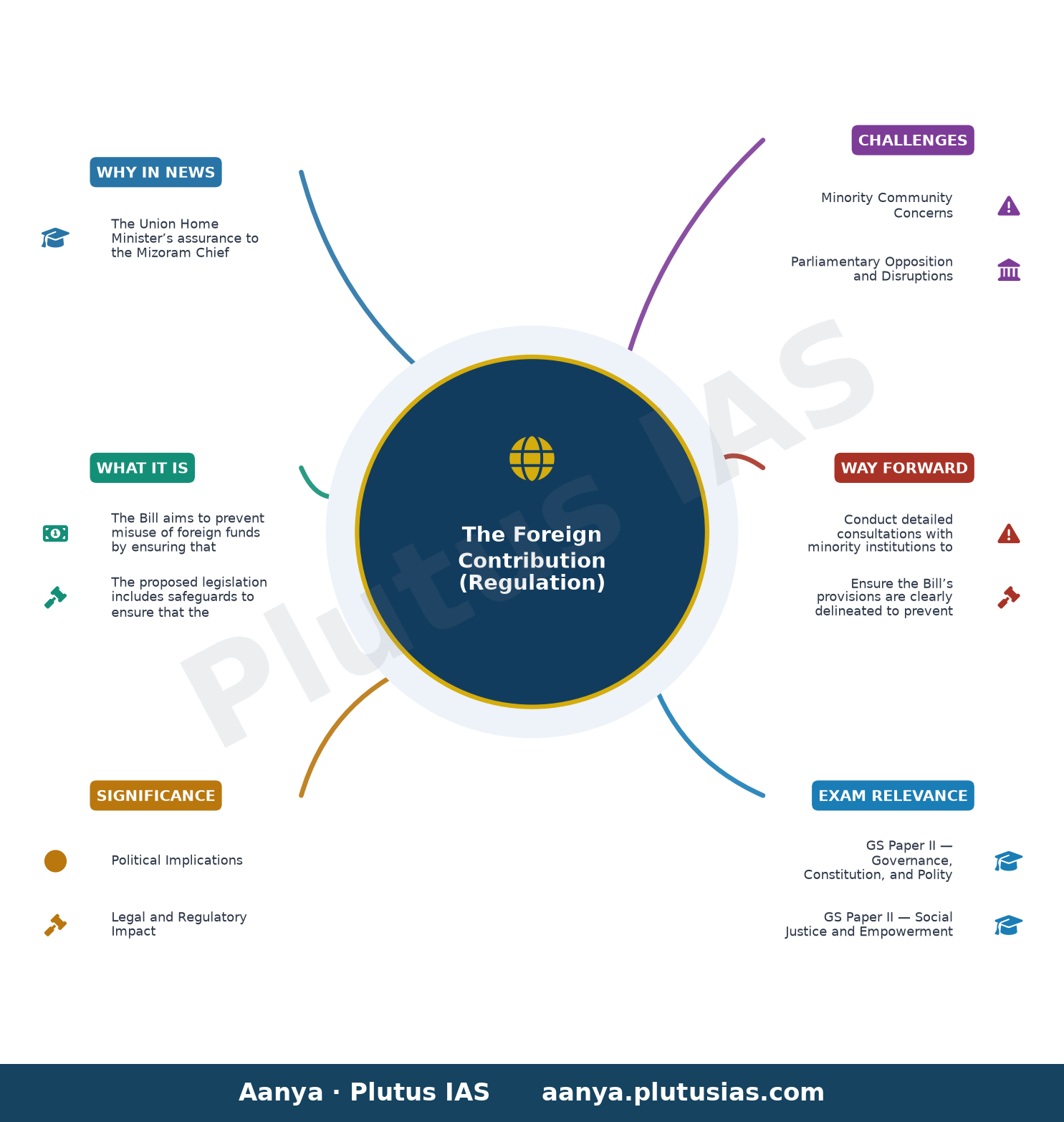
The Union Home Minister’s assurance to the Mizoram Chief Minister and Christian organisations regarding the non-retrospective nature of the proposed Foreign Contribution (Regulation) Amendment Bill, 2026, and its likely introduction in the Lok Sabha on August 12, 2026, has brought the Bill into sharp focus. The legislation seeks to address gaps in the management of institutions funded by foreign contributions under the FCRA, 2010, but has raised concerns over its potential impact on religious and minority institutions, particularly those established with foreign funds. The political sensitivity of the Bill, given its implications for Christian organisations and the BJP’s outreach to minority communities, underscores its significance for UPSC aspirants.
Background
- Christian organisations in India, particularly those in the Northeast and Kerala, have historically relied on foreign contributions for the establishment and maintenance of educational, healthcare, and religious institutions.
- The BJP’s outreach to minority communities, including Christians, has gained momentum in recent years, with the party seeking to expand its electoral base in states like Kerala and the Northeast.
- Parliamentary debates on the Bill are expected to focus on the balance between national security concerns and the protection of religious and minority rights under Articles 25 and 26 of the Constitution.
What is the Foreign Contribution (Regulation) Amendment Bill, 2026?
- The Bill aims to prevent misuse of foreign funds by ensuring that institutions managed under FCRA comply with the objectives for which the funds were received, thereby addressing concerns over foreign interference in domestic affairs.
- The proposed legislation includes safeguards to ensure that the management of religious institutions adheres to the practices of the religion to which they belong, as outlined in the official government statement.
- The Bill is intended to be debated in Parliament before passage, reflecting the government’s emphasis on legislative scrutiny and democratic deliberation.
- The assurance of non-retrospective application of the Bill addresses concerns raised by Christian organisations and minority communities regarding the potential impact on institutions established with foreign funds.
- The political context of the Bill is shaped by the BJP’s efforts to expand its footprint among minority communities, particularly Christians, while addressing national security concerns related to foreign funding.
Key Features
| Feature | Significance |
|---|---|
| Proposed Section 14B (Cessation of FCRA Certificate) | Introduces automatic cessation of FCRA registration if renewal is not applied, refused, or expired, ensuring regulatory compliance but raising concerns over institutional continuity. |
| Proposed Section 16A (Interim Management) | Provides for interim management of institutions during regulatory gaps, aiming to prevent misuse of foreign contributions while preserving religious autonomy. |
| Assurance of Non-Retrospective Application | Ensures that the Bill will not apply to past actions, addressing apprehensions of Christian organisations regarding retrospective penalisation of foreign-funded assets. |
| Lok Sabha Timing (August 12) | Indicates the government’s intent to prioritise parliamentary debate on the Bill, reflecting its political sensitivity and urgency in addressing minority concerns. |
| Debate-First Approach | Government preference for parliamentary discussion over forced passage, demonstrating caution in handling a Bill with potential electoral implications for minority communities. |
Why it Matters
Political Implications
- The Bill’s handling reflects the BJP’s strategic outreach to Christian communities, particularly in states like Kerala, where electoral consolidation is critical.
- Retrospective clause removal signals a calibrated approach to avoid alienating minority groups ahead of key elections.
- The Bill’s debate-first stance underscores the government’s sensitivity to parliamentary disruption risks.
Legal and Regulatory Impact
- The introduction of automatic cessation (Section 14B) and interim management (Section 16A) aims to tighten regulatory oversight over foreign contributions while mitigating institutional disruptions.
- The Bill’s focus on religious institutions’ autonomy aligns with constitutional protections under Article 25 (Freedom of Religion) and Article 26 (Religious and Cultural Rights).
- The assurance of non-retrospective application reduces legal uncertainty for organisations with long-standing foreign funding.
Institutional Continuity Concerns
- The Bill addresses gaps in managing institutions during FCRA registration lapses, ensuring assets are not left ungoverned or misused.
- Interim management provisions balance regulatory control with the need to preserve religious practices and institutional integrity.
Challenges
1. Minority Community Concerns
- Christian organisations fear the Bill could disrupt institutions built with foreign contributions, despite assurances of non-retrospective application.
- Perceived targeting of Christian-run institutions risks amplifying political narratives, particularly in states with significant Christian populations.
UPSC Link: GS Paper 2: Fundamental Rights (Article 25, 26)
2. Parliamentary Opposition and Disruptions
- The Bill’s introduction timing (August 12) coincides with monsoon session dynamics, where disruptions could delay or dilute its passage.
- Opposition parties may frame the Bill as an attempt to curtail minority rights, complicating consensus-building.
UPSC Link: GS Paper 2: Parliament and State Legislatures
3. Balancing Regulation and Autonomy
- Ensuring regulatory compliance without infringing on religious autonomy remains a key challenge, particularly for institutions with foreign-funded assets.
- The interim management framework must avoid overreach while fulfilling its stated objective of asset preservation.
UPSC Link: GS Paper 2: Fundamental Rights (Article 25)
4. Electoral Sensitivity
- The Bill’s handling reflects the BJP’s need to balance core ideological positions with electoral pragmatism in minority-dominated regions.
- Any perceived misstep could erode trust among Christian voters, particularly in states like Kerala and Northeast India.
UPSC Link: GS Paper 4: Ethical Governance (Electoral Ethics)
Challenges — UPSC Perspective
| Issue | Concern |
|---|---|
| Retrospective Application | Fear of penalising past actions of organisations, despite government assurances. |
| Institutional Disruptions | Risk of asset mismanagement or loss of control during FCRA registration lapses. |
| Parliamentary Gridlock | Potential disruptions in Lok Sabha could delay or alter the Bill’s passage. |
| Minority Alienation | Perception of targeting Christian institutions could fuel political narratives against the government. |
| Regulatory Overreach | Interim management provisions may inadvertently infringe on religious autonomy. |
Way Forward
- Conduct detailed consultations with minority institutions to address concerns over asset management and autonomy.
- Ensure the Bill’s provisions are clearly delineated to prevent misinterpretation, particularly regarding retrospective clauses.
- Engage opposition parties early to build consensus and mitigate disruptions during parliamentary debate.
- Clarify the interim management framework’s safeguards to prevent misuse while preserving institutional continuity.
- Monitor state-level reactions, especially in Kerala and Northeast India, to preempt political backlash.
- Publish FAQs or explanatory notes to demystify the Bill’s objectives for stakeholders and the public.
- Align the Bill’s timeline with parliamentary schedules to avoid clashes with other legislative priorities.
UPSC Value Addition
Keywords for Mains Answer-Writing
Foreign Contribution (Regulation) Amendment Bill, 2026 · FCRA · Amit Shah · Lok Sabha · August 12, 2026 · retrospective clause · Christian organisations · Parliamentary debate · institutional management under FCRA · foreign funding governance · minority rights · continuity of management · cessation of FCRA certificate · Section 14B and Section 16A of FCRA · BJP outreach to minority communities
Constitutional & Policy Linkages
- Article 25: Freedom of Religion (Religious practices and management of religious institutions).
- Article 26: Religious and Cultural Rights (Right to manage religious affairs).
Concept Flow
Foreign Contributions (FCRA) → Regulatory Gaps → Proposed Amendments (Sections 14B, 16A) → Assurance of Non-Retrospectivity → Parliamentary Debate → Institutional Continuity vs. Autonomy → Minority Concerns → Political Outreach and Electoral Implications
Prelims Practice Questions
Q1. Consider the following statements regarding the Foreign Contribution (Regulation) Amendment Bill, 2026:
1. The Bill proposes to introduce a retrospective clause affecting past foreign contributions.
2. Section 14B of the Bill introduces the concept of ‘cessation’ of an FCRA certificate if an organisation fails to renew it.
3. The Bill aims to ensure continuity in the management of institutions receiving foreign contributions in case of discontinuity in FCRA registration.
How many of the above statements are correct?
- Only one
- Only two
- Only three
- None
Answer: Only three — Statement 1 is incorrect as the Home Minister has assured that the Bill will not have a retrospective clause. Statements 2 and 3 are correct as per the Bill’s provisions and the government’s stated objectives.
Q2. Assertion (A): The Foreign Contribution (Regulation) Amendment Bill, 2026, seeks to regulate the management of institutions receiving foreign contributions by ensuring continuity in case of discontinuity in FCRA registration.
Reason (R): The Bill introduces provisions such as Section 14B (cessation of FCRA certificate) and Section 16A (interim management) to achieve this objective.
- Both A and R are true, and R is the correct explanation of A
- Both A and R are true, but R is NOT the correct explanation of A
- A is true, but R is false
- A is false, but R is true
Answer: Both A and R are true, and R is the correct explanation of A — Both the assertion and reason are true. The Bill indeed aims to ensure continuity in management, and the reason correctly explains the mechanisms proposed to achieve this objective.
Q3. Match the following provisions of the Foreign Contribution (Regulation) Amendment Bill, 2026 with their respective descriptions:
Column I
A. Section 14B
B. Section 16A
C. Retrospective clause
Column II
1. Ensures interim management of institutions in case of discontinuity in FCRA registration
2. Deems an FCRA certificate to have ceased if not renewed
3. Applies to past foreign contributions and is not included in the Bill
- A-2, B-1, C-3; A-1, B-2, C-3; A-3, B-1, C-2; A-2, B-3, C-1
- answer_string_key_match_1_2_3
- explain_match_pairs_A2_B1_C3: Section 14B introduces the concept of ‘cessation’ of an FCRA certificate, Section 16A provides for interim management, and the retrospective clause is not included in the Bill as per assurances given.
- format_match_1_2_3
Answer: A-2, B-1, C-3; A-1, B-2, C-3; A-3, B-1, C-2; A-2, B-3, C-1 —
Q4. Which of the following best describes the primary objective of the Foreign Contribution (Regulation) Amendment Bill, 2026, as stated by a senior government official?
- To impose stricter penalties on organisations violating FCRA norms
- To ensure continuity in the management of institutions receiving foreign contributions in case of discontinuity in FCRA registration
- To ban all foreign contributions to religious institutions
- To centralise the approval process for foreign contributions
Answer: To ensure continuity in the management of institutions receiving foreign contributions in case of discontinuity in FCRA registration — The primary objective, as stated by the government, is to ensure continuity in the management of institutions receiving foreign contributions if there is a break in their FCRA registration, including provisions for interim management.
Mains Practice Question
✍ Critically examine the constitutional and legal implications of the proposed Foreign Contribution (Regulation) Amendment Bill, 2026, with particular reference to its impact on minority institutions and the principles of secularism and religious freedom. Also, analyse the government’s assurances regarding the absence of a retrospective clause and the Bill’s emphasis on parliamentary debate. (15 Marks)
Approach: MODEL-ANSWER SKELETON:
1. **Introduction (2 Marks)**
– Briefly define FCRA (Foreign Contribution (Regulation) Act, 2010) and its objectives: regulating foreign contributions to ensure transparency and prevent misuse.
– Mention the context: the proposed Amendment Bill, 2026, and its stated objectives (continuity in management, interim provisions).
2. **Constitutional and Legal Implications (5 Marks)**
– **Article 25 (Freedom of Religion)**: Examine how the Bill may impact the autonomy of religious institutions, particularly minority-run institutions (e.g., Christian organisations in Mizoram, Kerala). Discuss the balance between regulation and religious freedom.
– **Article 26 (Freedom to Manage Religious Affairs)**: Analyse whether the Bill infringes on the right of religious denominations to manage their institutions, especially provisions like Section 14B (cessation of FCRA certificate) and Section 16A (interim management).
– **Article 14 (Equality)**: Assess whether the Bill disproportionately targets minority institutions or applies uniformly across all religious groups.
– **Doctrine of Proportionality**: Discuss whether the measures in the Bill (e.g., cessation, interim management) are proportionate to the stated objectives of ensuring continuity and transparency.
3. **Impact on Minority Institutions (4 Marks)**
– **Case of Christian Institutions**: Highlight concerns raised by Christian organisations (e.g., Catholic Bishops’ Conference of India) regarding the management of assets created through foreign contributions.
– **Political Sensitivity**: Explain the BJP’s outreach to minority communities, particularly in states like Kerala and Mizoram, and how the Bill may affect this outreach.
– **Comparative Analysis**: Contrast the treatment of minority institutions with other religious or non-religious institutions under the Bill.
4. **Government Assurances and Parliamentary Debate (3 Marks)**
– **Retrospective Clause**: Discuss the significance of the assurance that the Bill will not have a retrospective clause, referencing the Home Minister’s statement.
– **Parliamentary Debate**: Analyse the government’s emphasis on debating the Bill in Parliament rather than passing it amid disruptions. Discuss the democratic principles underlying this approach.
– **Critique**: Evaluate whether these assurances address the core concerns of minority institutions or merely mitigate political fallout.
5. **Conclusion (1 Mark)**
– Summarise the key findings and take a balanced position on whether the Bill strikes an appropriate balance between regulation and constitutional freedoms.
Source: The Indian Express
Generated by AanyaAi for educational purpose.

- तमिलनाडु के लिए क्या है ‘एल नीनो’ और उत्तर-पूर्वी मानसून का खतरा? - September 23, 2026
- El Nino & Northeast Monsoon: Impact on Tamil Nadu for UPSC 2026 - September 23, 2026
- हिमाचल में डिजिटल भुगतान क्रांति: बिलासपुर अव्वल, महिलाओं की भागीदारी 93% तक पहुंची - September 23, 2026

No Comments