


04 Oct Foodgrain Production and Storage: Backbone of India’s Agricultural Economy
This article covers “Daily Current Affairs” and the Foodgrain Production and Storage: Backbone of India’s Agricultural Economy
SYLLABUS MAPPING:
GS– 3 (Economics & Agriculture)- Foodgrain Production and Storage: Backbone of India’s Agricultural Economy
FOR PRELIMS
What is the role of PACS in villages?
FOR MAINS
Why is foodgrain storage important for India?
Why in the News?
India’s agricultural sector, a key pillar of the economy, has recently come into focus due to its critical role in food security, employment, and overall economic growth. With increasing discussions around sustainable agriculture, crop diversification, and nutritional security, the government and policymakers are emphasizing measures to strengthen the production of food grains like rice, wheat, millets, and pulses. These crops, rich in carbohydrates, proteins, and essential nutrients, are central to feeding India’s large population and supporting rural livelihoods. Recent initiatives on improving crop yield, ensuring fair prices, and promoting millets for nutrition and climate resilience have further highlighted the significance of the agricultural sector in national and global policy discourse.
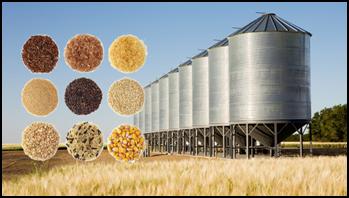
According to the Third Advance Estimates for 2024-25, India has achieved a record foodgrain production of 353.96 million tonnes, including 117.51 million tonnes of wheat and 149.07 million tonnes of rice.
The Importance of Food Grain Storage
Effective storage infrastructure is crucial for managing India’s food supply chain, minimizing wastage, and safeguarding the interests of both farmers and consumers.
Key Objectives of Food Grain Storage:
1. Reducing Post-Harvest Losses: Modern storage facilities, including cold storage and scientific warehouses, help significantly reduce wastage of agricultural produce.
2. Ensuring Food Security: Maintaining buffer stocks of food grains is essential for national food security and for distribution under schemes like the National Food Security Act (NFSA).
3. Preventing Distress Sales: Adequate storage allows farmers to retain their produce and sell it when market conditions are favorable, preventing distress sales and ensuring better income.
4. Price Stabilisation: Strategic buffer stocks help stabilize prices and protect consumers from extreme fluctuations in essential commodities.
5. Maintaining Quality: Scientific storage practices control factors such as moisture, pests, and temperature, ensuring that food grains remain safe and nutritious for consumption.
Food Grain Storage Systems in India
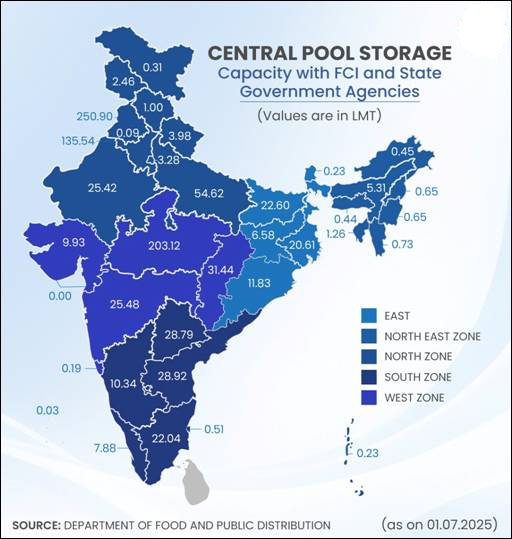
1. Centralized Storage of Food Grains: Food Corporation of India (FCI) is the primary agency responsible for centralized storage of food grains in India. Under the centralized procurement system, the procurement of food grains in Central Pool is undertaken either by FCI directly or by State Govt. Agencies (SGA). Quantity procured by SGAs is handed over to FCI for storage and the cost of the food grains procured by State agencies is reimbursed by FCI. The FCI manages this stock, storing it and subsequently issuing it for distribution through the Public Distribution System (PDS) or moving surplus stocks to other states as needed.
As of July 1, 2025, the Total Covered and CAP Storage Capacity available with FCI and State agencies for the storage of Central Pool foodgrains stood at 917.83 Lakh Metric Tonnes (LMT).
Covered storage capacity refers to the total quantity of foodgrains that can be stored in fully roofed and walled structures, such as godowns, warehouses, or silos. Foodgrains in ‘Cover and Plinth’ (CAP) storage are stored on elevated plinths and wooden crates are used as dunnage material.
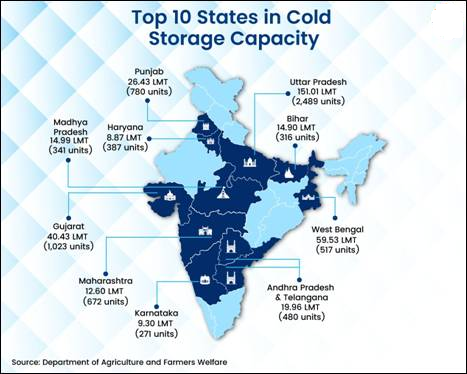
2. Cold Storage Infrastructure: The cold storage infrastructure plays a vital role in preserving perishable commodities such as fruits, vegetables, dairy products, meat, and seafood. These temperature-controlled facilities help maintain freshness, quality, and nutritional value, reducing post-harvest losses. Cold chain infrastructure includes facilities for pre-cooling, weighing, sorting, grading, packaging, Controlled Atmosphere (CA) storage, blast freezing, and refrigerated transport like reefer vans. These facilities are vital for extending the shelf life of perishable goods.
Decentralised Storage and PACS
Launched in 1997-98, the decentralised storage scheme allows states to procure, store, and distribute food grains under NFSA, reducing transit costs and promoting local procurement. The central government funds all operations. Primary Agricultural Credit Societies (PACS), grassroots co-operative bodies, provide loans to farmers and handle distribution and marketing of grains. PACS create village-level storage (500–2000 MT), enabling local storage, reducing losses, and helping farmers get better prices. Acting as procurement centres and Fair Price Shops (FPS), they improve efficiency and cut transport costs. To strengthen PACS, the government approved computerisation (Rs. 2,516 crores). As of June 2025, 73,492 PACS are computerized, and 5,937 new PACS have been registered, expanding village-level support for farmers.
Schemes for Strengthening Foodgrain Storage
A. Agriculture Infrastructure Fund (AIF)
Launched in 2020, the AIF aims to strengthen agricultural infrastructure across India. It is a medium-to-long-term debt financing facility providing interest subvention and credit guarantee support for investments in post-harvest management and farm assets. The scheme focuses on farm-gate storage and logistics, helping farmers store produce effectively, reduce post-harvest losses, and sell at better prices. Infrastructure under AIF includes warehouses, cold storage, sorting and grading units, and ripening chambers, enabling farmers to access wider markets and improve income by reducing dependence on intermediaries.
B. Agricultural Marketing Infrastructure (AMI)
AMI scheme is a key component of the Integrated Scheme for Agricultural Marketing (ISAM). The objective of this scheme is to strengthen agricultural marketing infrastructure across rural India by providing financial assistance for the construction and renovation of godowns and warehouses.
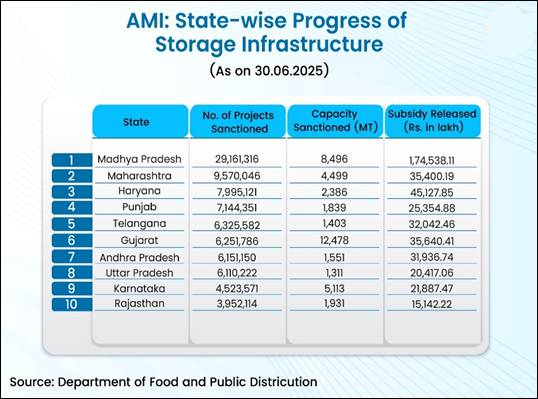
As of June 30, 2025, a total of 49,796 storage infrastructure projects has been sanctioned across 27 states in India. These projects collectively contribute to a storage capacity of 982.94 lakh MT and to support these initiatives, a total subsidy of Rs 4,829.37 crore has been disbursed.
Discuss the importance of food grain storage in India. Evaluate the role of centralized and decentralized storage systems, and key government schemes like AIF, PMKSY, AMI, and PACS in strengthening the country’s food security and supply chain.
D. Capital Investment Subsidy Scheme for Cold Storages and Horticulture Products
This scheme aims to promote scientific storage infrastructure and reduce post-harvest losses of perishable produce. Under the scheme, a credit-linked back-ended subsidy is provided at the rate of 35% of the project cost in general areas and 50% in North-Eastern, hilly, and scheduled areas for construction, expansion, or modernization of cold storages and Controlled Atmosphere (CA) storages with capacities between 5,000 MT and 20,000 MT. This initiative helps farmers and entrepreneurs improve storage, enhance shelf life, secure better prices, and strengthen the horticulture value chain.
E. Capital Investment Subsidy Scheme for Cold Storages and Horticultural Products
This scheme promotes scientific storage infrastructure to reduce post-harvest losses of perishable produce. It provides a credit-linked back-ended subsidy of 35% in general areas and 50% in North-Eastern, hilly, and scheduled areas for the construction, expansion, or modernization of cold storages and Controlled Atmosphere (CA) storages with capacities of 5,000–20,000 MT. The initiative helps farmers and entrepreneurs enhance storage capacity, extend shelf life, secure better prices, and strengthen the horticulture value chain.
F. World’s Largest Grain Storage Plan in Cooperative Sector
In May 2023, the government approved the World’s Largest Grain Storage Plan under the cooperative sector, supporting the vision of “Atmanirbhar Bharat”. The scheme aims to create agricultural infrastructure at the PACS level, including godowns, custom hiring centers, processing units, and Fair Price Shops. It leverages existing schemes such as AIF, Agricultural Marketing Infrastructure (AMI), Sub-Mission on Agricultural Mechanization (SMAM), and PMFME, integrating resources for greater efficiency. The key objectives include expanding storage capacity, improving supply chains, reducing wastage, and empowering farmers.
Conclusion
Agriculture continues to be the lifeline of India, sustaining livelihoods, feeding millions, and driving economic growth. While record foodgrain production highlights the sector’s strength, efficient storage and distribution are critical to ensure that every grain reaches consumers. The production and storage of food grains play a vital role in national food security. With a growing population and the challenges posed by climate change, it is essential to maintain adequate stocks, upgrade storage infrastructure, and minimize post-harvest losses to ensure year-round availability and price stability. Food grains, therefore, are not just crops—they form the backbone of agricultural growth, rural income, and the global food system.
Prelims question:
Q. With reference to India’s agricultural storage systems, consider the following statements:
1. The total storage capacity under FCI and State agencies as of July 2025 is over 900 LMT.
2. PACS primarily function as village-level procurement centres and Fair Price Shops.
3. The Agriculture Infrastructure Fund (AIF) provides interest subvention and credit guarantees for post-harvest management.
Which of the above statements are correct?
(a) 1 and 2 only
(b) 2 and 3 only
(c) 1 and 3 only
(d) 1, 2, and 3
Answer: D
Mains Question:
Q. Discuss the importance of food grain storage in India. Evaluate the role of centralized and decentralized storage systems, and key government schemes like AIF, PMKSY, AMI, and PACS in strengthening the country’s food security and supply chain.
(250 words)

- RBI’s Shrinking Real-Rate Cushion Amid Rising Inflation and Strong Demand - September 21, 2026
- India’s NGOs at a New Funding Crossroads - September 21, 2026
- Deep-Sea Discovery, Environmental Responsibility - September 19, 2026

No Comments