


12 Sep From Lift-Off to Letdowns: India’s Space Race Faces Its Toughest Test Yet
This article covers “Daily Current Affairs” and Topic details ” From Lift-Off to Letdowns: India’s Space Race Faces Its Toughest Test Yet
SYLLABUS MAPPING:
GS- 3-Science & Technology- From Lift-Off to Letdowns: India’s Space Race Faces Its Toughest Test Yet
FOR PRELIMS
What are the major challenges faced by India’s space sector, and what steps has the government taken to overcome them?
FOR MAINS
What are the key technological and human resource challenges in India’s space program, and how can they be addressed?
Why in the News?
ISRO Chief V. Narayanan recently stated that all Indian satellites performed round-the-clock during Operation Sindoor, successfully meeting mission requirements and showcasing India’s advanced space capabilities.
At a defence and technology event in New Delhi, he highlighted how ISRO is:
Strengthening India’s technological edge,
Promoting localisation and technology transfer,
Enabling space entrepreneurship,
And positioning India as a global space leader.
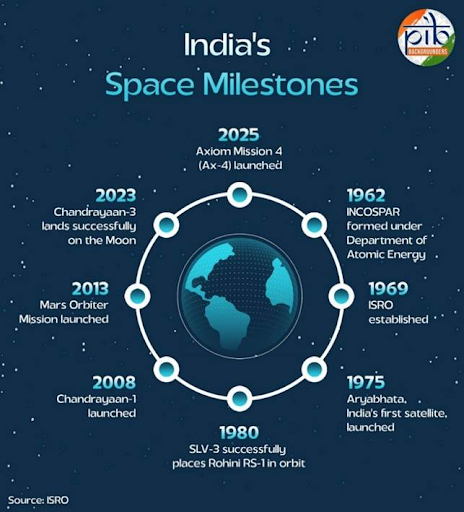
Applications of Space Technology in Key Domains
| Domain | Applications & Key Schemes |
|---|---|
| 1. Economy | – FASAL Scheme: Satellite-based crop forecasting improves agricultural planning. – BHUVAN platform: Geospatial data supports mining, fisheries, and infrastructure. |
| 2. Society | – e-Vidya & Telemedicine: Satellite communication bridges education and health gaps in rural areas. – SANCHAR Portal: Monitors telecom infrastructure for rural connectivity. |
| 3. Urban Development | – AMRUT & Smart Cities Mission: Satellite data for monitoring water supply, waste management, and infrastructure. – GIS-based master planning and remote sensing to detect illegal encroachments. |
| 4. Political Domain | – MGNREGA Geo-tagging: Satellite-based tracking of asset creation ensures transparency. – Digital India Initiatives: Space tech enables e-governance and better service delivery. |
| 5. National Security | – Cartosat Satellites: Provide high-resolution imagery for border surveillance and counter-insurgency. – Mission Shakti (2019): Showcased India’s anti-satellite (A-SAT) capability. |
| 6. Disaster Management | – ISRO’s Decision Support Centre (DSC): Real-time satellite data for early warning (floods, cyclones, forest fires). – JAL SHAKTI & FloodNET: Space data monitors droughts, groundwater levels, and flood zones |

Government Policy and Initiatives in the Space Sector
| Key Aspect | Details |
|---|---|
| 100% FDI Allowed | Liberalized FDI policy allows 100% foreign direct investment in the space sector with specified caps under automatic and government routes. |
| India Space Policy 2023 | Promotes holistic growth by encouraging greater private sector participation across the entire space economy value chain. |
| Space Vision 2047 | Long-term roadmap includes Bharatiya Antariksh Station (BAS), future lunar missions, next-gen launch vehicles, and Venus exploration. |
| Central Public Sector Enterprises | Antrix Corporation (ISRO’s commercial arm) and New Space India Limited (NSIL) drive commercialization and industry collaboration. |
| IN-SPACe | Indian National Space Promotion and Authorization Center: Autonomous body promoting private sector participation in satellites, launch vehicles, and services. |
| Growing Investments | ISRO has completed 100 launch missions in 11 years; the space budget has grown from ₹5,615 crores (2013–14) to ₹13,416 crores (2025–26). |
| Space Debris Experimental Mission (Spa DeX) | New initiative to monitor, manage, and reduce space debris in Earth’s orbit. |
| Startup Ecosystem Growth | Over 328 space startups have emerged, fostering innovation and collaboration with ISRO and global partners. |
Key Challenges in India’s Space Sector
| Category | Challenges |
|---|---|
| 1. Technological Challenges | – Developing reusable launch vehicles, human-rated spacecraft, and long-duration life support systems for space stations. – Limited indigenous capability in deep space propulsion, advanced robotics, and AI-based space systems. |
| 2. Infrastructure Limitations | – Need for more spaceports and advanced launch pads to meet growing demand. – Insufficient ground station networks for deep-space communication and real-time monitoring. |
| 3. Private Sector Ecosystem | – Nascent startup ecosystem with limited access to capital and skilled talent. – Weak industry-academia collaboration and insufficient R&D funding. |
| 4. Policy and Regulation | – Despite India Space Policy 2023, gaps remain in liability norms, space insurance, and satellite licensing. – Delays in FDI clearances and export approvals for critical technologies. |
| 5. International Competition | – Tough competition from SpaceX, CNSA, Blue Origin, etc., who lead in reusable rockets, mega constellations, and crewed missions. – India must balance cost-efficiency with speed of innovation. |
| 6. Sustainability & Debris Management | – Rising space debris threatens operational satellites and missions. – Post-mission disposal enforcement is in early stages despite ISRO’s DFSM initiative. |
| 7. Human Capital | – Shortage of skilled professionals in aerospace engineering, space law, and mission operations. – Brain drain to foreign agencies and private companies. |
| 8. Mission Risk & Failures | – Setbacks like Chandrayaan-2 lander failure highlight vulnerability. – Budget constraints restrict high-risk, high-reward missions. |
| 9. Cybersecurity & Space Assets | – Growing cyber threats to satellites and ground infrastructure. – Lack of robust cybersecurity frameworks and encryption standards. |
Measures to Strengthen India’s Space Program
| Major Measure | Key Subpoints |
|---|---|
| 1. Technological Advancements | – Development of Next-Gen Launch Vehicles (NGLV) with 30,000 kg LEO capacity. – Success of SpaDeX for satellite docking & servicing, paving the way for future space stations. |
| 2. Policy & Regulatory Reforms | – India Space Policy 2023 launched to boost private sector participation. – Debris-Free Space Missions (DFSM) initiative aims for zero debris by 2030. |
| 3. Institutional Support | – IN-SPACe acts as a single-window agency to support private space ventures. – NSIL drives global commercialization of ISRO technologies and services. |
| 4. Private Sector Growth | – 100% FDI permitted in satellite, ground infrastructure, and component segments. – Support for 328+ startups via funding access and policy incentives. |
| 5. International Collaborations | – Ongoing joint missions: NISAR (NASA), LUPEX (JAXA), TRISHNA (CNES). – Collaboration with ESA, Starlink, Jio, and Airtel for launch and communication services. |
| 6. Strategic & Civil Applications | – NavIC used for navigation, transport logistics, and disaster management. – GSAT-N2 enhances rural internet, e-learning, and digital governance. |
Conclusion
India’s space program is entering a new era of leadership and innovation. Milestones like Group Captain Shubhanshu Shukla’s mission highlight the nation’s growing capabilities. With initiatives like Gaganyaan and the Bharatiya Antariksh Station, India is advancing toward sustained human space presence. Strong policy support and private sector growth fuel scientific progress and economic development. India is now poised to be a major player shaping the future of space exploration.
Prelims question:
Q. With reference to Axiom Mission-4 (Ax-4), consider the following statements:
1. Axiom Mission-4 was the first fully private mission to dock with the International Space Station (ISS).
2. Group Captain Shubhanshu Shukla became the first Indian citizen to conduct a spacewalk during the mission.
3. The mission was jointly conducted by ISRO and NASA as a part of India’s Gaganyaan programme.
How many of the above statements are correct?
(a) Only one
(b) Only two
(c) All three
(d) None
Answer: A
Mains Question:
Q. India’s space program is transforming from a state-led scientific venture into a dynamic ecosystem driven by technology, policy, and private sector participation.” Discuss the major challenges faced by India’s space sector and the measures taken to strengthen it.
(250 words)

- Europe’s AI Rules May Become India’s Opportunity - August 14, 2026
- Transparency as the Foundation of Trust in Medicine - August 14, 2026
- A Timely Reset for the Food Security Act: From Foodgrain Security to Nutrition Security - August 13, 2026

No Comments