


25 Sep Gadkari Highlights 40% Pollution from Transport; Calls for 8 Buses per 1000 People
✎ Public transport expansion, particularly through electric buses under schemes like PM e-Bus Sewa, is a critical policy lever for reducing vehicular emissions, improving air quality, and enhancing energy security in India.
Subject Relevance — Where This Topic Fits
- GS Paper III — Environment and Pollution Control | GS Paper III — Infrastructure: Energy, Ports, Roads, Airports & Railways | GS Paper III — Government Budgeting and Financial Management
- Prelims: Air Quality Index (AQI), National Clean Air Programme (NCAP), PM e-Bus Sewa, Public Transport Policy, Electric Vehicle Policy, Bharat Stage Emission Standards (BSES), Fiscal Deficit and Import Substitution
- Essay: Sustainable Urban Mobility: Balancing Growth and Environmental Stewardship
Quick Revision: Public transport expansion, particularly through electric buses under schemes like PM e-Bus Sewa, is a critical policy lever for reducing vehicular emissions, improving air quality, and enhancing energy security in India.
Why is this in the news?
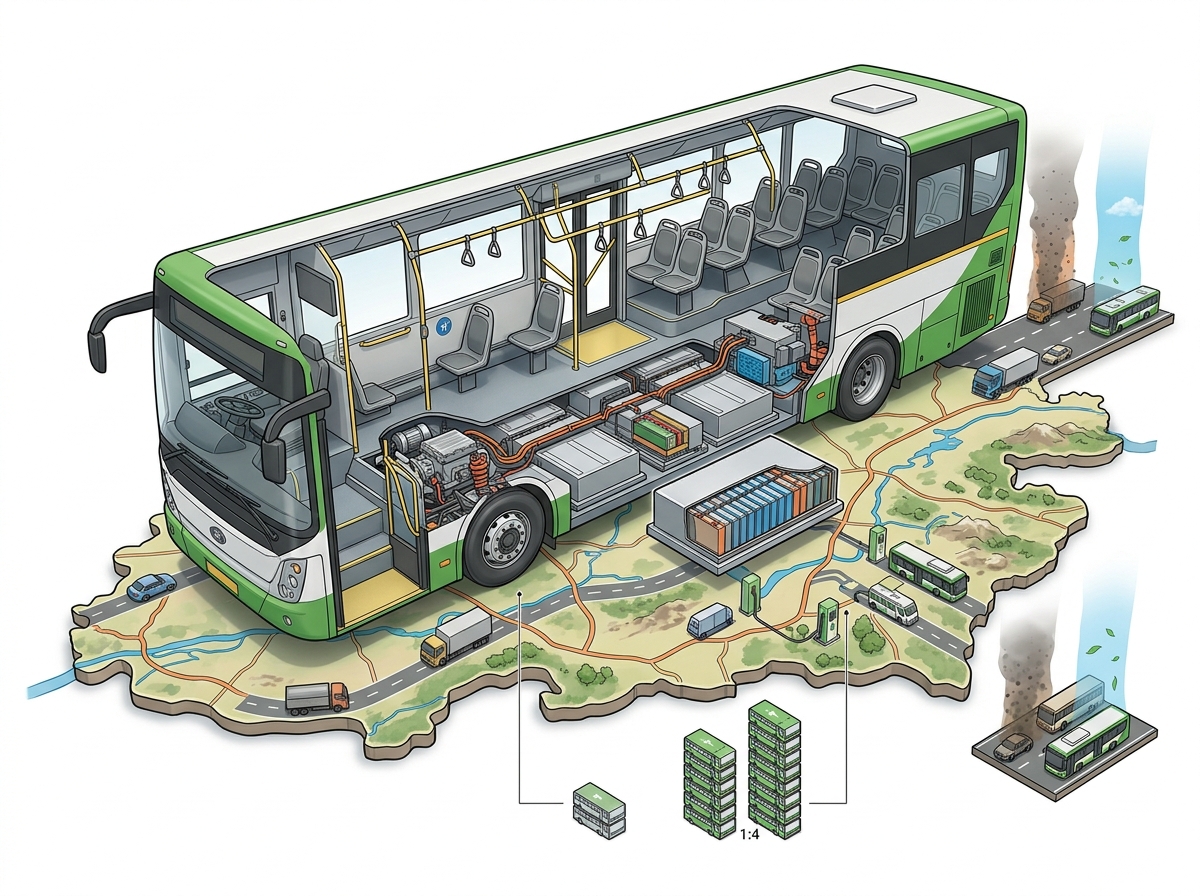
On 25 September 2026, Union Minister Nitin Gadkari highlighted the critical role of the transport sector in contributing approximately 40% of air pollution in India during the inauguration of the ‘Mukhyamantri Sugam Parivahan Sewa’ in Madhya Pradesh. He underscored the need to expand public bus transport to international benchmarks, citing the requirement of eight buses per 1,000 people, compared to the current national average of two. The remarks were made in the context of launching 972 electric buses under the PM e-Bus Sewa scheme for Madhya Pradesh, with a broader vision of deploying 25,000 electric buses nationwide to reduce vehicular emissions and fossil fuel imports.
Background
- The transport sector is a significant contributor to ambient air pollution in urban areas, with road transport alone responsible for approximately 40% of particulate matter (PM) and nitrogen oxides (NOx) emissions in India.
- The National Clean Air Programme (NCAP), launched in 2019, aims to reduce PM2.5 and PM10 concentrations by 20–30% by 2024 across 132 non-attainment cities, with public transport electrification as a key mitigation strategy.
- India’s dependence on imported crude oil for transportation fuels, valued at ₹22 lakh crore annually, poses macroeconomic risks, including fiscal strain and vulnerability to global price volatility.
- The Bharat Stage Emission Standards (BSES) regulate vehicular emissions, with BS-VI norms currently in force, mandating stringent limits on PM, NOx, and hydrocarbons.
- Madhya Pradesh’s ‘Mukhyamantri Sugam Parivahan Sewa’ represents a state-level initiative to improve intra-city and inter-city connectivity through private operators under government oversight, aligning with the broader national objective of sustainable mobility.
Public Transport Expansion and Air Quality Management: Policy Instruments and Institutional Frameworks
- Public transport systems, particularly electric buses, are recognised as a dual-purpose intervention: reducing vehicular emissions and mitigating dependence on imported fossil fuels.
- The recommended benchmark of eight buses per 1,000 population is derived from global best practices in urban transport planning, ensuring high service frequency, reduced congestion, and lower per-capita emissions.
- The PM e-Bus Sewa scheme operates under a PPP model, where private operators manage bus operations, maintenance, and charging infrastructure, while the government provides capital subsidies and operational support.
- Electric buses offer lifecycle cost advantages over diesel buses, including lower fuel and maintenance expenses, despite higher upfront capital costs, making them economically viable in the long term.
- The expansion of public transport infrastructure generates employment across multiple sectors, including bus manufacturing, charging station installation, driver training, and maintenance, thereby contributing to inclusive growth.
- State-level initiatives, such as Madhya Pradesh’s ‘Mukhyamantri Sugam Parivahan Sewa’, complement national schemes by addressing local mobility challenges through tailored operational models and governance structures.
- The transition to electric public transport aligns with India’s commitments under the Paris Agreement, particularly the Nationally Determined Contributions (NDCs) to reduce emissions intensity of GDP by 45% by 2030.
- Policy coherence between transport, energy, and environment ministries is essential to ensure seamless implementation, including streamlined approvals, land acquisition, and financial incentives for stakeholders.
Key Features
| Feature | Significance |
|---|---|
| Per 1,000 population bus density | Aligns with global standards (8 buses per 1,000) against current national average (~2 buses), aiming to reduce urban congestion and pollution. |
| Electric and clean-fuel buses | Promotes transition from diesel dependence, reducing vehicular emissions and import burden of fossil fuels. |
| Affordable public transport fares | Targets equitable access for economically weaker sections, labourers, and rural commuters through subsidised pricing. |
| PPP model for bus operations | Leverages private sector efficiency while ensuring public oversight, as seen in PM-eBus Sewa scheme allocations. |
| Employment generation | Expansion of bus fleets creates jobs in driver training, maintenance, charging infrastructure, and manufacturing sectors. |
Why it Matters
Environmental Sustainability
- Transport sector contributes ~40% to air pollution in India; electrification and fleet expansion directly address this via reduced tailpipe emissions.
- Shift from fossil fuel imports (₹22 lakh crore annually) to indigenous electric mobility enhances energy security and fiscal prudence.
Urban Mobility Governance
- Public transport expansion reduces private vehicle dependency, easing traffic congestion and improving urban livability.
- Standardised bus density metrics enable evidence-based policy formulation for city planners and transport authorities.
Economic Multiplier Effects
- Large-scale bus deployment stimulates ancillary industries: battery manufacturing, charging stations, and maintenance hubs.
- PPP frameworks optimise resource utilisation while distributing financial risks between public and private stakeholders.
Inclusive Development
- Subsidised fares and extended coverage ensure marginalised groups (rural, low-income) access dignified, safe transport options.
- Rural-urban connectivity improvements bridge socio-economic divides, aligning with Sustainable Development Goals (SDG 11).
Challenges
1. Infrastructure Bottlenecks
- Inadequate charging stations for electric buses, particularly in tier-2/3 cities and rural corridors.
- Grid capacity constraints in high-demand urban areas may require phased electrification.
- Land acquisition delays for bus depots and terminals hinder rapid deployment.
UPSC Link: GS-III: Infrastructure (Energy, Transport)
2. Financial Sustainability
- High upfront costs of electric buses (₹1.5–2 crore per bus) necessitate blended financing models.
- Operational viability hinges on fare subsidies and revenue guarantees, posing fiscal challenges for state exchequers.
- Private sector participation risks skewed towards profit-driven routes, neglecting low-density areas.
UPSC Link: GS-III: Mobilisation of Resources
3. Technological and Skill Gaps
- Limited indigenous manufacturing capacity for EV buses and components (batteries, motors) increases import dependency.
- Shortage of trained personnel for EV maintenance, charging infrastructure management, and driver upskilling.
- Standardisation of charging protocols and interoperability across states remains unresolved.
UPSC Link: GS-III: Science & Technology
4. Regulatory and Policy Hurdles
- Fragmented regulatory frameworks across states complicate seamless inter-city bus operations.
- Ambiguities in GST rates for electric buses (currently 5%) vs. diesel buses (12%) create cost disparities.
- Lack of uniform safety standards for electric buses in public transport networks.
UPSC Link: GS-II: Governance
Challenges — UPSC Perspective
| Issue | Concern |
|---|---|
| Charging Infrastructure | Insufficient grid capacity and sparse charging stations in rural/remote areas. |
| Cost Economics | High capital expenditure deters private investment without robust revenue-sharing models. |
| Skilled Workforce | Deficit of certified technicians for EV maintenance and battery recycling. |
| Policy Coherence | Divergent state-level incentives and tax structures impede national integration. |
| Public Acceptance | Resistance to fare hikes despite subsidies, and preference for personal vehicles. |
Way Forward
- Accelerate deployment of grid-scale battery storage and solar-powered charging hubs to address energy constraints.
- Establish a centralised EV bus procurement framework to leverage bulk purchasing discounts and standardise specifications.
- Launch skill development programmes (e.g., PMKVY) for EV technicians, drivers, and charging station operators.
- Implement dynamic fare structures with cross-subsidisation to ensure affordability without compromising operator viability.
- Strengthen inter-state coordination via the Inter-State Council to harmonise safety standards and tax regimes.
- Prioritise pilot projects in high-pollution cities (e.g., Delhi-NCR, Mumbai) for scalable replication.
- Enhance public awareness campaigns to shift commuter behaviour towards public transport adoption.
- Develop a national EV battery recycling policy to mitigate environmental risks from lithium-ion waste.
UPSC Value Addition
Keywords for Mains Answer-Writing
Public transport expansion · Air pollution mitigation · National Electric Bus Programme · Urban mobility governance · Sustainable transport infrastructure · Electric vehicle adoption · Public-Private Partnership in transport · Employment generation through transport sector · Urban transport policy · PM e-Bus Sewa Scheme · Air quality management · Decarbonisation of transport
Concept Flow
Urbanisation → Increased private vehicle ownership → Traffic congestion & air pollution (40% from transport) → Policy response: Public transport expansion (8 buses/1,000 people) with electrification → Implementation via PPP models (PM-eBus Sewa) and FAME-II incentives → Outcomes: Reduced emissions, energy security, job creation in EV ecosystem → Challenges: Infrastructure gaps, financing, skill shortages → Policy refinements → Long-term impact: Sustainable urban mobility, SDG 11 alignment, fiscal savings from import substitution
Prelims Practice Questions
Q1. Consider the following statements regarding the PM e-Bus Sewa Scheme:
1. The scheme aims to deploy 10,000 electric buses across India under a Public-Private Partnership model.
2. The central government has earmarked ₹20,000 crore for the scheme.
3. Under the scheme, Madhya Pradesh has been allocated 972 buses.
How many of the above statements are correct?
- Only one
- Only two
- All three
- None
Answer: All three — Statements 1 and 3 are correct. Statement 2 is incorrect as the central government’s contribution is approximately ₹20,000 crore, not the total allocation.
Q2. Assertion (A): Public transport expansion reduces vehicular emissions significantly.
Reason (R): The transport sector contributes approximately 40% to air pollution in India.
In the context of the above statements, which of the following is correct?
- Both A and R are true, and R is the correct explanation of A.
- Both A and R are true, but R is not the correct explanation of A.
- A is true, but R is false.
- A is false, but R is true.
Answer: Both A and R are true, but R is not the correct explanation of A. — Both the assertion and reason are true. Public transport expansion reduces vehicular emissions (A), and the transport sector is a major contributor to air pollution (R), with R correctly explaining A.
Q3. Match the following pairs related to urban transport policy:
Column I (Policy/Scheme) — Column II (Key Feature)
A. PM e-Bus Sewa Scheme — 1. Deployment of 25,000 electric buses
B. National Electric Bus Programme — 2. 10,000 buses under PPP model
C. Urban Transport Policy Framework — 3. Focus on cleaner fuels and reduced fares
D. JNNURM — 4. Subsidised public transport in urban areas
Select the correct match:
- A-2, B-1, C-3, D-4
- A-1, B-2, C-4, D-3
- A-3, B-1, C-2, D-4
- A-2, B-3, C-1, D-4
Answer: A-2, B-1, C-3, D-4 — Correct matches: A-2 (PM e-Bus Sewa Scheme deploys 10,000 buses under PPP), B-1 (National Electric Bus Programme aims for 25,000 buses), C-3 (Urban Transport Policy focuses on cleaner fuels and reduced fares), D-4 (JNNURM aimed at subsidised public transport in urban areas).
Mains Practice Question
✍ The expansion of public transport infrastructure is often cited as a critical strategy for mitigating urban air pollution and enhancing socio-economic equity. In this context, critically examine the role of the transport sector in contributing to air pollution in India and evaluate the policy measures proposed to address this challenge. (15 Marks)
Approach: MODEL-ANSWER SKELETON:
1. **Introduction (2 marks)**
– Briefly define the transport sector’s contribution to air pollution in India (e.g., 40% as highlighted by the Union Minister).
– State the dual objectives: pollution mitigation and inclusive mobility.
2. **Transport Sector and Air Pollution (4 marks)**
– **Data**: Cite the share of transport in total PM2.5 and NOx emissions (e.g., 18-30% for PM2.5, higher for NOx in urban areas).
– **Sources**: Highlight the dominance of diesel vehicles, two-wheelers, and private cars in urban areas.
– **Health and economic costs**: Reference the WHO’s estimates of premature deaths due to air pollution (e.g., 1.67 million annually in India) and the economic burden (e.g., 3-5% of GDP).
3. **Policy Measures and Their Efficacy (5 marks)**
– **PM e-Bus Sewa Scheme**: Outline its objectives, target (10,000 buses), and funding (₹20,000 crore).
– **National Electric Bus Programme**: Discuss its goal of 25,000 electric buses and employment generation.
– **Urban Transport Policy Framework**: Highlight the need for cleaner fuels, reduced fares (30% lower), and improved connectivity.
– **Challenges**: Cite issues like high upfront costs, lack of charging infrastructure, and last-mile connectivity.
4. **Comparative Perspective (2 marks)**
– Compare India’s per capita bus availability (2 buses per 1,000 people) with global standards (8 buses per 1,000 people).
– Reference successful models (e.g., Bogotá’s TransMilenio, London’s ULEZ).
5. **Conclusion (2 marks)**
– Emphasise the need for a multi-pronged approach: infrastructure investment, policy incentives, and public participation.
– Highlight the role of state governments (e.g., Madhya Pradesh’s allocation of 972 buses) in implementation.
**Balance of Views**: Acknowledge the potential of electric buses in reducing emissions but also note the transition challenges for informal transport sectors and low-income groups.
Source: amarujala.com
Generated by AanyaAi for educational purpose.
Related guides on our sites
- How to prepare for GS paper 1 for UPSC CSE mains exam
- Best UPSC coaching for IFOS exam
- Best geography optional coaching
- Best geography optional coaching

- Exercise Tarang Shakti 2026: India’s Mega Multi-Nation Air Power Showcase - September 27, 2026
- रबी अभियान 2026: राष्ट्रीय सम्मेलन में केंद्र-राज्य तालमेल पर होगा जोर - September 27, 2026
- Himachal CM Sukhu: All Doctor Vacancies to be Filled by March - September 27, 2026

No Comments