


14 Jan Gati Shakti Cargo Terminals: Enhancing Efficiency, Sustainability, and Trade Competitiveness
This article covers “Daily Current Affairs” and From Gati Shakti Cargo Terminals: Enhancing Efficiency, Sustainability, and Trade Competitiveness
SYLLABUS MAPPING
GS-3 -Indian Economy- Gati Shakti Cargo Terminals: Enhancing Efficiency, Sustainability, and Trade Competitiveness
FOR PRELIMS
What are the main features of the Gati Shakti Cargo Terminal Policy, 2021?
FOR MAINS
What are Gati Shakti Cargo Terminals, and why are they important?
Why in the News?
India’s logistics sector has witnessed a remarkable transformation in recent years, with logistics costs now reduced to 7.97% of GDP, bringing the nation closer to global benchmarks. This achievement reflects sustained reforms, integrated planning, and digital adoption, which together are reshaping the logistics ecosystem to be more efficient, cost-effective, and future-ready.
At the heart of this transformation is the PM Gati Shakti National Master Plan, which integrates railways, highways, ports, and airports into a unified framework. This multimodal approach enhances industry competitiveness, supports initiatives like Ease of Doing Business and Make in India, and promotes balanced regional growth. A key pillar of this vision is the development of Gati Shakti Cargo Terminals (GCTs), modern hubs designed to streamline freight operations and strengthen India’s position as a global trade hub.
Gati Shakti Cargo Terminals (GCTs): An Overview
A cargo terminal is a facility where goods are loaded, unloaded, and transferred between trains and other transport modes. Previously, freight in India moved in a fragmented manner across roads, railways, and ports, causing delays, congestion, and higher costs. The GCT initiative addresses these challenges by creating integrated multimodal hubs, reducing handling time, emissions, and overall logistics costs.
Developed under the GCT Policy, 2021 of the Ministry of Railways, GCTs operate with Engine-On-Load (EOL) systems, ensuring that locomotives remain at the terminal during loading/unloading, minimizing detentions, and optimizing railway infrastructure. Equipped with mechanized loading systems and silos, GCTs enhance efficiency and reliability, while promoting rail transport, which is more energy-efficient and environmentally sustainable compared to road freight.
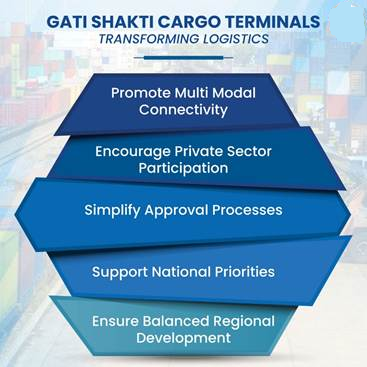
Key Features of GCTs
1. Multimodal Connectivity: Seamlessly links railways with roads, ports, and airports, enabling smooth cargo movement.
2. Private Sector Participation: Encourages investment, innovation, and capacity expansion.
3. Simplified Approval Processes: Time-bound clearances accelerate terminal development.
4. National Priority Alignment: Supports Ease of Doing Business, Make in India, and Atmanirbhar Bharat.
5. Regional Development: Terminals are strategically located to ensure inclusive economic growth.
Gati Shakti Cargo Terminal Policy, 2021
Introduced on 15 December 2021, the policy aims to:
1. Accelerate modern cargo terminal development and upgrade existing facilities.
2. Encourage private participation through incentives like cost exemptions, rail infrastructure support, and freight rebates.
3. Align terminal development with industry demand, promoting India as a global logistics hub.
Key incentives include:
1. Waivers for departmental charges, land license fees, and commercial staff costs.
2. Railways maintain common-user traffic facilities.
3. Terminals handling over 1 million tonnes outward traffic get a 10% freight rebate.
4. Maintenance of tracks, signaling, and OHE by Railways.
5. Surplus railway land can be developed under Rail Land Development Authority (RLDA) provisions.
Progress and Achievements
Since inception:
1. 306 GCT proposals approved, 118 commissioned with 192 million tonnes per annum capacity.
2. Mobilised ₹8,600 crore in private investment.
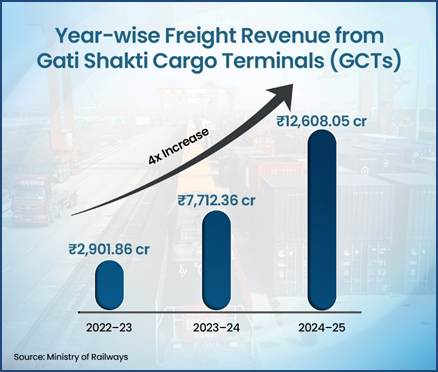
3. Freight revenue increased fourfold between 2022–23 and 2024–25.
4. Rail transport has shifted 2,672 million tonnes of freight from roads since 2014, saving 143.3 million tonnes of CO₂.
Strategic Terminals Driving Logistics Growth
Manesar, Haryana: India’s largest automobile GCT at Maruti Suzuki’s plant, with a capacity to handle 4.5 lakh vehicles annually, connected to Patli Railway Station through a 10 km dedicated rail link.
Northeast Terminals (Moinarband and Cinnamara, Assam): Handle coal, containers, fertilizers, petroleum products, and food grains, strengthening regional trade. Six new terminals under construction, including Baihata, Habaipur, and Jogighopa.
New Sanjali, Gujarat: First GCT built on private land along the Western Dedicated Freight Corridor, enhancing multimodal and high-speed cargo movement.
Way Forward for Gati Shakti Cargo Terminals
1. Enhanced Private Sector Participation: Encourage greater investment and collaboration with private players to accelerate the development and operational efficiency of GCTs. Public–private partnerships will expand capacity, bring innovation, and ensure timely project execution.
2. Strategic Terminal Expansion: Identify and develop new GCT locations based on industry demand, regional growth potential, and connectivity needs, ensuring balanced development across states and regions.
3. Advanced Digital Integration: Leverage the Gati Shakti digital platform for real-time cargo tracking, predictive analytics, and data-driven logistics management to enhance operational efficiency and transparency.
4. Eco-Friendly Freight Solutions: Promote the shift from road to rail, reducing carbon emissions, energy consumption, and congestion, aligning with India’s sustainability and decarbonisation goals.
5. Global Competitiveness and Industry Responsiveness: Build a world-class logistics ecosystem that meets international standards, supports industrial growth, enhances India’s trade competitiveness, and ensures responsive freight services for evolving market demands.
Conclusion
Gati Shakti Cargo Terminals represent a transformative step in modernizing India’s logistics sector. By combining infrastructure development, digital integration, and private participation, they address long-standing inefficiencies, reduce costs, and promote sustainability. As these terminals expand, they are poised to make India’s logistics network faster, greener, and globally competitive, reinforcing the country’s role as a key player in global trade.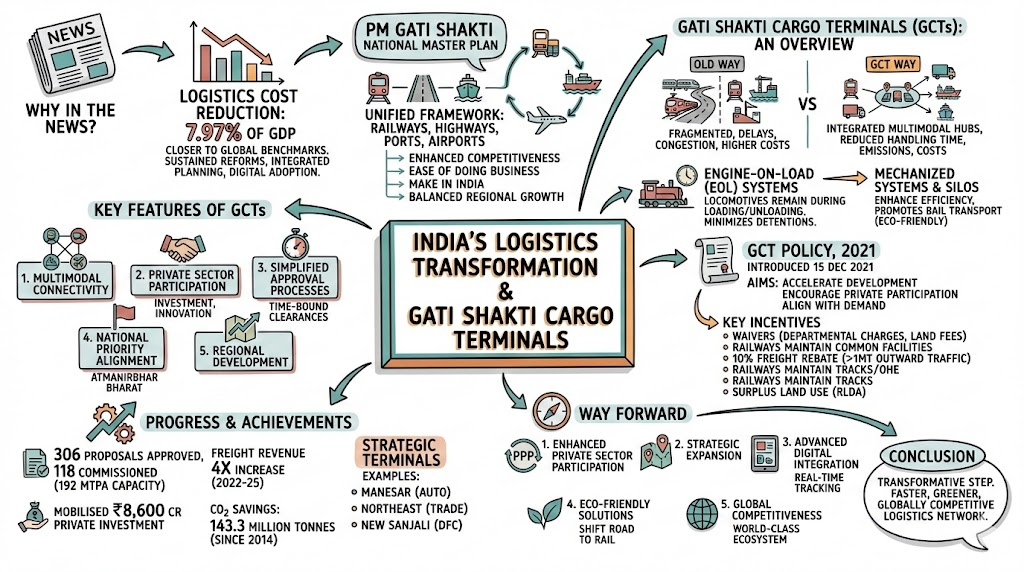
Best ias coaching in delhi Best ias coaching in chandigarh
Prelims question:
Q. Which of the following is/are correct regarding Gati Shakti Cargo Terminals (GCTs)?
1. GCTs operate with Engine-On-Load (EOL) systems.
2. They are developed under the PM Gati Shakti National Master Plan and GCT Policy, 2021.
3. They focus solely on road transport logistics.
Options:
(a) 1 and 2 only
(b) 2 and 3 only
(c) 1 and 3 only
(d) 1, 2, and 3
Answer: A
Q. Discuss the significance of Gati Shakti Cargo Terminals in modernizing India’s logistics sector and their role in enhancing economic competitiveness.
(250 words)

- RBI’s Shrinking Real-Rate Cushion Amid Rising Inflation and Strong Demand - September 21, 2026
- India’s NGOs at a New Funding Crossroads - September 21, 2026
- Deep-Sea Discovery, Environmental Responsibility - September 19, 2026

No Comments