


22 Oct GeM पोर्टल पर अनियमित खरीद: सरकार करेगी जांच, जानें UPSC-State PCS दृष्टिकोण
✎ GeM is India’s national public procurement portal, mandated under the Public Procurement (Preference to Make in India) Order, 2017, to ensure transparent, efficient, and accountable government purchases through a digital…
Subject Relevance — Where This Topic Fits
- GS Paper II — Government Policies and Interventions for Development in various sectors and Issues arising out of their Design and Implementation | GS Paper III — Issues related to Direct and Indirect Farm Subsidies and Minimum Support Prices; Public Distribution System Objectives, Functioning, Limitations, Revamping; Issues of Buffer Stocks and Food Security
- Prelims: GeM Portal, Public Procurement (Preference to Make in India) Order 2017, Government Procurement Policy, e-Procurement, Central Vigilance Commission (CVC), Financial Integrity in Public Expenditure, Comptroller and Auditor General of India (CAG), Lokpal and Lokayukta, Integrity Pact, Public Financial Management System (PFMS), Economic Survey Chapter on Public Expenditure Management
- Essay: Role of Technology in Governance: Transforming Public Service Delivery, Ethical Governance and Accountability in Public Institutions
Quick Revision: GeM is India’s national public procurement portal, mandated under the Public Procurement (Preference to Make in India) Order, 2017, to ensure transparent, efficient, and accountable government purchases through a digital marketplace integrated with PFMS and monitored by CVC and CAG.
Why is this in the news?
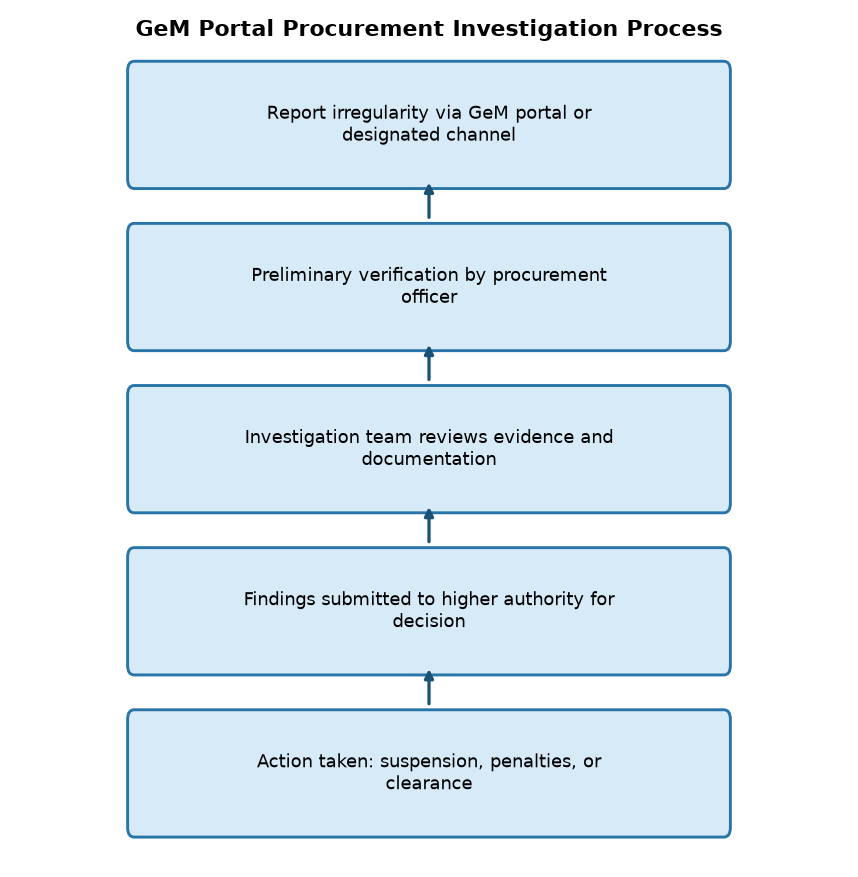
The directive that any irregularities detected in procurement transactions conducted via the Government e-Marketplace (GeM) portal will be subject to investigation underscores the portal’s role as a critical instrument of public procurement in India. This development highlights the institutional mechanisms in place to ensure financial integrity, transparency, and accountability in government purchases, particularly in the context of the GeM’s expanding mandate and the increasing volume of transactions conducted through the platform.
Background
- The Government e-Marketplace (GeM) was launched in August 2016 as a national public procurement portal to facilitate one-stop online procurement of goods and services for government ministries, departments, and public sector undertakings (PSUs).
- GeM operates under the aegis of the Ministry of Commerce and Industry, Government of India, and functions as a Section 8 company under the Companies Act, 2013.
- The portal aims to streamline procurement processes, reduce transaction costs, and enhance transparency by providing a digital marketplace for government buyers and sellers.
- GeM’s mandate includes the implementation of the Public Procurement (Preference to Make in India) Order, 2017, which mandates preference for domestically manufactured goods in government procurement.
- As of recent data, GeM has onboarded over 6 lakh sellers and service providers, with cumulative procurement exceeding ₹4 lakh crore since its inception.
- The portal is integrated with the Public Financial Management System (PFMS) to ensure real-time tracking of funds and financial transactions.
What is the Government e-Marketplace (GeM)?
- GeM is a digital platform established to enable end-to-end online procurement of goods and services by government entities, replacing traditional manual tendering processes with a transparent, efficient, and scalable system.
- The portal facilitates the procurement of a wide range of items, including office supplies, vehicles, IT equipment, construction materials, and professional services, thereby catering to the diverse needs of government departments.
- GeM operates on a reverse auction model, where sellers compete to offer the lowest price for goods or services, thereby promoting competitive pricing and value for money in public expenditure.
- The platform is designed to ensure compliance with government procurement policies, including the Public Procurement (Preference to Make in India) Order, 2017, which prioritises domestically manufactured goods and services.
- GeM’s governance structure includes a dedicated Project Monitoring Unit (PMU) under the Ministry of Commerce and Industry, responsible for overseeing the portal’s operations, policy implementation, and stakeholder coordination.
- The portal is integrated with the Central Vigilance Commission (CVC) and the Comptroller and Auditor General of India (CAG) to facilitate audits, investigations, and compliance checks, thereby enhancing accountability and integrity in procurement processes.
- GeM also incorporates an Integrity Pact, a voluntary agreement between buyers and sellers to commit to ethical practices, transparency, and zero tolerance for corruption in procurement transactions.
- The platform is supported by a robust grievance redressal mechanism, including an online dispute resolution system, to address issues related to quality, delivery, or pricing of procured goods and services.
UPSC Value Addition
Keywords for Mains Answer-Writing
Government e-Marketplace (GeM) · Public Procurement · Procurement Reforms · Transparency in Government Procurement · E-Governance · Financial Accountability · Government Procurement Policy · Anti-Corruption Measures · Centralised Procurement Mechanism · GeM Portal · Public Finance Management · Government Schemes · Regulatory Oversight · Procurement Audit · Efficiency in Public Expenditure
Prelims Practice Questions
Q1. Consider the following statements regarding the Government e-Marketplace (GeM) Portal:
1. GeM is an online platform for public procurement in India, launched under the Ministry of Commerce and Industry.
2. It aims to enhance transparency, efficiency, and speed in public procurement.
3. GeM allows only government departments and PSUs to procure goods and services.
4. The portal mandates the use of e-bidding for all procurements above a specified threshold.
How many of the above statements are correct?
- Only one
- Only two
- Only three
- All four
Answer: Only three — Statements 1, 2, and 3 are correct. GeM is indeed an online platform for public procurement, launched to improve transparency and efficiency. It is open to government departments and PSUs. However, statement 4 is incorrect as e-bidding is not mandatory for all procurements; it is used selectively based on procurement value and complexity.
Q2. Assertion (A): The Government e-Marketplace (GeM) Portal is designed to reduce the role of intermediaries in public procurement.
Reason (R): GeM facilitates direct procurement from manufacturers or authorised sellers, thereby minimising the involvement of middlemen and enhancing cost-efficiency.
Options:
A. Both A and R are true, and R is the correct explanation of A.
B. Both A and R are true, but R is NOT the correct explanation of A.
C. A is true, but R is false.
D. A is false, but R is true.
Answer: ? — Both Assertion (A) and Reason (R) are true, and Reason (R) correctly explains Assertion (A). GeM’s design to enable direct procurement from manufacturers or authorised sellers inherently reduces the role of intermediaries, thereby enhancing transparency and cost-efficiency in public procurement.
Q3. Match the following procurement-related terms with their correct descriptions:
Column I
1. Government e-Marketplace (GeM)
2. e-Bidding
3. Reverse Auction
4. Centralised Procurement
Column II
A. A procurement method where suppliers compete to offer the lowest price.
B. A digital platform for public procurement in India.
C. Procurement of goods/services by a central agency on behalf of multiple entities.
D. A competitive bidding process conducted electronically where the lowest bidder wins.
Options:
A. 1-A, 2-B, 3-C, 4-D
B. 1-B, 2-D, 3-A, 4-C
C. 1-C, 2-A, 3-D, 4-B
D. 1-D, 2-C, 3-B, 4-A
Answer: ? — The correct match is: 1-B (GeM is a digital platform for public procurement), 2-D (e-Bidding is a competitive electronic bidding process), 3-A (Reverse Auction is where suppliers compete to offer the lowest price), and 4-C (Centralised Procurement involves a central agency procuring on behalf of multiple entities).
Mains Practice Question
✍ The Government e-Marketplace (GeM) Portal has been established to streamline public procurement in India. Critically examine the institutional mechanisms within GeM that ensure transparency, accountability, and efficiency in procurement processes. Also, analyse the challenges in addressing irregularities and suggest measures to strengthen the oversight framework. (15 Marks)
Approach: MODEL-ANSWER SKELETON:
1. **Introduction (2 marks)**
– Define GeM: Government e-Marketplace as a national public procurement platform under the Ministry of Commerce and Industry, launched in 2016.
– Objective: To enhance transparency, efficiency, and cost-effectiveness in public procurement.
2. **Institutional Mechanisms for Transparency and Accountability (5 marks)**
– **Digital Platform Features**: Real-time tracking of procurement, e-bidding, reverse auctions, and e-payment systems.
– **Standardised Processes**: Use of Standard Operating Procedures (SOPs) for procurement, including e-procurement guidelines under the General Financial Rules (GFR) 2017.
– **Vendor Registration and Verification**: Mandatory registration with Aadhaar-based KYC and PAN verification to prevent fake entities.
– **Audit and Monitoring**: Integration with the Public Financial Management System (PFMS) and CAG audits for financial oversight.
– **Grievance Redressal**: Dedicated GeM Grievance Redressal Mechanism (GRM) for vendors and buyers.
3. **Addressing Irregularities: Challenges and Measures (5 marks)**
– **Challenges**:
– Lack of awareness among procuring entities about GeM’s features and processes.
– Delayed grievance redressal due to high volume of complaints.
– Potential for collusion between vendors and procuring officers.
– Limited use of e-bidding and reverse auctions in lower-value procurements.
– **Measures to Strengthen Oversight**:
– Mandatory training for procurement officers on GeM’s features and anti-corruption protocols.
– Strengthening the GeM Grievance Redressal Mechanism with faster resolution timelines.
– Integration of AI-driven anomaly detection systems to flag irregular patterns in procurement.
– Regular third-party audits of high-value procurements.
– Public disclosure of procurement data (e.g., vendor details, bid prices) to enhance transparency.
4. **Conclusion (3 marks)**
– GeM represents a significant step towards modernising public procurement in India.
– While institutional mechanisms like digital tracking and audit systems enhance accountability, persistent challenges such as low adoption of e-bidding and delayed grievance redressal require systemic reforms.
– Strengthening oversight through technology, training, and transparency can further reduce irregularities and improve efficiency.
Source: amarujala.com
Generated by AanyaAi for educational purpose.
Related guides on our sites
- Best PSIR optional coaching for upsc
- Best PSIR optional teacher for upsc
- Best teacher of PSIR optional for upsc
- Best PSIR optional coaching in delhi for UPSC

- GeM पोर्टल पर अनियमित खरीद: सरकार करेगी जांच, जानें UPSC-State PCS दृष्टिकोण - October 22, 2026
- केरल में विशेष सारांश संशोधन 2027: मतदाता सूची का प्रारूप 12 नवंबर को, अंतिम सूची 4 जनवरी को - October 22, 2026
- Kerala to Launch Apprenticeship Scheme for UG Students: Key Details - October 22, 2026

No Comments