


31 Jul Geopolitical Disruptions & Inland Economic Corridors: UPSC Current Affairs 2024
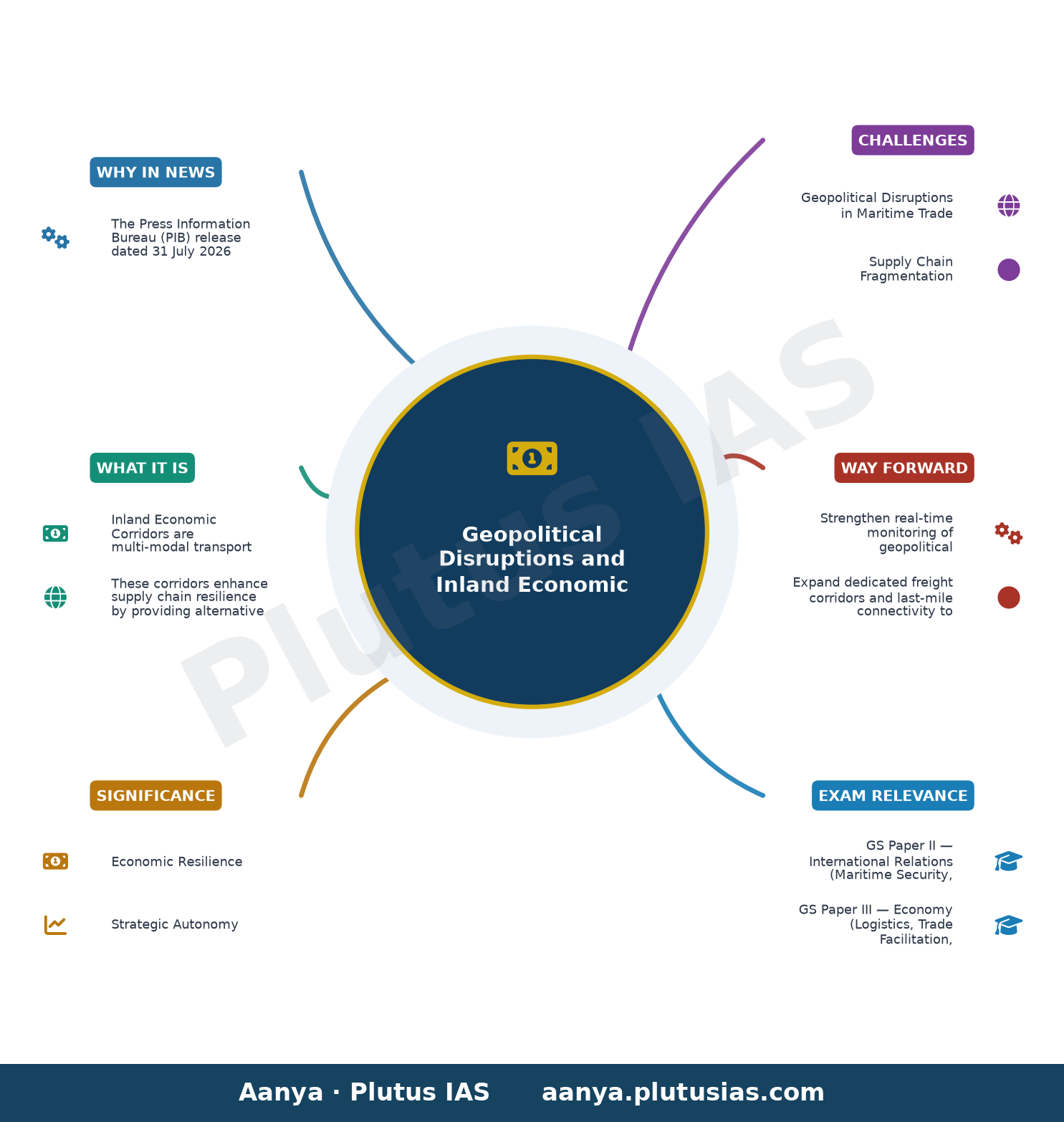
✎ Inland Economic Corridors mitigate geopolitical risks to maritime trade by providing alternative, multi-modal transport routes that reduce reliance on vulnerable sea lanes and enhance supply chain resilience.
Subject Relevance — Where This Topic Fits
- GS Paper II — International Relations (Maritime Security, Supply Chain Diplomacy) | GS Paper III — Economy (Logistics, Trade Facilitation, Infrastructure)
- Prelims: Maritime Silk Road, Sagarmala Initiative, Logistics Performance Index, Container Corporation of India (CONCOR), Export Promotion Capital Goods (EPCG) Scheme, Special Economic Zones (SEZ), Foreign Trade Warehousing Zones (FTWZ), Double-Stack Container Trains
- Essay: Global Supply Chain Resilience in an Era of Geopolitical Fragmentation, India’s Maritime Diplomacy: Balancing Trade and Security
Quick Revision: Inland Economic Corridors mitigate geopolitical risks to maritime trade by providing alternative, multi-modal transport routes that reduce reliance on vulnerable sea lanes and enhance supply chain resilience.
Why is this in the news?
The Press Information Bureau (PIB) release dated 31 July 2026 highlights the Indian government’s institutional mechanisms to mitigate the impact of geopolitical disruptions on global maritime trade and logistics. The announcement underscores coordinated policy interventions by multiple ministries—including the Ministries of Commerce, Ports, Shipping and Waterways, External Affairs, and Department of Financial Services—to ensure uninterrupted freight movement, reduce logistics costs, and enhance supply chain robustness amid evolving geopolitical challenges.
Background
- Maritime trade accounts for over 90% of India’s merchandise trade by volume, making supply chain resilience critical for economic stability.
- Geopolitical disruptions—such as conflicts, sanctions, or trade route blockades—can severely impact maritime logistics, leading to delays, increased costs, and supply chain fragmentation.
- India’s ‘Sagarmala Programme’ (2015) aims to modernise ports, develop coastal economic zones, and enhance port-led development to reduce logistics costs and improve trade competitiveness.
- The ‘National Logistics Policy’ (2022) prioritises multi-modal connectivity, digital integration, and trade facilitation to position India as a global logistics hub.
- Inland Waterways Transport (IWT) and Dedicated Freight Corridors (DFCs) are being leveraged to decongest major ports and reduce dependence on congested road and rail networks.
- Recent geopolitical tensions in the Red Sea, Strait of Malacca, and Black Sea have necessitated proactive policy measures to safeguard India’s trade interests.
What are Inland Economic Corridors and Their Role in Mitigating Geopolitical Risks?
- Inland Economic Corridors are multi-modal transport networks—comprising inland waterways, railways, and roads—that connect hinterlands to ports, enabling efficient movement of goods and reducing reliance on vulnerable maritime chokepoints.
- These corridors enhance supply chain resilience by providing alternative routes for trade, particularly when traditional sea lanes (e.g., Suez Canal, Strait of Hormuz) face disruptions due to geopolitical conflicts or piracy.
- India’s key inland corridors include the ‘National Waterway 1’ (Ganga-Bhagirathi-Hooghly), ‘National Waterway 2’ (Brahmaputra), and Dedicated Freight Corridors (DFCs) like the Eastern and Western DFCs.
- Policy measures such as the ‘Logistics Data Bank Project’ (tracking container movement) and ‘PM Gati Shakti National Master Plan’ (2021) aim to synchronise multi-modal logistics infrastructure.
- Geopolitical risks to maritime trade—such as sanctions on Russia, Houthi attacks in the Red Sea, or China’s assertiveness in the South China Sea—underscore the strategic importance of diversifying trade routes through inland corridors.
- The use of dry ports (inland container depots) and Free Trade Warehousing Zones (FTWZs) facilitates storage, customs clearance, and re-export, reducing dependency on coastal ports.
Key Features
| Feature | Significance |
|---|---|
| Inter-Ministerial Group (IMG) under DGFT | Ensures coordinated policy response to geopolitical disruptions in maritime trade and logistics through regular reviews and assessments. |
| Extension of Export Obligation Period (EOP) for EPCG and Advance Authorisation Schemes | Provides relief to exporters by extending compliance deadlines, reducing financial strain during supply chain disruptions. |
| Exemption of Ground Rent and Demurrage Charges at Major Ports | Reduces operational costs for importers and exporters, enhancing competitiveness of Indian ports in global trade. |
| Emergency Credit Line Guarantee Scheme (ECLGS) 5.0 for MSMEs | Addresses liquidity crunch faced by small businesses due to prolonged supply chain disruptions. |
| Sovereign Guarantee for Domestic Marine Insurance Pool | Lowers insurance premiums for maritime trade, mitigating risks associated with geopolitical volatility in shipping routes. |
Why it Matters
Economic Resilience
- Mitigates adverse impacts of geopolitical disruptions on India’s export-import logistics through targeted fiscal and operational measures.
- Enhances competitiveness of Indian ports by reducing transaction costs and improving cargo clearance efficiency.
- Supports MSMEs and export-oriented industries by ensuring liquidity and reducing compliance burdens during crises.
Strategic Autonomy
- Reduces dependency on volatile international shipping routes by strengthening domestic logistics infrastructure and insurance mechanisms.
- Ensures continuity of critical supply chains, particularly for petroleum products, food grains, and pharmaceuticals.
Policy Coordination
- Demonstrates effective inter-ministerial collaboration to address multi-dimensional challenges in maritime trade and logistics.
- Aligns fiscal, regulatory, and operational policies to create a cohesive response framework for global trade disruptions.
Sectoral Impact
- Agriculture and Processed Food Exports: Streamlined clearances and export incentives support farmers and agro-based industries.
- Gems and Jewellery Sector: Facilitated imports and storage in SEZs/FTWZs to maintain global supply chain linkages.
- Petrochemicals: Temporary duty exemptions on critical inputs reduce production costs and ensure energy security.
Challenges
1. Geopolitical Disruptions in Maritime Trade
- Prolonged delays and increased costs due to rerouting of ships around conflict zones (e.g., Red Sea, Black Sea).
- Volatility in freight rates and insurance premiums affecting export competitiveness.
- Disruptions in critical chokepoints (e.g., Strait of Hormuz, Malacca Strait) leading to supply chain bottlenecks.
UPSC Link: GS III: Infrastructure – Ports
2. Supply Chain Fragmentation
- Increased lead times for imports and exports, impacting just-in-time manufacturing sectors.
- Reliance on alternative, often costlier, logistics routes (e.g., trans-Siberian corridor) to bypass disrupted zones.
- Inventory pile-ups and working capital constraints for MSMEs due to delayed cargo clearances.
UPSC Link: GS III: Logistics and Supply Chain
3. Regulatory and Compliance Burdens
- Strict adherence to export obligation periods under EPCG/Advance Authorisation schemes during disruptions.
- Complex customs procedures and delayed refunds for diverted or returned cargo.
- Compliance with multiple regulatory agencies (e.g., CBIC, RBI, DGFT) adding operational overheads.
UPSC Link: GS III: Trade Facilitation
4. Financial Constraints for Exporters
- Extended credit periods and liquidity crunch due to delayed payments from overseas buyers.
- Increased working capital requirements to manage higher freight and insurance costs.
- Bank guarantees tied up in pending export obligations, limiting financial flexibility.
UPSC Link: GS III: Export Promotion
5. Infrastructure Bottlenecks
- Congestion at major ports due to delayed cargo clearance and limited storage capacity.
- Inadequate rail and road connectivity to hinterland regions, exacerbating last-mile delivery challenges.
- Underutilisation of dedicated freight corridors due to operational inefficiencies.
UPSC Link: GS III: Port Infrastructure
Challenges — UPSC Perspective
| Issue | Concern |
|---|---|
| Freight Rate Volatility | Increased shipping costs erode profit margins for exporters, particularly MSMEs. |
| Port Congestion | Delays in cargo clearance lead to demurrage charges and reduced port efficiency. |
| Customs Clearance Delays | Complex procedures and lack of automation hinder rapid clearance of diverted cargo. |
| Insurance Premium Hikes | Geopolitical risks drive up maritime insurance costs, raising trade expenses. |
| Liquidity Constraints | Delayed payments and extended credit periods strain working capital of exporters. |
| Alternative Route Costs | Rerouting ships via longer paths increases fuel and operational expenses. |
Government Initiatives — Must-Memorise for Prelims
- Export Promotion Capital Goods (EPCG) Scheme
- Advance Authorisation Scheme
- Emergency Credit Line Guarantee Scheme (ECLGS) 5.0
- Domestic Marine Insurance Pool (with Sovereign Guarantee)
- Export Credit Extension (RBI/DFS Measures)
Way Forward
- Strengthen real-time monitoring of geopolitical developments and their impact on maritime trade routes using AI-driven analytics.
- Expand dedicated freight corridors and last-mile connectivity to hinterland regions to reduce port congestion.
- Enhance automation in customs clearance processes to expedite clearance of diverted or returned cargo.
- Promote diversification of export markets to reduce dependency on volatile geopolitical regions.
- Increase investment in port infrastructure, including automation, mechanisation, and digitalisation for efficiency.
- Facilitate public-private partnerships (PPPs) to develop alternative logistics hubs and storage facilities.
- Conduct regular capacity-building programs for MSMEs to navigate compliance and financial challenges during disruptions.
- Collaborate with international agencies (e.g., UNCTAD, WTO) to advocate for stable global trade norms and dispute resolution mechanisms.
UPSC Value Addition
Keywords for Mains Answer-Writing
Geopolitical disruptions · Inland Economic Corridors · Maritime trade resilience · Supply chain continuity · Export promotion schemes · Port logistics reforms · Inter-ministerial coordination · Maritime insurance · Container clearance efficiency · Trade facilitation measures
Concept Flow
Geopolitical tensions in critical maritime chokepoints → Disruptions in global supply chains → Increased freight and insurance costs → Reduced export competitiveness → Supply chain bottlenecks → Delays in cargo clearance and port congestion → Higher demurrage and operational costs → Financial strain on exporters → Policy response: Inter-ministerial coordination → Fiscal measures (EPCG extensions, duty exemptions) → Operational relief (port fee waivers, ECLGS) → Insurance support (sovereign guarantee) → Implementation challenges: Regulatory compliance, liquidity constraints, infrastructure gaps → Mitigation through automation, PPPs, and market diversification → Outcome: Enhanced economic resilience, strategic autonomy in trade logistics, and sustainable growth of export-oriented industries
Prelims Practice Questions
Q1. Consider the following statements regarding the institutional mechanism to monitor geopolitical disruptions in maritime trade:
1. An inter-ministerial group under the Department of Commerce reviews the impact of geopolitical events on maritime trade and supply chains.
2. The group includes the Ministry of External Affairs, Ministry of Ports, Shipping and Waterways, and the Reserve Bank of India.
3. The mechanism focuses solely on port operations and does not address logistics or insurance costs.
How many of the above statements are correct?
- Only one
- Only two
- All three
- None
Answer: Only two — Statement 1 and 2 are correct as per the PIB release. Statement 3 is incorrect because the mechanism addresses logistics, freight, insurance costs, and supply chain continuity across multiple sectors.
Q2. Assertion (A): The Government of India has extended the export obligation period under the EPCG and Advance Authorisation schemes to 31 August 2026.
Reason (R): This extension was necessitated by geopolitical disruptions affecting maritime trade and supply chains.
Options:
A. Both A and R are true, and R is the correct explanation of A.
B. Both A and R are true, but R is not the correct explanation of A.
C. A is true, but R is false.
D. A is false, but R is true.
- A
- B
- C
- D
Answer: B — Both A and R are true. The extension of the export obligation period under EPCG and Advance Authorisation schemes to 31 August 2026 is explicitly mentioned in the PIB release, and the reason provided (geopolitical disruptions affecting maritime trade) aligns with the stated objective of ensuring supply chain continuity.
Q3. Which of the following measures has NOT been taken by the Government of India to mitigate the impact of geopolitical disruptions on maritime trade?
A. Extension of export obligation period under EPCG and Advance Authorisation schemes.
B. Reduction in ground rent and demurrage charges at major ports.
C. Imposition of additional customs duties on critical petrochemical products.
D. Activation of an emergency cell in the Ministry of Petroleum and Natural Gas.
- A
- B
- C
- D
Answer: C — The PIB release explicitly mentions the reduction in ground rent and demurrage charges at major ports, extension of export obligation periods, and activation of an emergency cell in the Ministry of Petroleum and Natural Gas. However, it does not mention the imposition of additional customs duties on critical petrochemical products; instead, it states that the basic customs duty on 40 critical petrochemical products was reduced to zero.
Mains Practice Question
✍ Geopolitical disruptions pose significant challenges to the continuity of global supply chains. In this context, critically examine the institutional and policy measures adopted by the Government of India to ensure the resilience of maritime trade and inland economic corridors. (15 Marks)
Approach: MODEL-ANSWER SKELETON:
1. **Introduction (2 marks)**
– Define geopolitical disruptions and their impact on maritime trade and supply chains.
– Highlight the importance of inland economic corridors for India’s trade resilience.
2. **Institutional Mechanisms (4 marks)**
– Discuss the role of the inter-ministerial group under the Department of Commerce, including its composition (e.g., Ministry of External Affairs, Ministry of Ports, Shipping and Waterways, RBI, CBIC, APEDA, etc.).
– Explain the focus areas of the group: monitoring international shipping routes, export-import movements, port operations, logistics, freight and insurance costs, and supply chain continuity.
3. **Policy Measures (5 marks)**
– **Export Promotion Schemes**: Extension of export obligation period under EPCG and Advance Authorisation schemes; restoration of RODTP rates; discharge of export obligations for 21,370 EPCG and Advance Authorisations.
– **Port and Logistics Reforms**: Reduction in ground rent and demurrage charges at major ports; waiver of demurrage charges on stranded containers; introduction of double-stack services on dedicated freight corridors.
– **Financial and Insurance Support**: Approval of a sovereign guarantee of $150 million for the domestic marine insurance pool; extension of export credit period to 450 days; launch of ECLGS 5.0 for MSME liquidity.
– **Sectoral Interventions**: Activation of an emergency cell in the Ministry of Petroleum and Natural Gas; reduction of basic customs duty on 40 critical petrochemical products to zero.
4. **Challenges and Critique (3 marks)**
– Acknowledge limitations: dependence on global geopolitical stability, potential delays in implementation, and the need for sustained coordination among ministries.
– Highlight the importance of inland economic corridors (e.g., Dedicated Freight Corridors) in reducing transit times and costs.
5. **Conclusion (1 mark)**
– Summarize the effectiveness of the measures in ensuring trade resilience and suggest the need for long-term strategies to mitigate future disruptions.
Source: PIB (Press Information Bureau)
Generated by AanyaAi for educational purpose.

- हिमाचल में डिजिटल भुगतान क्रांति: बिलासपुर अव्वल, महिलाओं की भागीदारी 93% तक पहुंची - September 23, 2026
- Himachal Pradesh Leads in Digital Payments: Bilaspur Tops, Women’s Role Rises - September 23, 2026
- केरल लोक सेवा आयोग ने उच्च न्यायालय में दायर किया मामला, सदस्यों के खिलाफ मामला रद्द करने की मांग - September 23, 2026

No Comments