


22 Sep Google to Report CSAM Directly to Indian Authorities: Implications for UPSC
✎ Direct reporting of CSAM by tech platforms to Indian authorities is a strategic move to reduce reporting delays and enhance child protection, supported by Section 67B of the IT Act, 2000, and the Intermediary Guidelines Rules…
Subject Relevance — Where This Topic Fits
- GS Paper II — International Relations (Global Digital Governance and Cyber Diplomacy) | GS Paper III — Science and Technology (Cyber Security, Digital Policy and Regulation) | GS Paper III — Internal Security (Cyber Crimes and Child Protection)
- Prelims: CyberTipline, NCMEC (National Center for Missing & Exploited Children), CSAM (Child Sexual Abuse Material), Section 67B of the IT Act, 2000, Intermediary Guidelines Rules, 2021, Digital Personal Data Protection Act, 2023, Cybercrime Coordination Centre (CCC), Interpol’s Global Complex for Innovation
- Essay: The Role of Technology in Safeguarding Vulnerable Populations: A Balancing Act Between Innovation and Accountability, Digital Sovereignty and Global Governance: Challenges in the Age of Transnational Cyber Threats
Quick Revision: Direct reporting of CSAM by tech platforms to Indian authorities is a strategic move to reduce reporting delays and enhance child protection, supported by Section 67B of the IT Act, 2000, and the Intermediary Guidelines Rules, 2021.
Why is this in the news?
The decision of Google to directly report flagged Child Sexual Abuse Material (CSAM) to Indian authorities, following Meta’s recent policy shift, marks a significant departure from the long-standing global practice of routing such reports through the US-based National Center for Missing & Exploited Children (NCMEC). This development underscores India’s evolving stance on digital governance, cybersecurity, and child protection, particularly in the context of its status as the largest market for these platforms. The move addresses concerns over delayed law enforcement responses due to intermediary bottlenecks and aligns with the government’s broader efforts to strengthen domestic cybercrime enforcement mechanisms.
Background
- The global reporting mechanism for CSAM has historically relied on the CyberTipline operated by the US-based National Center for Missing & Exploited Children (NCMEC), which received over 21.3 million reports of suspected child sexual exploitation worldwide in 2025.
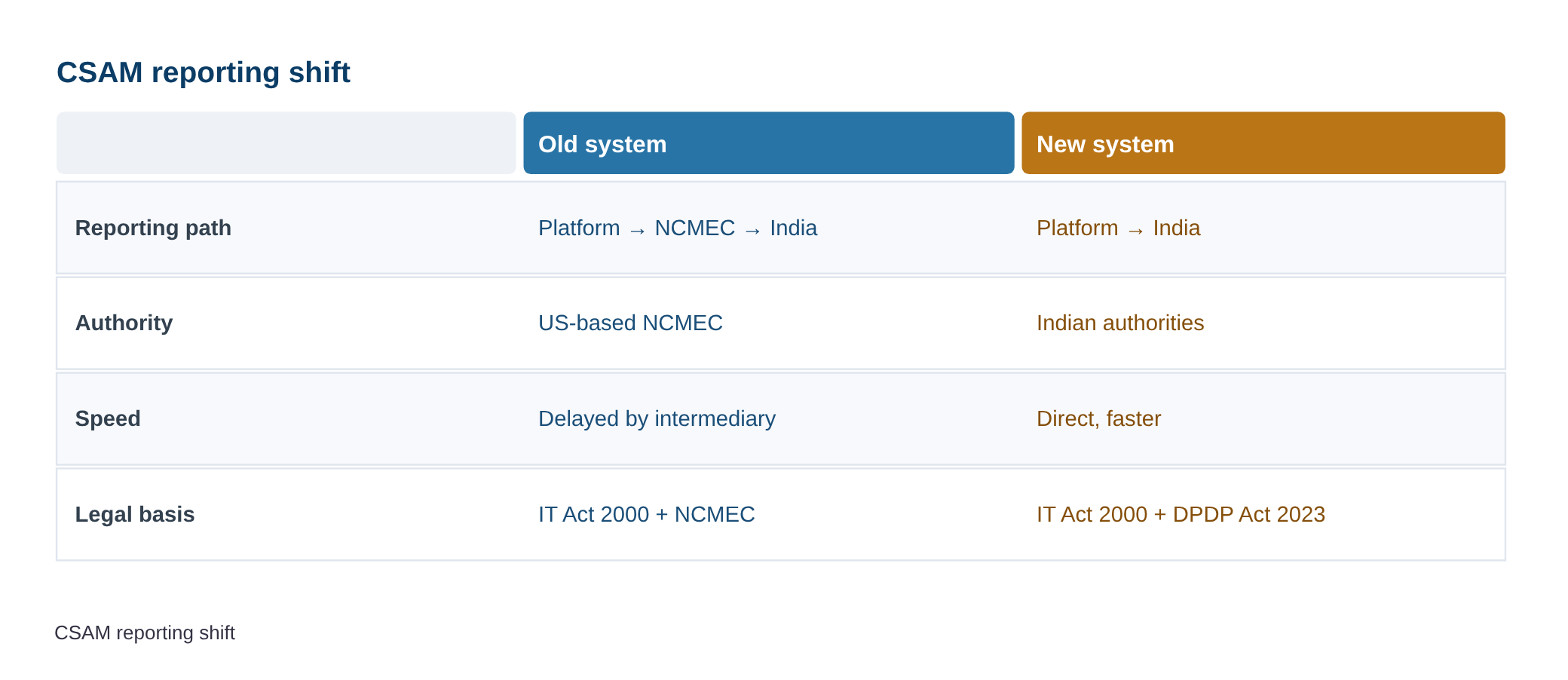
- The existing system involved tech platforms reporting CSAM to NCMEC, which then relayed the information to respective national law enforcement agencies, often leading to delays in urgent cases where children faced immediate risk.
- India, as the largest user base for platforms like Facebook and YouTube, has faced challenges in ensuring timely action against CSAM due to the intermediary-dependent reporting system.
- The Intermediary Guidelines Rules, 2021, under the IT Act, 2000, mandate due diligence by intermediaries to prevent the dissemination of unlawful content, including CSAM, but enforcement has faced operational constraints.
- The Digital Personal Data Protection Act, 2023, further strengthens the legal framework for data privacy and cybersecurity, necessitating robust mechanisms for reporting and addressing digital harms.
What is Direct Reporting of CSAM by Tech Platforms?
- Direct reporting refers to the practice where digital platforms, such as Google and Meta, bypass intermediary organizations like NCMEC and directly transmit flagged CSAM content to the law enforcement authorities of the jurisdiction where the content is hosted or accessed.
- This approach aims to reduce latency in reporting, enabling faster intervention by domestic agencies in cases involving immediate threats to children.
- The shift is driven by concerns that the traditional NCMEC-mediated system introduces delays, as reports must traverse international jurisdictions before reaching local law enforcement.
- Direct reporting aligns with the principle of digital sovereignty, asserting a nation’s authority over digital content hosted within its territory or accessible to its citizens.
- The practice is supported by provisions under Section 67B of the IT Act, 2000, which criminalizes the publication or transmission of material depicting children in sexually explicit acts, and mandates platforms to act against such content.
- The Intermediary Guidelines Rules, 2021, require intermediaries to establish mechanisms for grievance redressal and to remove unlawful content within 24 hours of receipt of a complaint, reinforcing the need for direct reporting pathways.
- The Cybercrime Coordination Centre (CCC) under the Ministry of Home Affairs serves as a nodal agency for coordinating cybercrime investigations, including those related to CSAM, and can facilitate direct reporting mechanisms.
- Global precedents for direct reporting exist in jurisdictions such as the European Union, where the Digital Services Act (DSA) mandates platforms to report illegal content directly to national authorities in certain cases.
Key Features
| Feature | Significance |
|---|---|
| Direct reporting of CSAM to Indian authorities | Eliminates intermediary delays, enabling faster law enforcement action to protect children at risk. |
| Shift from NCMEC-mediated reporting | Reduces dependency on a single US-based non-profit, aligning with sovereign data handling expectations. |
| Corporate commitment to detection and removal | Demonstrates proactive corporate responsibility in combating online child exploitation. |
| Alignment with government directives | Reflects compliance with central directives on platform accountability and cybersecurity. |
| Global precedent for direct reporting | Signals a potential shift in international norms for cross-border digital crime reporting. |
Why it Matters
Legal and Governance
- Reinforces India’s sovereign authority over digital platforms operating within its jurisdiction, consistent with the Information Technology (Intermediary Guidelines and Digital Media Ethics Code) Rules, 2021.
- Strengthens the legal framework for addressing online child sexual abuse material (CSAM) under Sections 67B and 67C of the IT Act, 2000.
- Enhances inter-agency coordination between tech platforms and Indian law enforcement agencies such as the National Crime Records Bureau (NCRB) and state cyber cells.
Technological and Operational
- Accelerates the detection-to-intervention cycle, reducing latency in emergency response for at-risk children.
- Leverages advanced AI and machine learning tools deployed by platforms like Google to proactively identify and flag CSAM.
- Ensures real-time data sharing protocols, improving the efficacy of the Indian Cyber Crime Coordination Centre (I4C).
Social and Ethical
- Prioritises child protection in digital spaces, aligning with the United Nations Convention on the Rights of the Child (UNCRC).
- Demonstrates corporate accountability in addressing grave human rights violations facilitated by digital platforms.
- Sets a benchmark for global tech governance, particularly in jurisdictions with high user bases and regulatory expectations.
Economic and Strategic
- Positions India as a leader in digital governance, potentially influencing global standards for platform accountability.
- May influence foreign direct investment (FDI) in India’s tech sector, with platforms adapting to local regulatory demands.
- Reduces reputational risks for Indian enterprises and public institutions targeted by impersonation campaigns (e.g., fake banking apps).
Challenges
1. Cross-border Data Jurisdiction
- Ensuring seamless data sharing while respecting international legal frameworks such as the US CLOUD Act and GDPR.
- Balancing sovereign data access with privacy protections under the Personal Data Protection Bill (PDPB).
- Managing potential conflicts between domestic laws and platform terms of service in foreign jurisdictions.
UPSC Link: PDPB, CLOUD Act
2. Platform Compliance and Scalability
- Maintaining consistent detection and reporting standards across diverse platforms (e.g., social media, cloud storage, messaging apps).
- Addressing false positives in AI-driven detection systems to avoid over-reporting and misuse.
- Ensuring resource allocation for continuous monitoring and rapid response in high-volume platforms like YouTube.
UPSC Link: IT Act, 2000
3. Law Enforcement Capacity
- Strengthening the investigative and forensic capabilities of Indian cyber cells to handle increased CSAM reports.
- Training law enforcement personnel in digital forensics, evidence preservation, and victim-centric approaches.
- Ensuring coordination between central agencies (I4C, NCRB) and state-level cyber units for timely action.
UPSC Link: NCRB, I4C
4. Privacy and Ethical Concerns
- Mitigating risks of mass surveillance or over-reach in digital monitoring while combating CSAM.
- Ensuring transparency in reporting mechanisms to maintain public trust and platform credibility.
- Balancing child protection with the right to privacy of users, including minors, under constitutional and statutory provisions.
UPSC Link: Article 21, PDPB
5. Global Harmonisation
- Aligning with international standards (e.g., INTERPOL’s ICSE database, WePROTECT Global Alliance) for consistency in CSAM reporting.
- Navigating differing regulatory expectations across jurisdictions to avoid fragmentation in enforcement.
- Collaborating with foreign governments and tech platforms to address cross-border CSAM networks.
UPSC Link: INTERPOL, WePROTECT
Challenges — UPSC Perspective
| Issue | Concern |
|---|---|
| Data Sovereignty | Ensuring Indian authorities have timely and unrestricted access to critical digital evidence. |
| Platform Accountability | Holding tech giants accountable for consistent and accurate CSAM detection and reporting. |
| Victim Protection | Balancing rapid intervention with safeguards against re-traumatisation of victims. |
| Resource Constraints | Addressing gaps in law enforcement infrastructure to handle increased caseloads. |
| Ethical AI Use | Preventing algorithmic bias or misuse in automated CSAM detection systems. |
| International Coordination | Harmonising reporting mechanisms with global partners to tackle transnational CSAM networks. |
Way Forward
- Establish a dedicated inter-ministerial task force comprising representatives from the Ministry of Electronics and Information Technology (MeitY), Ministry of Women and Child Development, NCRB, and I4C to oversee implementation.
- Develop standard operating procedures (SOPs) for platforms to report CSAM directly to Indian authorities within defined timelines.
- Enhance training programs for cyber forensic teams and law enforcement agencies to handle digital evidence and victim support.
- Invest in public-private partnerships to upgrade detection technologies and ensure scalability across platforms.
- Strengthen the Cyber Tipline portal under NCMEC for India-specific reporting while transitioning to direct reporting mechanisms.
- Conduct regular audits of platform compliance with reporting obligations and impose penalties for non-adherence.
- Launch awareness campaigns to educate users, especially minors and parents, on identifying and reporting CSAM.
- Collaborate with international bodies like INTERPOL and WePROTECT to align India’s CSAM reporting framework with global best practices.
UPSC Value Addition
Keywords for Mains Answer-Writing
Child Sexual Abuse Material (CSAM) · Intermediary Liability · Digital Personal Data Protection Act, 2023 · Section 67B of the Information Technology Act, 2000 · Platform accountability · CyberTipline mechanism · National Centre for Missing & Exploited Children (NCMEC) · International cooperation in cybercrime · Right to Privacy vs. State obligations · Due diligence obligations of intermediaries · Cybersecurity and data governance · Constitutional morality and digital governance · Supreme Court guidelines on online content regulation
Constitutional & Policy Linkages
- Article 21 (Right to Life and Personal Liberty) – Protection from harm in digital spaces.
- Article 19(1)(a) (Freedom of Speech) – Balancing with restrictions to prevent CSAM dissemination.
- Directive Principles of State Policy (Article 39(f)) – Safeguarding children’s interests.
Concept Flow
Digital platforms (Google, Meta) operate in India under IT Act, 2000 and Intermediary Guidelines, 2021. → CSAM detection by AI tools triggers reporting obligations under Section 67B of the IT Act. → Platforms previously routed reports via US-based NCMEC, causing delays in Indian law enforcement action. → Government pressures platforms to adopt direct reporting to Indian authorities for faster intervention. → Direct reporting enhances coordination between platforms, I4C, NCRB, and state cyber cells. → Faster reporting enables timely rescue, investigation, and prosecution of offenders. → Strengthened governance framework reinforces India’s sovereign authority over digital platforms.
Prelims Practice Questions
Q1. Consider the following statements regarding the reporting of Child Sexual Abuse Material (CSAM) by intermediaries in India:
1. Google and Meta now directly report CSAM to Indian authorities instead of routing reports through the US-based National Center for Missing & Exploited Children (NCMEC).
2. Section 67B of the Information Technology Act, 2000, mandates intermediaries to report CSAM to the designated authority within 24 hours of detection.
3. The Digital Personal Data Protection Act, 2023, imposes obligations on intermediaries to ensure the safety of children’s data but does not explicitly address CSAM reporting.
How many of the above statements are correct?
- Only one
- Only two
- All three
- None
Answer: Only two — Statement 1 is correct as per the recent policy shift by Google and Meta. Statement 2 is incorrect because Section 67B does not specify a 24-hour timeline; it requires reporting without undue delay. Statement 3 is correct as the DPDP Act focuses on data protection but does not explicitly mandate CSAM reporting timelines.
Q2. Assertion (A): The Central Government has the power to direct intermediaries to remove content under Section 69A of the Information Technology Act, 2000.
Reason (R): Section 69A empowers the government to issue directions for blocking public access to any information in the interest of sovereignty and integrity of India, defence of India, or public order.
Code:
- Both A and R are true, and R is the correct explanation of A
- Both A and R are true, but R is not the correct explanation of A
- A is true but R is false
- A is false but R is true
Answer: Both A and R are true, and R is the correct explanation of A — Both Assertion (A) and Reason (R) are correct, and Reason (R) correctly explains Assertion (A) as Section 69A is the legal basis for such directives.
Q3. Match the following legal provisions with their respective objectives:
Column I (Provision) | Column II (Objective)
———————|———————-
A. Section 67B, IT Act, 2000 | 1. Mandates removal of CSAM by intermediaries
B. Section 69A, IT Act, 2000 | 2. Empowers government to block content in public interest
C. Section 79, IT Act, 2000 | 3. Provides safe harbour to intermediaries for third-party content
D. Article 21, Constitution of India | 4. Protects the right to privacy and dignity
Options:
- A-1, B-2, C-3, D-4
- A-2, B-1, C-3, D-4
- A-4, B-2, C-1, D-3
- A-3, B-4, C-2, D-1
Answer: A-1, B-2, C-3, D-4 — The correct match is: A (Section 67B) mandates reporting of CSAM, B (Section 69A) empowers blocking of content, C (Section 79) provides safe harbour to intermediaries, and D (Article 21) protects the right to privacy and dignity.
Mains Practice Question
✍ Critically examine the implications of the recent policy shift by Google and Meta to directly report Child Sexual Abuse Material (CSAM) to Indian authorities, rather than routing such reports through the US-based National Center for Missing & Exploited Children (NCMEC). In your answer, discuss the legal framework governing intermediaries’ obligations under the Information Technology Act, 2000, and analyse the balance between platform accountability and the right to privacy. (15 Marks)
Approach: MODEL-ANSWER SKELETON:
1. **Introduction (2 marks)**
– Briefly define CSAM and its global prevalence.
– State the recent policy shift by Google and Meta and its significance in the Indian context.
2. **Legal Framework Governing Intermediaries (4 marks)**
– Section 67B of the Information Technology Act, 2000: Mandate for intermediaries to report CSAM.
– Section 79 of the IT Act: Safe harbour provisions and due diligence obligations.
– Section 69A: Government’s power to block content in public interest.
– Digital Personal Data Protection Act, 2023: Overlapping obligations on data safety and child protection.
3. **Platform Accountability vs. Right to Privacy (5 marks)**
– **Platform Accountability**: Direct reporting ensures faster action, reduces delays, and aligns with India’s sovereignty concerns. Cite the CyberTipline’s global data (21.3 million reports in 2025) to highlight inefficiencies in the intermediary model.
– **Right to Privacy**: Direct reporting may infringe on users’ privacy, especially if data is shared without judicial oversight. Refer to the Puttaswamy judgment (2017) on privacy as a fundamental right.
– **Judicial Precedents**: Mention any relevant Supreme Court judgments on intermediary liability (e.g., Shreya Singhal v. Union of India, 2015).
4. **International Cooperation and Sovereignty (2 marks)**
– Discuss the tension between global platforms and national sovereignty in cybercrime regulation.
– Highlight India’s stance on data localisation and cross-border data flows under the DPDP Act.
5. **Conclusion (2 marks)**
– Summarise the need for a balanced approach: ensuring child safety while protecting privacy and constitutional rights.
– Suggest measures such as judicial oversight for direct reporting and harmonised global frameworks.
Source: orissapost.com
Generated by AanyaAi for educational purpose.
Related guides on our sites
- Best PSIR optional coaching for upsc
- Best economics optional coaching for upsc
- Best PSIR optional teacher for upsc
- Best teacher of PSIR optional for upsc

- Google to Report CSAM Directly to Indian Authorities: Implications for UPSC - September 22, 2026
- राज्यों द्वारा सरकारी प्रतिभूतियों की नीलामी में ₹16,750 करोड़ का सफल संग्रह - September 22, 2026
- RBI Auction Results: State Govt Securities Yield Trends & Implications for UPSC 2026 - September 22, 2026

No Comments