


09 Aug Government’s Strategic MOUs to Boost Startup Ecosystem in India
✎ Public-Private Partnerships (PPPs) in India’s startup ecosystem are strategic alliances between DPIIT and private entities to enhance digital infrastructure, fintech capabilities, and global market access for startups, thereby…
Subject Relevance — Where This Topic Fits
- GS Paper III — Technology, Economic Development, Biodiversity, Environment, Security and Disaster Management (Startup ecosystem, Digital infrastructure, Fintech, AI, Green hydrogen) | GS Paper II — Government Policies and Interventions for Development in various sectors
- Prelims: Startup India initiative, DPIIT, Fintech, Digital Public Infrastructure (DPI), AI-driven mobility, Cloud infrastructure, Green hydrogen, KYC norms, Cross-border transactions, Mentorship networks
- Essay: The role of public-private partnerships in India’s economic transformation, Innovation as a driver of national competitiveness
Quick Revision: Public-Private Partnerships (PPPs) in India’s startup ecosystem are strategic alliances between DPIIT and private entities to enhance digital infrastructure, fintech capabilities, and global market access for startups, thereby accelerating innovation-led economic growth.
Why is this in the news?
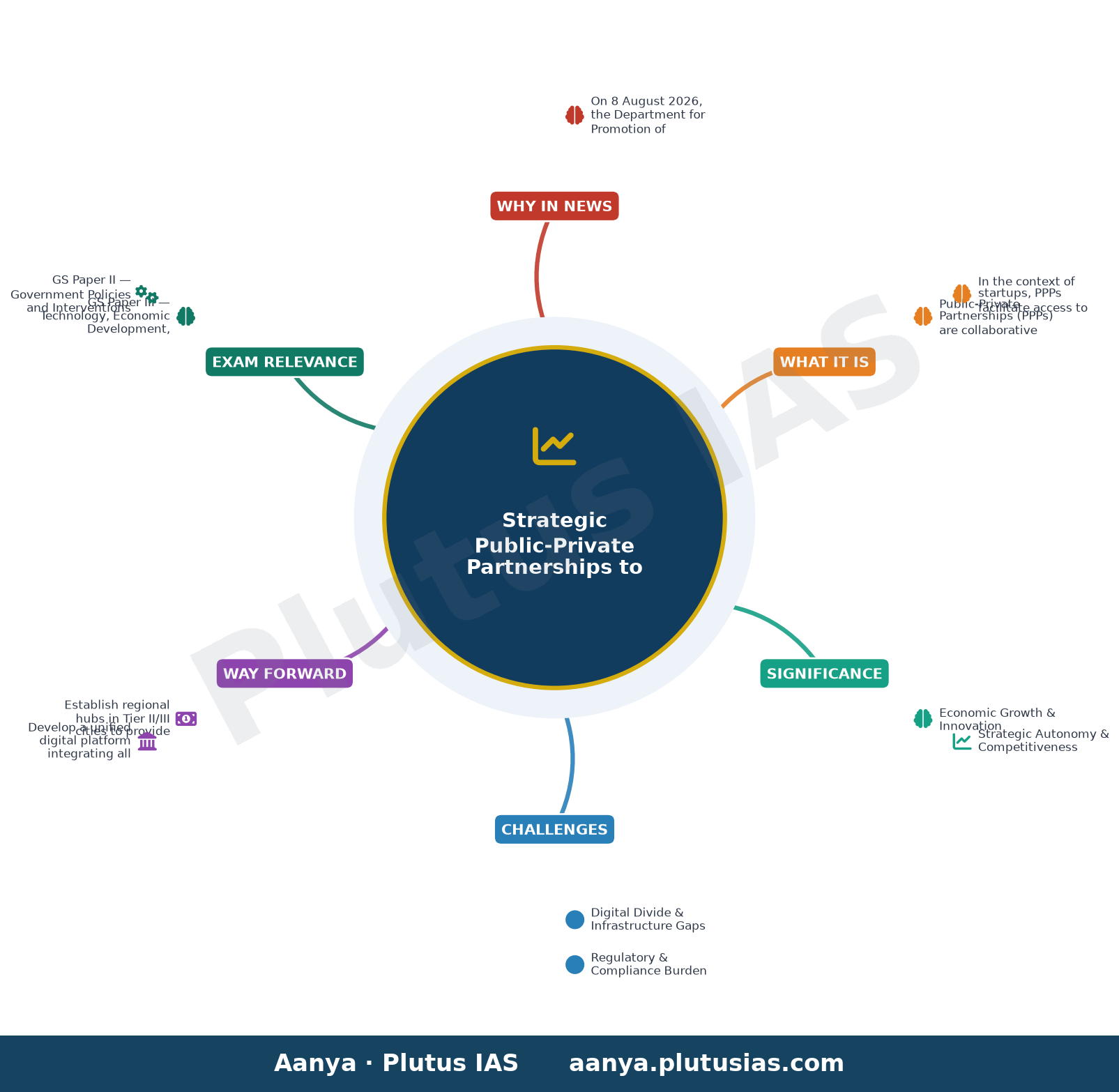
On 8 August 2026, the Department for Promotion of Industry and Internal Trade (DPIIT), Ministry of Commerce and Industry, Government of India, formalised strategic Memoranda of Understanding (MoUs) with five leading industry ecosystem partners—Cashfree Payments, Darwin Dynamics LLP, Walter Private Limited, Cars24 Services Private Limited, and Council for Startup India—to enhance support for startups through digital infrastructure, fintech capabilities, mentorship, and global market access. These agreements underscore the government’s commitment to leveraging private sector expertise in building a resilient, inclusive, and globally competitive startup ecosystem under the Startup India initiative.
Background
- DPIIT, under the Ministry of Commerce and Industry, serves as the nodal department for implementing Startup India policies, including recognition of startups, funding support, and regulatory simplification.
- Digital Public Infrastructure (DPI) has emerged as a critical enabler for startups, facilitating seamless digital payments, cloud-based scalability, and AI-driven innovation.
- The government’s emphasis on ‘Atmanirbhar Bharat’ aligns with these partnerships to reduce dependency on foreign technology and enhance domestic innovation capacity.
Strategic Public-Private Partnerships in India’s Startup Ecosystem
- Public-Private Partnerships (PPPs) are collaborative arrangements between government agencies and private sector entities to achieve shared objectives, such as infrastructure development, innovation, and capacity building.
- In the context of startups, PPPs facilitate access to critical resources—financial, technological, and mentorial—thereby accelerating growth, reducing market entry barriers, and enhancing global competitiveness.
- DPIIT’s recent MoUs with industry leaders are structured to address specific gaps in the startup ecosystem, including digital payments, cloud infrastructure, AI-driven mobility, and inclusive entrepreneurship.
- These partnerships are not merely financial but involve co-creation of solutions, knowledge sharing, and institutional capacity building through workshops, hackathons, and mentorship programs.
- The collaboration with Cashfree Payments focuses on strengthening digital payment infrastructure, fintech capabilities, and compliance frameworks for DPIIT-recognised startups.
- The partnership with Darwin Dynamics LLP aims to promote inclusive entrepreneurship by targeting Tier II/III cities and rural areas, with a focus on green hydrogen, AI, and climate technologies.
- Cars24 Services Private Limited’s collaboration with DPIIT is geared towards fostering AI-driven mobility innovations, aligning with India’s push for sustainable and smart transportation solutions.
- The Council for Startup India partnership seeks to enhance the global visibility and market access of Indian startups, positioning them as key players in international innovation ecosystems.
Key Features
| Feature | Significance |
|---|---|
| Digital Payment Infrastructure (Cashfree Payments) | Enables DPIIT-recognised startups to access secure, scalable payment and payout solutions, reducing transaction friction and enhancing financial inclusion for innovators. |
| Fintech Capability Building (Cashfree Payments) | Facilitates capacity-building through workshops, mentoring sessions, and AI-focused hackathons to upskill founders in compliance, fraud prevention, and cross-border transactions. |
| Inclusive Entrepreneurship (Darwin Dynamics) | Expands the Startup India initiative’s reach to Tier II/III cities and rural areas, promoting equitable access to entrepreneurship and innovation. |
| Deep-Tech & Green Innovation Support (Darwin Dynamics) | Focuses on strategic sectors such as clean energy, green hydrogen, AI, climate technologies, and advanced manufacturing to align startups with India’s sustainable development goals. |
| Cloud Infrastructure Access (Walter India) | Provides DPIIT-recognised startups with scalable cloud solutions, reducing operational costs and accelerating product development cycles. |
| AI-Driven Mobility Innovation (Cars24 Services) | Strengthens the startup ecosystem by fostering AI-powered mobility solutions, aligning with India’s push for smart mobility and digital transformation. |
| Global Competitiveness Framework (Council for Startup India) | Establishes a structured partnership to enhance Indian startups’ global market access, investor connect, and policy research, reinforcing India’s position in the global innovation economy. |
Why it Matters
Economic Growth & Innovation
- Accelerates the formalisation of India’s startup ecosystem, transitioning informal innovations into scalable, revenue-generating enterprises.
- Enhances India’s position as a global innovation hub by fostering deep-tech, green-tech, and AI-driven solutions.
- Reduces transaction costs and operational barriers for startups, enabling faster market entry and scalability.
- Aligns with the vision of a $5 trillion economy by 2025 by strengthening the digital and financial infrastructure for startups.
Strategic Autonomy & Competitiveness
- Reduces dependence on foreign cloud and payment infrastructure, promoting indigenous solutions for startups.
- Encourages domestic investment in strategic sectors like clean energy, AI, and advanced manufacturing, reducing import reliance.
- Enhances India’s soft power in global innovation by positioning its startups as leaders in sustainable and AI-driven technologies.
Inclusive Development
- Bridges the urban-rural divide by extending entrepreneurship opportunities to Tier II/III cities and rural areas.
- Supports underrepresented groups such as women entrepreneurs, first-generation founders, and innovators from marginalised regions.
- Promotes equitable access to mentorship, funding, and market opportunities, fostering a diverse and resilient startup ecosystem.
Policy & Governance
- Demonstrates the government’s commitment to creating a conducive environment for startups through public-private partnerships.
- Integrates digital public infrastructure (DPI) with private sector expertise to address systemic gaps in the startup ecosystem.
- Lays the groundwork for future policy interventions in areas like fintech regulation, cloud governance, and AI ethics.
Challenges
1. Digital Divide & Infrastructure Gaps
- Persistent disparities in internet connectivity and digital literacy between urban and rural areas may limit the reach of these initiatives.
- Dependence on private cloud providers may raise concerns about data sovereignty and vendor lock-in for startups.
UPSC Link: GS3: Digital Infrastructure
2. Regulatory & Compliance Burden
- Complex and evolving regulatory frameworks for fintech, AI, and data governance may pose compliance challenges for startups.
- Cross-border transactions and cross-jurisdictional data flows require harmonised policies to avoid legal ambiguities.
UPSC Link: GS2: Government Policies
3. Access to Funding & Investor Connect
- Despite improved infrastructure, access to seed and growth-stage funding remains a critical bottleneck for early-stage startups.
- Lack of structured investor networks in Tier II/III cities may hinder the effectiveness of mentorship and funding initiatives.
UPSC Link: GS3: Investment Models
4. Talent & Skill Shortages
- Shortages of skilled professionals in AI, cloud computing, and fintech may constrain the scalability of these initiatives.
- High attrition rates in the tech sector exacerbate the challenge of retaining talent within startups.
UPSC Link: GS3: Human Resource Development
5. Sustainability & Green Transition
- Ensuring that deep-tech and green innovation initiatives translate into commercially viable and scalable solutions remains a challenge.
- Balancing rapid innovation with environmental sustainability requires robust policy frameworks and incentives.
UPSC Link: GS3: Environment & Sustainable Development
6. Cybersecurity & Fraud Risks
- Increased digitalisation exposes startups to heightened cybersecurity threats, including data breaches and financial fraud.
- Lack of awareness and resources to implement robust cybersecurity measures may undermine trust in digital payment solutions.
UPSC Link: GS3: Cybersecurity
Challenges — UPSC Perspective
| Issue | Concern |
|---|---|
| Digital Infrastructure Gaps | Limited internet connectivity and digital literacy in rural areas may restrict the reach of startup support initiatives. |
| Regulatory Complexity | Evolving fintech and AI regulations may create compliance burdens for startups. |
| Funding Accessibility | Early-stage startups face challenges in securing seed and growth-stage funding despite improved infrastructure. |
| Talent Shortages | Shortages of skilled professionals in AI, cloud computing, and fintech may hinder startup scaling. |
| Sustainability Integration | Ensuring that green-tech solutions are commercially viable and scalable remains a challenge. |
| Cybersecurity Risks | Increased digitalisation exposes startups to cyber threats, requiring robust security measures. |
Government Initiatives — Must-Memorise for Prelims
- Startup India initiative (DPIIT)
Way Forward
- Establish regional hubs in Tier II/III cities to provide on-ground mentorship, funding, and infrastructure support for startups.
- Develop a unified digital platform integrating all DPIIT-recognised startups with government schemes, investor networks, and cloud services.
- Strengthen cybersecurity frameworks for fintech and cloud services, including mandatory audits and compliance training for startups.
- Introduce tax incentives and subsidies for startups adopting green technologies and sustainable practices.
- Expand AI and fintech skilling programmes in partnership with educational institutions and private sector players.
- Create a dedicated fund for rural and women-led startups to address funding disparities.
- Enhance cross-border collaboration with global innovation hubs to facilitate market access for Indian startups.
- Implement a real-time monitoring system to track the impact of these partnerships on startup growth and ecosystem development.
UPSC Value Addition
Keywords for Mains Answer-Writing
Startup India initiative · Department for Promotion of Industry and Internal Trade (DPIIT) · strategic MoUs for startups · digital infrastructure for startups · financial technology (fintech) support · inclusive entrepreneurship · deep-tech innovation · cloud infrastructure for startups · AI-driven mobility innovation · global competitiveness of Indian startups
Concept Flow
Government recognises gaps in digital infrastructure, funding, and mentorship for startups → DPIIT signs MoUs with private sector leaders to address these gaps → Private partners provide digital payment, cloud, AI, and mentorship solutions → Startups gain access to scalable infrastructure, funding, and global markets → Enhanced startup ecosystem contributes to economic growth, innovation, and job creation → India strengthens its position in the global innovation economy
Prelims Practice Questions
Q1. Consider the following statements regarding the Department for Promotion of Industry and Internal Trade (DPIIT):
1. DPIIT operates under the Ministry of Commerce and Industry, Government of India.
2. DPIIT is responsible for the implementation of the ‘Startup India’ initiative.
3. DPIIT has recently signed MoUs with major industry leaders to strengthen the startup ecosystem.
How many of the above statements are correct?
- Only one
- Only two
- All
- None
Answer: All — Statements 1 and 2 are correct as DPIIT is a department under the Ministry of Commerce and Industry and implements the Startup India initiative. Statement 3 is also correct as DPIIT has signed multiple MoUs to support startups.
Q2. Assertion (A): The DPIIT’s collaboration with Cashfree Payments aims to enhance digital payment infrastructure for startups.
Reason (R): Cashfree Payments specializes in providing secure and scalable payment solutions, which aligns with DPIIT’s objective of supporting startups.
Options:
A. Both A and R are true, and R is the correct explanation of A.
B. Both A and R are true, but R is not the correct explanation of A.
C. A is true, but R is false.
D. A is false, but R is true.
Answer: ? — Both the Assertion (A) and Reason (R) are true, and R correctly explains A as the collaboration specifically targets digital payment infrastructure enhancement for startups.
Q3. Match the following DPIIT collaborations with their respective objectives:
Column I (Collaboration) | Column II (Objective)
————————————————–|————————————————–
A. DPIIT & Cashfree Payments | 1. Strengthening cloud infrastructure for startups
B. DPIIT & Darwin Dynamics | 2. Enhancing digital payment infrastructure
C. DPIIT & Walter India | 3. Promoting inclusive entrepreneurship and deep-tech innovation
D. DPIIT & Cars24 Services Pvt. Ltd. | 4. AI-driven mobility innovation and startup ecosystem strengthening
Options:
A – 2, B – 3, C – 1, D – 4
A – 1, B – 2, C – 3, D – 4
A – 3, B – 1, C – 2, D – 4
A – 2, B – 4, C – 1, D – 3
Answer: ? — A matches with 2 (Cashfree Payments focuses on digital payment infrastructure), B matches with 3 (Darwin Dynamics promotes inclusive entrepreneurship and deep-tech innovation), C matches with 1 (Walter India strengthens cloud infrastructure), and D matches with 4 (Cars24 focuses on AI-driven mobility innovation).
Mains Practice Question
✍ The Government of India, through the Department for Promotion of Industry and Internal Trade (DPIIT), has recently entered into strategic MoUs with leading industry players to bolster the startup ecosystem. Critically examine the rationale behind these collaborations and their potential impact on India’s innovation-driven growth trajectory. (15 Marks)
Approach: MODEL-ANSWER SKELETON:
1. **Introduction (2 Marks)**
– Briefly define the ‘Startup India’ initiative and DPIIT’s role in its implementation.
– Mention the recent strategic MoUs signed by DPIIT with industry leaders (Cashfree Payments, Darwin Dynamics, Walter India, Cars24, Council for Startup India).
2. **Rationale Behind Collaborations (5 Marks)**
– **Digital Infrastructure Support**: Explain how collaborations like DPIIT-Cashfree Payments (digital payments, fintech) and DPIIT-Walter India (cloud infrastructure) address critical gaps in the startup ecosystem.
– **Inclusive Entrepreneurship**: Highlight DPIIT-Darwin Dynamics’ focus on tier-II/III cities and rural areas to promote inclusive entrepreneurship.
– **Deep-Tech and AI Innovation**: Discuss DPIIT-Cars24’s partnership to foster AI-driven mobility innovation and global competitiveness.
– **Policy and Market Access**: Mention the Council for Startup India’s role in enhancing policy research and global market access for startups.
– **Capacity Building**: Emphasize the emphasis on mentorship, workshops, hackathons, and knowledge-sharing programs.
3. **Potential Impact on Innovation-Driven Growth (5 Marks)**
– **Economic Growth**: Discuss how these collaborations can accelerate India’s transition to a $5 trillion economy by fostering innovation and entrepreneurship.
– **Global Competitiveness**: Analyze how these partnerships can position India as a global hub for startups, particularly in fintech, AI, and green technologies.
– **Job Creation**: Highlight the potential for employment generation, especially for youth, women, and first-generation entrepreneurs.
– **Regional Balanced Development**: Evaluate the impact on reducing regional disparities by promoting entrepreneurship in tier-II/III cities and rural areas.
4. **Challenges and Way Forward (3 Marks)**
– **Implementation Gaps**: Discuss potential challenges such as bureaucratic hurdles, regulatory complexities, and uneven access to resources.
– **Sustainability**: Highlight the need for long-term funding, mentorship, and policy stability.
– **Conclusion**: Summarize the transformative potential of these collaborations while acknowledging the need for continuous monitoring and adaptive policies.
Source: PIB (Press Information Bureau)
Generated by AanyaAi for educational purpose.

- UPSC Civil Services (Main) Examination 2026 — Mechanical Engineering Optional Paper I: Question Paper | Plutus IAS - September 24, 2026
- सुप्रीम कोर्ट ने टीएमसी नाम और चुनाव चिह्न विवाद पर चुनाव आयोग से समयसीमा मांगी, 28 सितंबर को सुनवाई - September 24, 2026
- UPSC Civil Services (Main) Examination 2026 — Chemistry Optional Paper I: Questions with Model Answers | Plutus IAS - September 24, 2026

No Comments