


10 Aug Governor and his Powers
Governor and His Powers — UPSC CSE Law Optional (Paper I)
1) Orientation & Exam Relevance
The office of the Governor sits at the intersection of Union–State relations and the working of State governments. For the UPSC Law Optional (Paper I – Constitutional Law), it routinely yields analytical questions: the Governor’s status as a constitutional head; the scope and limits of discretion; assent to bills under Articles 200–201; the ordinance-making power under Article 213; appointment and removal; and the use (or misuse) of the Governor’s report under Article 356. The topic also connects with federalism, separation of powers, judicial review, legislative process in States, and the rule of law.
2) Constitutional Scheme & Articles
Articles 153–167 lay down the State Executive: Governor, Council of Ministers headed by the Chief Minister, and the Advocate-General. Article 153 mandates that there shall be a Governor for each State (one person may be Governor of two or more States). Article 154 vests the executive power of the State in the Governor, to be exercised either directly or through subordinate officers in accordance with the Constitution. Articles 155–156 cover appointment and tenure; 157–158 define qualification and conditions of office; 159 prescribes the oath; 160 allows the President to make provisions for discharge of duties in contingencies.
Article 163 is crucial: there shall be a Council of Ministers with the Chief Minister at the head to aid and advise the Governor, except in so far as the Governor is by or under the Constitution required to exercise functions in his discretion. Article 174 (summoning/prorogation), 175 (address and messages), 176 (special address), 200–201 (assent to bills), and 213 (ordinances) shape the Governor’s legislative interface. Article 161 gives the pardoning power in respect of offences against State law. Article 356 gives the President power to impose President’s Rule, typically acting on the Governor’s report.
3) Appointment, Qualifications, Oath & Conditions
(a) Appointment (Art. 155)
The Governor is appointed by the President by warrant under his hand and seal. In practice, this means a political appointment by the Union executive. The Sarkaria and Punchhi Commissions suggested consultative norms (including the Chief Minister) and choosing non-partisan, eminent persons of stature, preferably outsiders to the State to reduce local factional pulls.
(b) Eligibility & Conditions (Arts. 157–158)
- Citizen of India; completed 35 years of age.
- Must not be a member of either House of Parliament or of a State legislature; if such membership exists, it is deemed vacated on taking office.
- Must not hold any other office of profit.
- Emoluments & allowances are charged on the Consolidated Fund of the State.
(c) Oath (Art. 159)
The Governor swears to preserve, protect and defend the Constitution and the law, and to devote himself to the service and well-being of the people.
4) Tenure & Removal
Term: nominally five years from the date he enters office (Art. 156(3)), but he holds office during the pleasure of the President (Art. 156(1)). The “pleasure” is not absolute or arbitrary in constitutional practice. A Governor may resign by writing to the President.
Key Principle — Removal of Governors
Constitution Bench dicta emphasise that Governors are neither Union employees nor agents of the ruling party at the Centre. While they serve during the President’s pleasure, removal cannot be for arbitrary, capricious, or purely political reasons; it must be for valid reasons though not justiciable as to sufficiency. The decision underscores the expected neutrality of the office and its insulation from partisan churns.
Acting & Additional Charge: Under Article 160, the President may make provisions for the discharge of the Governor’s functions in unforeseen contingencies; additional charges across States are common.
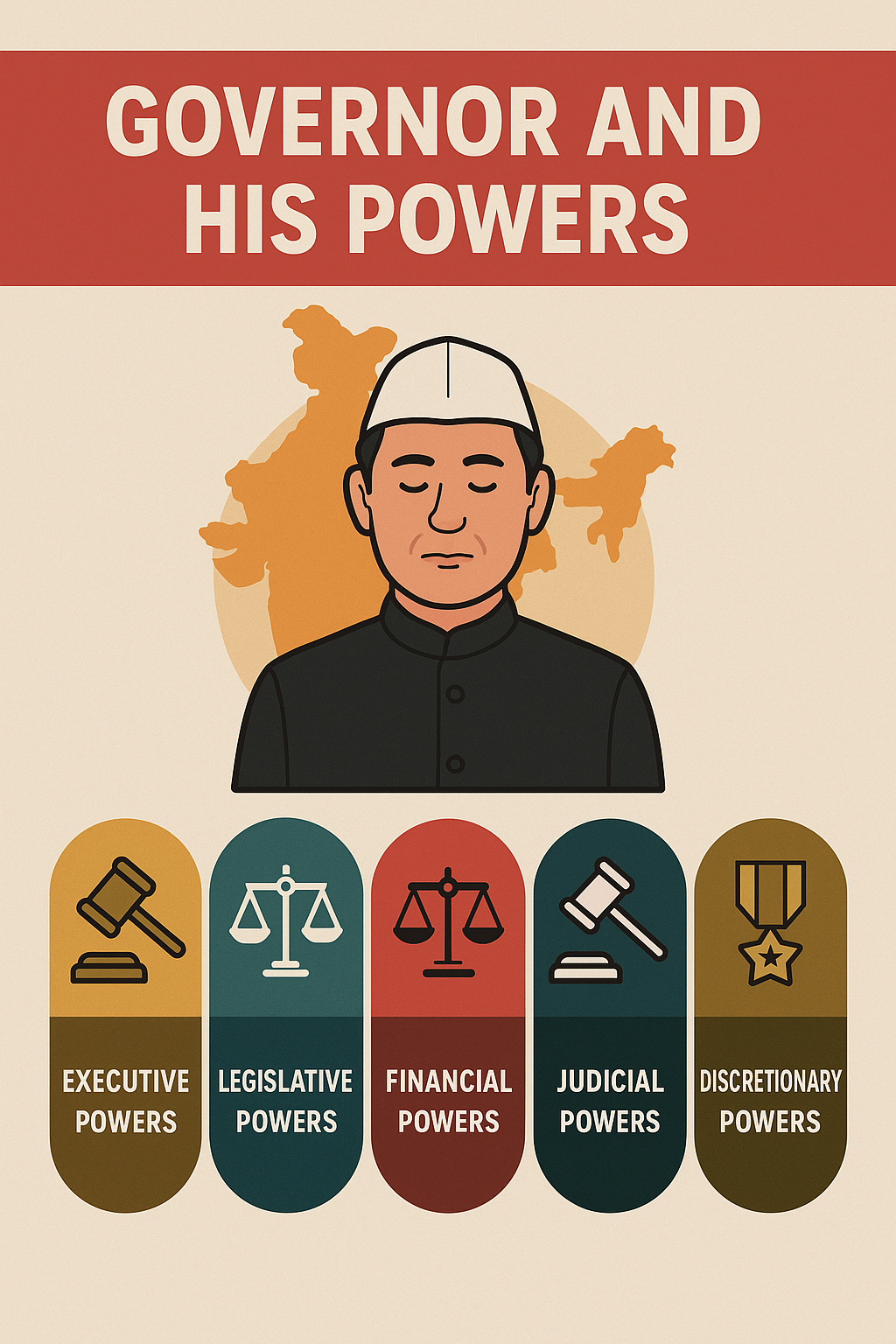
5) Powers of the Governor — The Complete Spectrum
5.1 Executive Powers (Arts. 154, 162, 166, 167)
- Vesting & Extent: State executive power is vested in the Governor and extends to matters the State legislature can make laws upon.
- Appointment & Dismissal: Appoints the Chief Minister (normally leader of majority) and on advice, other Ministers; appoints the Advocate-General (Art. 165) and key constitutional authorities (e.g., State Election Commissioner, State PSC members as per relevant provisions/statutes).
- Allocation of Business: All executive action is expressed to be taken in the name of the Governor; rules of business allocate portfolios among ministers (Art. 166).
- Right to Information: The Chief Minister is duty-bound to communicate to the Governor all decisions of the Council of Ministers and furnish information as the Governor may call for (Art. 167).
- Special Responsibilities (select States): In certain special contexts (e.g., tribal areas in some States), the Constitution or parliamentary statutes confer special responsibilities requiring individual judgment.
5.2 Legislative Powers (Arts. 174–176, 200–201)
- Summon, Prorogue, Dissolve: The Governor summons and prorogues the State legislature and can dissolve the Legislative Assembly (normally on the advice of the Council of Ministers).
- Address & Messages: Special address at the first session each year and after a general election (Art. 176); can send messages to the Houses (Art. 175).
- Assent to Bills (Art. 200): See the detailed flow in the dedicated section below.
5.3 Ordinance-Making Power (Art. 213)
When both Houses (or the sole House in unicameral States) are not in session, the Governor may promulgate ordinances if he is satisfied that circumstances exist which render it necessary. Ordinances have the same force as Acts but must be laid before the legislature and cease to operate six weeks after reassembly, unless earlier disapproved or replaced by an Act. Ordinances cannot be issued to contravene constitutional limits (e.g., cannot amend the Constitution; cannot encroach upon matters reserved to Parliament except as permitted; cannot be used to cure lack of legislative competence). Judicial review examines whether the ordinance power has been exercised bona fide, within constitutional bounds, and not to bypass the legislature habitually.
5.4 Financial Role
- The annual financial statement (budget) is caused to be laid before the legislature in the Governor’s name; Money Bills require prior recommendation.
- Demands for Grants, Appropriation and Finance Bills follow State rules; the Governor ensures constitutional process and assent.
5.5 Pardoning Power (Art. 161)
The Governor may grant pardons, reprieves, respites, remissions of punishment, or suspend, remit, or commute the sentence of any person convicted of any offence against any law relating to a matter to which the State’s executive power extends. Note carefully:
- The Governor’s pardoning power does not extend to death sentences imposed for offences under central laws where the President’s power under Article 72 applies (though remission/commutation routes may arise depending on the offence and executive competence; examiners expect nuanced comparison with Art. 72).
- Exercise of clemency is subject to judicial review on limited grounds (mala fides, irrelevant considerations, arbitrariness).
6) Discretionary Powers & Their Limits (Art. 163)
Article 163 acknowledges the possibility of discretion only where the Constitution expressly contemplates it or where its scheme necessarily implies individual judgment (e.g., when no party has a clear majority; or specific statutory responsibilities). The default rule is that the Governor acts on the aid and advice of the Council of Ministers.
Examples often discussed in exams:
- Appointment of Chief Minister in a hung House (assess staked claims, letters of support, past coalition agreements; avoid partisan cherry-picking).
- Assent to Bills and reservation for President (only where constitutionally warranted; reasons should be communicated without undue delay).
- Recommendation for President’s Rule (Art. 356) where governance cannot be carried on per the Constitution; must be based on objective material.
- Calling for a Floor Test to determine the majority (requires objective material indicating loss of confidence; not to be triggered merely due to intra-party disputes).
Best Law optional coaching for upsc
Best law optional teacher for upsc
7) Assent to State Bills (Arts. 200–201): The Process & Modern Constraints
When a Bill is presented, the Governor has four theoretical options (subject to constitutional limits):
- Assent: The Bill becomes law.
- Withhold assent: If withholding, the Bill should typically be returned to the House (other than a Money Bill) with a message for reconsideration — and this must be done as soon as possible. If the Bill is repassed and presented again, the Governor is ordinarily bound to assent (unless reservation is constitutionally mandatory for reasons such as derogation of High Court’s powers or conflict with central laws requiring President’s consideration).
- Return for reconsideration: (not applicable to Money Bills) with a message.
- Reserve for President: Mandatory in certain cases (e.g., where required by the Constitution) and permissible where the Governor considers it necessary; the President may assent or withhold assent under Article 201. Modern jurisprudence has significantly curtailed open-ended reservation and delay.

- तमिलनाडु के लिए क्या है ‘एल नीनो’ और उत्तर-पूर्वी मानसून का खतरा? - September 23, 2026
- El Nino & Northeast Monsoon: Impact on Tamil Nadu for UPSC 2026 - September 23, 2026
- हिमाचल में डिजिटल भुगतान क्रांति: बिलासपुर अव्वल, महिलाओं की भागीदारी 93% तक पहुंची - September 23, 2026

No Comments