


12 Aug Govt may send FCRA Bill to Parliamentary Panel for Consensus: Key Details
✎ The Foreign Contribution (Regulation) Amendment Bill seeks to amend the FCRA, 2010 by introducing stricter compliance mechanisms, including digital wallet regulations and utilisation certificates, to enhance transparency in…
Subject Relevance — Where This Topic Fits
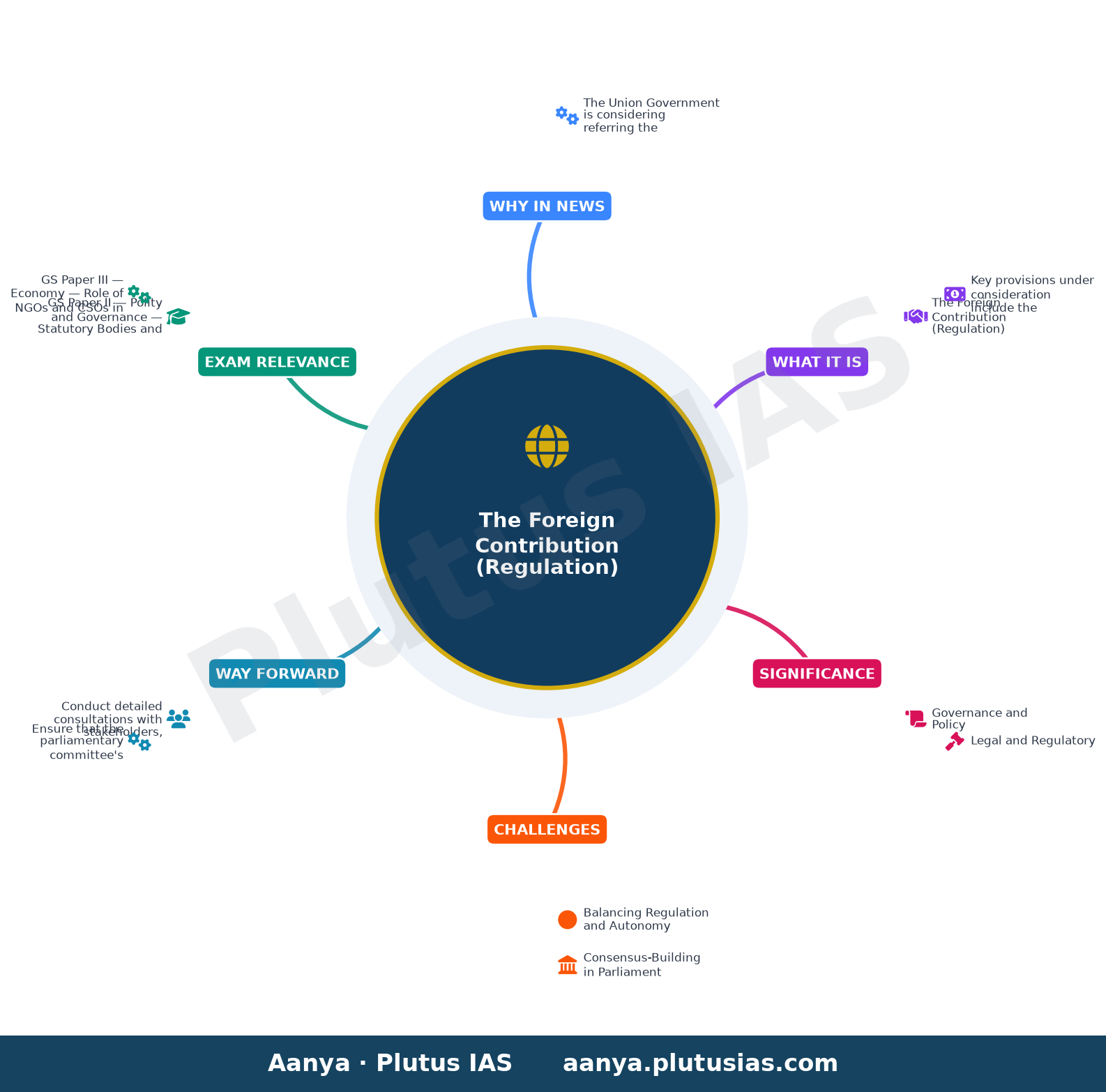
- GS Paper II — Polity and Governance — Statutory Bodies and Constitutional Provisions | GS Paper III — Economy — Role of NGOs and CSOs in Development
- Prelims: Foreign Contribution (Regulation) Act, 2010, Parliamentary Standing Committees, Joint Committee of Parliament, Lok Sabha, Rajya Sabha, FCRA 2025 Amendment Bill
- Essay: The role of parliamentary committees in ensuring participatory democracy, Balancing transparency and civil society autonomy in governance
Quick Revision: The Foreign Contribution (Regulation) Amendment Bill seeks to amend the FCRA, 2010 by introducing stricter compliance mechanisms, including digital wallet regulations and utilisation certificates, to enhance transparency in foreign funding for NGOs.
Why is this in the news?
The Union Government is considering referring the Foreign Contribution (Regulation) Amendment Bill to a joint committee of Parliament to address concerns raised by opposition parties and civil society organisations regarding its provisions that may restrict foreign funding to non-governmental organisations (NGOs). This procedural step is being pursued to foster consensus on the contentious legislation, which has elicited protests from stakeholders over its alleged potential to stifle civil society participation in development and advocacy.
Background
- The Foreign Contribution (Regulation) Act, 2010 (FCRA, 2010) regulates the acceptance and utilisation of foreign contributions by individuals, associations, and NGOs in India to ensure transparency and prevent misuse.
- The FCRA, 2010 has been amended multiple times, including in 2015, 2016, 2019, and 2020, to tighten compliance mechanisms and broaden the scope of entities subject to regulation.
- Civil society organisations, including religious bodies, have raised concerns that certain provisions may disproportionately impact NGOs engaged in social, developmental, and advocacy work.
- Opposition parties have demanded either the withdrawal of the bill or its referral to a parliamentary committee for detailed scrutiny, citing the need for broader consultations.
- The Business Advisory Committee of the Rajya Sabha, comprising members from multiple parties, plays a key role in deciding the legislative trajectory of bills, including their referral to committees.
What is the Foreign Contribution (Regulation) Amendment Bill?
- The Foreign Contribution (Regulation) Amendment Bill is a legislative proposal aimed at amending the Foreign Contribution (Regulation) Act, 2010, to introduce stricter provisions governing the receipt and utilisation of foreign contributions by NGOs and other entities.
- Key provisions under consideration include the regulation of foreign contributions received through digital wallets, mandatory utilisation certificates, and restrictions on the transfer of foreign funds to other organisations (sub-granting).
- The bill seeks to enhance transparency in the utilisation of foreign funds by mandating the submission of annual returns and audited statements to the designated authority within a stipulated timeframe.
- It proposes to empower the government to suspend or cancel the registration of NGOs for non-compliance with FCRA provisions, including delays in reporting or utilisation of funds.
- The bill also introduces provisions to prohibit the receipt of foreign contributions by organisations engaged in activities detrimental to public interest or national security, aligning with the Act’s broader objectives.
- The amendment bill is part of a broader effort to streamline the regulatory framework governing foreign contributions while balancing the need for transparency with the autonomy of civil society organisations.
- The proposed amendments reflect the government’s intent to address gaps in the existing FCRA framework, particularly in the context of digital transactions and cross-border fund flows.
- The bill’s referral to a joint committee of Parliament would enable multi-stakeholder consultations, including inputs from opposition parties, civil society, and subject-matter experts, to refine its provisions.
Key Features
| Feature | Significance |
|---|---|
| Provision for parliamentary scrutiny via joint committee | Enables multi-party deliberation and stakeholder consultation, enhancing legislative inclusivity and consensus-building. |
| Foreign Contribution (Regulation) Amendment Bill, 2026 | Proposes amendments to the FCRA, 2010, aiming to regulate foreign funding of NGOs and associations. |
| Demand for referral to parliamentary panel | Opposition and civil society groups seek detailed scrutiny to address concerns over potential restrictions on NGOs. |
| Government outreach to opposition parties | Demonstrates an attempt to incorporate diverse perspectives before finalising the bill’s provisions. |
| Provisions allegedly stifling foreign funding | Raises debates on balancing regulatory oversight with the operational autonomy of NGOs and civil society organisations. |
Why it Matters
Governance and Policy
- The referral of the FCRA Amendment Bill to a parliamentary committee underscores the importance of legislative scrutiny in democratic governance, ensuring that proposed laws are examined for potential unintended consequences.
- The process highlights the role of parliamentary committees in mediating between executive proposals and parliamentary oversight, particularly for contentious legislation affecting civil society and non-profit sectors.
- The bill’s provisions reflect ongoing debates about the regulation of foreign contributions, balancing national security concerns with the need to preserve the autonomy of voluntary organisations.
Legal and Regulatory
- The FCRA, 2010, governs the acceptance and utilisation of foreign contributions by individuals, associations, and NGOs, making amendments to it a matter of legal and regulatory significance.
- The proposed amendments may impact the operational freedom of NGOs, particularly those reliant on foreign funding for activities such as advocacy, humanitarian work, and social development.
- The referral to a parliamentary panel suggests an effort to reconcile divergent legal interpretations of the FCRA’s provisions, including those related to administrative powers and compliance requirements.
Societal and Institutional
- Civil society organisations, including religious bodies, play a critical role in democratic societies, and their concerns about the bill’s provisions warrant careful consideration in the legislative process.
- The debate over the FCRA Amendment Bill reflects broader societal discussions about the role of NGOs, transparency in foreign funding, and the balance between regulation and freedom of association.
- Parliamentary scrutiny provides a platform for diverse stakeholders, including NGOs, legal experts, and policymakers, to engage in evidence-based discussions on the bill’s implications.
Challenges
1. Balancing Regulation and Autonomy
- The primary challenge lies in drafting amendments that effectively regulate foreign funding without stifling the legitimate activities of NGOs and civil society organisations.
- Concerns have been raised that stringent provisions may disproportionately affect smaller NGOs, which often rely on foreign contributions for their operations.
- The need to address national security concerns while preserving the independence of voluntary organisations remains a contentious issue in the legislative process.
UPSC Link: GS-II: Role of Civil Society in Governance
2. Consensus-Building in Parliament
- Achieving a consensus on the bill’s provisions requires navigating divergent political and ideological perspectives, particularly among opposition parties and civil society groups.
- The referral to a parliamentary panel aims to bridge these divides, but the success of this approach depends on the committee’s ability to incorporate diverse viewpoints.
- The process highlights the challenges of legislative negotiation in a multi-party democracy, where consensus is often elusive.
UPSC Link: GS-II: Parliamentary Procedures and Committees
3. Operational Impact on NGOs
- NGOs and associations may face increased compliance burdens, including stricter reporting requirements and potential restrictions on foreign funding, which could affect their operational efficiency.
- The bill’s provisions may necessitate changes in the governance structures of NGOs, including board compositions and fund utilisation policies, to align with regulatory expectations.
- Smaller NGOs, in particular, may struggle to adapt to the new regulatory environment, potentially leading to a reduction in their activities or closure.
UPSC Link: GS-II: Role and Challenges of NGOs in India
4. Transparency and Accountability
- Ensuring transparency in the utilisation of foreign contributions is a key objective of the FCRA, but the proposed amendments must be carefully drafted to avoid ambiguity or misuse of regulatory powers.
- The challenge lies in designing provisions that enhance accountability without creating barriers for legitimate NGOs engaged in social welfare and advocacy.
- Civil society groups have raised concerns about the potential for arbitrary enforcement of the FCRA’s provisions, which could undermine trust in the regulatory framework.
UPSC Link: GS-II: Transparency and Accountability in Governance
5. Public Perception and Trust
- The debate over the FCRA Amendment Bill has sparked public discourse on the role of NGOs and the regulation of foreign funding, which may influence perceptions of the bill’s intent and impact.
- Building public trust in the legislative process requires clear communication of the bill’s objectives and the safeguards it incorporates to protect the autonomy of NGOs.
- Misinterpretation or misrepresentation of the bill’s provisions could lead to polarisation, further complicating the consensus-building process.
UPSC Link: GS-II: Role of Media and Public Discourse in Governance
Challenges — UPSC Perspective
| Issue | Concern |
|---|---|
| Potential restriction on foreign funding | May limit the operational capacity of NGOs dependent on foreign contributions for social and developmental work. |
| Increased compliance burden | Stricter reporting and administrative requirements could divert resources from core activities to regulatory compliance. |
| Risk of arbitrary enforcement | Concerns about the potential misuse of regulatory powers to target specific NGOs or sectors. |
| Balancing national security and autonomy | Ensuring that regulatory measures do not unduly restrict the independence of civil society organisations. |
| Achieving parliamentary consensus | Navigating divergent political and ideological perspectives to finalise the bill’s provisions. |
| Impact on smaller NGOs | Potential disproportionate effect on smaller organisations with limited administrative capacity. |
Way Forward
- Conduct detailed consultations with stakeholders, including NGOs, legal experts, and civil society representatives, to gather diverse perspectives on the bill’s provisions.
- Ensure that the parliamentary committee’s recommendations are evidence-based, incorporating data on the operational and financial impact of the FCRA’s provisions on NGOs.
- Clarify the objectives of the amendments, particularly regarding national security concerns and the need to regulate foreign funding, to address misconceptions and build public trust.
- Design provisions that enhance transparency and accountability without creating excessive administrative burdens, particularly for smaller NGOs.
- Establish clear guidelines for the enforcement of the FCRA’s provisions, including safeguards against arbitrary action and mechanisms for appeal and redressal.
- Monitor the implementation of the amended FCRA post-enactment to assess its impact on NGOs and civil society, and make adjustments as necessary.
- Promote awareness among NGOs about the new regulatory requirements and provide capacity-building support to help them comply with the amended provisions.
UPSC Value Addition
Keywords for Mains Answer-Writing
Foreign Contribution Regulation Act (FCRA), 2010 · Foreign Contribution (Regulation) Amendment Bill, 2025 · Parliamentary Standing Committee · Joint Committee of Parliament · Foreign funding of NGOs · Regulation of foreign contributions · Article 19(1)(c) of the Constitution · Right to Association · Non-Governmental Organisations (NGOs) · Foreign Contribution (Regulation) Act, 1976 · Parliamentary scrutiny of bills · Consensus-building in Parliament · Foreign funding and national security · Stakeholder consultations in law-making
Concept Flow
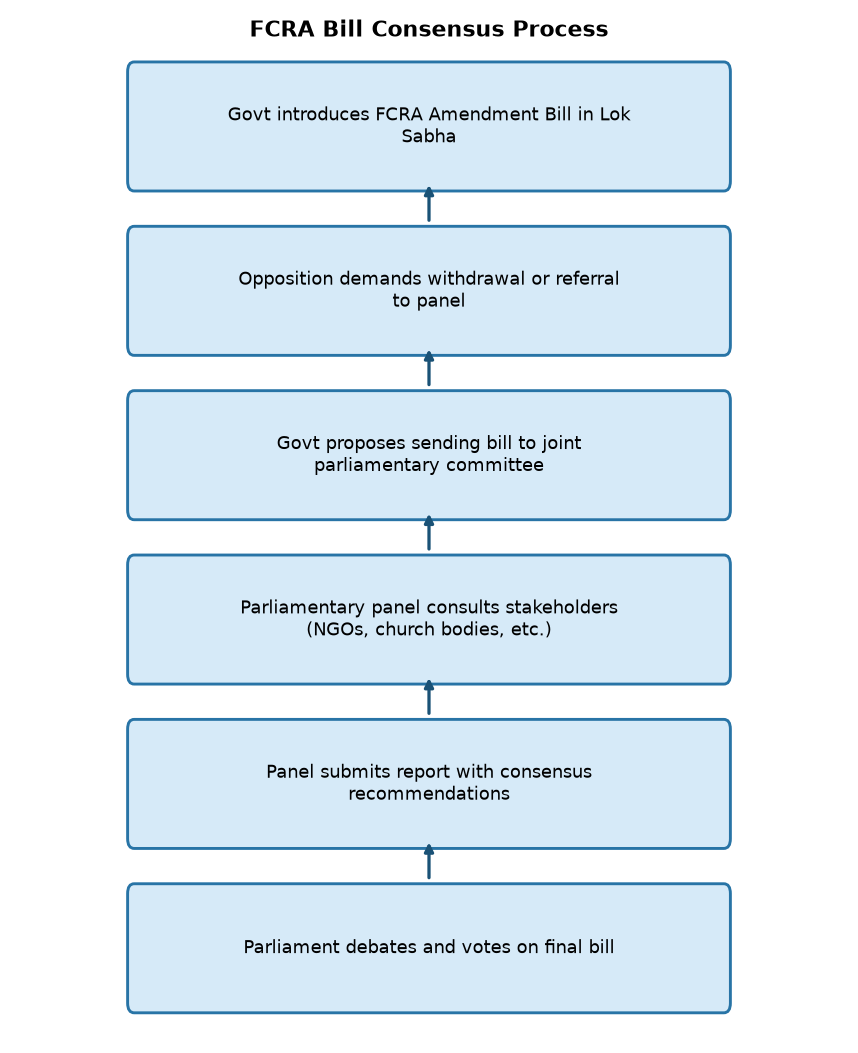
Introduction of the Foreign Contribution (Regulation) Amendment Bill, 2026 in Parliament → Demand for referral to a joint parliamentary committee due to concerns over provisions allegedly stifling NGOs → Government’s decision to send the bill to a parliamentary panel for detailed scrutiny → Parliamentary committee conducts consultations with stakeholders, including opposition parties and civil society groups → Committee submits recommendations, incorporating diverse perspectives and addressing concerns → Bill is debated and passed in Parliament, incorporating amendments based on committee recommendations → Amended FCRA is enacted, with provisions balancing regulation and autonomy for NGOs
Prelims Practice Questions
Q1. Consider the following statements regarding the Foreign Contribution (Regulation) Amendment Bill, 2025:
1. The Bill seeks to amend the Foreign Contribution (Regulation) Act, 2010.
2. The Bill proposes to prohibit any transfer of foreign contribution to another person.
3. The Bill mandates that foreign contributions must be received only through designated banks.
4. The Bill exempts political parties from the purview of foreign contributions.
How many of the above statements are correct?
- Only one
- Only two
- Only three
- All four
Answer: Only three — Statements 2 and 3 are correct as per the provisions of the Foreign Contribution (Regulation) Amendment Bill, 2025. Statement 1 is incorrect because the Bill seeks to amend the Foreign Contribution (Regulation) Act, 1976, not the 2010 Act. Statement 4 is incorrect as the Bill does not provide any exemption for political parties.
Q2. Assertion (A): The Foreign Contribution (Regulation) Act, 1976, was enacted to regulate the acceptance and utilisation of foreign contributions by individuals, associations, and companies.
Reason (R): The Act aims to ensure that foreign contributions do not affect the sovereignty and integrity of India or the public interest.
In the context of the above two statements, which one of the following is correct?
- Both A and R are true, and R is the correct explanation of A.
- Both A and R are true, but R is not the correct explanation of A.
- A is true, but R is false.
- A is false, but R is true.
Answer: Both A and R are true, but R is not the correct explanation of A. — The Foreign Contribution (Regulation) Act, 1976, was indeed enacted to regulate the acceptance and utilisation of foreign contributions, and the stated objective includes ensuring that such contributions do not compromise India’s sovereignty, integrity, or public interest. Therefore, both the assertion and reason are true, and the reason correctly explains the assertion.
Q3. Match the following provisions of the Foreign Contribution (Regulation) Act, 1976 with their respective descriptions:
Column I (Provision) | Column II (Description)
1. Section 5 | A. Prohibition on acceptance of foreign contribution by certain persons
2. Section 6 | B. Registration of associations for receiving foreign contribution
3. Section 7 | C. Prohibition on transfer of foreign contribution to another person
4. Section 8 | D. Utilisation of foreign contribution for specified purposes
Select the correct match:
- 1-A, 2-B, 3-C, 4-D
- 1-B, 2-A, 3-D, 4-C
- 1-C, 2-D, 3-A, 4-B
- 1-D, 2-C, 3-B, 4-A
Answer: 1-A, 2-B, 3-C, 4-D — Section 5 of the FCRA, 1976 prohibits the acceptance of foreign contribution by certain persons. Section 6 pertains to the registration of associations for receiving foreign contribution. Section 7 prohibits the transfer of foreign contribution to another person. Section 8 deals with the utilisation of foreign contribution for specified purposes.
Mains Practice Question
✍ The Foreign Contribution (Regulation) Amendment Bill, 2025 seeks to amend the Foreign Contribution (Regulation) Act, 1976, with provisions that have sparked debates regarding their potential impact on the functioning of non-governmental organisations (NGOs) and civil society in India. Critically examine the constitutional and legal implications of these amendments, particularly in the context of the right to association under Article 19(1)(c) of the Constitution. Also, analyse the role of parliamentary scrutiny in ensuring that such amendments balance national security concerns with democratic freedoms. (15 Marks)
Approach: MODEL-ANSWER SKELETON:
1. **Introduction (2 Marks)**
– Briefly outline the Foreign Contribution (Regulation) Act, 1976, and its objectives.
– Mention the key provisions of the Foreign Contribution (Regulation) Amendment Bill, 2025 (e.g., prohibition on transfer of foreign contributions, mandatory use of designated banks, enhanced reporting requirements).
– State the constitutional context: Article 19(1)(c) guarantees the right to form associations, subject to reasonable restrictions under Article 19(4).
2. **Constitutional and Legal Implications (6 Marks)**
– **Right to Association (Article 19(1)(c))**: Discuss how the amendments may restrict the right to association by imposing stringent conditions on NGOs receiving foreign funds. Cite judicial precedents such as *Common Cause v. Union of India* (2013) and *Indian Social Action Forum (INSAF) v. Union of India* (2016), which upheld the right to association while recognising reasonable restrictions.
– **Proportionality Test**: Analyse whether the amendments pass the proportionality test under *Puttaswamy* (2017) — i.e., whether the restrictions are narrowly tailored to achieve a legitimate state aim (e.g., national security, public order).
– **Overbreadth Concern**: Examine if the provisions are overbroad, potentially capturing legitimate activities of NGOs not intended to be regulated.
– **Judicial Review**: Discuss the role of the judiciary in reviewing the constitutionality of such amendments, citing cases like *K.S. Puttaswamy v. Union of India* (2017) on privacy and *Shreya Singhal v. Union of India* (2015) on free speech.
3. **National Security vs. Democratic Freedoms (4 Marks)**
– **State Interest**: Acknowledge the state’s legitimate interest in regulating foreign contributions to prevent undue foreign influence, money laundering, or threats to sovereignty (e.g., *People’s Union for Civil Liberties v. Union of India*, 1997).
– **Chilling Effect**: Discuss the potential chilling effect on civil society, including NGOs working on human rights, environmental issues, or minority rights, which often rely on foreign funding.
– **Comparative Perspective**: Briefly compare India’s approach with international standards (e.g., UN Declaration on Human Rights Defenders, 1998) and practices in other democracies.
4. **Role of Parliamentary Scrutiny (3 Marks)**
– **Parliamentary Committees**: Explain the function of parliamentary standing committees or joint committees in scrutinising bills, particularly contentious ones. Highlight their role in incorporating stakeholder feedback (e.g., consultations with NGOs, civil society, and experts).
– **Consensus-Building**: Discuss how sending the bill to a joint committee can foster consensus, as seen in other legislative processes (e.g., *Citizenship (Amendment) Act, 2019* discussions in the Joint Committee on the Citizenship (Amendment) Bill, 2019).
– **Transparency and Accountability**: Emphasise the importance of transparent processes in law-making to balance competing interests and uphold democratic principles.
5. **Conclusion (2 Marks)**
– Summarise the key points: The amendments must strike a balance between national security and democratic freedoms, ensuring that restrictions are reasonable and proportionate.
– Reiterate the role of judicial review and parliamentary scrutiny in safeguarding constitutional rights while addressing legitimate state concerns.
– Conclude with a balanced view: The amendments may be necessary for national security, but their implementation must be carefully calibrated to avoid undermining civil society and the right to association.
Source: Times of India
Generated by AanyaAi for educational purpose.

- Gurugram’s groundwater extraction exceeds limit by 212%; HC seeks ban - October 4, 2026
- स्वतंत्रता सेनानी श्यामजी कृष्ण वर्मा की जन्म जयंती पर पीएम का श्रद्धांजलि - October 4, 2026
- KWML’s Feasibility Reports for Water Metro in 18 Cities: UPSC & PCS Insights - October 3, 2026

No Comments