


28 Sep Goyal to attend G20 Trade Ministers Meet in US: Key Agenda for UPSC
✎ The G20 Trade Ministers’ Meeting in Milwaukee is a critical platform for India to advocate for a rules-based, non-discriminatory multilateral trading system under the WTO, while simultaneously advancing its bilateral trade agenda…
Subject Relevance — Where This Topic Fits
- GS Paper II — International Relations: Bilateral, Regional and Global Groupings and Agreements involving India and/or affecting India’s interests | GS Paper III — Economy: Issues relating to Planning, Mobilization of Resources, Growth, Development and Employment; Effects of Liberalization on the Economy, Changes in Industrial Policy and their Effects on Industrial Growth | GS Paper III — Economy: India’s Foreign Trade: Policy; Composition and Direction; Export Promotion; International Economic Organisations and Agreements
- Prelims: G20, World Trade Organization (WTO), Bilateral Trade Agreement (BTA), United States Trade Representative (USTR), Most Favoured Nation (MFN) status, Non-Tariff Barriers (NTBs), Export-oriented Units (EOUs), Start-up India, Make in India
- Essay: Globalisation and its Discontents: Balancing Economic Openness with National Sovereignty, The Role of Multilateral Institutions in Shaping a Rules-Based International Economic Order
Quick Revision: The G20 Trade Ministers’ Meeting in Milwaukee is a critical platform for India to advocate for a rules-based, non-discriminatory multilateral trading system under the WTO, while simultaneously advancing its bilateral trade agenda with the United States through a balanced and mutually beneficial Bilateral Trade Agreement (BTA).
Why is this in the news?
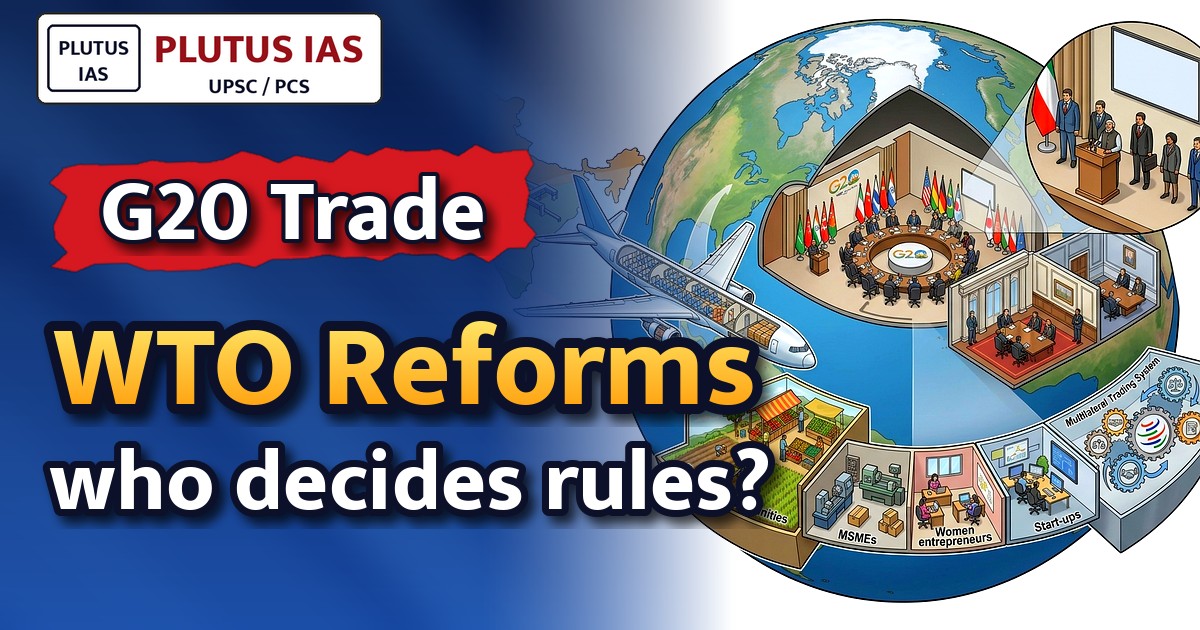
The visit of the Union Minister of Commerce and Industry to the United States from 29 September to 5 October 2026, including participation in the G20 Trade Ministers’ Meeting in Milwaukee, Wisconsin, underscores India’s proactive engagement in shaping the global trade agenda. The visit is significant as it aligns with India’s strategic objectives of advancing a rules-based, transparent, and non-discriminatory multilateral trading system under the WTO framework, while simultaneously pursuing bilateral trade agreements to enhance economic cooperation with the United States. The emphasis on expanding opportunities for farmers, MSMEs, women entrepreneurs, and start-ups reflects India’s commitment to inclusive economic growth and its role as a key stakeholder in the global trade ecosystem.
Background
- The G20, established in 1999, is an international forum comprising 19 countries and the European Union, representing major advanced and emerging economies. It accounts for over 80% of global GDP, 75% of international trade, and 60% of the world’s population.
- India has been a founding member of the G20 since its inception and has played an active role in shaping its agenda, particularly in areas such as trade, investment, and sustainable development.
- The World Trade Organization (WTO), established in 1995, is the only global international organization dealing with the rules of trade between nations. Its core functions include administering WTO trade agreements, providing a forum for negotiations, and settling disputes.
- The proposed India-US Bilateral Trade Agreement (BTA) aims to address trade barriers, enhance market access, and promote investment flows, aligning with the broader objective of deepening economic ties between the two nations.
- India’s trade policy has evolved to prioritize export promotion, ease of doing business, and integration into global value chains, as reflected in initiatives such as ‘Make in India’ and ‘Digital India’.
What is the G20 Trade Ministers’ Meeting and India’s Role in It?
- The G20 Trade Ministers’ Meeting is a high-level forum where trade ministers from G20 member countries convene to discuss global trade challenges, multilateral trade rules, and policy coordination. The meeting in Milwaukee, Wisconsin, focuses on advancing a rules-based, transparent, and non-discriminatory multilateral trading system under the WTO.
- India’s participation is guided by its commitment to uphold the principles of the WTO, including non-discrimination, transparency, and fairness, while ensuring that the interests of developing countries are adequately represented.
- Key agenda items for India include advocating for the removal of non-tariff barriers (NTBs), addressing agricultural subsidies, and promoting sustainable trade practices that align with environmental and social objectives.
- India also seeks to highlight the importance of digital trade, e-commerce, and the role of MSMEs in global trade, ensuring that these sectors are not left behind in the evolving trade landscape.
- The meeting provides an opportunity for India to engage in bilateral and plurilateral discussions with other G20 members, fostering cooperation on trade facilitation, investment, and technology transfer.
- India’s stance in the G20 aligns with its broader foreign policy objectives of promoting South-South cooperation, strengthening ties with developed nations, and advocating for a more inclusive global economic order.
- The outcomes of the meeting are expected to influence the agenda of the G20 Leaders’ Summit, which will be held later in the year, and shape the future of global trade governance.
- India’s active participation in the G20 reflects its growing influence in global economic affairs and its role as a bridge between developed and developing countries.
Key Features
| Feature | Significance |
|---|---|
| G20 Trade Ministers’ Meeting (30 Sep–1 Oct 2026, Milwaukee, USA) | Platform for 20 major economies to negotiate multilateral trade rules, align on WTO reforms, and address global supply chain resilience under India’s G20 Presidency (2023–24) and ongoing engagement as a key stakeholder. |
| India’s Position on Rules-Based Multilateral Trade System | Reaffirms commitment to WTO-centric, transparent, non-discriminatory trade architecture, balancing developing country interests with global economic integration. |
| Bilateral Trade Agreement (BTA) Negotiations with USA | Efforts to finalise an interim trade deal aligned with the 7 Feb 2026 Joint Statement, aiming to reduce tariff and non-tariff barriers, enhance market access, and strengthen economic ties. |
| Engagement with US Industry Leaders & Investors | Direct outreach to CEOs in manufacturing, agri-business, technology, and retail to attract FDI, promote Make-in-India initiatives, and foster technology transfer partnerships. |
| Focus on MSMEs, Start-ups, and Women Entrepreneurs | Targeted discussions to expand opportunities for grassroots economic actors, aligning with India’s self-reliance (Atmanirbhar Bharat) and inclusive growth objectives. |
Why it Matters
Economic Diplomacy & Trade Policy
- Demonstrates India’s proactive role in shaping global trade governance through multilateral forums like G20 and WTO, ensuring its developmental priorities are reflected in international rules.
- Signals intent to deepen economic partnerships with the USA, a critical partner for technology, capital, and market access, while mitigating trade frictions through structured negotiations.
- Reinforces India’s strategic pivot toward diversifying trade partners beyond traditional blocs, reducing over-reliance on any single market.
Strategic Bilateral Relations
- Highlights the institutionalisation of India-US economic dialogue, building on the 7 Feb 2026 Joint Statement and prior agreements like the Trade Policy Forum (TPF).
- Lays groundwork for long-term cooperation in critical sectors (semiconductors, clean energy, pharmaceuticals) under frameworks like the India-US Initiative on Critical and Emerging Technologies (iCET).
- Strengthens people-to-people ties through engagement with the Indian diaspora, fostering goodwill and facilitating business networking.
Domestic Economic Growth
- Aligns with India’s goal of becoming a $5 trillion economy by leveraging foreign investment and technology to boost manufacturing (e.g., PLI schemes) and export competitiveness.
- Supports MSMEs and start-ups by facilitating access to global supply chains, capital, and mentorship networks in the USA.
- Promotes agricultural and fisheries exports through dialogue on sanitary and phytosanitary (SPS) measures and market access negotiations.
Challenges
1. Non-Tariff Barriers (NTBs) in US Market
- Technical regulations, standards, and certification requirements that disproportionately affect Indian exporters, particularly in agriculture, pharmaceuticals, and engineering goods.
- Need for harmonisation with US norms while preserving India’s policy space for public health and environmental protection.
UPSC Link: WTO Agreements (SPS, TBT)
2. Geopolitical Constraints in Trade Negotiations
- Balancing strategic autonomy with economic interdependence, particularly in sectors like semiconductors and defence where US export controls may limit collaboration.
- Avoiding over-dependence on the US market while ensuring equitable trade terms that do not disadvantage other partners.
UPSC Link: India’s Foreign Trade Policy
Challenges — UPSC Perspective
| Issue | Concern |
|---|---|
| Tariff Disputes (e.g., Steel, Aluminium, Agriculture) | US Section 232 tariffs and retaliatory measures distort trade flows, impacting Indian exporters. |
| Intellectual Property Rights (IPR) Negotiations | Pressure to align IP laws with US standards may conflict with India’s public health priorities (e.g., compulsory licensing for medicines). |
| Digital Trade Rules | US insistence on data localisation restrictions and cross-border data flows may limit India’s policy flexibility in the digital economy. |
| Subsidy and Countervailing Measures | Disputes over agricultural subsidies and export promotion schemes (e.g., PLI) under WTO rules. |
| Labour and Environmental Standards | US demands for higher labour and environmental compliance may raise compliance costs for Indian firms. |
| Currency Manipulation Concerns | US Treasury’s monitoring of exchange rate policies could lead to trade sanctions if deemed unfair. |
Way Forward
- Conclude the interim India-US trade deal by addressing core issues: tariff reductions, IPR flexibilities, and digital trade frameworks, while safeguarding developmental priorities.
- Leverage the G20 platform to advocate for WTO reforms, including dispute settlement reform, special and differential treatment for developing countries, and agriculture subsidies discipline.
- Enhance export competitiveness of MSMEs and start-ups through targeted mentorship programs, trade facilitation, and access to US venture capital and accelerators.
- Strengthen bilateral engagement in high-tech sectors (semiconductors, AI, clean energy) under frameworks like iCET to diversify trade and reduce strategic vulnerabilities.
- Establish a dedicated trade facilitation cell to monitor NTBs, resolve disputes expeditiously, and provide real-time support to Indian exporters in the US market.
- Promote India as a manufacturing hub for global supply chains by showcasing PLI schemes, ease of doing business improvements, and infrastructure investments in industrial corridors.
- Foster people-to-people ties through diaspora engagement, facilitating knowledge transfer, investment linkages, and cultural diplomacy to deepen economic ties.
UPSC Value Addition
Keywords for Mains Answer-Writing
G20 Trade Ministers’ Meeting · World Trade Organization (WTO) · India-US Bilateral Trade Agreement (BTA) · Multilateral Trade System · Non-discriminatory Trade · MSMEs and Trade · Investment Promotion · Plurilateral Trade Agreements · Rule-based Global Trade · Trade Facilitation · Agricultural Trade Reforms · Digital Trade and E-commerce · Trade in Services
Concept Flow
India’s participation in G20 Trade Ministers’ Meeting → Negotiation of multilateral trade rules under WTO framework → Bilateral trade discussions with USA → Focus on reducing NTBs and tariffs → Alignment with 7 Feb 2026 Joint Statement → Finalisation of interim trade deal → Enhanced FDI and technology transfer → Growth in manufacturing, MSMEs, and start-ups → Strengthening of India-US economic partnership → Contribution to India’s $5 trillion economy goal.
Prelims Practice Questions
Q1. Consider the following statements regarding the G20 grouping:
1. The G20 is a formal international organization with a permanent secretariat.
2. The G20 Presidency rotates annually among member countries.
3. The G20 includes the European Union as a permanent member.
4. The G20 focuses exclusively on economic and financial issues.
How many of the above statements are correct?
- Only one
- Only two
- Only three
- All
Answer: Only three — Statements 2 and 3 are correct. The G20 has a rotating presidency but no permanent secretariat; it addresses broader economic issues including trade, climate, and sustainable development.
Q2. Assertion (A): The World Trade Organization (WTO) operates on the principle of non-discrimination, enshrined in its Most Favoured Nation (MFN) clause.
Reason (R): The MFN clause requires that trade concessions granted to one WTO member must be extended to all other members without exception.
In the context of the above two statements, which one of the following is correct?
- Both A and R are true, and R is the correct explanation of A
- Both A and R are true, but R is not the correct explanation of A
- A is true, but R is false
- A is false, but R is true
Answer: Both A and R are true, and R is the correct explanation of A — Both A and R are true, and R correctly explains A. The MFN principle is a cornerstone of the WTO’s non-discriminatory trade system.
Q3. Match the following international groupings with their respective headquarters:
Column I
A. G20
B. WTO
C. UNCTAD
D. OECD
Column II
1. Geneva
2. Paris
3. New York
4. No permanent headquarters
Choose the correct match:
- A-4, B-1, C-3, D-2
- A-1, B-4, C-2, D-3
- A-3, B-2, C-1, D-4
- A-2, B-3, C-4, D-1
Answer: A-4, B-1, C-3, D-2 — G20 has no permanent headquarters (rotating presidency); WTO is headquartered in Geneva; UNCTAD is headquartered in Geneva; OECD is headquartered in Paris.
Mains Practice Question
✍ The promotion of a rule-based, open, inclusive, transparent, fair, and non-discriminatory multilateral trading system remains central to India’s trade diplomacy. In this context, critically examine the significance of the G20 Trade Ministers’ Meeting for India’s trade policy objectives. Also, assess the potential challenges in achieving a balanced India-US Bilateral Trade Agreement (BTA) that aligns with these multilateral principles. (15 Marks)
Approach: MODEL-ANSWER SKELETON:
1. **Context and Significance of G20 Trade Ministers’ Meeting** (4 points):
– Role of G20 as a premier forum for international economic cooperation, addressing trade, investment, and sustainable development.
– India’s engagement in G20 Trade Track: emphasis on WTO-centric, rule-based trade system; non-discrimination (MFN principle), transparency, and inclusivity.
– Focus areas: facilitation of trade in goods and services, digital trade, MSMEs, and gender-inclusive trade policies.
– Alignment with India’s ‘Vasudhaiva Kutumbakam’ (World is One Family) and ‘Atmanirbhar Bharat’ frameworks.
2. **India’s Trade Policy Objectives** (3 points):
– Advocacy for Special and Differential Treatment (SDT) for developing countries within WTO to ensure policy space for industrialization and food security.
– Promotion of plurilateral agreements (e.g., Trade in Services Agreement) while preserving multilateralism.
– Addressing non-tariff barriers (NTBs) and agricultural subsidies in developed countries.
3. **India-US Bilateral Trade Agreement (BTA): Challenges and Alignment** (5 points):
– **Challenges**: Divergent regulatory standards (e.g., agriculture, digital trade, IPR), labor and environmental clauses, and market access issues.
– **Alignment with Multilateral Principles**: Ensuring BTA does not undermine WTO rules; avoiding discriminatory provisions that could violate MFN.
– **Balanced Approach**: Addressing concerns of farmers, MSMEs, and women entrepreneurs while fostering investment and technology transfer.
– **Recent Developments**: Reference to the 7 February 2026 Joint Statement and ongoing negotiations on interim agreements.
– **Potential Consequences**: Risk of trade diversion, impact on third countries, and erosion of multilateral trust if BTA is perceived as preferential.
4. **Conclusion** (3 points):
– India’s dual-track strategy: strengthening multilateralism (G20/WTO) while pursuing calibrated bilateral engagements (e.g., BTA with the US).
– Need for domestic reforms (e.g., logistics, ease of doing business) to complement trade diplomacy.
– Emphasis on ‘strategic autonomy’ in trade policy while remaining engaged in global rule-making.
Source: PIB (Press Information Bureau)
Generated by AanyaAi for educational purpose.
Related guides on our sites
- Current affairs for upsc 2026
- Best PSIR optional coaching for upsc
- Best PSIR optional teacher for upsc
- Best teacher of PSIR optional for upsc

- भारत खनन सप्ताह 2026: 19 देशों के राजनयिकों का बड़ा जमावड़ा - September 30, 2026
- India-South Korea Defence Logistics: 10th Joint Committee Meeting Outcomes - September 30, 2026
- एनजीटी ने हजारीबाग जिलाधिकारी को दिया नोटिस, ओकनी तालाब पुनरुद्धार में हुई लापरवाही - September 30, 2026

No Comments