


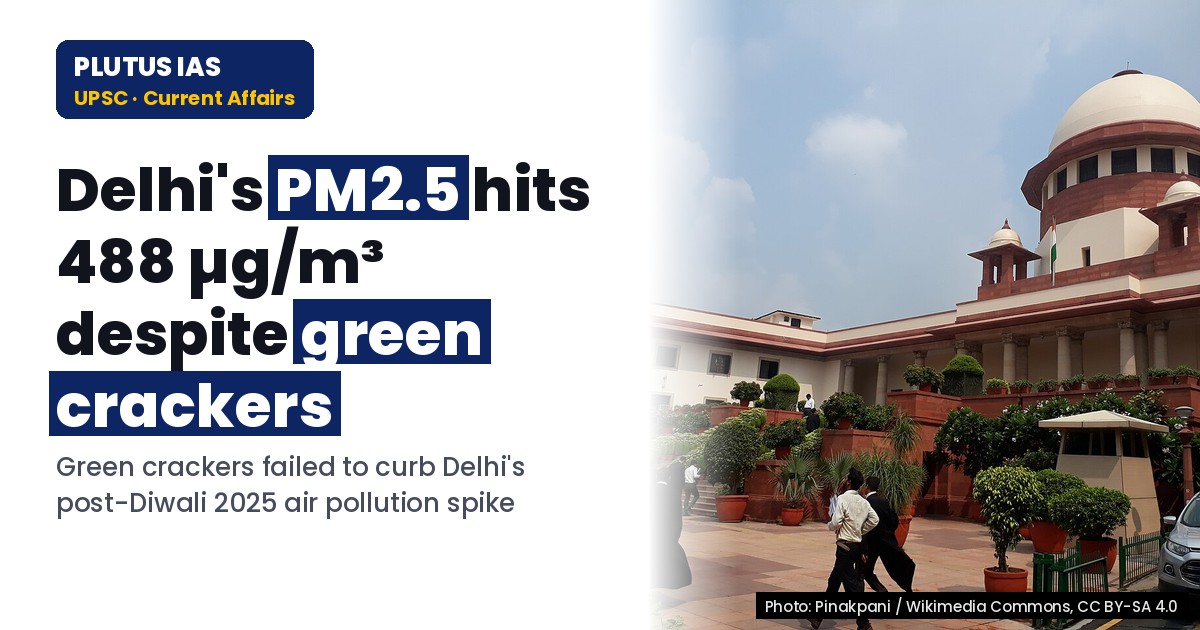
14 Oct Green Crackers: Do They Really Control Delhi’s Winter Pollution Crisis?
✎ Green crackers, mandated by the Supreme Court in 2018, aim to reduce particulate emissions but face enforcement gaps, as evidenced by Delhi’s 2025 post-Diwali PM2.5 spike, highlighting the need for stronger regulatory compliance…
Subject Relevance — Where This Topic Fits
- GS Paper III — Environment and Disaster Management | GS Paper III — Science and Technology
- Prelims: Supreme Court of India, National Green Tribunal, PM2.5, CSIR-NEERI, Commission for Air Quality Management (CAQM), Arjun Gopal vs Union of India (2018), green crackers, noise pollution, air pollution, QR code certification
- Essay: Environmental governance and judicial activism in India, Balancing cultural traditions with public health imperatives
Quick Revision: Green crackers, mandated by the Supreme Court in 2018, aim to reduce particulate emissions but face enforcement gaps, as evidenced by Delhi’s 2025 post-Diwali PM2.5 spike, highlighting the need for stronger regulatory compliance and public awareness.
Why is this in the news?
The Supreme Court of India’s evolving jurisprudence on fireworks regulation in the National Capital Region (NCR), particularly its 2018 judgment in *Arjun Gopal and Others vs Union of India* and subsequent modifications, has brought the issue of ‘green crackers’ to the forefront. Recent data from the 2025 Diwali season in Delhi highlights the limited efficacy of these measures in reducing particulate matter (PM2.5) levels, raising questions about enforcement, certification, and the broader governance framework for managing air and noise pollution during festivals.
Background
- In November 2016, the Supreme Court suspended all fireworks licences in the NCR following Diwali celebrations that caused PM2.5 levels to exceed 700 µg/m³, a severe health risk.
- The Court relaxed the suspension in September 2017 but restored it for Diwali in October 2017, balancing livelihood concerns with public health imperatives.
- The landmark judgment in *Arjun Gopal vs Union of India* (2018) permitted only ‘green crackers’—low-emission fireworks with reduced particulate matter—and banned joined firecrackers (laris). It also imposed a two-hour window for fireworks to limit exposure.
- The 2025 Diwali season in Delhi recorded an average PM2.5 concentration of 488 µg/m³ post-Diwali, the highest since 2021, with hourly peaks at 675 µg/m³, despite the use of green crackers.
- The Council of Scientific and Industrial Research–National Environmental Engineering Research Institute (CSIR-NEERI) claims green crackers reduce PM10 emissions by 45–60%, but these reductions are not consistently observed in real-world conditions.
- Enforcement challenges persist, including the sale of QR codes to unregistered manufacturers and the lack of testing facilities in Delhi, undermining the certification process for green crackers.
What are green crackers and the regulatory framework governing fireworks in the NCR?
- Green crackers are low-emission fireworks designed to reduce particulate matter (PM) emissions compared to conventional firecrackers.
- The Supreme Court’s 2018 judgment in *Arjun Gopal vs Union of India* mandated the use of green crackers in the NCR, banned joined firecrackers (laris), and restricted fireworks to a two-hour window during Diwali.
- The judgment also directed the formation of a committee to develop standards for green crackers, leading to the introduction of QR codes for certification and tracking.
- The Commission for Air Quality Management (CAQM) was established in 2021 to coordinate air quality management across the NCR, including enforcement of fireworks regulations.
- Despite these measures, enforcement remains weak due to the informal nature of fireworks manufacturing, the sale of QR codes to unregistered entities, and the lack of testing infrastructure in key states.
- Noise pollution from firecrackers is another critical concern, with studies linking high decibel levels to adverse health impacts, particularly for vulnerable populations such as children and the elderly.
- The regulatory framework operates within the broader context of Delhi’s air pollution crisis, where sources such as vehicular emissions, construction dust, stubble burning, and meteorological conditions exacerbate winter pollution.
- Judicial interventions in this domain reflect the tension between cultural practices (e.g., Diwali celebrations) and the constitutional obligation to protect public health under Article 21 (Right to Life and Personal Liberty).
Key Features
| Feature | Significance |
|---|---|
| Green crackers (reduced-emission) | Claimed to reduce particulate matter (PM10 and PM2.5) by 45%-60% compared to conventional firecrackers, as per CSIR-NEERI assessments. |
| Two-hour fireworks window (post-2018) | Limits the duration of fireworks to mitigate acute spikes in air pollution during Diwali celebrations. |
| QR code certification system | Intended to authenticate green crackers and prevent counterfeit products from entering the market. |
| Supreme Court’s graded restrictions (2016-2026) | Balances environmental protection with livelihood concerns, evolving from a complete ban to selective relaxation of fireworks use. |
| Commission for Air Quality Management (CAQM) | Oversees enforcement of pollution control measures, including monitoring compliance with green cracker regulations. |
Why it Matters
Environmental
- Firecrackers contribute to acute spikes in PM2.5 and PM10 levels during winter, exacerbating the air quality crisis in Delhi-NCR.
- Noise pollution from crackers poses health risks, particularly for vulnerable groups such as children, the elderly, and individuals with cardiovascular conditions.
- Stubble burning, vehicular emissions, and construction dust compound the pollution burden, making firecrackers a critical but not the sole contributor to winter smog.
Legal-Judicial
- The Supreme Court’s intervention in Arjun Gopal vs Union of India (2018) established a legal framework for regulating firecrackers, balancing environmental rights with socio-economic considerations.
- Judicial orders have progressively refined restrictions, reflecting the evolving understanding of pollution dynamics and enforcement challenges.
Economic
- The fireworks industry, particularly in Sivakasi (Tamil Nadu), is a significant employment generator, with livelihoods dependent on its operations.
- Regulatory compliance and certification processes impose costs on manufacturers, potentially affecting market competitiveness.
Public Health
- Exposure to high PM2.5 concentrations (e.g., 488 µg/m³ post-Diwali 2025) is linked to respiratory diseases, cardiovascular disorders, and premature mortality.
- Noise pollution from crackers can cause hearing impairment, sleep disturbances, and psychological stress, particularly in urban areas.
Institutional
- The CSIR-NEERI’s role in developing green crackers underscores the importance of scientific research in pollution mitigation strategies.
- The CAQM’s enforcement challenges highlight the need for robust institutional capacity to implement environmental regulations effectively.
Challenges
1. Enforcement and Compliance
- Lack of testing infrastructure in Delhi for verifying green cracker authenticity hampers regulatory oversight.
- Sale of QR codes to unregistered manufacturers enables counterfeit products to bypass certification.
- Police and regulatory bodies face difficulties in distinguishing green crackers from conventional ones, undermining enforcement.
UPSC Link: GS-III: Environmental Pollution & Degradation
2. Public Sentiment and Cultural Practices
- Deep-rooted cultural and emotional attachments to firecrackers during festivals pose a barrier to stricter regulations.
- Judicial orders often factor in public sentiment, limiting the scope of bans despite environmental imperatives.
UPSC Link: GS-II: Social Empowerment & Governance
3. Real-World Efficacy of Green Crackers
- CSIR-NEERI’s reported reductions in PM10 (45%-60%) do not account for real-world conditions, where increased usage negates potential gains.
- Noise pollution remains unaddressed by green cracker technology, requiring separate mitigation strategies.
UPSC Link: GS-III: Science & Technology in Governance
4. Multi-Source Pollution
- Firecrackers are one among several sources of winter pollution in Delhi-NCR, including stubble burning, vehicular emissions, and construction dust.
- Stagnant atmospheric conditions during winter exacerbate the impact of all pollution sources, complicating targeted interventions.
UPSC Link: GS-III: Environmental Pollution & Degradation
5. Industrial and Livelihood Constraints
- Stringent regulations risk destabilising the fireworks industry, which employs thousands, particularly in traditional manufacturing hubs.
- Formalisation of the sector requires significant investment, posing challenges for small and medium-scale producers.
UPSC Link: GS-III: Industrial Policy & Employment
Challenges — UPSC Perspective
| Issue | Concern |
|---|---|
| Lack of testing infrastructure | Inability to verify authenticity of green crackers in Delhi, leading to counterfeit products in the market. |
| QR code system vulnerabilities | Sale of QR codes to unregistered manufacturers enables unauthorised firecrackers to bypass certification. |
| Public sentiment vs. environmental goals | Cultural and emotional attachments to firecrackers limit the scope of regulatory bans despite pollution risks. |
| Real-world efficacy of green crackers | Reported reductions in PM10 do not translate to lower pollution levels due to increased usage and unaddressed noise pollution. |
| Multi-source pollution dynamics | Firecrackers are one of several contributors to winter smog, complicating targeted interventions. |
| Industrial livelihood impacts | Regulations risk destabilising the fireworks industry, which is a significant employer in traditional manufacturing hubs. |
Way Forward
- Strengthen institutional capacity for enforcement by establishing dedicated testing facilities for green crackers in high-pollution zones like Delhi-NCR.
- Enhance transparency in the QR code certification system by integrating blockchain or AI-based verification to prevent counterfeit products.
- Launch targeted awareness campaigns to educate the public on the health impacts of firecrackers, leveraging religious and community leaders to promote behavioural change.
- Expand the scope of green cracker regulations to include noise standards, ensuring holistic mitigation of both air and noise pollution.
- Integrate firecracker regulations with broader winter pollution control strategies, including stubble burning management and vehicular emission norms.
- Promote research and development in alternative festive celebrations (e.g., laser shows, drone displays) to reduce dependence on firecrackers.
- Formalise the fireworks industry through incentives for compliance, such as subsidies for certification and technological upgrades.
- Establish a multi-stakeholder task force comprising environmental scientists, industry representatives, and civil society to review and refine firecracker regulations annually.
UPSC Value Addition
Keywords for Mains Answer-Writing
Air pollution · Noise pollution · Green crackers · Supreme Court of India · Environmental governance · Particulate Matter (PM2.5, PM10) · Council of Scientific and Industrial Research–National Environmental Engineering Research Institute (CSIR-NEERI) · Commission for Air Quality Management (CAQM) · Pollution control measures · Public health and environmental law · Regulatory enforcement · Winter air quality management in Delhi-NCR · Supreme Court judgments on environmental protection · Festive pollution control · Industrial and vehicular pollution · Stubble burning · Constitutional provisions for environmental protection (Article 21, 48A, 51A(g))
Constitutional & Policy Linkages
- {‘Article 21’: ‘Right to Life and Personal Liberty (interpreted to include the right to a healthy environment)’}
- {‘Article 48A’: ‘Directive Principle of State Policy on protection and improvement of environment’}
Concept Flow
Supreme Court’s intervention in Arjun Gopal vs Union of India (2018) → Gradual relaxation of fireworks ban with green cracker regulations → CSIR-NEERI develops reduced-emission crackers → Implementation of QR code certification system → Enforcement challenges emerge (counterfeit products, lack of testing) → Public health impacts (PM2.5 spikes, noise pollution) → Judicial orders factor in public sentiment → Need for holistic winter pollution control strategies.
Prelims Practice Questions
Q1. Consider the following statements regarding the Supreme Court of India’s directives on firecrackers in the National Capital Region (NCR):
1. The Supreme Court suspended licences for the sale of fireworks in the NCR in November 2016.
2. The Court allowed only reduced-emission and ‘green’ crackers in 2018, imposing a two-hour window for their use.
3. The Court banned all firecrackers in the NCR in 2020, citing severe air pollution levels.
4. The Court permitted specified next-generation joined green crackers in its latest order.
How many of the above statements are correct?
- Only one
- Only two
- Only three
- All four
Answer: Only three — Statements 1, 2, and 4 are correct. Statement 3 is incorrect as the Supreme Court did not impose a total ban on firecrackers in 2020; it permitted limited use of green crackers.
Q2. Assertion (A): The Council of Scientific and Industrial Research–National Environmental Engineering Research Institute (CSIR-NEERI) claims that green crackers promise a 45%-60% reduction in PM10 emissions.
Reason (R): Green crackers are designed to emit lower levels of particulate matter compared to conventional firecrackers.
In the context of the above statements, which of the following is correct?
- Both A and R are true, and R is the correct explanation of A.
- Both A and R are true, but R is not the correct explanation of A.
- A is true, but R is false.
- A is false, but R is true.
Answer: A is true, but R is false. — Both A and R are true. However, the reduction in PM10 emissions claimed by CSIR-NEERI does not fully reflect real-world conditions, as the savings can be negated by increased usage and enforcement challenges.
Q3. Which of the following institutions is responsible for regulating the sale and use of firecrackers in the National Capital Region (NCR) to control air and noise pollution?
- National Green Tribunal (NGT)
- Commission for Air Quality Management (CAQM)
- Central Pollution Control Board (CPCB)
- Ministry of Environment, Forest and Climate Change
Answer: Central Pollution Control Board (CPCB) — The Commission for Air Quality Management (CAQM) is the designated authority for regulating firecracker use in the NCR to address air and noise pollution.
Mains Practice Question
✍ Critically examine the efficacy of the Supreme Court’s directives on the use of green crackers in the National Capital Region (NCR) as a measure to control air and noise pollution during festive seasons. (15 Marks)
Approach: MODEL-ANSWER SKELETON:
1. **Context and Judicial Intervention**:
– Brief background of the Supreme Court’s intervention in 2016 (suspension of fireworks licences) and 2018 (Arjun Gopal case) allowing only green crackers with emission standards and a two-hour window.
– Mention the constitutional and statutory basis (Article 21, 48A, 51A(g) of the Constitution; Air (Prevention and Control of Pollution) Act, 1981).
2. **Efficacy of Green Crackers**:
– Data from CSIR-NEERI on claimed reductions in PM10 (45%-60%) and limitations in real-world applicability.
– Evidence from post-Diwali 2025 data (PM2.5 levels reaching 488 µg/m³) highlighting the ineffectiveness of green crackers alone in controlling pollution spikes.
– Role of other pollution sources (stubble burning, vehicular emissions, construction dust) in exacerbating the crisis.
3. **Regulatory and Enforcement Challenges**:
– Issues in enforcement: QR code system, sale of unregistered manufacturers, lack of testing facilities in Delhi.
– Role of the Commission for Air Quality Management (CAQM) and limitations in distinguishing green from conventional crackers.
4. **Balancing Public Sentiment and Environmental Justice**:
– The Supreme Court’s reluctance to impose a total ban, citing public sentiment and livelihood concerns of fireworks manufacturers.
– The tension between cultural practices and environmental protection.
5. **Alternative and Complementary Measures**:
– Need for a multi-pronged approach: stricter enforcement, public awareness, transition to formal sector manufacturing, and integration with broader air quality management plans.
6. **Conclusion**:
– Green crackers are a partial and insufficient measure. A holistic strategy combining regulatory, technological, and behavioural interventions is essential to address the NCR’s winter air quality crisis.
Source: The Hindu
Generated by AanyaAi for educational purpose.
Related guides on our sites
- Best geography optional coaching
- Best geography optional coaching
- Best geography optional teacher
- Best geography optional teacher

- आरबीआई द्वारा 91, 182 और 364 दिनीय ट्रेजरी बिलों की नीलामी: प्रमुख तथ्य - November 7, 2026
- Shram Samvad: Capacity Building on Labour Codes in Ujjain - November 7, 2026
- पटना में ठोस अपशिष्ट प्रबंधन: नगर निगम की नई योजना - November 7, 2026

No Comments