


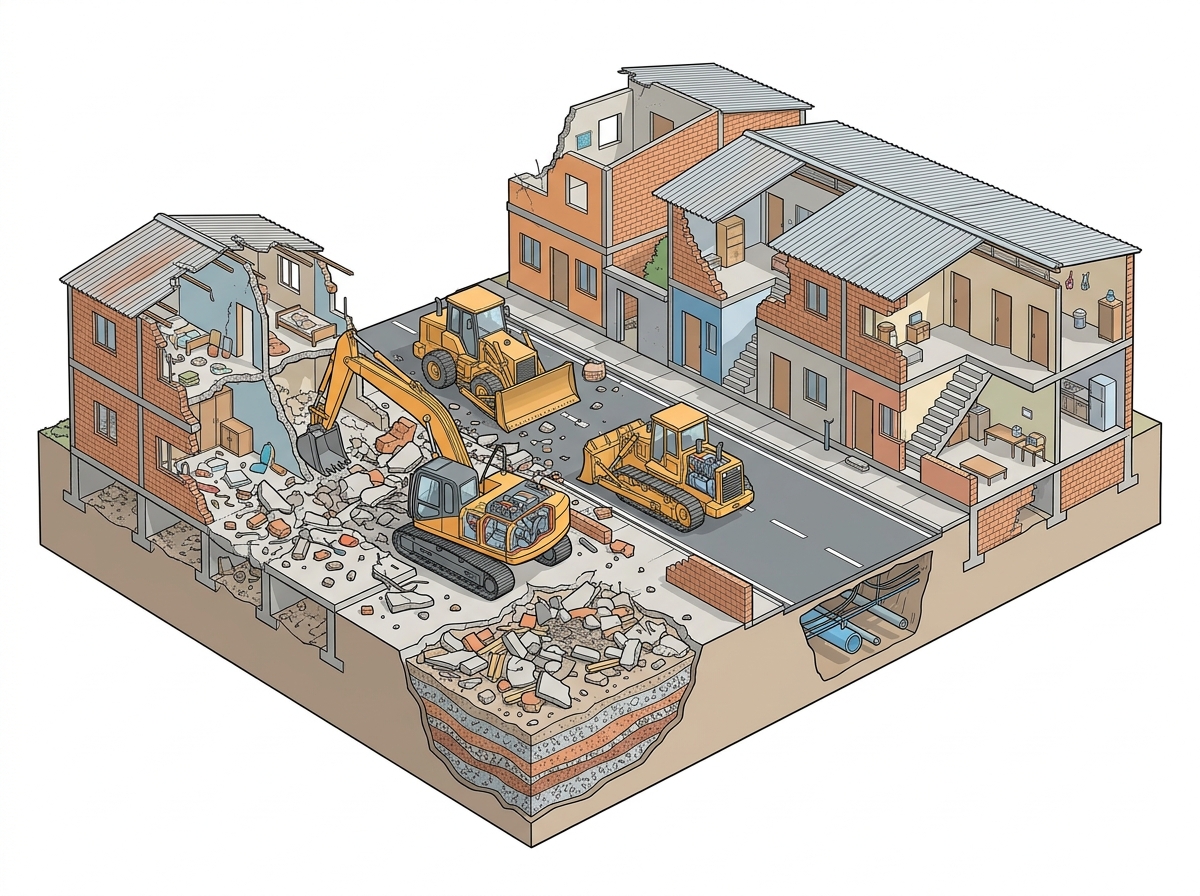
11 Aug Gujarat HC Slams Senior Officers in Nasirnagar Demolition Case: Inquiry Must Be Credible
✎ The Gujarat High Court’s directive in the Nasirnagar case reaffirms that administrative accountability in demolition drives must be visibly upheld, particularly when senior officers are under scrutiny, to ensure the integrity of…
Subject Relevance — Where This Topic Fits
- GS Paper II — Functions and Responsibilities of the Union and the States, Issues and Challenges Pertaining to the Federal Structure | GS Paper III — Urban Development, Land Reforms, and Issues Relating to Displacement
- Prelims: Demolition drives under municipal laws, Prima facie misconduct, Rehabilitation obligations under urban development policies, Gujarat Municipal Corporation Act, 1949, EWS housing schemes, Doctrine of ‘Justice must not only be done but also be seen to be done’
- Essay: Accountability in governance: Balancing administrative efficiency and citizen rights, Urban governance and the challenge of displacement: Legal and ethical dimensions
Quick Revision: The Gujarat High Court’s directive in the Nasirnagar case reaffirms that administrative accountability in demolition drives must be visibly upheld, particularly when senior officers are under scrutiny, to ensure the integrity of inquiries and public trust in governance.
Why is this in the news?
The Gujarat High Court, during the hearing of a petition filed by 26 residents of Nasirnagar, Surat, whose houses were demolished on May 30, 2026, raised critical questions about the integrity of an inquiry into the demolition drive. The court questioned the continued posting of senior officers, including the Surat Municipal Commissioner and police officials, against whom allegations of prima facie misconduct have been levelled. The court’s directive underscores the constitutional principle that administrative accountability must be visibly upheld to maintain public trust in governance institutions, particularly in cases involving citizen displacement.
Background
- The Nasirnagar demolition drive in Surat, Gujarat, on May 30, 2026, resulted in the razing of at least 106 residential units, displacing numerous families.
- The Gujarat state government constituted an inquiry committee under the Gujarat Municipal Corporation Act, 1949, to examine the legality of the demolition, the role of municipal and police officials, and the involvement of private actors.
- The inquiry committee’s mandate includes assessing whether the demolition complied with statutory procedures and identifying officers responsible for any violations.
- Junior officers against whom prima facie misconduct was alleged have already faced disciplinary action, raising questions about the differential treatment of senior officers.
- The Surat Municipal Corporation proposed rehabilitating affected families through the EWS housing scheme, requiring beneficiaries to make payments, which the court deemed unacceptable.
- The case highlights recurring issues in urban governance, including arbitrary demolition drives, inadequate rehabilitation mechanisms, and the erosion of public trust in administrative processes.
What constitutes accountability in urban demolition drives?
- Urban demolition drives are governed by municipal laws, including the Gujarat Municipal Corporation Act, 1949, which prescribes procedures for land use, encroachment removal, and rehabilitation.
- Prima facie misconduct refers to conduct that, on the face of it, appears to violate legal or administrative norms, warranting immediate scrutiny and potential disciplinary action.
- The doctrine of ‘Justice must not only be done but also be seen to be done’ requires that administrative actions, especially those involving citizen rights, must be transparent and free from the perception of bias or conflict of interest.
- Senior officers hold vicarious responsibility for actions taken by their subordinates, particularly when such actions occur under their supervision or within their jurisdiction.
- Rehabilitation of displaced persons is a constitutional obligation under Article 21 (Right to Life and Personal Liberty) and Directive Principles of State Policy (Articles 38, 39, and 41), which mandate state intervention to mitigate hardship caused by state actions.
- The EWS housing scheme, while a welfare measure, cannot be imposed as a condition for rehabilitation in cases of state-led displacement without ensuring affordability and accessibility for affected families.
- Judicial oversight in administrative matters ensures that executive actions are subjected to legal scrutiny, particularly when they impact fundamental rights or public interest.
- The principle of ‘procedural fairness’ requires that inquiries into administrative misconduct be conducted without undue delay and that officers under scrutiny be temporarily relieved of their duties to prevent interference with the process.
Key Features
| Feature | Significance |
|---|---|
| Demolition of 106 housing units in Nasirnagar, Surat (May 30, 2026) | Triggered legal scrutiny over procedural compliance and accountability in municipal demolition drives. |
| Gujarat High Court’s prima facie observation on officer retention | Underscores the principle that senior officers under inquiry should not influence proceedings to ensure impartiality. |
| State-constituted inquiry committee under Gujarat Municipal Corporation Act, 1949 | Mandates examination of legality, role of municipal officials, and private actors in demolition. |
| Court’s directive on rehabilitation costs | Reaffirms state’s constitutional obligation (Article 21) to provide shelter and uphold dignity of affected citizens. |
| Corporation’s proposal to rehabilitate via EWS housing scheme with beneficiary contribution | Raises concerns over equity and feasibility, as displaced families may lack financial capacity. |
Why it Matters
Legal and Governance
- The case exemplifies judicial oversight of executive actions, particularly municipal governance, ensuring adherence to statutory provisions (Gujarat Municipal Corporation Act, 1949).
- Highlights the doctrine of ‘justice must not only be done but seen to be done,’ necessitating temporary removal of senior officers under inquiry to prevent bias.
- Reinforces the constitutional mandate under Article 21 (Right to Life and Personal Liberty) to provide rehabilitation for displaced persons.
Administrative Accountability
- Demonstrates the scrutiny of administrative hierarchy, where junior officers face action while senior officials remain unchecked, potentially undermining public trust.
- Questions the efficacy of internal inquiries when officers under scrutiny retain positions, risking influence over evidence and witnesses.
- Exposes gaps in inter-departmental coordination between municipal corporations and police during demolition drives.
Urban Planning and Social Equity
- Raises concerns over the legality of demolitions under urban planning laws, particularly if conducted without due process or rehabilitation plans.
- Highlights the vulnerability of economically weaker sections (EWS) to displacement without adequate state support, exacerbating housing insecurity.
- Underscores the need for transparent and participatory urban development policies to prevent arbitrary evictions.
Challenges
1. Accountability in Municipal Governance
- Risk of institutional cover-up when senior officers remain in positions during inquiries, compromising impartiality.
- Lack of standardized protocols for rehabilitation of displaced populations in municipal demolition cases.
- Potential misuse of urban planning laws to justify demolitions without addressing underlying housing shortages.
UPSC Link: GS2: Local Government, Constitutional & Statutory Bodies
2. Judicial-Executive Interface
- Balancing judicial intervention with executive autonomy in governance matters, particularly in sensitive urban development issues.
- Ensuring timely judicial redressal for affected citizens without undue delays in legal proceedings.
- Addressing the perception of judicial overreach while upholding constitutional rights.
UPSC Link: GS2: Judiciary, Judicial Review
3. Social Impact and Displacement
- Long-term socio-economic consequences for displaced families, including loss of livelihoods and access to essential services.
- Inadequacy of rehabilitation schemes (e.g., EWS housing) in addressing the immediate needs of affected populations.
- Risk of marginalization of vulnerable groups in urban planning decisions.
UPSC Link: GS1: Social Issues, Vulnerable Sections
4. Legal and Procedural Compliance
- Ensuring demolitions comply with the Gujarat Municipal Corporation Act, 1949, and other relevant laws (e.g., Right to Fair Compensation and Transparency in Land Acquisition Act, 2013).
- Preventing arbitrary use of force or coercion during demolition drives, which may violate fundamental rights.
- Establishing clear chains of command and responsibility in municipal and police operations.
UPSC Link: GS2: Fundamental Rights, Legal Framework
Challenges — UPSC Perspective
| Issue | Concern |
|---|---|
| Retention of senior officers under inquiry | Undermines impartiality of investigation and public trust in administrative accountability. |
| Rehabilitation of displaced families via EWS scheme | May impose financial burden on affected individuals, defeating the purpose of state support. |
| Lack of standardized demolition protocols | Raises risks of arbitrary evictions and procedural lapses in urban governance. |
| Inter-departmental coordination failures | Police and municipal corporation actions may lack alignment, leading to legal and ethical violations. |
| Judicial delays in redressal | Prolonged legal proceedings may exacerbate hardships for displaced families. |
Way Forward
- Constitute an independent, multi-stakeholder committee to oversee rehabilitation of displaced families, ensuring transparency and equity.
- Formulate standardized operating procedures (SOPs) for municipal demolitions, mandating due process, notice periods, and rehabilitation plans.
- Temporarily relocate senior officers under inquiry to non-sensitive posts or place them under suspension during investigations to maintain impartiality.
- Strengthen grievance redressal mechanisms for affected citizens, including fast-track courts for demolition-related disputes.
- Conduct a comprehensive audit of EWS housing schemes to assess feasibility and accessibility for displaced populations.
- Enhance inter-departmental coordination between municipal corporations, police, and civil society to prevent arbitrary evictions.
- Promote participatory urban planning by involving affected communities in decision-making processes for redevelopment.
- Ensure strict adherence to the Gujarat Municipal Corporation Act, 1949, and other relevant laws in all demolition drives.
UPSC Value Addition
Keywords for Mains Answer-Writing
Constitutional accountability of civil servants · Right to housing under Article 21 · Administrative law and judicial review · Procedural fairness in demolition drives · Gujarat Municipal Corporation Act, 1949 · Doctrine of legitimate expectations · Suspension of officers during inquiry · Rehabilitation of displaced persons · Separation of powers and executive accountability · Judicial oversight of administrative action
Constitutional & Policy Linkages
- [‘Article 21: Right to Life and Personal Liberty (rehabilitation obligations)’]
- [‘Article 14: Equality before Law (fair treatment of displaced persons)’]
- [‘Article 300A: Right to Property (protection against arbitrary deprivation)’]
Concept Flow
Municipal demolition drive in Nasirnagar (May 30, 2026) -> Allegations of procedural lapses and officer misconduct -> State inquiry under Gujarat Municipal Corporation Act, 1949 -> Gujarat High Court’s prima facie observation on officer retention -> Court’s directive on rehabilitation costs and impartiality -> Broader implications for urban governance and constitutional rights.
Prelims Practice Questions
Q1. Consider the following statements regarding the Gujarat High Court’s observations in the Nasirnagar demolition case:
1. The Court directed the state to explain why senior officers under scrutiny should continue to hold their posts during the inquiry.
2. The Court held that the cost of rehabilitation of affected families must be borne solely by the affected individuals.
3. The Court noted that junior officers against whom prima facie misconduct was alleged had already faced action.
How many of the above statements are correct?
- Only one
- Only two
- All three
- None
Answer: All three — Statement 1 is correct as the Court explicitly directed the state to explain the continued posting of senior officers. Statement 2 is incorrect because the Court ruled that the state and the Corporation must bear the cost of rehabilitation. Statement 3 is correct as the Court observed that junior officers had already faced action.
Q2. Assertion (A): The Gujarat High Court in the Nasirnagar demolition case emphasized that the rehabilitation of displaced persons must be the responsibility of the state and municipal corporation.
Reason (R): The Court held that affected individuals should not be required to pay for their rehabilitation under any circumstances.
Options:
A. Both A and R are true, and R is the correct explanation of A.
B. Both A and R are true, but R is not the correct explanation of A.
C. A is true, but R is false.
D. A is false, but R is true.
Answer: ? — Assertion (A) is true as the Court directed the state to bear the cost of rehabilitation. Reason (R) is also true and correctly explains (A), as the Court explicitly prohibited the Corporation from shifting the financial burden to the affected individuals.
Q3. Match the following provisions with their respective legal frameworks:
Column I (Provision)
A. Right to housing
B. Suspension of officers during inquiry
C. Municipal governance
D. Judicial review of administrative action
Column II (Legal Framework)
1. Article 21 of the Constitution of India
2. Gujarat Municipal Corporation Act, 1949
3. Administrative law principles
4. All India Services (Discipline and Appeal) Rules, 1969
Options:
A. A-1, B-4, C-2, D-3
B. A-2, B-1, C-3, D-4
C. A-3, B-2, C-1, D-4
D. A-4, B-3, C-1, D-2
Answer: ? — A (Right to housing) is linked to Article 21 of the Constitution. B (Suspension of officers) is governed by the All India Services (Discipline and Appeal) Rules, 1969. C (Municipal governance) falls under the Gujarat Municipal Corporation Act, 1949. D (Judicial review) is a principle of administrative law.
Mains Practice Question
✍ The Gujarat High Court, in its order on the Nasirnagar demolition case, underscored the imperative of procedural fairness and institutional accountability in administrative actions involving displacement of citizens. Critically examine the constitutional and administrative law principles that underpin the Court’s observations. Also, analyse the implications of the Court’s directive on the suspension of officers during inquiry for the doctrine of separation of powers. (15 Marks)
Approach: MODEL-ANSWER SKELETON:
1. **Constitutional Foundations**:
– Right to housing and shelter as part of the broader right to life and personal liberty under Article 21 of the Constitution.
– Doctrine of legitimate expectations: citizens’ expectation of fair treatment by the state in administrative actions.
– Procedural fairness: audi alteram partem and reasoned decision-making in administrative actions.
2. **Administrative Law Principles**:
– Judicial review of administrative action under Articles 32 and 226 of the Constitution.
– Principle of accountability: civil servants’ responsibility for actions taken in their official capacity.
– Suspension during inquiry: balance between protecting institutional integrity and ensuring fairness to officers.
3. **Doctrine of Separation of Powers**:
– Judicial oversight vs. executive autonomy: the Court’s role in ensuring accountability without encroaching on executive functions.
– Implications for executive accountability: need for transparency and responsiveness in governance.
4. **Contemporary Relevance**:
– Recent judicial trends in cases involving displacement and rehabilitation (e.g., Odisha Industrial Development Corporation v. Subashree Panda, 2020).
– Role of municipal corporations in urban governance and their accountability to citizens.
5. **Balanced View**:
– Arguments for and against suspension of officers during inquiry: protecting institutional memory vs. ensuring fairness.
– Need for institutional reforms to prevent recurrence of such incidents.
Source: The Indian Express
Generated by AanyaAi for educational purpose.

- Gurugram’s groundwater extraction exceeds limit by 212%; HC seeks ban - October 4, 2026
- स्वतंत्रता सेनानी श्यामजी कृष्ण वर्मा की जन्म जयंती पर पीएम का श्रद्धांजलि - October 4, 2026
- KWML’s Feasibility Reports for Water Metro in 18 Cities: UPSC & PCS Insights - October 3, 2026

No Comments