


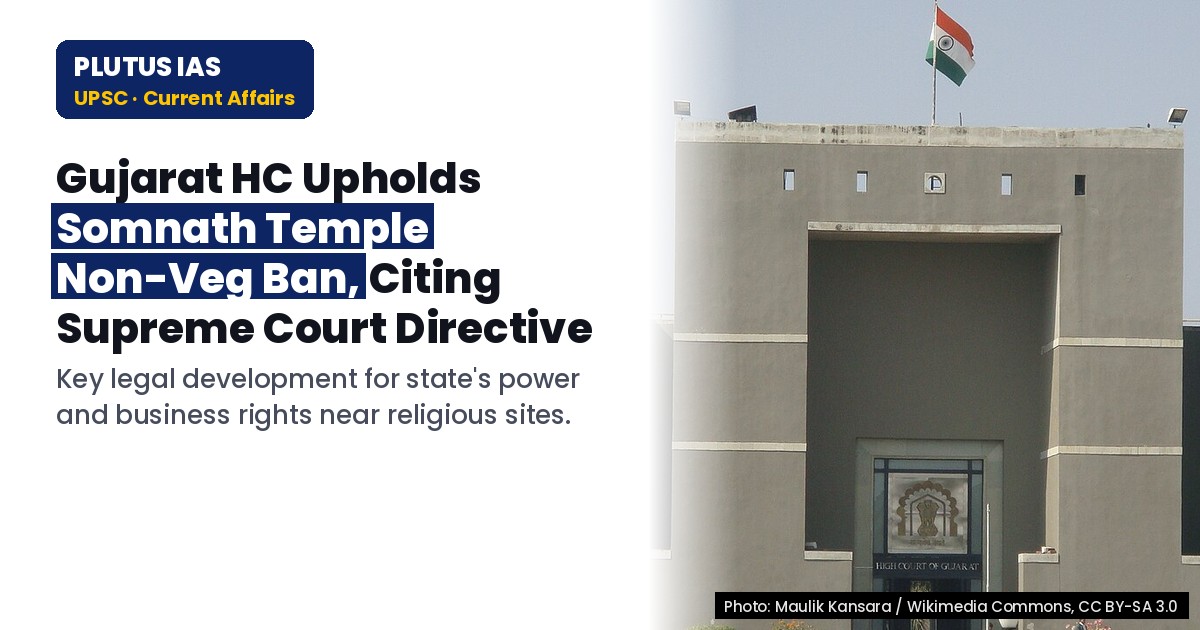
26 Nov Gujarat HC Upholds Somnath Temple Non-Veg Ban
✎ The case illustrates the judiciary's role in scrutinising executive actions against the touchstone of fundamental rights and statutory powers, particularly concerning the right to trade and religious sentiments.
Subject Relevance — Where This Topic Fits
- GS Paper II — Indian Constitution: Fundamental Rights, Writs, Judicial Review, High Courts, Supreme Court | GS Paper II — Governance: Government Policies and Interventions
- Prelims: Judicial Review, Fundamental Rights (Article 19), Gujarat Police Act, District Magistrate powers, Special Leave Petition (SLP), High Court jurisdiction, Division Bench, Single-judge Bench
- Essay: Balancing religious sentiments with individual freedoms in a secular state, The role of the judiciary in upholding constitutional principles
Quick Revision: The case illustrates the judiciary’s role in scrutinising executive actions against the touchstone of fundamental rights and statutory powers, particularly concerning the right to trade and religious sentiments.
Why is this in the news?
The Gujarat High Court has extended the interim ban on the sale of non-vegetarian food and eggs in the vicinity of the Somnath temple, listing the state’s appeal for further hearing. This development follows a directive from the Supreme Court, which dismissed a Special Leave Petition challenging the interim arrangement and mandated the High Court to dispose of the pending appeal within two months. The case involves a notification issued by the Gir Somnath District Magistrate prohibiting such sales within a 500-meter radius of the temple, which was initially quashed by a single-judge bench of the High Court before being reinstated by a Division Bench.
Background
- On August 10, a notification was issued by the Gir Somnath District Magistrate, prohibiting the preparation, sale, and storage of non-vegetarian food and eggs along specified routes and within 500 metres of the Somnath temple in Prabhas Patan, Veraval taluka.
- Restaurant owners challenged this notification, arguing that it lacked legal authority and infringed upon their fundamental right to carry on business.
- On October 30, a single-judge bench of the Gujarat High Court allowed the petitions, setting aside the District Magistrate’s notification on the grounds that it exceeded the powers conferred by the Gujarat Police Act and violated fundamental rights.
- The State of Gujarat subsequently filed an appeal against this single-judge order, and a Division Bench of the High Court stayed the single-judge’s decision, thereby restoring the restrictions on non-vegetarian food sales pending the appeal.
- Restaurant owners then filed a Special Leave Petition (SLP) in the Supreme Court, challenging the interim arrangement established by the Division Bench.
- On November 6, the Supreme Court dismissed the SLP and directed the Gujarat High Court to dispose of the pending appeal within two months, leading to the current extension of the ban by the High Court.
- The state’s contention is based on the religious significance of the Somnath temple and the large number of pilgrims it attracts, while petitioners assert a lack of legal empowerment for such a prohibition and an infringement of their right to livelihood.
Key Legal and Constitutional Concepts Involved
- **Judicial Review:** The power of the Supreme Court and High Courts to examine the constitutionality of legislative enactments and executive orders of both the Central and State governments. If they are found to be violative of the Constitution, they can be declared illegal, unconstitutional, and invalid by the judiciary.
- **Fundamental Rights:** Enshrined in Part III of the Indian Constitution (Articles 12-35), these rights are guaranteed to all citizens. Article 19(1)(g) guarantees the right to practice any profession, or to carry on any occupation, trade, or business, subject to reasonable restrictions.
- **Article 226:** Empowers High Courts to issue writs (Habeas Corpus, Mandamus, Prohibition, Quo Warranto, and Certiorari) for the enforcement of fundamental rights and for any other purpose.
- **Article 136 (Special Leave Petition – SLP):** Grants the Supreme Court discretionary power to grant special leave to appeal from any judgment, decree, determination, sentence, or order in any cause or matter passed or made by any court or tribunal in the territory of India.
- **Gujarat Police Act:** A state legislation that governs the structure, powers, and duties of the police force in Gujarat, and also confers certain powers on executive magistrates for maintaining public order and safety.
- **District Magistrate:** An executive officer in charge of a district, responsible for maintaining law and order, revenue administration, and exercising various statutory powers under different acts, including those related to public health and safety.
- **Single-judge Bench vs. Division Bench:** In High Courts, cases are typically heard by a single judge. Appeals against the decisions of a single judge are heard by a Division Bench, which consists of two or more judges.
Key Features
| Feature | Significance |
|---|---|
| Judicial Review of Administrative Actions | Ensures that executive and administrative orders, such as the District Magistrate’s notification, are scrutinised for legality and adherence to statutory powers, upholding the rule of law. |
| Freedom to Practice Trade or Business (Article 19(1)(g)) | Highlights the constitutional protection afforded to citizens to pursue any lawful occupation, trade, or business, subject to reasonable restrictions. |
| Religious Significance of Public Spaces | Illustrates the state’s consideration of cultural and religious sentiments in regulating activities around places of worship, balancing religious sanctity with individual rights. |
| Jurisdictional Limits of Statutory Powers (Gujarat Police Act) | Emphasises that administrative authorities must operate strictly within the powers conferred upon them by specific statutes, preventing arbitrary exercise of power. |
| Hierarchy of Courts and Appellate Process | Demonstrates the structured legal recourse available, from a single-judge bench to a division bench of the High Court, and ultimately to the Supreme Court, ensuring thorough judicial examination. |
Why it Matters
Legal and Constitutional Implications
- The case underscores the principle of judicial review, where administrative notifications are subject to scrutiny for their legality and adherence to statutory provisions, ensuring that executive actions do not exceed delegated powers.
- It involves a critical examination of the fundamental right to carry on any occupation, trade, or business guaranteed under Article 19(1)(g) of the Constitution, and the permissible limits of ‘reasonable restrictions’ that can be imposed by the state.
- The proceedings highlight the interplay between religious sentiments, public order, and individual economic rights, necessitating a balanced approach by the judiciary in interpreting and applying legal frameworks.
Governance and Administrative Precedent
- The High Court’s initial quashing of the ban on grounds of exceeding powers under the Gujarat Police Act sets a precedent regarding the precise scope of administrative authority in issuing prohibitory orders.
- The state’s appeal and the Supreme Court’s directive for timely disposal reflect the importance of clarity in administrative law and the need for definitive judicial pronouncements on matters of public policy and rights.
- It illustrates the challenges faced by district administrations in balancing local religious sensitivities with broader constitutional rights and statutory limitations.
Socio-Cultural Context
- The dispute brings to the fore the cultural sensitivities surrounding religious sites in India, where certain food items are often considered incongruous with the sanctity of temples.
- It reflects the ongoing societal debate regarding the regulation of commercial activities in the vicinity of religious institutions, considering both pilgrim sentiments and the livelihoods of local businesses.
- The case contributes to the discourse on how secular governance accommodates religious practices and beliefs within a constitutional framework that also guarantees fundamental rights to all citizens.
Challenges
1. Balancing Fundamental Rights and Public Interest
- Reconciling the fundamental right to carry on any occupation, trade, or business (Article 19(1)(g)) with the state’s objective of maintaining the sanctity of religious places and addressing public sentiments.
- Defining the ‘reasonable restrictions’ that can be imposed on fundamental rights, ensuring they are proportionate, necessary, and not arbitrary.
UPSC Link: Fundamental Rights; Reasonable Restrictions
2. Scope of Administrative Powers
- Ensuring that administrative authorities, such as District Magistrates, act strictly within the powers conferred upon them by specific statutes like the Gujarat Police Act.
- Preventing the overreach of executive power and ensuring that prohibitory orders are legally sound and not ultra vires the enabling legislation.
UPSC Link: Administrative Law; Delegated Legislation
3. Livelihood Concerns
- Addressing the economic impact of such bans on local businesses, particularly small restaurant owners and vendors whose livelihoods depend on commercial activities in the affected areas.
- Considering the potential for economic displacement and the need for alternative livelihood strategies if restrictions are upheld.
UPSC Link: Economic Development; Livelihood Issues
4. Judicial Interpretation and Consistency
- Ensuring consistent judicial interpretation of constitutional provisions and statutory laws across different levels of the judiciary.
- The need for timely disposal of appeals by higher courts to provide legal certainty and avoid prolonged uncertainty for affected parties.
UPSC Link: Judicial System; Constitutional Interpretation
Challenges — UPSC Perspective
| Issue | Concern |
|---|---|
| Legality of Notification | Whether the District Magistrate’s order exceeded the powers granted under the Gujarat Police Act, infringing upon the right to trade. |
| Right to Trade vs. Religious Sentiment | Balancing the constitutional right of restaurant owners to conduct business with the state’s intent to preserve the religious sanctity of the Somnath temple vicinity. |
| Economic Impact | The adverse effect of the ban on the livelihoods of restaurant owners and vendors, particularly during peak seasons like Diwali. |
| Judicial Delays | The prolonged legal process, involving multiple court levels, leading to uncertainty for businesses and the administration. |
| Scope of ‘Reasonable Restrictions’ | Determining whether the prohibition on non-vegetarian food sales constitutes a ‘reasonable restriction’ under Article 19(6) of the Constitution. |
Way Forward
- Expeditious judicial resolution by the Gujarat High Court, as directed by the Supreme Court, to provide legal clarity and certainty for all stakeholders.
- Development of clear, legally sound guidelines for administrative authorities regarding the scope and limits of their powers in issuing prohibitory orders, especially concerning fundamental rights.
- Conducting comprehensive socio-economic impact assessments before implementing such bans to understand and mitigate potential adverse effects on livelihoods.
- Exploring alternative regulatory measures that balance religious sensitivities with economic activities, such as designated zones or specific time restrictions, rather than outright prohibitions.
- Facilitating dialogue between local businesses, religious bodies, and administrative authorities to find mutually agreeable solutions that respect both constitutional rights and community sentiments.
- Ensuring that any restrictions imposed are proportionate to the objective sought and are based on demonstrable public order or health concerns, rather than solely on subjective moral or religious grounds.
- Promoting public awareness campaigns to educate citizens and businesses about their rights and responsibilities, as well as the legal framework governing such regulations.
UPSC Value Addition
Keywords for Mains Answer-Writing
Fundamental Rights · Right to Trade and Business · Article 19(1)(g) · Reasonable Restrictions · Public Order · Morality · Gujarat Police Act · Judicial Review · District Magistrate Powers · Constitutional Law · Religious Significance · Balancing Interests
Constitutional & Policy Linkages
- Article 19(1)(g): Freedom to practice any profession, or to carry on any occupation, trade or business.
- Article 19(6): Reasonable restrictions on the right to trade.
- Article 226: High Court’s power to issue writs for enforcement of rights.
- Article 136: Supreme Court’s special leave to appeal.
- Article 14: Equality before law and equal protection of laws.
Concept Flow
District Magistrate issues notification banning non-veg food near temple. → Restaurant owners challenge ban, citing infringement of trade rights. → Single-judge bench quashes ban, citing exceeding statutory powers. → State appeals to Division Bench, which stays single-judge order, restoring ban. → Restaurant owners’ SLP dismissed by Supreme Court, directing HC to dispose of appeal. → Gujarat High Court extends interim ban, schedules further hearing on state’s appeal.
Prelims Practice Questions
Q1. Consider the following statements regarding the Right to Practice any Profession, or to Carry on any Occupation, Trade or Business in India:
1. This right is enshrined under Article 19(1)(g) of the Constitution of India.
2. The State can impose reasonable restrictions on this right in the interest of the general public.
3. Restrictions related to public order, morality, or health are explicitly mentioned as grounds for reasonable restrictions.
How many of the above statements are correct?
- Only one
- Only two
- Only three
- None
Answer: Only three — Statement 1 is correct: Article 19(1)(g) guarantees the right to practice any profession, or to carry on any occupation, trade or business. Statement 2 is correct: Article 19(6) allows the State to impose reasonable restrictions on this right in the interest of the general public. Statement 3 is incorrect: While public order and morality are grounds for restrictions under other sub-clauses of Article 19, for Article 19(1)(g), the grounds are primarily ‘in the interest of the general public’ and ‘prescribing professional or technical qualifications’. Health is not an explicit ground for restricting trade under 19(6) but can be subsumed under general public interest.
Q2. Which of the following constitutional provisions empowers High Courts to issue writs for the enforcement of Fundamental Rights?
- Article 32
- Article 136
- Article 226
- Article 142
Answer: Article 226 — Article 226 of the Constitution of India empowers High Courts to issue writs for the enforcement of Fundamental Rights and for any other purpose. Article 32 grants similar power to the Supreme Court. Article 136 deals with special leave to appeal to the Supreme Court, and Article 142 deals with the Supreme Court’s power to do complete justice.
Mains Practice Question
✍ Examine the concept of ‘reasonable restrictions’ on fundamental rights, particularly in the context of Article 19(1)(g) of the Indian Constitution. Discuss with reference to recent judicial pronouncements where the balance between individual liberties and public interest has been deliberated. (15 Marks)
Approach: MODEL-ANSWER SKELETON:
1. **Introduction**: Define Fundamental Rights as enshrined in Part III of the Indian Constitution, highlighting their non-absolute nature and the concept of reasonable restrictions.
2. **Article 19(1)(g)**: Briefly explain the right to practice any profession, or to carry on any occupation, trade or business.
3. **Concept of ‘Reasonable Restrictions’**: Elaborate on Article 19(6), which permits the State to impose reasonable restrictions. Discuss key characteristics of ‘reasonableness’:
* Must be in the interest of the general public.
* Must not be arbitrary or excessive.
* Must have a direct and proximate nexus with the object sought to be achieved.
* Judicial review is the ultimate arbiter of reasonableness.
4. **Grounds for Restrictions under 19(6)**: Explicitly state the grounds: ‘in the interest of the general public’ and ‘prescribing professional or technical qualifications’.
5. **Judicial Pronouncements/Case Law**: Refer to landmark and recent judgments that have interpreted ‘reasonable restrictions’ in the context of trade/business. Examples could include:
* **Chintaman Rao v. State of Madhya Pradesh (1951)**: Established the test of proportionality for restrictions.
* **Mohd. Hanif Qureshi v. State of Bihar (1958)**: Discussed restrictions on cow slaughter in the context of trade and religious sentiments.
* **Om Prakash v. State of Uttar Pradesh (1955)**: Upheld restrictions on carrying on a business that is inherently dangerous or immoral.
* **Current Case (Gujarat HC ban on non-veg food near Somnath Temple)**: Use this as a contemporary example where the High Court initially quashed the ban, citing infringement of the right to business and exceeding powers under the Gujarat Police Act, and the subsequent stay by a Division Bench, highlighting the ongoing judicial deliberation on balancing religious significance and trade rights.
6. **Balancing Individual Liberties and Public Interest**: Discuss the inherent tension and the judiciary’s role in striking a balance, considering factors like public order, morality, health, and religious sentiments versus economic freedom.
7. **Conclusion**: Summarize the dynamic nature of ‘reasonable restrictions’ and the judiciary’s crucial role in safeguarding fundamental rights while allowing for necessary state regulation in the public interest.
Source: The Indian Express
Gujarat PCS (GPSC) — State PCS Practice
Prelims: Which of the following statements is/are correct regarding the recent decision by the Gujarat High Court concerning the Somnath temple vicinity?
1. The High Court has extended a ban on the sale of non-vegetarian food.
2. The ban applies to an area within a 1-kilometer radius of the Somnath temple.
3. The decision is primarily based on public health concerns.
Select the correct option:
- A. 1 only
- B. 1 and 2 only
- C. 2 and 3 only
- D. 1, 2 and 3
Answer: A. 1 only — The Gujarat High Court extended the ban on non-vegetarian food sales in the Somnath temple vicinity, as per the provided topic. No information about a 1-kilometer radius or public health concerns was given.
Mains: Discuss the potential socio-cultural and administrative implications of the Gujarat High Court’s decision to extend the ban on the sale of non-vegetarian food in the Somnath temple vicinity, considering the balance between religious sentiments and livelihood rights in a state like Gujarat. (10 marks, 100 words)
Generated by AanyaAi for educational purpose.
Related guides on our sites
- UPSC History optional
- Is history a good optional for upsc exam
- Best history optional teacher for UPSC
- How to prepare for GS paper 1 for UPSC CSE mains exam

- Gujarat HC Upholds Somnath Temple Non-Veg Ban - November 26, 2026
- एयर इंडिया और एआई एक्सप्रेस का ‘एक समूह, दो ब्रांड’ के रूप में संचालन - November 26, 2026
- Parliament Prorogation: UPSC & State PCS Polity Guide - November 26, 2026

No Comments