


11 Aug Gurjar Protest in Rajasthan: OBC Report Sparks Reservation Demand
Gurjar communityOBC commissionCaste dataReservation benefitsMBC categoryState Backward Classes Commission✎ State Backward Classes Commissions are statutory bodies tasked with identifying socially and educationally backward classes; their caste enumeration directly influences reservation quotas and political representation in local…
Subject Relevance — Where This Topic Fits
- GS Paper II — Constitutional and Statutory Bodies | GS Paper II — Constitutional Provisions for SCs, STs and OBCs | GS Paper IV — Role of Civil Society in Governance | GS Paper V — Panchayati Raj Institutions
- Prelims: Constitutional provisions for OBC reservation, Article 15(4), 16(4), 243D, 243T, National Commission for Backward Classes (Repeal) Act, 2018, State Backward Classes Commissions, Panchayati Raj Institutions (PRIs), MBC (Most Backward Classes), Reservation in local bodies
- Essay: Social justice and inclusive governance: The role of data in policy formulation
Quick Revision: State Backward Classes Commissions are statutory bodies tasked with identifying socially and educationally backward classes; their caste enumeration directly influences reservation quotas and political representation in local self-government institutions.
Why is this in the news?
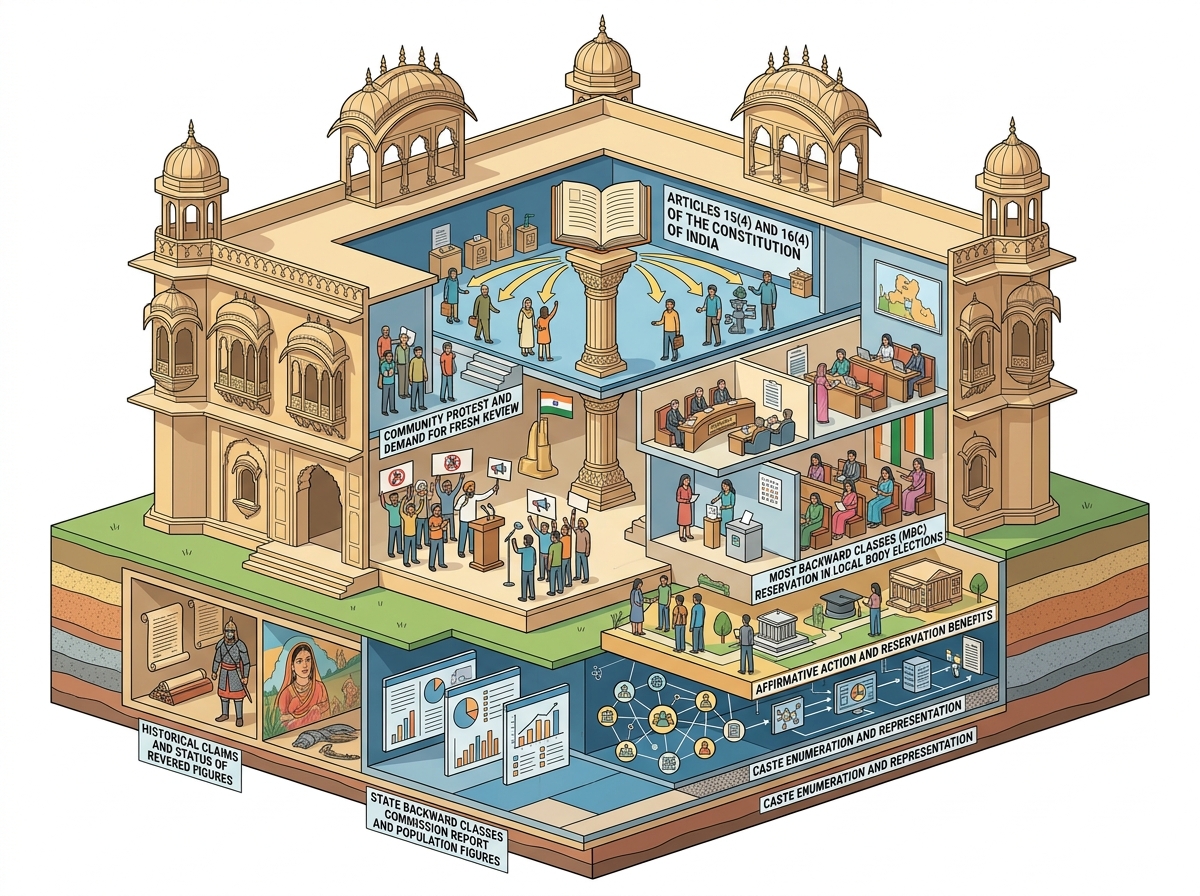
The Gurjar community in Rajasthan has expressed strong dissatisfaction with the population figures for their caste as reported by the State Backward Classes Commission, alleging undercounting. This has led to demands for a fresh review of the caste data, verification of historical claims regarding the caste status of revered figures such as Maa Pannadhay, and the extension of reservation benefits to the Most Backward Classes (MBC) category in local body elections. The controversy underscores the critical role of accurate caste enumeration in determining access to affirmative action and political representation.
Background
- The Constitution of India, through Articles 15(4) and 16(4), empowers the state to make provisions for the advancement of socially and educationally backward classes, including reservations in public employment and educational institutions.
- The National Commission for Backward Classes (NCBC) was established under the National Commission for Backward Classes Act, 1993. It was granted constitutional status by the 102nd Constitutional Amendment Act, 2018, which inserted Article 338B into the Constitution.
- State Backward Classes Commissions are statutory bodies constituted under respective state legislation to identify and classify socially and educationally backward classes and recommend measures for their welfare.
- The 103rd Constitution Amendment Act, 2019, introduced a 10% reservation for the Economically Weaker Sections (EWS) among unreserved categories.
- Local self-government institutions under the 73rd and 74th Constitutional Amendments (Panchayati Raj and Municipalities) provide for reservation of seats for SCs, STs, and OBCs in proportion to their population, subject to state-specific legislation.
- Rajasthan has historically implemented reservation policies for OBCs, with specific sub-categories such as MBCs receiving additional affirmative action measures.
What is the Role and Functioning of State Backward Classes Commissions?
- State Backward Classes Commissions are statutory bodies constituted under state legislation to identify and classify socially and educationally backward classes (SEBCs) within the state.
- Their primary functions include conducting surveys and studies to assess the social, educational, and economic backwardness of various castes and communities.
- They recommend to the state government the inclusion or exclusion of castes/communities in the list of backward classes eligible for reservation and other welfare measures.
- The commissions also monitor the implementation of reservation policies and submit annual reports to the state legislature.
- The accuracy of caste data compiled by these commissions is crucial, as it directly impacts the quantum of reservation and political representation in local bodies and public institutions.
- The commissions operate under the constitutional framework provided by Articles 15(4) and 16(4), which allow for affirmative action but require evidence-based classification to avoid arbitrary exclusion or inclusion.
- Disputes over caste enumeration, such as the one involving the Gurjar community in Rajasthan, highlight the need for transparent, verifiable, and participatory data collection methods.
- The commissions may also address historical or cultural claims, such as the caste status of revered figures, but such determinations must be based on credible historical and sociological evidence.
UPSC Value Addition
Keywords for Mains Answer-Writing
Other Backward Classes (OBC) Commission · caste enumeration · reservation in local bodies · MBC (Most Backward Classes) reservation · Gurjar community · Panchayati Raj Institutions · political representation · socio-economic justice · Constitutional provisions for social justice · Article 243D · Article 340 · caste-based data · social audit of caste data · Panchayati Raj Act · local governance and representation
Prelims Practice Questions
Q1. Consider the following statements regarding the constitutional provisions for reservation in local bodies:
1. Article 243D provides for reservation of seats for Scheduled Castes and Scheduled Tribes in Panchayats.
2. Article 243T provides for reservation of seats for Women in Panchayats.
3. Reservation for Other Backward Classes (OBCs) in Panchayats is mandatory under the 73rd Constitutional Amendment Act.
How many of the above statements are correct?
- Only one
- Only two
- All three
- None
Answer: All three — Statement 1 is correct as Article 243D mandates reservation for SCs and STs in Panchayats. Statement 2 is correct as Article 243T provides for reservation for women. Statement 3 is incorrect because reservation for OBCs in Panchayats is not mandatory under the 73rd Amendment; it is left to the discretion of the state legislatures.
Q2. Assertion (A): The President of India can refer the matter of caste enumeration to the National Commission for Backward Classes (NCBC) for suo motu review.
Reason (R): The NCBC is a statutory body constituted under Article 340 of the Constitution to investigate and monitor matters related to backward classes.
Options:
A) Both A and R are true, and R is the correct explanation of A.
B) Both A and R are true, but R is not the correct explanation of A.
C) A is true, but R is false.
D) A is false, but R is true.
Answer: ? — Assertion (A) is false because the President does not have the power to suo motu refer caste enumeration matters to the NCBC. Reason (R) is true as the NCBC is indeed a statutory body under Article 340. However, R does not explain A.
Q3. Match the following provisions with their respective articles:
Column I (Provision) | Column II (Article)
1. Reservation for SCs and STs in Panchayats | A. Article 243T
2. Reservation for Women in Panchayats | B. Article 243D
3. Reservation for OBCs in Panchayats | C. Article 243G
4. Powers, authority and responsibilities of Panchayats | D. Article 340
- 1-B, 2-A, 3-C, 4-D
- 1-A, 2-B, 3-C, 4-D
- 1-B, 2-A, 3-D, 4-C
- 1-A, 2-B, 3-D, 4-C
Answer: 1-B, 2-A, 3-C, 4-D — 1-B: Article 243D provides for reservation for SCs and STs in Panchayats. 2-A: Article 243T provides for reservation for women in Panchayats. 3-C: Article 243G empowers Panchayats with powers, authority, and responsibilities. 4-D: Article 340 relates to the appointment of a Commission to investigate the conditions of backward classes.
Mains Practice Question
✍ The enumeration of caste data and its subsequent use for determining reservation in local bodies is a contentious issue in Indian politics. In this context, critically examine the constitutional and legal framework governing caste enumeration and reservation in Panchayati Raj Institutions (PRIs). Also, analyse the implications of incorrect caste data on social justice and political representation. (15 Marks)
Approach: MODEL-ANSWER SKELETON:
1. **Constitutional and Legal Framework**:
– **Article 340**: Provides for the appointment of a Commission to investigate the conditions of backward classes and recommend steps for their advancement.
– **73rd Constitutional Amendment Act, 1992**: Mandates reservation for SCs and STs in PRIs (Article 243D) and empowers states to provide reservation for OBCs (Article 243D(6)).
– **State-specific legislations**: Highlight the discretionary power of state legislatures in providing OBC/MBC reservation in PRIs (e.g., Rajasthan Panchayati Raj Act).
– **Supreme Court judgments**: Cite landmark cases such as *Indra Sawhney v. Union of India* (1992) and *Ashoka Thakur v. Union of India* (2008) to underscore the judicial stance on caste-based reservations.
2. **Caste Enumeration Process**:
– **Methodology**: Discuss the challenges in caste enumeration, including the reliance on outdated census data, socio-economic surveys, and community self-identification.
– **Accuracy and transparency**: Highlight the need for robust, verifiable, and periodically updated caste data to ensure fair representation.
– **Role of OBC Commissions**: Explain the function of state-level OBC Commissions in conducting caste surveys and their limitations (e.g., lack of statutory powers in some states).
3. **Implications of Incorrect Caste Data**:
– **Social justice**: Discuss how underrepresentation or overrepresentation in caste data can distort the allocation of reservation benefits, exacerbating socio-economic disparities.
– **Political representation**: Analyse the impact on democratic representation in PRIs, where reservation is a tool for inclusive governance.
– **Constitutional principles**: Link to the principles of equality (Article 14), non-discrimination (Article 15), and social justice (Preamble and Directive Principles).
4. **Way Forward**:
– **Periodic enumeration**: Advocate for regular, scientific caste enumeration tied to socio-economic indicators.
– **Judicial and legislative safeguards**: Propose mechanisms for judicial review of caste data and legislative amendments to ensure transparency.
– **Community participation**: Emphasise the role of civil society and community leaders in validating caste data.
5. **Balanced View**:
– Acknowledge the complexities of caste enumeration, including political sensitivities and historical injustices.
– Stress the need for a balanced approach that upholds constitutional values while addressing historical marginalisation.
Source: amarujala.com
Generated by AanyaAi for educational purpose.

- यूएस-चीन एआई हॉटलाइन: क्यों शी जिनपिंग-ट्रम्प शिखर वार्ता में टैरिफ से आगे बढ़ा ‘सुपर इंटेलिजेंस’ का मुद्दा - September 26, 2026
- US-China AI Hotline: Xi-Trump Summit’s Game-Changing AI Dialogue Explained - September 26, 2026
- आईसीएआर द्वारा स्वच्छता अभियान: गणेश विसर्जन से पर्यावरण संरक्षण तक - September 26, 2026

No Comments