


19 Sep HAL delivers two LCA trainer jets to IAF: Key for UPSC & State PCS
✎ The LCA Tejas Twin-Seater Trainer (FOC configuration), HTT-40 basic trainer, and Dhruv NG helicopter represent key indigenisation milestones in India’s defence aerospace sector, supporting pilot training, operational readiness…
Subject Relevance — Where This Topic Fits
- GS Paper III — Science and Technology (Indigenisation and Defence Manufacturing) | GS Paper III — Internal Security (Aviation Infrastructure)
- Prelims: LCA Tejas, HTT-40, Dhruv NG, Hindustan Aeronautics Limited (HAL), Final Operational Clearance (FOC), Defence Procurement Procedure (DPP), Public Sector Undertaking (PSU), Aeronautical Development Agency (ADA), Indian Air Force (IAF), Pawan Hans Limited (PHL)
- Essay: Indigenous innovation as a catalyst for national security and economic sovereignty, The role of public-private partnerships in advancing India’s defence industrial base
Quick Revision: The LCA Tejas Twin-Seater Trainer (FOC configuration), HTT-40 basic trainer, and Dhruv NG helicopter represent key indigenisation milestones in India’s defence aerospace sector, supporting pilot training, operational readiness, and civil aviation needs.
Why is this in the news?
The handover of two Light Combat Aircraft (LCA) Tejas twin-seater trainers to the Indian Air Force (IAF) by Hindustan Aeronautics Limited (HAL) on 18 September 2026 underscores the progress in India’s indigenous defence aerospace capabilities. This development, alongside the induction of the civil-certified Dhruv NG helicopters into Pawan Hans Limited (PHL) and the delivery of HTT-40 basic trainer aircraft to the IAF, highlights the expanding role of domestic manufacturing in meeting the training and operational requirements of India’s armed forces and civil aviation sector.
Background
- The Light Combat Aircraft (LCA) Tejas programme was initiated in the 1980s to reduce India’s dependence on foreign fighter aircraft, with the Aeronautical Development Agency (ADA) designated as the nodal agency under the Defence Research and Development Organisation (DRDO).
- The Final Operational Clearance (FOC) configuration of the LCA Tejas includes enhancements such as improved avionics, weapons integration, and structural modifications to meet operational standards for combat roles.
- The Hindustan Turbo Trainer-40 (HTT-40) was developed by HAL to replace ageing basic trainer aircraft like the Kiran in the IAF’s training pipeline, with a focus on cost-effectiveness and indigenous content.
- The Dhruv helicopter, developed by HAL, has been a multi-role platform for both military and civil applications, with the Next Generation (NG) variant incorporating upgrades for enhanced performance, safety, and civil certification.
- India’s defence procurement policy emphasises indigenisation through the ‘Make in India’ initiative, with preference given to domestic manufacturers under the Defence Procurement Procedure (DPP).
- Public-private partnerships are increasingly recognised as critical to scaling up defence production and meeting the demands of modernisation across the armed forces.
What are the LCA Tejas Twin-Seater Trainers, HTT-40 Basic Trainer Aircraft, and Dhruv NG Helicopters?
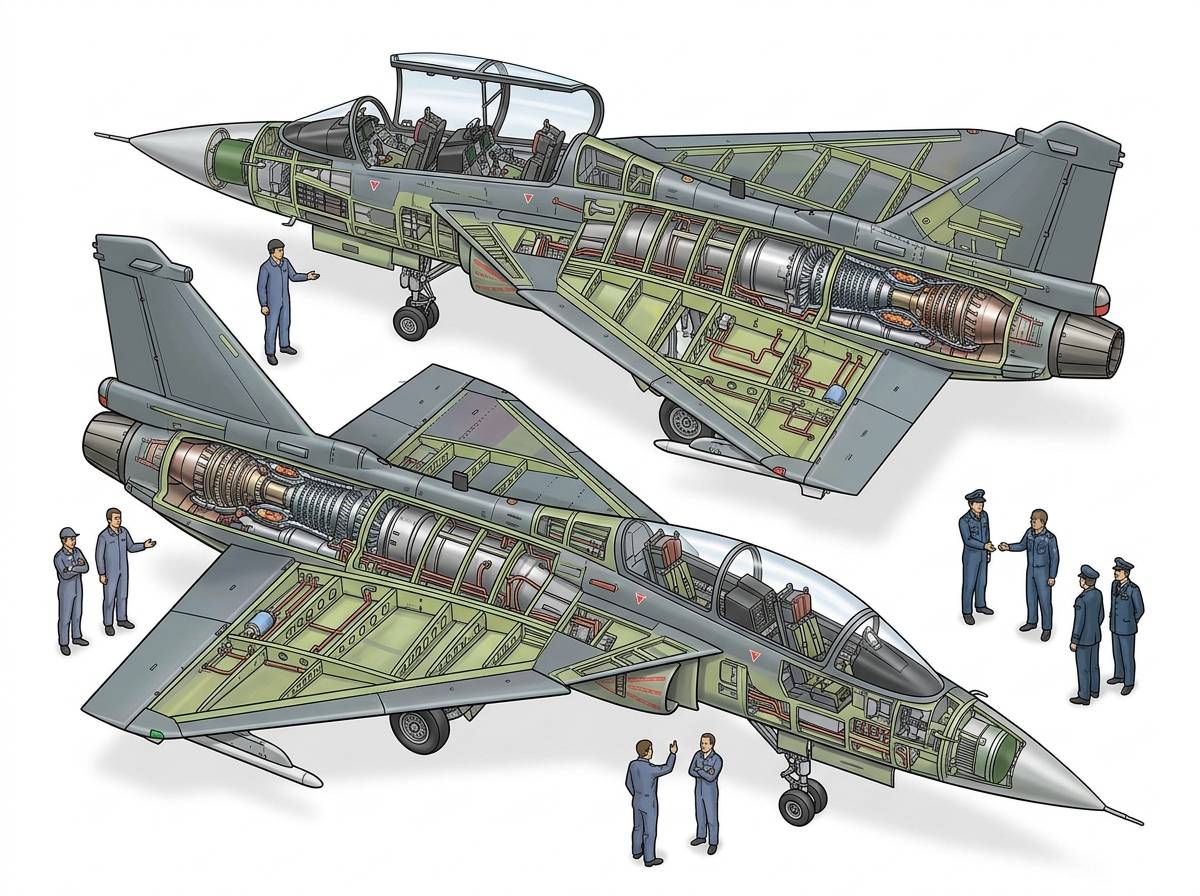
- The LCA Tejas Twin-Seater Trainer is a dual-seat variant of the indigenous Light Combat Aircraft designed to facilitate pilot training and transition to advanced fighter aircraft. It is part of the FOC configuration, which includes avionics upgrades, weapons systems, and structural reinforcements for operational readiness.
- The HTT-40 Basic Trainer Aircraft, officially named ‘Ankur’, is a turboprop trainer developed by HAL to meet the primary training needs of the IAF. It supports stages such as aerobatics, instrument flying, navigation, and night flying, with a focus on cost-efficiency and indigenous content.
- The Dhruv NG (Next Generation) is an upgraded variant of the Dhruv helicopter, featuring enhanced engines, avionics, and a configurable cabin for multi-role civil applications. It is certified for civil operations and is capable of roles such as VIP transport, air ambulance, disaster relief, and offshore operations.
- All three platforms—LCA Tejas Twin-Seater, HTT-40, and Dhruv NG—are products of India’s indigenous defence aerospace ecosystem, developed under the aegis of HAL with contributions from the Aeronautical Development Agency (ADA) and other DRDO laboratories.
- The LCA Tejas programme aligns with India’s strategic objective of reducing import dependence in critical defence sectors, as outlined in the Defence Procurement Procedure (DPP) and the ‘Make in India’ initiative.
- The HTT-40 and Dhruv NG platforms demonstrate the dual-use potential of indigenous defence technologies, supporting both military training and civil aviation requirements, thereby enhancing cost-effectiveness and resource optimisation.
- The induction of these platforms into the IAF and civil aviation sectors reflects the maturation of India’s aerospace manufacturing capabilities, with a growing emphasis on public-private collaboration to meet future demands.
- The FOC certification of the LCA Tejas Twin-Seater Trainer is a milestone in the aircraft’s development, signifying its readiness for full operational deployment and pilot training across the IAF.
Key Features
| Feature | Significance |
|---|---|
| LCA Tejas Twin-Seater Trainer (FOC) | Enables advanced pilot training for fighter aircraft conversion, reducing reliance on foreign platforms and enhancing indigenous defence capabilities. |
| Dhruv NG Helicopter (Civil-Certified) | A versatile 5.5-tonne twin-engine helicopter adaptable for VIP transport, air ambulance, offshore operations, and disaster relief, expanding civil aviation utility. |
| Hindustan Turbo Trainer-40 (HTT-40) | Designed for primary pilot training across aerobatics, instrument flying, and night operations, supporting the IAF’s training pipeline with indigenous technology. |
| Public-Private Synergy in Aerospace | Emphasises collaboration between HAL and private sector to accelerate defence production, reduce timelines, and mitigate technology obsolescence risks. |
| Final Operational Clearance (FOC) for LCA | Certifies the twin-seater LCA for operational deployment, marking a milestone in India’s indigenous fighter aircraft development and self-reliance (Atmanirbhar Bharat). |
Why it Matters
Strategic Autonomy
- Reduces dependence on foreign defence equipment by enhancing indigenous manufacturing capabilities in fighter aircraft and helicopters.
- Strengthens the Indian Air Force’s training infrastructure with locally developed platforms, ensuring operational readiness.
- Supports the ‘Atmanirbhar Bharat’ initiative by promoting self-sufficiency in critical defence technologies.
Economic Impact
- Boosts the aerospace manufacturing sector, creating jobs and fostering innovation in defence and civil aviation.
- Potential for export of indigenous platforms like Dhruv NG and HTT-40, generating foreign exchange and enhancing India’s global aerospace standing.
- Encourages private sector participation in defence production, diversifying the ecosystem and reducing bottlenecks in supply chains.
Technological Advancement
- Demonstrates India’s capability to develop and certify advanced military and civil aviation platforms, including multi-role helicopters and trainer aircraft.
- Facilitates technology transfer and upskilling within the domestic aerospace industry, aligning with global standards.
- Enhances the operational flexibility of the IAF and civil aviation through adaptable platforms like the Dhruv NG.
Training and Human Capital
- Provides a robust indigenous training pipeline for fighter pilots, reducing reliance on foreign training aircraft and associated costs.
- Supports the development of a skilled workforce in aerospace engineering, maintenance, and operations, critical for long-term defence preparedness.
Challenges
1. Project Delays and Timelines
- Delays in defence projects can lead to critical gaps in operational capabilities, increased costs, and technology obsolescence.
- Public-private partnerships require streamlined coordination to avoid bureaucratic hurdles and ensure timely delivery of platforms.
UPSC Link: Defence Procurement Procedure (DPP) 2020
2. Technology Obsolescence
- Rapid advancements in aerospace technology necessitate continuous upgrades to maintain operational relevance.
- Ensuring that indigenous platforms remain competitive against global counterparts requires sustained R&D investment.
UPSC Link: Defence Research and Development Organisation (DRDO)
3. Supply Chain and Manufacturing Bottlenecks
- Dependence on imported components for certain subsystems may pose risks to production timelines and cost efficiency.
- Scaling up indigenous manufacturing requires investment in advanced tooling, testing facilities, and workforce training.
UPSC Link: Make in India in Defence
4. Certification and Regulatory Compliance
- Achieving civil aviation certifications for platforms like the Dhruv NG involves stringent regulatory processes, which can delay market entry.
- Ensuring interoperability with existing defence and civil aviation systems requires adherence to international standards.
UPSC Link: Directorate General of Civil Aviation (DGCA)
5. Cost Escalation and Budgetary Constraints
- Cost overruns in defence projects can strain the national exchequer and limit the procurement of additional platforms.
- Balancing indigenous production with cost-effectiveness remains a persistent challenge in defence acquisition.
UPSC Link: Defence Budget Allocation
Challenges — UPSC Perspective
| Issue | Concern |
|---|---|
| Indigenous R&D Gaps | Insufficient investment in cutting-edge aerospace R&D may hinder the development of next-generation platforms. |
| Private Sector Participation | Limited involvement of private players in high-tech aerospace manufacturing due to risk aversion and regulatory hurdles. |
| Export Market Penetration | Competing with established global aerospace manufacturers for export orders requires robust marketing and after-sales support. |
| Skill Development | Shortage of specialised aerospace engineers and technicians to support large-scale indigenous production. |
| Regulatory Hurdles | Complex certification processes for civil aviation platforms can delay commercial deployment. |
| Infrastructure Constraints | Limited testing and manufacturing infrastructure in India may constrain production scalability. |
Way Forward
- Accelerate the implementation of the Defence Production and Export Promotion Policy (DPEPP) 2020 to streamline procurement and enhance private sector participation.
- Invest in R&D for next-generation aerospace technologies, including stealth, unmanned systems, and sustainable aviation fuels, to maintain a competitive edge.
- Strengthen the Defence Research and Development Organisation (DRDO) and HAL through targeted funding and collaboration with academic institutions for skill development.
- Establish dedicated testing and certification facilities for civil aviation platforms to expedite the certification process for indigenous helicopters like the Dhruv NG.
- Promote public-private partnerships (PPPs) in aerospace manufacturing by offering incentives such as tax breaks, land allocation, and assured orders for compliant firms.
- Develop a robust export strategy for indigenous platforms, leveraging India’s diplomatic ties to penetrate markets in Africa, Southeast Asia, and Latin America.
- Enhance the Defence Procurement Procedure (DPP) to prioritise indigenous platforms in defence acquisitions, ensuring a level playing field for domestic manufacturers.
- Focus on indigenisation of critical components and subsystems to reduce import dependence and improve cost-efficiency in defence production.
UPSC Value Addition
Keywords for Mains Answer-Writing
Indigenous defence production · Light Combat Aircraft (LCA) Tejas · Final Operational Clearance (FOC) · Hindustan Aeronautics Limited (HAL) · Indian Air Force (IAF) · Dhruv Next Generation (NG) helicopter · Hindustan Turbo Trainer-40 (HTT-40) · Defence indigenisation · Public-Private Partnership (PPP) in defence · Aerospace ecosystem · Defence Research and Development Organisation (DRDO) · Make in India in defence sector
Concept Flow
Indigenous aerospace development (LCA, Dhruv NG, HTT-40) → Enhances strategic autonomy and reduces import dependence → Supports Atmanirbhar Bharat initiative. → Handing over platforms to IAF and civil aviation → Strengthens operational readiness and training infrastructure → Improves defence preparedness. → Public-private synergy in aerospace → Accelerates production timelines and innovation → Reduces bottlenecks in supply chains. → Certification and regulatory compliance for civil aviation → Ensures market readiness and global competitiveness → Expands export potential. → Investment in R&D and skill development → Fosters technological advancement and workforce capabilities → Sustains long-term aerospace growth. → Export promotion and PPPs → Enhances economic impact and global standing → Contributes to national GDP and employment generation.
Prelims Practice Questions
Q1. Consider the following statements regarding the Light Combat Aircraft (LCA) Tejas:
1. The LCA Tejas is a single-engine, multirole light fighter aircraft.
2. The Final Operational Clearance (FOC) variant of the LCA Tejas is designed for trainer roles.
3. The LCA Tejas is developed by the Hindustan Aeronautics Limited (HAL) under the Make in India initiative.
How many of the above statements are correct?
- Only one
- Only two
- All three
- None
Answer: All three — Statements 1 and 3 are correct. Statement 2 is incorrect as the FOC variant includes both single-seat fighter and twin-seat trainer configurations.
Q2. Assertion (A): The Dhruv Next Generation (NG) helicopter is a light twin-engine, multi-role helicopter developed by HAL.
Reason (R): The Dhruv NG is designed to meet the requirements of both military and civil aviation segments in India.
Options:
A. Both A and R are true, and R is the correct explanation of A.
B. Both A and R are true, but R is not the correct explanation of A.
C. A is true, but R is false.
D. A is false, but R is true.
Answer: ? — Both the assertion and reason are correct, and the reason correctly explains the assertion as the Dhruv NG is indeed a twin-engine helicopter designed for multi-role operations in both military and civil aviation.
Q3. Match the following trainer aircraft with their respective roles:
Column I (Aircraft) Column II (Role)
A. LCA Tejas (FOC Twin Seater) 1. Basic training for trainee pilots
B. HTT-40 2. Advanced training and fighter transition
C. Dhruv NG 3. Civil aviation and VIP transport
D. Kiran Mk-II 4. Helicopter training and utility operations
Options:
A-2, B-1, C-3, D-4
A-1, B-2, C-3, D-4
A-2, B-1, C-4, D-3
A-4, B-2, C-3, D-1
Answer: ? — Correct matching: A-2 (LCA Tejas FOC Twin Seater for advanced training and fighter transition), B-1 (HTT-40 for basic training), C-3 (Dhruv NG for civil aviation and VIP transport), D-4 (Kiran Mk-II for helicopter training and utility operations).
Mains Practice Question
✍ The indigenisation of defence production in India has witnessed significant progress with the induction of platforms like the LCA Tejas, HTT-40, and Dhruv NG helicopters. Critically examine the role of Hindustan Aeronautics Limited (HAL) in this transformation. Also, analyse the challenges in achieving self-reliance in the aerospace sector and the measures required to enhance public-private synergy. (15 Marks)
Approach: MODEL-ANSWER SKELETON:
1. Introduction (2 marks): Define indigenisation in defence production and its strategic importance for India (e.g., reducing import dependence, enhancing technological sovereignty, supporting ‘Make in India’).
2. Role of HAL (3 marks):
– HAL as a Defence Public Sector Undertaking (DPSU) under the Ministry of Defence.
– Key contributions: Development and production of LCA Tejas (single-seat and twin-seat FOC variants), HTT-40 basic trainer, and Dhruv NG helicopters.
– Strategic partnerships with DRDO, ISRO, and private sector for technology transfer and co-development.
– Role in fulfilling IAF’s operational requirements and reducing import burden (e.g., reducing reliance on foreign trainers like Hawk and Pilatus).
3. Challenges in achieving self-reliance (4 marks):
– Technology gaps and reliance on foreign components (e.g., engines, avionics).
– Delays in project timelines and cost escalations (reference to Defence Minister’s remarks on realistic timelines).
– Limited private sector participation due to high entry barriers, risk aversion, and lack of R&D investment.
– Regulatory and bureaucratic hurdles in defence procurement and technology absorption.
– Competition from global OEMs and the need for continuous innovation.
4. Measures to enhance public-private synergy (4 marks):
– Strengthening the ‘Make in India’ ecosystem through policy incentives (e.g., Defence Procurement Procedure (DPP) 2020, SP model).
– Encouraging private sector participation via joint ventures, technology transfer agreements, and offset obligations.
– Investment in R&D and innovation hubs (e.g., DRDO labs, HAL’s design centres, and private sector R&D facilities).
– Streamlining defence procurement processes to reduce delays and improve ease of doing business.
– Promoting skill development and capacity building in aerospace engineering and manufacturing.
5. Conclusion (2 marks): Summarise the transformative role of HAL and the need for a collaborative ecosystem to achieve true self-reliance in defence production, while acknowledging the progress made and the road ahead.
Source: The Hindu
Generated by AanyaAi for educational purpose.
Related guides on our sites
- How to prepare for GS paper 1 for UPSC CSE mains exam
- Best UPSC coaching for IFOS exam
- Best mentorship programme for upsc
- UPSC+BA degree

- HAL delivers two LCA trainer jets to IAF: Key for UPSC & State PCS - September 19, 2026
- एनसीएल द्वारा शुरू हुआ ‘विशेष अभियान 6.0’: स्वच्छता और ई-कचरा प्रबंधन पर जोर - September 19, 2026
- NCERT & NCL Launch ‘Special Campaign 6.0’ for Clean Governance: Key Details for UPSC - September 19, 2026

No Comments