


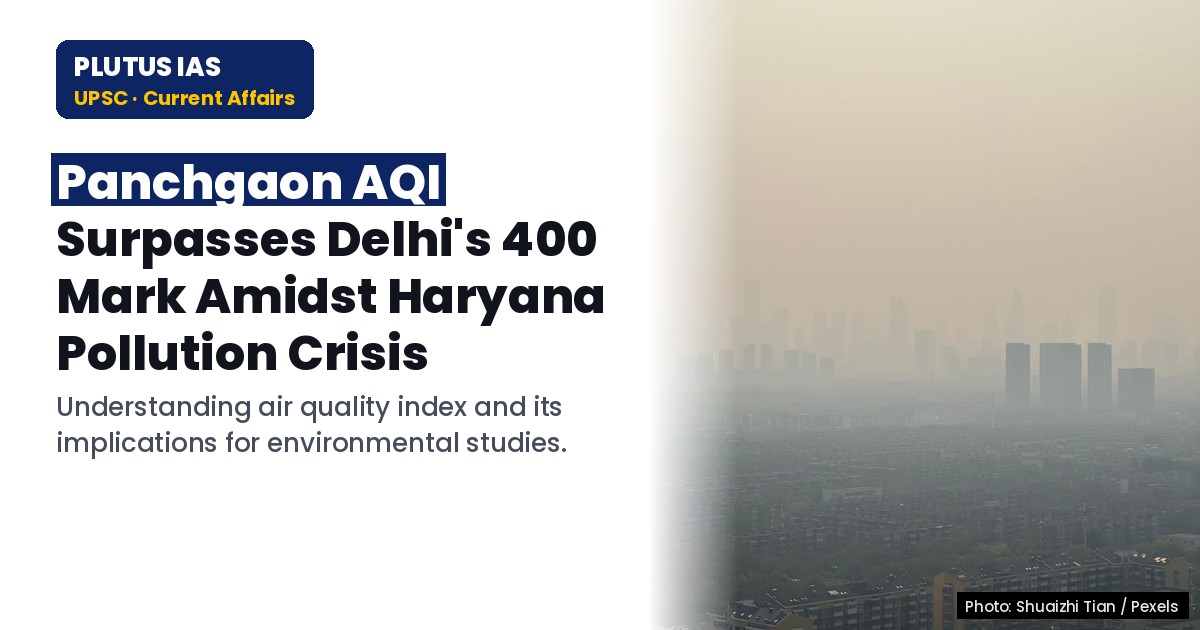
08 Nov Haryana Pollution Crisis: Panchgaon AQI Exceeds Delhi’s 400 Mark
✎ The escalating Air Quality Index (AQI) in Haryana cities, particularly Panchgaon and Gurugram, underscores the critical need for comprehensive and sustained measures to address anthropogenic emissions and adverse meteorological…
Subject Relevance — Where This Topic Fits
- GS Paper I — Geography (Environmental Geography) | GS Paper III — Environment and Ecology (Environmental Pollution and Degradation, Environmental Impact Assessment) | GS Paper III — Science and Technology (Pollution Control Technologies)
- Prelims: Air Quality Index (AQI), PM2.5, PM10, Central Pollution Control Board (CPCB), National Ambient Air Quality Standards (NAAQS), Graded Response Action Plan (GRAP)
- Essay: Environmental Degradation and Sustainable Development, Urbanization, Industrialization, and Public Health Challenges
Quick Revision: The escalating Air Quality Index (AQI) in Haryana cities, particularly Panchgaon and Gurugram, underscores the critical need for comprehensive and sustained measures to address anthropogenic emissions and adverse meteorological conditions contributing to severe air pollution in the National Capital Region.
Why is this in the news?
Recent data from the Central Pollution Control Board (CPCB) indicates a significant deterioration in air quality across several cities in Haryana, particularly Panchgaon and Gurugram, thereby highlighting an escalating environmental concern in the National Capital Region (NCR).
Background
- Air pollution in the National Capital Region (NCR) is a recurring phenomenon, particularly during the post-monsoon and winter months, attributed to a combination of meteorological factors and anthropogenic activities.
- The Air Quality Index (AQI) is a tool for effectively communicating air quality status to the public, categorizing air quality into six levels ranging from ‘Good’ to ‘Severe’.
- Particulate Matter (PM2.5 and PM10) are primary pollutants of concern, with PM2.5 being particularly hazardous due to its ability to penetrate deep into the respiratory system.
- Key anthropogenic sources contributing to air pollution in the region include vehicular emissions, dust from construction and demolition activities, industrial discharges, and agricultural stubble burning.
- Meteorological conditions such as lower temperatures, reduced wind speed, and atmospheric inversion layers exacerbate pollution by trapping pollutants closer to the ground.
- The Central Pollution Control Board (CPCB) is the statutory organization responsible for monitoring air quality and enforcing environmental standards across India.
Understanding Air Quality Index (AQI) and its Implications
- The Air Quality Index (AQI) is a comprehensive metric that provides a simple, single number to describe the ambient air quality.
- It considers eight major pollutants: Particulate Matter (PM2.5 and PM10), Ozone (O3), Carbon Monoxide (CO), Sulfur Dioxide (SO2), Nitrogen Dioxide (NO2), Ammonia (NH3), and Lead (Pb).
- The AQI scale ranges from 0 to 500, with higher values indicating poorer air quality and greater health concerns.
- Categories include Good (0-50), Satisfactory (51-100), Moderately Polluted (101-200), Poor (201-300), Very Poor (301-400), and Severe (401-500).
- An AQI in the ‘Very Poor’ or ‘Severe’ category signifies a high risk of respiratory effects on people with lung and heart diseases, and even healthy people may experience adverse health impacts.
- Prolonged exposure to high levels of air pollution can lead to chronic respiratory and cardiovascular diseases, reduced lung function, and increased mortality rates.
- Government initiatives like the National Clean Air Programme (NCAP) aim to reduce particulate matter concentration by 20-30% by 2024 in 102 non-attainment cities.
- The Graded Response Action Plan (GRAP) is an emergency measure implemented in the NCR to combat severe air pollution, involving steps like banning construction activities, restricting vehicular movement, and closing brick kilns and industries.
Key Features
| Feature | Significance |
|---|---|
| Elevated AQI in Haryana Cities | Indicates severe air pollution, surpassing levels observed in Delhi on certain days, particularly in Panchgaon. |
| Panchgaon’s AQI Exceeding 400 | Signifies ‘Severe’ category air quality, posing significant health risks to the populace. |
| Rapid Deterioration of Air Quality | A substantial increase in AQI within a short span (e.g., 185 points in Gurugram over six days) highlights a concerning trend. |
| Dominant Pollutants (PM2.5 and PM10) | Identifies the primary particulate matter contributing to the poor air quality, with PM10 being dominant on specific days in certain areas. |
| Attribution to Anthropogenic and Meteorological Factors | Points to vehicular emissions, construction dust, industrial discharges, and adverse weather conditions (temperature drop, slow winds) as key contributors. |
Why it Matters
Environmental Significance
- Highlights the pervasive nature of air pollution beyond major metropolitan centers, indicating a regional environmental crisis.
- Emphasizes the critical need for comprehensive regional air quality management strategies, transcending administrative boundaries.
Public Health Significance
- Elevated pollution levels, especially in the ‘Severe’ category, pose acute and chronic health risks, particularly for vulnerable populations such as children, the elderly, and individuals with respiratory or cardiovascular conditions.
- Increased healthcare burden due to pollution-related illnesses necessitates robust public health interventions and awareness campaigns.
Governance and Policy Significance
- Underscores the imperative for stringent enforcement of environmental regulations concerning vehicular emissions, construction activities, and industrial pollution.
- Calls for enhanced inter-state and inter-agency coordination in the National Capital Region (NCR) to address transboundary air pollution effectively.
Challenges
1. Transboundary Nature of Air Pollution
- Pollutants originating from one region can significantly impact air quality in adjacent areas, necessitating coordinated efforts across states and administrative units.
- Lack of synchronized policies and enforcement mechanisms across the NCR exacerbates the problem.
UPSC Link: Environmental Pollution and Degradation
2. Multiple and Diverse Sources of Pollution
- The confluence of vehicular emissions, construction dust, industrial discharges, and agricultural stubble burning presents a complex challenge for targeted interventions.
- Identifying and regulating all contributing sources effectively requires extensive monitoring and data analysis.
UPSC Link: Conservation, Environmental Pollution and Degradation
3. Adverse Meteorological Conditions
- Factors such as temperature inversion and low wind speeds during winter months trap pollutants near the ground, intensifying pollution episodes.
- These natural phenomena amplify the impact of anthropogenic emissions, making mitigation more challenging.
UPSC Link: Geophysical Phenomena; Environmental Pollution
4. Public Health Burden and Awareness
- Prolonged exposure to severe air pollution leads to increased incidence of respiratory and cardiovascular diseases, placing a strain on public health infrastructure.
- Limited public awareness regarding the severity of health impacts and individual mitigation measures hinders collective action.
UPSC Link: Issues Relating to Health; Environmental Pollution
Challenges — UPSC Perspective
| Issue | Concern |
|---|---|
| Regional Air Quality Disparity | Pollution levels in smaller towns and peripheral areas sometimes exceed those in major cities, indicating a wider geographical spread of the problem. |
| Effectiveness of Current Mitigation Strategies | Despite existing policies, the persistent and escalating pollution levels suggest that current measures may be insufficient or inadequately implemented. |
| Data-Driven Policy Making | The need for granular, real-time data on pollutant sources and concentrations to formulate precise and effective intervention strategies. |
| Sustainable Urban Development | Balancing rapid urbanization and infrastructure development with environmental protection to prevent further degradation of air quality. |
Government Initiatives — Must-Memorise for Prelims
- National Clean Air Programme (NCAP)
- Graded Response Action Plan (GRAP)
Way Forward
- Implement and rigorously enforce the Graded Response Action Plan (GRAP) across the entire National Capital Region (NCR) with enhanced coordination among states.
- Strengthen monitoring networks and data analytics to identify primary pollution sources in specific areas and periods, enabling targeted interventions.
- Promote cleaner public transportation, electric vehicles, and improved fuel standards to reduce vehicular emissions.
- Mandate and enforce dust control measures at all construction and demolition sites, including the use of anti-smog guns and green netting.
- Encourage the adoption of cleaner industrial technologies and ensure strict compliance with emission standards for industrial units.
- Develop and implement sustainable urban planning policies that integrate green infrastructure, promote walking and cycling, and reduce reliance on private vehicles.
- Launch public awareness campaigns to educate citizens on the health impacts of air pollution and individual actions for mitigation.
UPSC Value Addition
Keywords for Mains Answer-Writing
Air Quality Index (AQI) · Particulate Matter (PM2.5, PM10) · Air pollution sources · Health impacts of pollution · National Clean Air Programme (NCAP) · Commission for Air Quality Management (CAQM) · Environmental Protection Act, 1986 · Sustainable urban development · Pollution control measures · Crop residue burning
Constitutional & Policy Linkages
- {‘article’: ‘Article 21’, ‘note’: ‘Right to a healthy environment’}
- {‘article’: ‘Article 48A’, ‘note’: ‘Protection and improvement of environment’}
- {‘article’: ‘Article 51A (g)’, ‘note’: ‘Duty to protect natural environment’}
Concept Flow
Increased Vehicular Emissions, Construction Dust, Industrial Discharges → Accumulation of Pollutants (PM2.5, PM10) due to Anthropogenic Activities → Adverse Meteorological Conditions (Low Wind Speed, Temperature Inversion) → Trapping of Pollutants Near Ground Level → Elevated Air Quality Index (AQI) in ‘Very Poor’ to ‘Severe’ Categories → Significant Public Health Risks and Environmental Degradation
Prelims Practice Questions
Q1. Consider the following statements regarding air pollution in India:
1. The Air Quality Index (AQI) is a tool used by the Central Pollution Control Board (CPCB) to communicate air quality to the public.
2. PM2.5 refers to particulate matter with a diameter of 2.5 micrometres or less, which can penetrate deep into the lungs.
3. The National Clean Air Programme (NCAP) aims to reduce particulate matter concentration by 20-30% by 2024, with 2017 as the base year.
How many of the above statements are correct?
- Only one
- Only two
- All three
- None
Answer: All three — Statement 1 is correct: AQI is a key CPCB initiative. Statement 2 is correct: PM2.5’s small size allows deep lung penetration. Statement 3 is correct: NCAP’s target and base year are as stated.
Q2. Which of the following are identified as major contributors to urban air pollution in the Indo-Gangetic Plains?
1. Vehicular emissions
2. Industrial emissions
3. Construction dust
4. Crop residue burning
Select the correct answer using the code given below:
- 1 and 2 only
- 2, 3 and 4 only
- 1, 3 and 4 only
- 1, 2, 3 and 4
Answer: 1, 2, 3 and 4 — All four factors—vehicular emissions, industrial emissions, construction dust, and crop residue burning—are significant contributors to air pollution in the Indo-Gangetic Plains, particularly during the winter months.
Mains Practice Question
✍ The persistent rise in urban air pollution, as evidenced by recent Air Quality Index (AQI) data, poses significant public health and environmental challenges. Critically examine the primary anthropogenic and meteorological factors contributing to this phenomenon in the Indo-Gangetic Plains. Also, discuss the efficacy of current policy interventions in mitigating this crisis. (15 Marks)
Approach: Introduction: Define urban air pollution and its severity, citing the AQI as an indicator. Mention the recent news of high AQI in Haryana as a contemporary hook.
Part 1: Primary Factors Contributing to Air Pollution:
A. Anthropogenic Factors:
1. Vehicular Emissions: Incomplete combustion, older vehicles, traffic congestion. (Reference: Bharat Stage Emission Standards).
2. Industrial Emissions: Thermal power plants, small-scale industries, inadequate pollution control devices.
3. Construction and Demolition Activities: Dust generation, lack of adherence to guidelines.
4. Agricultural Practices: Crop residue burning (stubble burning) in neighbouring states, leading to transboundary pollution.
5. Domestic Sources: Biomass burning for cooking and heating in certain areas.
B. Meteorological Factors:
1. Temperature Inversion: Trapping of pollutants near the ground during colder months.
2. Low Wind Speed: Reduced dispersion of pollutants.
3. Stagnant Air Mass: Accumulation of pollutants over an area.
Part 2: Efficacy of Current Policy Interventions:
A. National Clean Air Programme (NCAP): Targets, implementation challenges, funding.
B. Commission for Air Quality Management (CAQM): Role, powers, Graded Response Action Plan (GRAP) implementation, inter-state coordination.
C. Environmental Protection Act, 1986: Legal framework, CPCB’s role, enforcement issues.
D. Specific Measures: Promotion of electric vehicles, public transport, odd-even schemes, dust control norms, industrial emission standards, PUSA decomposer for stubble.
E. Challenges: Lack of strict enforcement, inter-state coordination issues, technological limitations, public awareness and participation, economic considerations.
Conclusion: Summarise the complex nature of the problem and suggest a multi-pronged, integrated approach involving technological solutions, stricter enforcement, public participation, and regional cooperation for sustainable air quality management.
Source: jagran.com
Haryana PCS (HPSC / HCS) — State PCS Practice
Prelims: Which of the following cities in Haryana recently recorded an Air Quality Index (AQI) exceeding 400, making it the most polluted city in the state and surpassing even Delhi’s AQI levels?
- Gurugram
- Faridabad
- Panchgaon
- Sonipat
Answer: Panchgaon — Panchgaon recorded an AQI exceeding 400, making it the most polluted city in Haryana, even surpassing Delhi’s AQI.
Mains: हरियाणा के शहरों में प्रदूषण के रिकॉर्ड टूटने और पंचगांव का AQI 400 पार करने की घटना को देखते हुए, राज्य सरकार द्वारा वायु प्रदूषण को नियंत्रित करने के लिए उठाए जा सकने वाले संभावित कदमों और उनके सामाजिक-आर्थिक प्रभावों का विश्लेषण करें।
Generated by AanyaAi for educational purpose.
Related guides on our sites
- Best PSIR optional coaching in delhi for UPSC
- How to prepare for GS paper 1 for UPSC CSE mains exam
- Best UPSC coaching for IFOS exam
- Best geography optional coaching

- Haryana Pollution Crisis: Panchgaon AQI Exceeds Delhi’s 400 Mark - November 8, 2026
- बस्तर में पीएम: नक्सलवाद पर विजय और आंतरिक सुरक्षा का महत्व - November 8, 2026
- SEBI’s New Settlement Regulations: Key Changes & Impact - November 8, 2026

No Comments