


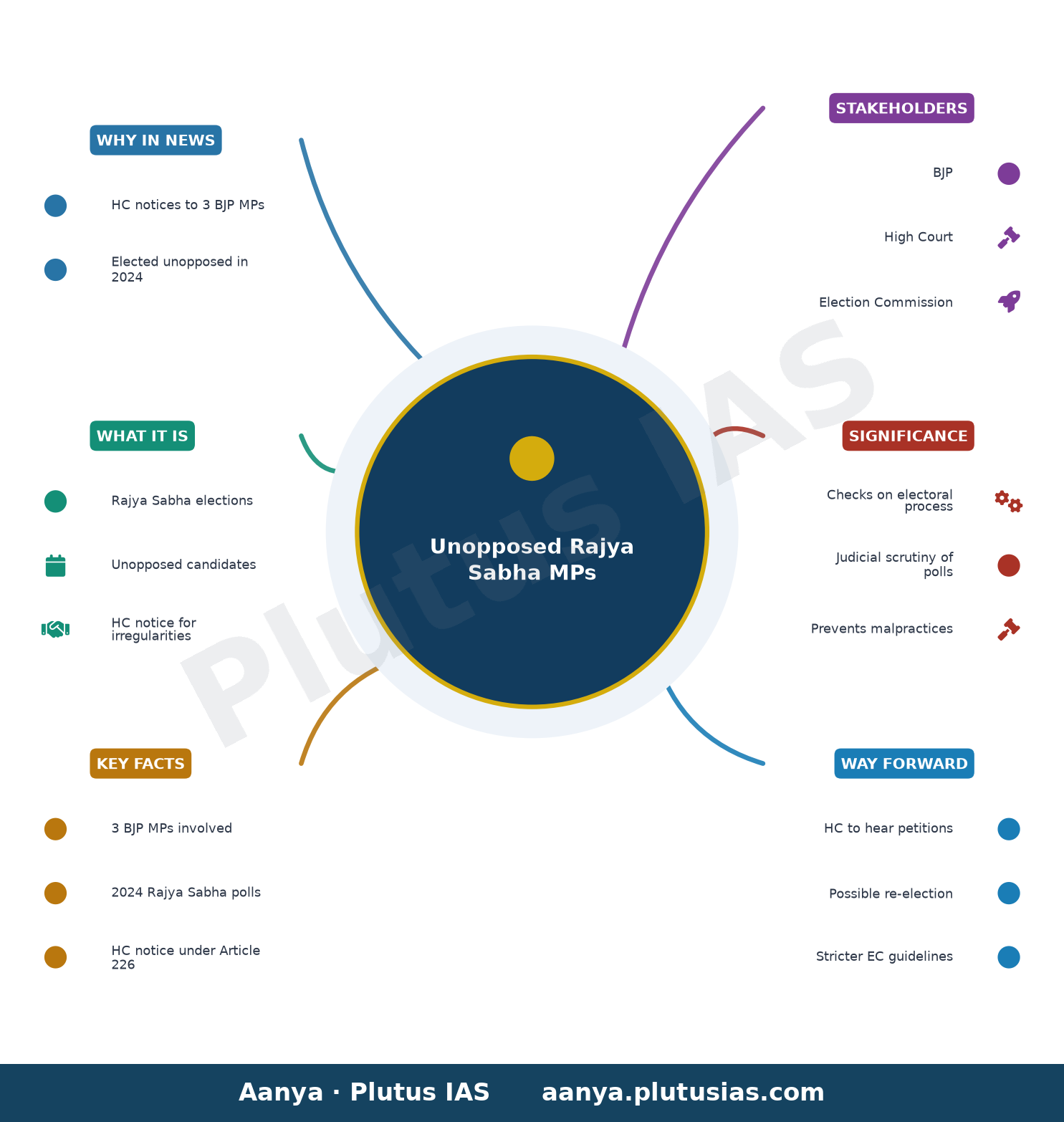
05 Aug High Court Issues Notices to 3 BJP Rajya Sabha MPs Over Unopposed Election
✎ Unopposed Rajya Sabha MPs face judicial scrutiny for electoral irregularities, highlighting checks on democracy.
Relevance for UPSC & State PCS: Polity
The recent development where a High Court has issued notices to three Bharatiya Janata Party (BJP) Rajya Sabha MPs who were elected unopposed raises significant constitutional and procedural questions, particularly concerning the conduct of elections to the Upper House of Parliament. The notices pertain to allegations of procedural lapses or potential violations of the Representation of the People Act, 1951, which governs the election of Rajya Sabha members. Since Rajya Sabha elections are indirect and conducted by state legislators through a system of proportional representation, the election of MPs without a contest—often due to a lack of opposition candidates—has occasionally drawn scrutiny over whether such processes adhere strictly to democratic norms. The High Court’s intervention underscores the judiciary’s role in ensuring that electoral processes, even those deemed routine, remain transparent and compliant with the law.
For UPSC and State PCS aspirants, this case is a critical study in the interplay between constitutional provisions, electoral laws, and judicial oversight. The Constitution mandates that Rajya Sabha members be elected by the elected members of state legislative assemblies, and any deviation from prescribed procedures can be challenged under Article 32 or Article 226 of the Constitution, which empower the Supreme Court and High Courts to issue writs for the enforcement of fundamental rights or legal rights. The issue also touches upon the broader theme of electoral reforms, a recurring topic in the UPSC syllabus under polity and governance sections. Aspirants must understand how the judiciary interprets electoral laws, especially in cases involving unopposed elections, where the absence of a contest might mask underlying procedural deficiencies.
The relevance of this case extends to the functioning of Parliament and the Rajya Sabha’s role in India’s federal structure. Since Rajya Sabha MPs represent states and Union Territories, their election process must reflect the will of the state legislatures, ensuring that the federal balance is maintained. Any legal challenge to their election could have implications for the legitimacy of their subsequent legislative actions, particularly if the High Court were to invalidate the election on grounds of procedural irregularities. For State PCS aspirants, this case highlights the importance of understanding state legislative assembly procedures, as state MLAs play a pivotal role in electing Rajya Sabha members. It also serves as a reminder of how judicial interventions can shape electoral practices, reinforcing the need for aspirants to stay updated on recent judicial pronouncements affecting constitutional and electoral laws.
Source: ndtv.com
Practice Questions
Q1. Why did the High Court issue notices to the three BJP Rajya Sabha MPs who were elected unopposed?
- For alleged financial misconduct during their election campaigns
- For failing to disclose their assets and liabilities as required by law
- For violating the model code of conduct during their unopposed election
- For not attending Parliament sessions regularly
Answer
For failing to disclose their assets and liabilities as required by law — The notices were issued due to the non-disclosure of assets and liabilities by the MPs, which is a mandatory requirement under the Representation of the People Act, 1951. The High Court took cognizance of this violation and sought an explanation from the MPs.
Q2. Under which legal provision can a High Court issue notices to elected representatives for non-disclosure of assets?
- Article 32 of the Constitution
- Section 125A of the Representation of the People Act, 1951
- Section 100 of the Civil Procedure Code
- Article 226 of the Constitution
Answer
Section 125A of the Representation of the People Act, 1951 — Section 125A of the Representation of the People Act, 1951, mandates the disclosure of assets and liabilities by elected representatives. Failure to comply can lead to disqualification, and the High Court can issue notices under this provision.
Generated by AanyaAi for educational purpose.

- मद्रास उच्च न्यायालय ने एआईएडीएमके के व्हिप के मामले को खारिज किया, मेकेदातू संशोधन पर तमिलनाडु विधानसभा का फैसला बरकरार - September 23, 2026
- Madras HC Rejects AIADMK Plea Against Mekedatu Resolution Amendment - September 23, 2026
- कर्नाटक में उद्योग-आधारित पाठ्यक्रम तैयार करेगा विशेष समिति: मुख्यमंत्री - September 23, 2026

No Comments