


26 Jul High Court Judge Transfers & Appointments: Constitutional & MOP Guidelines Explained
Subject Relevance — Where This Topic Fits
- GS Paper II — Polity and Governance
- Prelims: Article 222, Article 124, Article 217, Article 224, Memorandum of Procedure (MoP), Collegium System, Judicial Appointments, Puisne Judges, Second and Third Judges Cases
- Essay: Judicial independence and accountability: Balancing constitutional provisions and executive-legislative roles, Role of the judiciary in upholding federalism and constitutional morality
Quick Revision: The transfer and appointment of High Court judges in India are governed by constitutional provisions (Articles 124, 217, 222, 224) and the Memorandum of Procedure (MoP), which ensures a consultative and structured process involving the judiciary, executive, and state governments.
Why is this in the news?
The Press Information Bureau (PIB) issued a press release on 25 July 2026 clarifying that the transfer and appointment of High Court judges in India are governed strictly by constitutional provisions (Articles 124, 217, 222, and 224) and the Memorandum of Procedure (MoP), as evolved through judicial precedents such as the Second and Third Judges Cases. This clarification assumes significance amid public discourse on judicial appointments and transfers, underscoring the structured and consultative nature of the process.
Background
- The Indian judiciary operates under a federal structure, with High Courts established for each state and Union Territory, and the Supreme Court at the apex.
- The Constitution of India, through Articles 124, 217, and 224, delineates the framework for the appointment and transfer of judges in the higher judiciary.
- The MoP was shaped by landmark judicial decisions, including the Second Judges Case (1993) and the Third Judges Case (1998), which reinforced the primacy of the judiciary in judicial appointments.
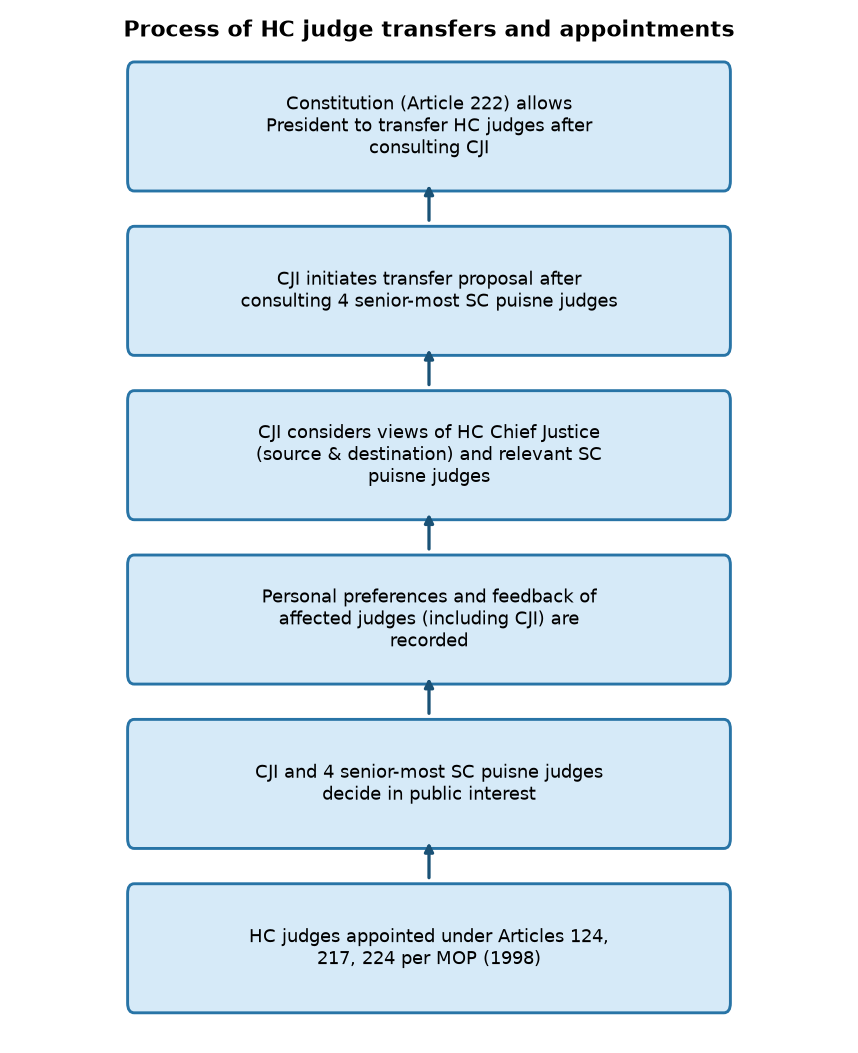
- Transfers of High Court judges are governed by Article 222, which empowers the President to transfer a judge from one High Court to another after consultation with the Chief Justice of India (CJI).
- The process is consultative, involving the CJI, senior puisne judges of the Supreme Court, and the Chief Justices of the concerned High Courts, with a focus on judicial efficiency and administrative convenience.
What is the Memorandum of Procedure (MoP) and how does it govern judicial appointments and transfers?
- The MoP is a procedural document that operationalises the constitutional provisions governing the appointment and transfer of judges in the higher judiciary, ensuring a structured and consultative process.
- It was formulated in compliance with the Supreme Court’s directives in the Second Judges Case (1993) and the Third Judges Case (1998), which established the collegium system for judicial appointments.
- For appointments to the Supreme Court, the MoP stipulates that the proposal is initiated by the Chief Justice of India (CJI).
- For appointments to High Courts, the proposal is initiated by the Chief Justice of the concerned High Court in consultation with the two senior-most puisne judges of that High Court.
- The MoP mandates that High Courts submit their recommendations for appointments at least six months before the anticipated vacancy arises, ensuring timely processing.
- The transfer of High Court judges under Article 222 involves consultation with the CJI, the four senior-most puisne judges of the Supreme Court, and the Chief Justices of both the transferring and receiving High Courts, with due consideration given to the judge’s preferences and personal circumstances.
- All transfers and appointments are made in the public interest, aimed at enhancing the efficiency and effectiveness of the judicial system across the country.
- The MoP also incorporates inputs from the concerned state governments and other relevant reports before final recommendations are made to the Supreme Court Collegium.
Key Features
| Feature | Significance |
|---|---|
| Constitutional Provision (Article 222) | Empowers the President to transfer High Court judges after consulting the Chief Justice of India (CJI), ensuring judicial independence and administrative efficiency. |
| Memorandum of Procedure (MoP) | Lays down the detailed process for transfers and appointments, ensuring transparency, consultation, and adherence to judicial standards. |
| Consultation Mechanism | Involves the CJI, four senior-most Puisne Judges of the Supreme Court, and the Chief Justices of the transferring and receiving High Courts, balancing judicial and administrative considerations. |
| Personal Preferences of Judges | Mandates consideration of the judge’s preferences, including preferred destinations, ensuring fairness and voluntary compliance. |
| Objective of Transfers | Transfers are made solely in the public interest to enhance the effectiveness of judicial administration across High Courts. |
Why it Matters
Judicial Administration
- Ensures optimal distribution of judicial resources across High Courts, reducing workload disparities and improving case disposal rates.
- Facilitates the transfer of judges with specialized expertise to High Courts facing complex legal challenges.
- Promotes uniformity in judicial standards and practices by enabling the movement of judges between regions.
Constitutional Governance
- Upholds the separation of powers by ensuring that judicial transfers and appointments are guided by constitutional provisions rather than executive or political influence.
- Reinforces the independence of the judiciary by embedding consultation mechanisms with the CJI and senior judges.
- Maintains the federal structure by involving state governments in the appointment process for High Court judges.
Transparency and Accountability
- The MoP provides a structured framework for transfers and appointments, reducing arbitrariness and enhancing public trust in judicial processes.
- Mandatory consultations with multiple judicial authorities ensure checks and balances in the decision-making process.
Challenges
1. Regional Imbalance in Judicial Workload
- High Courts in certain states face disproportionately high case pendency due to limited judicial capacity, necessitating targeted transfers.
- Transfers must balance workload demands with judges’ personal preferences and career considerations.
UPSC Link: GS-II (Judicial System)
2. Delays in Appointment Process
- The requirement for High Courts to submit recommendations six months in advance may lead to delays in filling vacancies, particularly in states with complex administrative processes.
- Coordination between the judiciary, state governments, and the central government can sometimes result in prolonged delays.
UPSC Link: GS-II (Appointment of Judges)
3. Perceived Lack of Transparency
- Despite the structured MoP, the opacity in the selection and transfer criteria may lead to perceptions of favoritism or bias.
- Public scrutiny of transfers and appointments remains limited, raising concerns about accountability.
UPSC Link: GS-II (Judicial Reforms)
4. Judicial Workforce Mobility Constraints
- Reluctance of judges to relocate, especially to High Courts in less desirable locations, can hinder the effectiveness of transfers.
- Cultural and linguistic barriers may further complicate transfers to High Courts in non-native regions.
UPSC Link: GS-II (Judicial Workforce Management)
Challenges — UPSC Perspective
| Issue | Concern |
|---|---|
| Regional Workload Disparities | High Courts in certain states face severe case backlogs, requiring urgent transfers but constrained by judges’ preferences. |
| Administrative Delays | The six-month advance notice requirement may not align with urgent vacancies, leading to prolonged understaffing. |
| Perceived Bias in Transfers | Lack of public disclosure of transfer criteria may fuel suspicions of political or personal influences. |
| Judicial Reluctance to Relocate | Cultural and linguistic barriers, along with personal preferences, may hinder the effectiveness of transfers. |
| Coordination Gaps | Delays in inter-institutional consultations between the judiciary, state governments, and the central government can stall appointments. |
Way Forward
- Strengthen the transparency of the MoP by publishing anonymized transfer and appointment criteria, subject to judicial confidentiality.
- Establish a dedicated judicial workforce management cell to monitor workload disparities and recommend targeted transfers.
- Introduce incentives for judges to relocate to High Courts with high pendency, such as priority in future postings or career advancements.
- Streamline inter-institutional consultations by setting strict timelines for state governments and the central government to respond to recommendations.
- Conduct periodic reviews of the MoP to identify bottlenecks and incorporate feedback from judges and stakeholders.
- Enhance digital platforms for tracking vacancies and transfers to improve real-time monitoring and accountability.
- Promote regional language training programs to reduce cultural barriers for judges transferring to non-native High Courts.
UPSC Value Addition
Keywords for Mains Answer-Writing
Judicial appointments · Judicial transfers · Constitutional provisions for judiciary · Memorandum of Procedure (MoP) · Collegium system · Article 222 of the Constitution · President’s power of transfer · Judicial independence · Judicial accountability · Judicial collegium · Appointment of High Court Judges · Judicial governance
Constitutional & Policy Linkages
- Article 222: Transfer of High Court judges
- Article 124: Appointment of Supreme Court judges
- Article 217: Appointment of High Court judges
- Article 224: Appointment of additional and acting judges
Concept Flow
Constitutional mandate (Article 222) → Empowers President to transfer judges after CJI consultation → MoP establishes detailed procedural framework for transfers and appointments → Consultation with CJI, senior Supreme Court judges, and High Court Chief Justices → Consideration of judges’ preferences and public interest criteria → Final decision by CJI and senior judges, followed by presidential approval → Implementation of transfer, ensuring judicial efficiency and workload balance
Prelims Practice Questions
Q1. Which constitutional article empowers the President to transfer a High Court judge from one High Court to another?
- Article 124
- Article 217
- Article 222
- Article 324
Answer: Article 222 — Article 222 of the Indian Constitution specifically empowers the President to transfer a judge from one High Court to another after consulting the Chief Justice of India.
Q2. The Memorandum of Procedure (MoP) for judicial appointments and transfers in India was formulated in compliance with which judicial decisions?
- First Judges Case and Second Judges Case
- Second Judges Case and Third Judges Case
- Third Judges Case and Fourth Judges Case
- First Judges Case and Fourth Judges Case
Answer: Second Judges Case and Third Judges Case — The MoP was framed in compliance with the Second Judges Case (1993) and the Third Judges Case (1998) to streamline judicial appointments and transfers.
Q3. Under the MoP, which authority is responsible for initiating the proposal for the appointment of a judge to a High Court?
- The President of India
- The Chief Justice of India
- The Chief Justice of the concerned High Court
- The Prime Minister of India
Answer: The Chief Justice of the concerned High Court — The MoP stipulates that the Chief Justice of the concerned High Court initiates the proposal for appointment, after consulting the two senior-most puisne judges of that High Court.
Q4. Which of the following is NOT a requirement under the MoP for the transfer of a High Court judge?
- Consultation with the Chief Justice of India
- Consultation with the four senior-most puisne judges of the Supreme Court
- Consultation with the Chief Justices of the transferring and receiving High Courts
- Consultation with the Prime Minister of India
Answer: Consultation with the Prime Minister of India — The MoP does not require consultation with the Prime Minister for the transfer of a High Court judge; the process involves the Chief Justice of India and senior Supreme Court judges.
Mains Practice Question
✍ Analyse the constitutional and procedural safeguards embedded in the Memorandum of Procedure (MoP) for the appointment and transfer of High Court judges in India. How do these safeguards balance judicial independence with judicial accountability? Critically evaluate.
Approach: The answer must first outline the constitutional framework governing judicial appointments and transfers, particularly Articles 124, 217, and 222. Next, discuss the role of the MoP as a procedural guideline framed in compliance with judicial precedents such as the Second and Third Judges Cases. Highlight the consultative mechanism involving the Chief Justice of India, senior Supreme Court judges, and the Chief Justices of the transferring and receiving High Courts. Critically examine how these safeguards ensure judicial independence by insulating the judiciary from executive interference while simultaneously maintaining accountability through a structured consultative process. Conclude with a balanced assessment of the effectiveness of these mechanisms in preserving the integrity of the judiciary.
Source: PIB (Press Information Bureau)
Generated by AanyaAi for educational purpose.

- मध्य प्रदेश: हाईकोर्ट ने बलात्कार मामले में आरोपी को डीएनए सबूत के आधार पर किया दोषमुक्त - September 21, 2026
- MP High Court Acquits Rape Convict Due to Negative DNA Evidence - September 21, 2026
- Odisha Launches Shree Jagannath Darshan Yojana for Senior Citizens Pilgrimage - September 21, 2026

No Comments