


01 Sep Himachal CM Announces Policy for Multi-Task Workers: UPSC Polity & Governance Insights
✎ The Himachal Pradesh government has announced the formulation of a comprehensive policy for multi-task workers, ensuring the provision of minimum wages across departments.
Subject Relevance — Where This Topic Fits
- GS Paper II — Governance, Administration and Challenges | GS Paper III — Labour, Employment and Social Security
- Prelims: Minimum Wages Act, 1948, Code on Wages, 2019, Unorganised Workers’ Social Security Act, 2008, Himachal Pradesh Industrial Disputes Act, 1957, National Floor Level Minimum Wage
- Essay: The Role of State in Ensuring Fair Wages and Labour Rights, Balancing Economic Growth with Social Justice in Labour Policies
Why is this in the news?
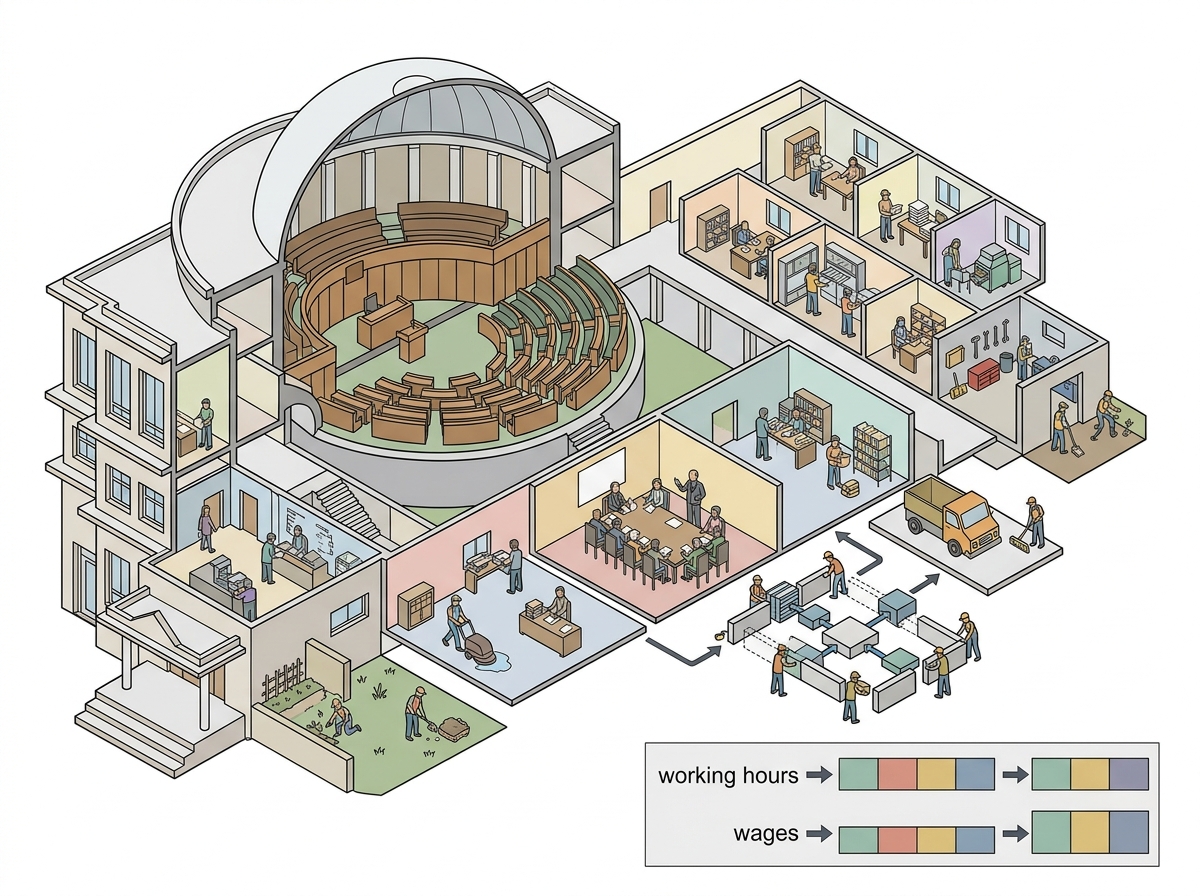
The Himachal Pradesh government has announced the formulation of a comprehensive policy for multi-task workers, ensuring the provision of minimum wages across departments. This initiative addresses the existing disparity in wages and working hours for such workers, who currently operate under fragmented departmental policies. The development underscores the state’s commitment to labour rights and social security within the broader framework of the Code on Wages, 2019.
Background
- The term ‘multi-task workers’ refers to employees engaged in multiple roles or tasks across various departments, often without standardised wage or working hour regulations.
- Currently, Himachal Pradesh lacks a unified policy for such workers, leading to inconsistencies in wages—ranging from 4 to 6 hours of work per day—and remuneration across departments.
- Himachal Pradesh’s initiative reflects a broader national trend toward formalising informal labour and addressing wage disparities in sectors like healthcare, education, and public services.
What are Multi-Task Workers and Why Do They Require Policy Intervention?
- Multi-task workers are individuals employed in roles that involve performing multiple functions or tasks, often across different departments or sectors, without standardised job descriptions or wage structures.
- Such workers are prevalent in sectors like healthcare (e.g., ANMs, ASHAs), education (e.g., para-teachers, multi-task staff), and public services, where flexibility in roles is necessary but often exploited due to lack of regulation.
- The absence of a unified policy leads to **wage disparities**, **inconsistent working hours**, and **lack of social security benefits**, exacerbating vulnerability among these workers.
- Policy interventions for multi-task workers must address **wage fixation**, **working hour regulations**, **social security coverage**, and **grievance redressal mechanisms** to ensure equity and dignity.
- Such policies also align with the **Sustainable Development Goals (SDG 8)**, particularly targets related to **decent work and economic growth**, by formalising informal labour and reducing wage gaps.
Key Features
| Feature | Significance |
|---|---|
| Formulation of a comprehensive policy for multi-task workers | Ensures uniform wage standards across departments, addressing disparities in remuneration and working hours. |
| Provision of minimum wages for multi-task workers | Guarantees a basic income floor, reducing exploitation and improving livelihood security for informal and contractual workforce. |
| Current lack of uniform policy across departments | Exposes inconsistencies in wage structures and working conditions, necessitating centralised regulation. |
| Technical education sector reforms | Highlights systemic gaps in infrastructure and staffing, necessitating quality-focused interventions over expansion. |
| Vacancy of 234 seats in technical institutions | Indicates underutilisation of resources due to inadequate planning, impacting skill development and employment outcomes. |
Why it Matters
Economic
- Introduces formalisation of a segment of the workforce, enhancing transparency and reducing wage arbitrage across departments.
- Minimum wage provisions may increase disposable income, potentially stimulating local economies in Himachal Pradesh.
- Addresses labour market inefficiencies by standardising employment conditions for multi-task workers.
Social
- Improves livelihood security for multi-task workers, a predominantly informal and vulnerable segment of the workforce.
- Reduces exploitation by ensuring a baseline income and regulated working hours.
- Promotes equity in wage distribution across government departments.
Institutional
- Demonstrates the need for coordinated policymaking across departments to avoid fragmentation in labour regulations.
- Highlights the role of state governments in addressing gaps in central labour laws for informal sectors.
- Sets a precedent for proactive labour policy reforms in other states.
Educational
- Underscores the importance of quality over quantity in technical education, aligning with national skill development priorities.
- Exposes systemic deficiencies in infrastructure and faculty, necessitating targeted interventions.
- Links labour market reforms to education policy, ensuring alignment between skills imparted and job market demands.
Challenges
1. Fragmented Labour Policy Framework
- Lack of uniform wage standards across departments leads to inequities and wage disparities.
- Inconsistent working hours (e.g., 4 hours vs. 6 hours) create confusion and exploitation risks.
- Absence of a centralised database for multi-task workers complicates policy implementation and monitoring.
UPSC Link: GS-III: Labour Reforms
2. Underutilisation of Technical Education Infrastructure
- Vacancies in technical institutions (234 seats) indicate poor utilisation of resources due to inadequate planning.
- Politically motivated expansion of institutions without ensuring staffing and infrastructure leads to systemic inefficiencies.
- Quality of education suffers due to lack of qualified faculty and modern facilities.
UPSC Link: GS-II: Education Policy
3. Implementation and Enforcement Gaps
- Ensuring compliance with minimum wage provisions across departments requires robust monitoring mechanisms.
- Addressing historical underfunding in technical education institutions demands sustained budgetary allocations.
- Coordination between multiple stakeholders (government, private sector, educational bodies) is essential for effective reform.
UPSC Link: GS-II: Governance
4. Labour Market Informality
- Multi-task workers often fall outside formal employment frameworks, limiting access to social security benefits.
- Lack of formal contracts increases vulnerability to arbitrary wage cuts and unsafe working conditions.
- Standardising wages and working conditions may face resistance from departments accustomed to informal labour practices.
UPSC Link: GS-III: Informal Sector
5. Resource Allocation and Prioritisation
- Balancing wage reforms with budgetary constraints requires careful prioritisation of expenditures.
- Redirecting funds from expansion to quality improvement in technical education necessitates political will.
- Ensuring equitable distribution of benefits across rural and urban areas poses logistical challenges.
UPSC Link: GS-III: Public Finance
Challenges — UPSC Perspective
| Issue | Concern |
|---|---|
| Lack of uniform wage standards | Creates inequities and exploitation risks for multi-task workers. |
| Inconsistent working hours across departments | Leads to confusion and potential labour rights violations. |
| Underutilisation of technical education seats | Indicates poor planning and resource wastage. |
| Politically driven expansion of institutions | Compromises quality due to inadequate staffing and infrastructure. |
| Enforcement gaps in labour policies | Undermines the effectiveness of proposed minimum wage provisions. |
| Informal employment practices | Excludes workers from social security benefits and formal protections. |
Way Forward
- Draft a comprehensive policy framework for multi-task workers, incorporating input from all relevant departments.
- Conduct a state-wide survey to assess the number of multi-task workers, their current wages, and working conditions.
- Establish a monitoring mechanism to track implementation of minimum wage provisions and working hour regulations.
- Prioritise quality improvement in technical education by filling faculty vacancies and upgrading infrastructure.
- Align technical education reforms with labour market demands to ensure skill development aligns with employment opportunities.
- Allocate dedicated funds for wage reforms and technical education improvements in the state budget.
- Strengthen inter-departmental coordination to ensure uniform enforcement of labour and education policies.
- Engage stakeholders, including worker unions and educational bodies, in the policy formulation and review process.
UPSC Value Addition
Keywords for Mains Answer-Writing
Labour policy formulation · Minimum wage determination · Multi-task workers · Unorganised labour · State government initiatives · Wage parity · Labour welfare schemes · Concurrent List · Constitutional provisions on labour · Policy coherence in labour governance
Concept Flow
Fragmented labour policies across departments → Exploitation of multi-task workers → Proposal for uniform minimum wage policy → Inadequate planning in technical education → Underutilisation of seats and infrastructure → Reform focus on quality over expansion → Politically motivated expansion of institutions → Systemic inefficiencies → Need for evidence-based policymaking → Implementation of wage reforms → Requires monitoring and enforcement → Ensures compliance and accountability → Labour market informality → Limited access to social security → Formalisation through policy reforms → Resource allocation challenges → Balancing wage reforms and education improvements → Prioritisation based on need and impact
Prelims Practice Questions
Q1. Consider the following statements regarding the constitutional provisions related to labour in India:
1. Labour is a subject under the Concurrent List of the Seventh Schedule of the Constitution.
2. The Minimum Wages Act, 1948, is a Central legislation that empowers the Central Government to fix minimum wages for certain employments.
3. The Code on Wages, 2019, subsumes and replaces four labour laws including the Minimum Wages Act, 1948.
How many of the above statements are correct?
- Only one
- Only two
- All three
- None
Answer: All three — Statements 1 and 3 are correct. Labour is indeed under the Concurrent List (Entry 22), and the Code on Wages, 2019, replaces the Minimum Wages Act, 1948. Statement 2 is incorrect as the Minimum Wages Act empowers both the Central and State Governments to fix minimum wages for employments specified in the Act.
Q2. Assertion (A): The Government of India has recently notified a national floor-level minimum wage to ensure wage parity across states.
Reason (R): The Code on Wages, 2019, empowers the Central Government to fix a floor wage that acts as a reference for state governments to determine their minimum wages.
- Both A and R are true, and R is the correct explanation of A.
- Both A and R are true, but R is not the correct explanation of A.
- A is true, but R is false.
- A is false, but R is true.
Answer: Both A and R are true, but R is not the correct explanation of A. — Both the assertion and reason are true. The Code on Wages, 2019, introduced the concept of a ‘floor wage’ to ensure a minimum standard across states, which aligns with the assertion.
Q3. Match the following columns related to labour policy and governance in India:
Column I (Policy/Initiative) | Column II (Year of Enactment/Implementation)
— | —
A. Minimum Wages Act | 1. 2019
B. Code on Wages | 2. 1948
C. Industrial Disputes Act | 3. 1947
D. Factories Act | 4. 1926
- A-2, B-1, C-3, D-4
- A-1, B-2, C-3, D-4
- A-2, B-1, C-4, D-3
- A-3, B-2, C-1, D-4
Answer: A-2, B-1, C-3, D-4 — The correct matches are: A (Minimum Wages Act) – 2 (1948), B (Code on Wages) – 1 (2019), C (Industrial Disputes Act) – 3 (1947), D (Factories Act) – 4 (1926).
Mains Practice Question
✍ The formulation of a state-level policy for multi-task workers, including the provision of minimum wages, reflects a significant shift in labour governance. Critically examine the challenges and opportunities such a policy presents for ensuring labour welfare and economic equity in India. (15 Marks)
Approach: MODEL-ANSWER SKELETON:
1. **Contextualisation**: Define multi-task workers and their significance in the unorganised sector. Highlight the current policy fragmentation across departments in states like Himachal Pradesh.
2. **Opportunities**:
– **Wage Equity**: Discuss how a unified minimum wage policy can reduce wage disparities and exploitation.
– **Social Security**: Link to the Code on Social Security, 2020, and the need for comprehensive social security coverage.
– **Productivity and Formalisation**: Explain how formalisation through wage regulation can enhance productivity and reduce informality.
– **Constitutional Basis**: Reference Entry 22 (Labour) of the Concurrent List and the Directive Principles of State Policy (Articles 38, 39, 41, 42, 43).
3. **Challenges**:
– **Implementation Gaps**: Discuss the challenges in monitoring and enforcing wage policies, especially in remote and rural areas.
– **Economic Viability**: Address concerns of small enterprises and the informal sector regarding cost implications.
– **Inter-state Coordination**: Highlight the need for coordination with the Central Government’s floor wage under the Code on Wages, 2019.
– **Data Deficiencies**: Emphasise the lack of reliable data on multi-task workers, complicating policy design.
4. **Comparative Perspective**: Briefly compare India’s approach with international models (e.g., ILO conventions, EU labour policies).
5. **Conclusion**: Summarise the need for a balanced policy that ensures labour welfare without stifling economic growth. Suggest measures like phased implementation, capacity building for enforcement agencies, and stakeholder consultations.
Source: amarujala.com
Himachal Pradesh PCS (HPPSC (HAS)) — State PCS Practice
Prelims: In the recent Himachal Pradesh Legislative Assembly session, Chief Minister Sukhvinder Singh Sukhu announced the formulation of a policy aimed at benefiting which specific group of workers?
- A. Seasonal agricultural laborers
- B. Multi-tasking workers in government departments
- C. Private sector employees in IT sector
- D. Unorganized sector workers in construction
Answer: B. Multi-tasking workers in government departments — The policy is being created specifically for multi-tasking workers in government departments to address their wage and work-related concerns.
Mains: Critically analyze the significance of the Himachal Pradesh government’s initiative to formulate a policy for multi-tasking workers in government departments. Discuss its potential socio-economic impact on the state’s workforce and governance.
Generated by AanyaAi for educational purpose.
Related guides on our sites
- Current affairs for upsc 2026
- Best PSIR optional coaching for upsc
- Best PSIR optional teacher for upsc
- Best teacher of PSIR optional for upsc

- India-Australia AUSTRAHIND 2026 Exercise: Key Highlights for UPSC & State PCS - October 22, 2026
- एससीओ बैठक में भारत का आतंकवाद विरोध: क्षेत्रीय सहयोग पर जोर - October 22, 2026
- SEC Directs Strict SC Order Compliance for Andhra ULB Polls - October 22, 2026

No Comments