


19 Jul Himachal CM Slams Union Budget, Raises 16th Finance Commission Concerns
Subject Relevance — Where This Topic Fits
- GS Paper II — Indian Constitution, Functions and Responsibilities of the Union and the States, Issues and Challenges Pertaining to the Federal Structure, Devolution of Powers and Finances up to Local Levels and Challenges Therein | GS Paper III — Indian Economy and Issues Relating to Planning, Mobilization of Resources, Growth, Development and Employment, Government Budgeting
- Prelims: Finance Commission, Article 280, Revenue Deficit Grants, Fiscal Federalism, Special Category States, Union Budget, Vertical Devolution, Horizontal Devolution, Article 275(1), Fiscal Capacity
- Essay: The evolving dynamics of fiscal federalism in India: Challenges and opportunities., Balancing economic growth with regional equity: The role of inter-governmental fiscal transfers.
Quick Revision: The 16th Finance Commission’s decision to discontinue Revenue Deficit Grants for some states raises critical questions about fiscal federalism, equitable resource allocation, and the unique challenges faced by special category hill states, necessitating a re-evaluation of support mechanisms for sustainable development.
Why is this in the news?
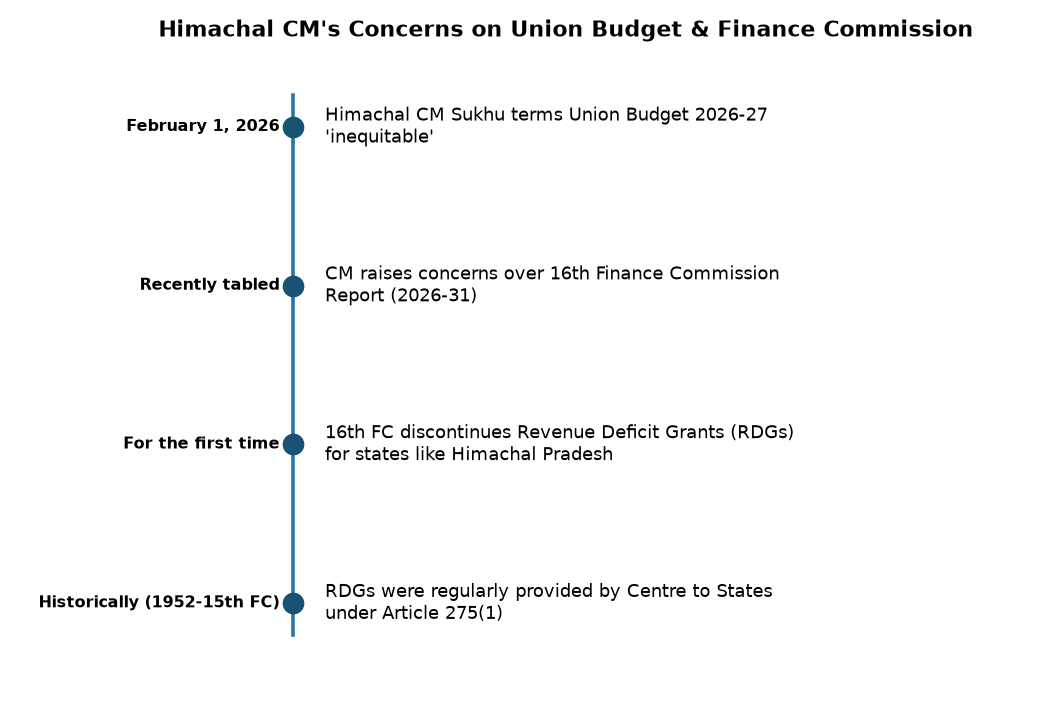
The Chief Minister of Himachal Pradesh, Sukhvinder Singh Sukhu, recently termed the Union Budget 2026-27 ‘inequitable’ and raised significant concerns regarding the 16th Finance Commission’s (FC-XVI) report for the period 2026-31. His primary contention was the Commission’s decision to discontinue Revenue Deficit Grants (RDGs) for smaller states, including Himachal Pradesh, which he argued overlooks the unique fiscal handicaps and development challenges faced by such states, particularly those with difficult terrain and fragile ecology.
Background
- The Finance Commission is a constitutional body established under Article 280 of the Indian Constitution, primarily tasked with recommending the distribution of tax revenues between the Union and the States, and among the States themselves.
- Revenue Deficit Grants (RDGs) are provided under Article 275(1) of the Constitution to states that face a revenue deficit post-devolution of taxes, ensuring they can meet their essential expenditure commitments.
- Historically, RDGs have been a crucial component of fiscal support for states, especially those with limited own-revenue bases or specific structural disadvantages.
- Himachal Pradesh, being a special category hill state, faces unique challenges such as high per-capita cost of service delivery, frequent natural disasters, and a significant proportion of forest and ecological cover, which limit its revenue generation capacity.
- The Union Budget outlines the government’s financial plans for the upcoming fiscal year, including revenue and expenditure estimates, and reflects the broader economic policy direction.
- The 16th Finance Commission was constituted to make recommendations for the period 2026-31, building upon the work of previous commissions and addressing contemporary fiscal challenges.
What is the Finance Commission and Revenue Deficit Grant?
- The Finance Commission (FC) is a quasi-judicial body constituted by the President of India every five years (or earlier) under Article 280 of the Constitution.
- Its primary function is to recommend the distribution of net proceeds of taxes between the Union and the States (vertical devolution) and among the States themselves (horizontal devolution).
- It also recommends the principles governing grants-in-aid to the States out of the Consolidated Fund of India, including Revenue Deficit Grants (RDGs).
- RDGs are specific grants provided to states under Article 275(1) of the Constitution to bridge the gap between their revenue expenditure and revenue receipts, after accounting for tax devolution.
- These grants aim to ensure that states can maintain fiscal stability and provide essential public services, especially those with inherent fiscal weaknesses or structural disadvantages.
- The criteria for recommending RDGs typically include a state’s fiscal capacity, expenditure needs, and efforts towards fiscal consolidation.
- The recommendations of the Finance Commission are advisory in nature but are usually accepted by the Union Government to maintain fiscal harmony and cooperative federalism.
- The 16th Finance Commission, constituted in December 2023, is tasked with making recommendations for the period 2026-31, with its report expected by October 2025.
Key Features
| Feature | Significance |
|---|---|
| Constitutional Mandate (Article 280) | Ensures periodic review of fiscal relations between Union and States, vital for federal balance. |
| Vertical Devolution | Determines the share of Union taxes to be transferred to the States, impacting their fiscal autonomy. |
| Horizontal Devolution | Establishes criteria for distributing the States’ share among them, addressing inter-state disparities. |
| Grants-in-Aid (Article 275) | Provides specific financial assistance to states, including RDGs, for specific purposes or to cover deficits. |
| Disaster Relief Funding | Recommends measures for financing disaster management, crucial for vulnerable states. |
| Local Bodies’ Finances | Suggests measures to augment the Consolidated Fund of a State to supplement resources of Panchayats and Municipalities. |
Why it Matters
Fiscal Federalism and Equity
- The Finance Commission’s recommendations are central to the practice of fiscal federalism in India, ensuring a fair and equitable distribution of financial resources between the Union and the States.
- RDGs play a crucial role in addressing horizontal fiscal imbalances, allowing less fiscally robust states to maintain essential public services and reduce regional disparities.
- The discontinuation of RDGs for certain states can exacerbate existing fiscal challenges, potentially leading to increased indebtedness or reduced capacity for public service delivery.
State Autonomy and Development
- Adequate fiscal transfers empower states to pursue their development priorities and respond to local needs without excessive reliance on discretionary central grants.
- For states like Himachal Pradesh, with unique geographical and ecological constraints, consistent fiscal support is vital for sustainable development and resilience against natural disasters.
- The absence of predictable revenue support can force states to make difficult choices between essential service delivery and long-term investments, hindering their growth trajectory.
Economic Stability and Welfare
- Robust fiscal health of states contributes to overall national economic stability and facilitates the implementation of welfare schemes.
- The ability of states to manage their finances effectively is critical for maintaining social welfare commitments and addressing issues like unemployment and poverty.
- Concerns raised by states highlight the need for a nuanced approach to fiscal transfers that considers the diverse socio-economic and geographical realities across the country.
Challenges
1. Discontinuation of Revenue Deficit Grants
- The 16th FC’s decision to discontinue RDGs for states like Himachal Pradesh poses a significant fiscal challenge.
- This omission overlooks structural fiscal handicaps such as high forest cover, higher per-capita cost of service delivery in mountainous terrain, and frequent natural disasters.
- It can constrain states’ ability to deliver essential public services, maintain fiscal sustainability, and invest in future growth, potentially leading to increased indebtedness.
UPSC Link: GS Paper II — Federal Structure; GS Paper III — Government Budgeting
2. Unique Challenges of Hill States
- Special category hill states face inherent disadvantages due to difficult terrain, fragile ecology, and limited own-revenue bases.
- These states often incur higher costs for infrastructure development and service delivery compared to plain states.
- The impact of natural disasters is disproportionately high, requiring substantial relief and rehabilitation efforts that strain state finances.
UPSC Link: GS Paper I — Geography; GS Paper II — Federal Structure
3. Fiscal Sustainability and Indebtedness
- Without adequate fiscal support, states may be forced to borrow more, increasing their debt burden and compromising long-term fiscal sustainability.
- This can lead to a vicious cycle where a larger portion of revenue is spent on debt servicing, leaving less for development and welfare.
- Maintaining fiscal balance and delivering essential public services becomes increasingly difficult under such circumstances.
UPSC Link: GS Paper III — Indian Economy; Government Budgeting
4. Impact on Specific Sectors
- The Union Budget’s perceived failure to address critical issues like unemployment, poverty, and escalating prices can have widespread socio-economic consequences.
- Specific sectors, such as apple growers in Himachal Pradesh, who contribute significantly to the state’s economy, may feel neglected without targeted support.
- This can lead to economic distress in key regional industries and impact the livelihoods of thousands of families.
UPSC Link: GS Paper III — Economy; Agriculture
5. Erosion of Cooperative Federalism
- Unaddressed concerns from states regarding fiscal transfers can strain Union-State relations and undermine the spirit of cooperative federalism.
- A perception of inequity in resource allocation can lead to political friction and hinder collaborative efforts on national development agendas.
- The effectiveness of national policies often depends on the willing cooperation and financial capacity of state governments.
UPSC Link: GS Paper II — Federal Structure; Union-State Relations
Challenges — UPSC Perspective
| Issue | Concern |
|---|---|
| Discontinuation of RDGs | Loss of critical fiscal support for states with structural handicaps. |
| High Per-Capita Service Cost | Mountainous terrain leads to increased expenditure for service delivery. |
| Fragile Ecology & Disasters | Frequent natural calamities cause significant economic losses and strain state budgets. |
| Limited Own-Revenue Base | States like Himachal Pradesh have fewer avenues for generating substantial internal revenue. |
| Fiscal Sustainability | Absence of grants may force states into higher borrowing and increased indebtedness. |
| Sectoral Neglect | Union Budget perceived to overlook key sectors like horticulture, impacting state economies. |
Government Initiatives — Must-Memorise for Prelims
- Centrally Sponsored Schemes (CSS)
- National Disaster Response Fund (NDRF)
- State Disaster Response Fund (SDRF)
- Pradhan Mantri Gram Sadak Yojana (PMGSY)
- Jal Jeevan Mission (JJM)
- National Health Mission (NHM)
- Mahatma Gandhi National Rural Employment Guarantee Act (MGNREGA)
- Rashtriya Krishi Vikas Yojana (RKVY)
- Horticulture Mission for North East & Himalayan States (HMNEH)
- Special Assistance to States for Capital Expenditure
Way Forward
- The 16th Finance Commission should reconsider the unique fiscal challenges of states like Himachal Pradesh, particularly those with difficult terrain and ecological vulnerabilities, when formulating recommendations for grants.
- A clear and predictable framework for continued Revenue Deficit Grants (RDGs) or similar compensatory mechanisms should be established for states facing structural fiscal handicaps.
- The Union Budget should incorporate specific provisions and targeted schemes to address the economic concerns of key sectors and regions, such as horticulture in hill states.
- Enhance the disaster management framework with robust financial support mechanisms to help states recover from frequent natural calamities without undue fiscal strain.
- Promote greater dialogue and consultation between the Union and State governments to foster a more cooperative and responsive fiscal federalism.
- Explore innovative revenue generation avenues for states, coupled with capacity building initiatives, to reduce their dependence on central transfers in the long run.
- The criteria for horizontal devolution should be periodically reviewed to ensure they adequately capture the diverse needs and fiscal capacities of all states, promoting equity.
- Implement a transparent mechanism for assessing and addressing the ‘per-capita cost of service delivery’ in geographically challenging regions to ensure equitable resource allocation.
UPSC Value Addition
Keywords for Mains Answer-Writing
Fiscal Federalism · Revenue Deficit Grants · Finance Commission · Article 280 · Article 275(1) · Cooperative Federalism · Horizontal Imbalances · Vertical Imbalances · Special Category Status · State Fiscal Autonomy · Union-State Financial Relations · Disaster Management Funding · Sustainable Development Goals (SDGs) · Inclusive Growth
Constitutional & Policy Linkages
- Article 280: Constitution of Finance Commission
- Article 275(1): Grants from the Union to certain States
- Article 268-279: Provisions relating to distribution of revenues between the Union and the States
- Seventh Schedule: Distribution of legislative powers (Union List, State List, Concurrent List)
- Article 293: Borrowing by States
- Article 360: Financial Emergency
Concept Flow
State faces structural fiscal handicaps (e.g., difficult terrain, high disaster risk). → Limited own-revenue base and higher expenditure needs. → Reliance on central transfers, including Revenue Deficit Grants (RDGs). → 16th Finance Commission discontinues RDGs for some states. → State faces increased revenue deficit and fiscal strain. → Compromised ability to deliver public services and invest in growth. → Potential for increased indebtedness and regional disparities.
Prelims Practice Questions
Q1. Which of the following statements regarding the Finance Commission in India is/are correct?
1. It is a statutory body constituted by the President of India every five years.
2. It recommends the distribution of net proceeds of taxes between the Union and the States.
3. Revenue Deficit Grants are provided under Article 275(1) of the Constitution based on its recommendations.
Select the correct answer using the code given below:
- A. 1 and 2 only
- B. 2 and 3 only
- C. 1 and 3 only
- D. 1, 2 and 3
Answer: B. 2 and 3 only — Statement 1 is incorrect: The Finance Commission is a constitutional body (Article 280), not a statutory body. Statement 2 is correct: It recommends vertical and horizontal devolution of taxes. Statement 3 is correct: Article 275(1) provides for grants-in-aid, including RDGs, based on FC recommendations.
Q2. Consider the following factors that might contribute to a state’s fiscal handicap:
1. High forest and ecological cover.
2. Higher per-capita cost of service delivery in mountainous terrain.
3. Frequent natural disasters causing significant losses.
4. High population density.
Which of the factors mentioned above are likely to be considered by a Finance Commission while assessing a state’s need for special grants?
- A. 1 and 4 only
- B. 2, 3 and 4 only
- C. 1, 2 and 3 only
- D. 1, 2, 3 and 4
Answer: C. 1, 2 and 3 only — Factors 1, 2, and 3 directly contribute to a state’s structural fiscal handicaps by limiting revenue generation or increasing expenditure needs, and are typically considered for special grants. High population density (factor 4) might increase overall expenditure but is usually addressed through general devolution criteria rather than specific ‘handicap’ grants, and can also be a source of revenue.
Mains Practice Question
✍ Critically examine the implications of the 16th Finance Commission’s decision to discontinue Revenue Deficit Grants for certain states on India’s fiscal federalism. Discuss the unique challenges faced by special category hill states and suggest measures to ensure equitable resource allocation and sustainable development in such regions. (250 words)
Approach: Begin by defining fiscal federalism and the role of the Finance Commission and Revenue Deficit Grants. Critically analyze the implications of discontinuing RDGs, focusing on potential fiscal strain, increased indebtedness, and impact on public services for affected states. Elaborate on the unique challenges of special category hill states, such as geographical constraints, high service delivery costs, and disaster vulnerability. Conclude by suggesting a multi-pronged approach including reconsideration of grant frameworks, targeted central support, enhanced disaster financing, and greater Union-State dialogue to foster equitable resource allocation and sustainable development.
Source: The Hindu
Generated by AanyaAi for educational purpose.

- Shivraj Singh Chouhan launches ‘Khet Bachao Abhiyan’ to save farmland - October 23, 2026
- उत्तराखंड राज्यपाल की पीएम मोदी से महत्वपूर्ण बैठक: जानिए मुख्य बिंदु - October 23, 2026
- How India’s Rs 20,000 Cr CCUS Budget Can Drive Net-Zero Goals - October 23, 2026

No Comments