


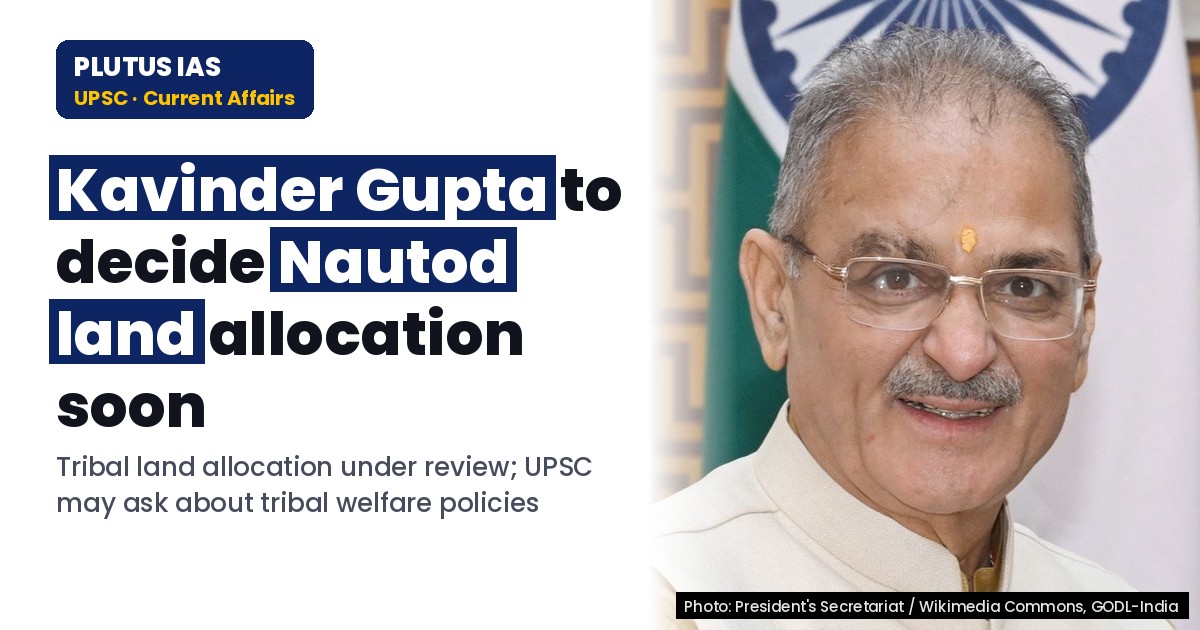
02 Oct Himachal Pradesh Governor to Decide on Nautod Land Soon: Key UPSC Topic
✎ The Governor of Himachal Pradesh has directed district authorities to expedite decisions on Nautod land allocation in tribal areas, highlighting the need for transparent, legally compliant guidelines under the Fifth Schedule and…
Subject Relevance — Where This Topic Fits
- GS Paper II — Functions and Responsibilities of the Union and the States | GS Paper III — Land Reforms and Issues Relating to Tribal Areas
- Prelims: Nautod land, Scheduled Areas under Fifth Schedule, Forest (Conservation) Act, 1980, Governor’s discretionary powers under Article 239 and Fifth Schedule, Tribal Sub-Plan
- Essay: Role of Governors in State Administration: Balancing Constitutional Duties and Executive Support, Tribal Rights and Land Reforms: Challenges in Sustainable Development
Quick Revision: The Governor of Himachal Pradesh has directed district authorities to expedite decisions on Nautod land allocation in tribal areas, highlighting the need for transparent, legally compliant guidelines under the Fifth Schedule and the Forest (Conservation) Act, 1980.
Why is this in the news?
The Governor of Himachal Pradesh has directed district authorities to expedite a decision on the long-pending ‘Nautod’ land allocation in tribal areas, following a second meeting with the state Revenue Minister. This directive underscores the intersection of constitutional provisions, forest laws, and land reform policies in Scheduled Areas, with implications for tribal livelihoods and migration control.
Background
- The term ‘Nautod’ refers to a traditional land tenure system in Himachal Pradesh’s tribal regions, where land is allocated to eligible families for cultivation and habitation.
- The issue has remained unresolved for decades, with approximately 20,000 pending applications at the sub-divisional level, as reported by the state government.
- Tribal communities in Himachal Pradesh, particularly in districts like Kinnaur, Lahaul-Spiti, and Chamba, rely heavily on land for livelihoods, and unresolved land disputes contribute to out-migration.
- The state government has sought exemptions under the Forest (Conservation) Act, 1980, to facilitate land allocation, citing the need for tribal welfare and sustainable development.
- The matter is governed by constitutional provisions under the Fifth Schedule of the Constitution, which empowers Governors to regulate land administration in Scheduled Areas.
- Previous directives from the Governor’s office have emphasized the need for transparent, uniform, and legally compliant guidelines for Nautod land allocation.
What is ‘Nautod’ Land and the Legal Framework Governing Its Allocation?
- ‘Nautod’ land is a form of customary land tenure prevalent in the tribal regions of Himachal Pradesh, where land is traditionally allocated to eligible families for agricultural and residential purposes.
- The allocation of Nautod land is governed by constitutional provisions and forest laws, and local customs, but its implementation has been inconsistent due to legal and administrative challenges.
- The Fifth Schedule of the Constitution empowers the Governor of a state to regulate land administration in Scheduled Areas, including the power to make regulations for the welfare of Scheduled Tribes.
- The Forest (Conservation) Act, 1980, imposes restrictions on the diversion of forest land for non-forest purposes, which has created a legal bottleneck in the allocation of Nautod land, as much of the land in tribal areas falls under forest or revenue records.
- The state government’s request for exemptions under the Forest (Conservation) Act, 1980, reflects the need to reconcile tribal land rights with environmental conservation goals.
- The Governor’s role in this context is both constitutional (as the head of the Tribal Advisory Council) and administrative (as the constitutional head of the state), requiring a balance between executive support and impartial oversight.
- The pending applications for Nautod land allocation highlight systemic delays in land reform implementation, despite the existence of legal provisions and policy frameworks.
- Resolving the Nautod land issue is critical for addressing tribal livelihoods, reducing migration, and ensuring equitable access to land resources in Scheduled Areas.
Key Features
| Feature | Significance |
|---|---|
| Nautod land allocation | Aims to provide land rights to tribal families in Himachal Pradesh, potentially enhancing livelihood opportunities and reducing migration from tribal areas. |
| Governor’s intervention | The constitutional role of the Governor in ensuring timely resolution of pending administrative matters, particularly in scheduled areas. |
| Revenue, Horticulture & Tribal Development Ministry | The nodal department responsible for implementing land reforms and tribal welfare policies in the state. |
| District administration’s role | Submission of detailed reports to the Governor’s office for review of pending cases, legal status, and procedural gaps. |
| Forest (Conservation) Act, 1980 | Regulates diversion of forest land for non-forest purposes, posing a legal hurdle to land allocation under Nautod provisions. |
Why it Matters
Economic
- Land rights under Nautod can enhance agricultural productivity and economic stability for tribal communities by providing legal ownership of land.
- Reduction in migration from tribal areas may alleviate pressure on urban infrastructure and contribute to balanced regional development.
- Potential for increased investment in tribal areas if land tenure security improves, fostering local enterprises and agro-based industries.
Social
- Addressing long-pending land disputes in tribal areas can improve social cohesion and trust in government institutions.
- Land ownership may empower women in tribal societies, traditionally marginalized in land-related decision-making processes.
- Legal clarity on land rights can reduce conflicts over land use and ownership within tribal communities.
Administrative
- The Governor’s proactive role underscores the importance of constitutional oversight in ensuring timely implementation of welfare schemes in scheduled areas.
- District-level coordination between revenue, forest, and tribal departments is critical for resolving procedural bottlenecks.
- Transparent eligibility criteria and grievance redressal mechanisms are essential to prevent future disputes.
Legal
- The case highlights the tension between land reform policies and forest conservation laws, necessitating careful legal interpretation.
- Constitutional provisions for scheduled areas (Fifth Schedule) mandate special safeguards for tribal land rights, which must be balanced with developmental needs.
Challenges
1. Legal and Procedural Bottlenecks
- Forest (Conservation) Act, 1980 imposes stringent conditions for diversion of forest land, complicating land allocation under Nautod provisions.
- Lack of uniform, transparent eligibility criteria for Nautod land allocation has led to inconsistencies and delays in processing applications.
- Pending applications (reportedly ~20,000) require exhaustive verification of land records, tribal status, and encroachment issues.
UPSC Link: Forest Conservation Act, 1980; Fifth Schedule
2. Inter-departmental Coordination
- Multiple agencies (Revenue, Forest, Tribal Development) must align their processes, but bureaucratic silos often delay decision-making.
- District administrations face challenges in reconciling local customs with statutory requirements for land allocation.
- Absence of a unified digital platform for land records and application tracking exacerbates delays and opacity.
UPSC Link: District Administration and Land Reforms
3. Tribal Land Rights and Customs
- Tribal communities often rely on customary land tenure systems, which may not align with statutory land records.
- Historical land alienation and encroachments complicate verification of genuine claims under Nautod provisions.
- Cultural sensitivities around land ownership and inheritance require careful handling to avoid social disruptions.
UPSC Link: Fifth Schedule and Tribal Rights
4. Governance and Oversight
- Ensuring timely resolution of pending cases requires sustained political will and administrative efficiency.
- The Governor’s intervention, while constitutional, must be balanced with the elected government’s autonomy to avoid overreach.
- Public grievance redressal mechanisms need strengthening to address misinformation and ensure equitable distribution.
UPSC Link: Role of Governor in State Administration
Challenges — UPSC Perspective
| Issue | Concern |
|---|---|
| Forest land diversion | Strict provisions under the Forest (Conservation) Act, 1980 hinder land allocation for tribal use. |
| Pending applications | Approximately 20,000 applications await processing, reflecting systemic delays in land reforms. |
| Lack of uniform criteria | Inconsistent eligibility norms across districts lead to inequities and disputes. |
| Inter-departmental delays | Coordination gaps between Revenue, Forest, and Tribal Development departments stall progress. |
| Tribal customs vs. statutory records | Customary land tenure systems clash with formal land records, complicating verification. |
Government Initiatives — Must-Memorise for Prelims
- Nautod Land Allocation Scheme (Himachal Pradesh)
Way Forward
- Constitute a high-powered committee comprising representatives from Revenue, Forest, and Tribal Development departments to expedite case reviews.
- Develop a unified digital portal for Nautod land applications, integrating land records, tribal status verification, and application tracking.
- Formulate transparent, district-wise eligibility criteria for Nautod land allocation, incorporating tribal customs and statutory provisions.
- Conduct awareness campaigns in tribal areas to educate communities about Nautod provisions, eligibility, and application processes.
- Strengthen inter-departmental coordination by establishing monthly review meetings at the district and state levels.
- Ensure timely submission of district-level reports to the Governor’s office, with clear timelines for case resolution.
- Explore legal avenues for exemptions under the Forest (Conservation) Act, 1980, where tribal welfare objectives justify land diversion.
- Institute a grievance redressal mechanism for rejected applications, with provisions for appeals and re-verification.
UPSC Value Addition
Keywords for Mains Answer-Writing
Nautod land allocation · Scheduled Areas and Scheduled Tribes (Part X) · Forest (Conservation) Act, 1980 · Governor’s discretionary powers under Article 239 · Tribal land rights · Revenue administration in tribal regions · Constitutional safeguards for tribal areas · Land reforms and tribal welfare · Role of District Magistrate (Deputy Commissioner) · Judicial review of executive decisions
Constitutional & Policy Linkages
- Fifth Schedule (Constitution of India) — Special provisions for administration and control of scheduled areas.
- Article 244(1) — Governance framework for scheduled areas.
Concept Flow
Tribal land alienation and historical grievances → Long-pending Nautod applications → Governor’s intervention for expedited resolution → District administration’s report submission → Legal review under Forest (Conservation) Act, 1980 → Inter-departmental coordination for eligibility criteria → Land allocation to eligible tribal families → Enhanced livelihoods and reduced migration.
Prelims Practice Questions
Q1. Consider the following statements regarding the ‘Nautod’ land allocation issue in Himachal Pradesh:
1. The term ‘Nautod’ refers to a specific type of agricultural land reserved for tribal communities under the Forest (Conservation) Act, 1980.
2. The Governor of Himachal Pradesh has sought a report from the Deputy Commissioners of concerned districts to expedite the decision on Nautod land allocation.
3. The allocation of Nautod land is governed by the provisions of the Fifth Schedule of the Constitution.
4. The Forest (Conservation) Act, 1980, allows for blanket exemptions to tribal communities for land use without any conditions.
How many of the above statements are correct?
- Only one
- Only two
- Only three
- All four
Answer: Only three — Statements 2 and 3 are correct. Statement 1 is incorrect as ‘Nautod’ is not a defined term under the Forest (Conservation) Act, 1980. Statement 4 is incorrect as the Act does not provide blanket exemptions but requires compliance with certain conditions.
Q2. Assertion (A): The Governor of a State in India can exercise discretionary powers in matters related to tribal land rights without the advice of the Council of Ministers.
Reason (R): The Fifth Schedule of the Constitution empowers the Governor to make regulations for the peace and good government of Scheduled Areas.
Options:
A. Both A and R are true, and R is the correct explanation of A.
B. Both A and R are true, but R is not the correct explanation of A.
C. A is true, but R is false.
D. A is false, but R is true.
Answer: ? — Both the Assertion and Reason are true. The Governor can exercise discretionary powers in matters related to tribal areas under the Fifth Schedule, and the Reason correctly explains the Assertion.
Mains Practice Question
✍ Critically examine the constitutional and legal framework governing the allocation of tribal land in Scheduled Areas, with particular reference to the ‘Nautod’ land issue in Himachal Pradesh. Also, analyse the role of the Governor and the District Administration in facilitating or hindering such allocations. (15 Marks)
Approach: MODEL-ANSWER SKELETON:
1. **Constitutional Framework**:
– Fifth Schedule of the Constitution: Role of the Governor in Scheduled Areas (Article 244(1), Provisions of the Fifth Schedule).
– PESA Act, 1996: Extent of tribal self-governance and land rights.
– Constitutional safeguards for tribal areas (Article 244(1) and Sixth Schedule where applicable).
2. **Legal Framework**:
– Forest (Conservation) Act, 1980: Provisions restricting diversion of forest land and exemptions for tribal communities.
– Himachal Pradesh Land Revenue Act, 1954: Provisions related to land allocation and revenue administration.
– Judicial precedents: Landmark judgments such as Samata v. State of Andhra Pradesh (1997) and Orissa Mining Corporation v. Ministry of Environment and Forests (2013) on tribal land rights.
3. **Institutional Roles**:
– Governor’s discretionary powers under the Fifth Schedule: Scope and limitations (Article 239, Governor’s role in Scheduled Areas).
– Role of the District Magistrate (Deputy Commissioner): Functions in land revenue administration and implementation of tribal welfare schemes.
– Executive vs. judicial balance: How land allocation decisions are subject to judicial review.
4. **Contemporary Challenges**:
– Delays in land allocation: Causes such as bureaucratic hurdles, legal ambiguities, and political considerations.
– Impact on tribal livelihoods: Link to migration, economic dependency, and social justice.
– Recent initiatives: Himachal Pradesh’s efforts to streamline Nautod land allocation and the role of the Governor in expediting decisions.
5. **Critical Analysis**:
– Evaluate whether the existing framework adequately protects tribal land rights or if reforms are needed.
– Discuss the balance between conservation (Forest Act) and tribal welfare (land rights).
– Suggest measures for expeditious and transparent allocation of tribal land.
Source: amarujala.com
Himachal Pradesh PCS (HPPSC (HAS)) — State PCS Practice
Prelims: As per the recent statement by Himachal Pradesh Governor Kavinder Gupta regarding the ‘Nautod’ land issue, what immediate action has been directed to expedite the resolution?
- A. Formation of a special task force under the Chief Secretary
- B. Submission of a report by the Deputy Commissioner within a stipulated timeframe
- C. Direct intervention by the High Court of Himachal Pradesh
- D. Immediate survey by the Revenue Department across all affected districts
Answer: B. Submission of a report by the Deputy Commissioner within a stipulated timeframe — The Governor directed the Deputy Commissioner to submit a report on the ‘Nautod’ land issue to facilitate an early decision.
Mains: Discuss the constitutional and administrative implications of the Governor’s directive to the Deputy Commissioner regarding the ‘Nautod’ land issue in Himachal Pradesh. How does this align with the principles of federalism and the role of the Governor in state governance?
Generated by AanyaAi for educational purpose.
Related guides on our sites
- Best PSIR optional coaching for upsc
- Best economics optional coaching for upsc
- Best PSIR optional teacher for upsc
- Best teacher of PSIR optional for upsc

- Himachal Pradesh Governor to Decide on Nautod Land Soon: Key UPSC Topic - October 2, 2026
- तमिलनाडु में पहली बार शुरू हुई बाधारहित बहु-पथ मुक्त-आवागमन पथकर प्रणाली, जानिए इसके फायदे - October 2, 2026
- Bhashini’s Multilingual AI Solutions Showcased in J&K 2.0 Expo - October 2, 2026

No Comments