


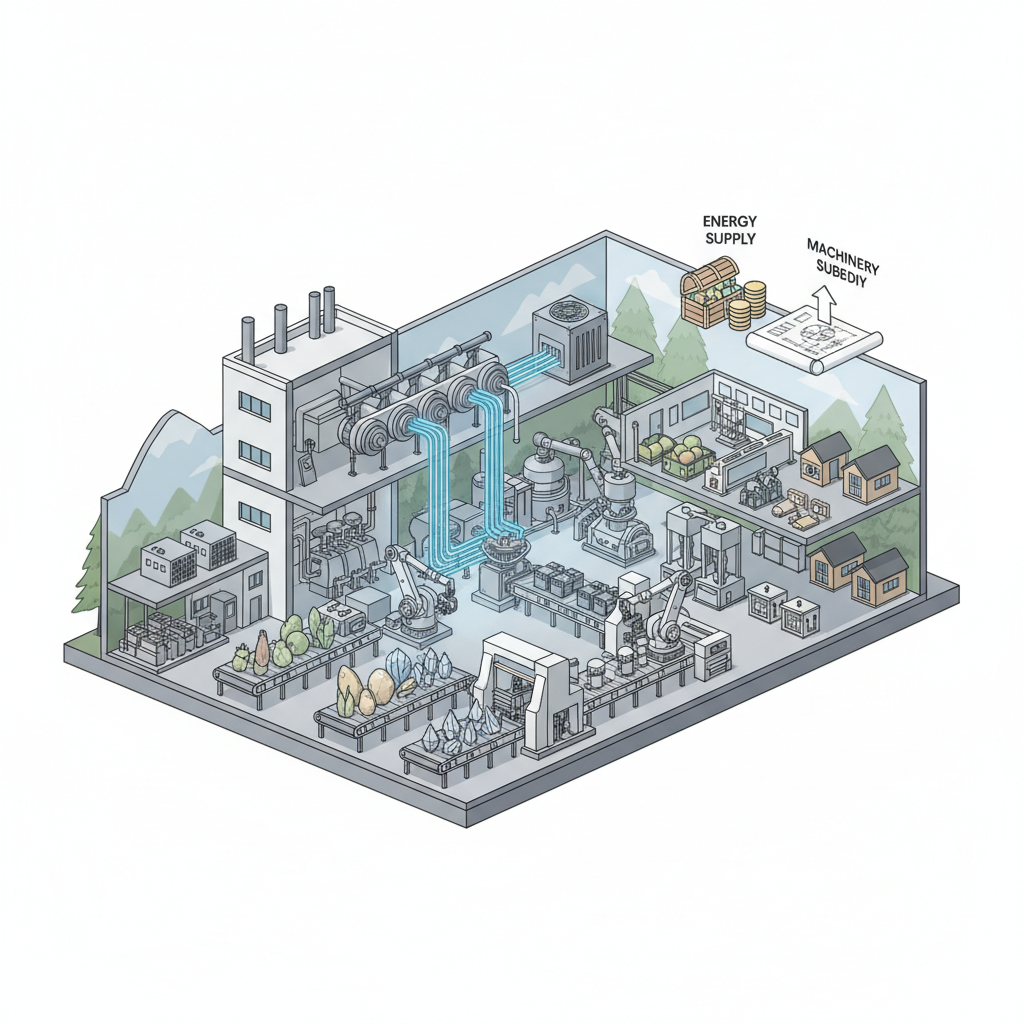
25 Sep Himachal Pradesh’s New Industrial Policy 2026: Key Subsidies & Cheaper Power
✎ Himachal Pradesh’s Draft Industrial Policy 2026 proposes machinery subsidies and concessional power tariffs to attract investment, expand industries, and generate employment, aligning with constitutional provisions and national…
Subject Relevance — Where This Topic Fits
- GS Paper III — Indian Economy: Industrial Policy, Investment Promotion, and Subsidies | GS Paper III — Infrastructure: Energy Pricing and Industrial Power Supply
- Prelims: Industrial Policy, Subsidies on Machinery, Ease of Doing Business, State Industrial Policies, Power Tariffs for Industries, Investment Attraction
- Essay: Industrialisation and Sustainable Development: Balancing Growth with Environmental and Fiscal Constraints
Quick Revision: Himachal Pradesh’s Draft Industrial Policy 2026 proposes machinery subsidies and concessional power tariffs to attract investment, expand industries, and generate employment, aligning with constitutional provisions and national industrialisation goals.
Why is this in the news?
The Himachal Pradesh government is preparing to notify a new Industrial Policy by 11 October 2026, replacing the existing policy that has been granted a two-month extension. The draft policy introduces fiscal incentives such as subsidies on machinery procurement and reduced electricity tariffs to stimulate industrial investment, expand existing industries, and enhance employment opportunities in the state. This initiative reflects a broader strategy to improve the state’s industrial competitiveness and align with national objectives of promoting manufacturing and ease of doing business.
Background
- Himachal Pradesh’s industrial ecosystem is predominantly micro, small, and medium-scale, with a focus on agro-based, pharmaceutical, and tourism-linked industries.
- The state’s geographical constraints, high logistics costs, and limited land availability necessitate targeted fiscal and regulatory interventions to attract investment.
- The existing Industrial Policy of Himachal Pradesh, framed in 2019, is set to expire on 11 October 2026, prompting the urgency to finalise a new policy.
- Industrial policies in Indian states are instruments to operationalise constitutional provisions under Article 246 (State List: Industries).
- Subsidies on machinery and concessional power tariffs are common fiscal tools used by state governments to incentivise capital-intensive industries, particularly in hilly and industrially lagging regions.
- The policy aligns with the national vision of ‘Make in India’ and state-led industrialisation under the ‘Ease of Doing Business’ reforms.
What is the Himachal Pradesh Draft Industrial Policy 2026?
- The Himachal Pradesh Draft Industrial Policy 2026 is a state-level policy framework designed to promote industrial growth, attract investment, and enhance employment by offering fiscal incentives and regulatory simplifications.
- Key proposals include subsidies on machinery procurement to reduce initial capital expenditure for new and expanding industries, and reduced electricity tariffs to lower operational costs.
- The policy aims to improve the state’s industrial competitiveness by addressing challenges such as high power costs, limited land availability, and logistical constraints.
- It seeks to operationalise the state’s constitutional authority under the State List (Industries) and Concurrent List (Economic and Social Planning) to foster industrial development.
- The policy is expected to be notified by 11 October 2026, following approval by the Chief Minister and formal gazette notification.
- Industrial policies in India are typically structured around four pillars: fiscal incentives, infrastructure development, regulatory reforms, and institutional support.
- Subsidies on machinery are usually provided as a percentage of the capital investment, with eligibility criteria based on industry type, location, and employment generation potential.
- Reduced electricity tariffs for industries are often tied to time-bound commitments, such as minimum investment or employment generation, to ensure accountability.
Key Features
| Feature | Significance |
|---|---|
| Subsidies on machinery | Reduces initial capital expenditure for new and expanding industries, enhancing investment attractiveness in Himachal Pradesh. |
| Reduced electricity tariffs | Lowers operational costs for industries, particularly energy-intensive sectors, improving competitiveness. |
| Ease of Doing Business reforms | Streamlines regulatory processes to attract investment and facilitate industrial growth. |
| Employment generation focus | Aims to create job opportunities through industrial expansion and new investments. |
| Policy continuity mechanism | Extension of the existing industrial policy ensures stability during the transition to the new framework. |
Why it Matters
Economic Growth
- Stimulates industrialisation in Himachal Pradesh by reducing financial barriers for investors.
- Enhances the state’s GDP contribution through increased industrial output and value addition.
- Promotes diversification of the industrial base beyond traditional sectors like horticulture and tourism.
Strategic Development
- Aligns with national objectives of promoting balanced regional industrial growth and reducing inter-state disparities.
- Supports the ‘Make in India’ initiative by fostering a conducive environment for manufacturing units.
- Leverages Himachal Pradesh’s geographical advantages, such as hydroelectric power potential, for industrial sustainability.
Governance and Policy
- Demonstrates proactive state-level policy formulation to address economic challenges and opportunities.
- Highlights the role of state governments in implementing sector-specific reforms under cooperative federalism.
- Emphasises the importance of periodic policy reviews to adapt to evolving economic conditions.
Challenges
1. Fiscal Sustainability
- Subsidies and reduced tariffs may strain state finances, necessitating careful budgetary planning.
- Long-term viability of financial incentives depends on sustained revenue generation from industrial growth.
UPSC Link: GS-III: Fiscal Policy
2. Infrastructure Constraints
- Limited industrial infrastructure, including land availability and connectivity, may hinder policy implementation.
- Dependence on hydroelectric power for reduced tariffs raises concerns about seasonal variability and environmental impact.
UPSC Link: GS-III: Infrastructure
3. Environmental Considerations
- Industrial expansion must balance economic growth with environmental sustainability, particularly in ecologically sensitive regions.
- Stringent compliance with environmental norms may increase operational costs for industries.
UPSC Link: GS-III: Environment & Ecology
4. Skilled Labour Availability
- Limited availability of skilled labour in the state may constrain industrial growth despite policy incentives.
- Vocational training and skill development initiatives are essential to meet industry demands.
UPSC Link: GS-III: Human Resource Development
5. Policy Implementation Gaps
- Effective execution of the policy requires coordination among multiple stakeholders, including state departments and local bodies.
- Monitoring and evaluation mechanisms are crucial to assess the impact and address implementation challenges.
UPSC Link: GS-II: Governance
Challenges — UPSC Perspective
| Issue | Concern |
|---|---|
| Fiscal sustainability of subsidies | Potential strain on state finances due to revenue foregone from tax exemptions and subsidies. |
| Infrastructure bottlenecks | Inadequate industrial land, power transmission networks, and transport connectivity. |
| Environmental compliance | Balancing industrial growth with ecological preservation in a Himalayan state. |
| Labour market mismatch | Shortage of skilled workforce to support expanding industries. |
| Bureaucratic delays | Risk of slow approval processes undermining the policy’s ease of doing business objectives. |
Way Forward
- Finalise subsidy rates and electricity tariff reductions through stakeholder consultations and economic impact assessments.
- Develop a phased rollout plan for subsidies and tariff reliefs to ensure fiscal prudence and phased industrial absorption.
- Strengthen industrial infrastructure by identifying and developing industrial corridors and clusters with private sector participation.
- Establish skill development centres in collaboration with industries to address labour market gaps.
- Create a single-window clearance system for industrial approvals to reduce bureaucratic delays.
- Monitor policy implementation through a dedicated task force with quarterly reviews and corrective measures.
- Promote renewable energy integration to ensure long-term sustainability of reduced electricity tariffs.
- Engage with industry associations to gather feedback and refine policy provisions for better alignment with market needs.
UPSC Value Addition
Keywords for Mains Answer-Writing
Industrial Policy 2026 · Subsidies on machinery · Ease of Doing Business · State-level industrial policy · Investment promotion · Employment generation · Electricity tariff rationalisation · Himachal Pradesh · Industrialisation in hill states · Sub-national economic governance · Ease of Doing Business reforms · Fiscal incentives for industry · Industrial competitiveness
Concept Flow
State-level industrial policy formulation → Economic growth objectives → Investment incentives (subsidies, tariffs) → Industrial expansion → Employment generation → Revenue augmentation → Fiscal sustainability challenges → Environmental and infrastructure constraints → Policy refinement and implementation.
Prelims Practice Questions
Q1. Consider the following statements regarding the proposed Himachal Pradesh Industrial Policy 2026:
1. The policy proposes subsidies on machinery to reduce initial investment costs for industries.
2. The policy includes provisions for cheaper electricity tariffs to lower production costs.
3. The policy aims to reduce the Goods and Services Tax (GST) rates for industrial inputs.
How many of the above statements are correct?
- Only one
- Only two
- All three
- None
Answer: Only two — Statements 1 and 2 are correct as per the proposed policy. Statement 3 is incorrect as the policy does not mention any changes to GST rates.
Q2. Assertion (A): State industrial policies often include fiscal incentives such as subsidies and tax concessions to attract investment.
Reason (R): Such incentives are designed to improve the ease of doing business and enhance industrial competitiveness within the state.
Options:
A. Both A and R are true, and R is the correct explanation of A.
B. Both A and R are true, but R is NOT the correct explanation of A.
C. A is true, but R is false.
D. A is false, but R is true.
Answer: ? — Both Assertion (A) and Reason (R) are true, and Reason (R) correctly explains Assertion (A) as fiscal incentives are a standard tool in state industrial policies to improve the business environment.
Mains Practice Question
✍ Critically examine the role of state-level industrial policies in promoting industrialisation in hill states like Himachal Pradesh. In your answer, discuss the proposed fiscal incentives in the Himachal Pradesh Industrial Policy 2026 and their potential impact on investment, employment, and industrial competitiveness. (15 Marks)
Approach: MODEL-ANSWER SKELETON:
1. **Introduction (2 marks)**: Define industrial policy and its significance for hill states, highlighting challenges like geographical constraints, high logistics costs, and limited industrial base.
2. **Role of State Industrial Policies (3 marks)**:
– Discuss how state governments use industrial policies to attract investment, create employment, and foster economic growth.
– Reference constitutional provisions: Art. 246 (7th Schedule) and Art. 254 (concurrent powers on industries and electricity).
– Cite examples of successful state policies (e.g., Gujarat, Tamil Nadu) and their impact.
3. **Proposed Incentives in HP Industrial Policy 2026 (4 marks)**:
– **Subsidies on machinery**: Reduce capital expenditure for new and expanding industries.
– **Cheaper electricity**: Rationalise tariffs to lower production costs and improve competitiveness.
– **Ease of Doing Business (EoDB) reforms**: Streamline approvals, reduce compliance burdens, and improve infrastructure.
– Reference the policy’s objective to enhance industrial competitiveness and attract investment.
4. **Potential Impact (3 marks)**:
– **Investment**: Fiscal incentives may attract domestic and foreign investors, diversifying the industrial base.
– **Employment**: Expansion of industries can generate jobs, particularly in labour-intensive sectors.
– **Industrial competitiveness**: Lower production costs (via subsidies and cheaper electricity) can enhance competitiveness of HP-based industries.
– **Challenges**: Fiscal constraints, environmental concerns, and ensuring equitable benefits across regions.
5. **Critical Analysis (3 marks)**:
– **Effectiveness**: Fiscal incentives alone may not suffice; complementary measures like skill development, infrastructure, and land reforms are essential.
– **Sustainability**: Long-term viability of subsidies and tariff rationalisation must be ensured without straining state finances.
– **Comparative perspective**: Contrast with policies of other hill states (e.g., Uttarakhand) to highlight best practices.
6. **Conclusion (2 marks)**: Summarise the role of state industrial policies in promoting industrialisation, reiterate the importance of balanced incentives, and suggest a way forward for HP.
Source: amarujala.com
Himachal Pradesh PCS (HPPSC (HAS)) — State PCS Practice
Prelims: Which of the following is a key feature of Himachal Pradesh’s proposed new industrial policy aimed at boosting manufacturing and industrial growth?
- A. Subsidies on machinery and affordable electricity for industries
- B. Mandatory export quotas for all new industries
- C. Complete ban on private industrial units in tribal areas
- D. 50% tax exemption for foreign investors only
Answer: A. Subsidies on machinery and affordable electricity for industries — The proposed new industrial policy focuses on providing subsidies on machinery and ensuring affordable electricity to attract and promote industrial growth in Himachal Pradesh.
Mains: Discuss the significance of the proposed subsidies on machinery and affordable electricity in Himachal Pradesh’s new industrial policy for the state’s economic development. Also, analyze the potential challenges in its implementation.
Generated by AanyaAi for educational purpose.
Related guides on our sites
- Current affairs for upsc 2026
- Best PSIR optional coaching for upsc
- Best PSIR optional teacher for upsc
- Best teacher of PSIR optional for upsc

- UPSC Alert: VP Calls for Strategic Collaboration Among Global South Nations - September 25, 2026
- ब्लेज़ार से मिले नए एक्स-रे संकेत: सक्रिय आकाशगंगाओं की ऊर्जा प्रक्रिया का रहस्योद्घाटन - September 25, 2026
- मध्यप्रदेश में शुरू हुई मुख्यमंत्री सुगम परिवहन सेवा, जानें क्या है खास - September 25, 2026

No Comments