


23 Sep Himachal Pradesh’s Strict Action Against Bulk Waste Generators: Electricity & Water Cut
✎ The Solid Waste Management Rules, 2026, mandate source segregation of waste into four categories and empower State Pollution Control Boards to enforce compliance through penalties, including disconnection of essential services…
Subject Relevance — Where This Topic Fits
- GS Paper III — Environment and Disaster Management | GS Paper IV — Ethics, Integrity and Aptitude (Environmental Governance)
- Prelims: Solid Waste Management Rules, 2026, Bulk Waste Generators, State Pollution Control Boards, Source Segregation, Extended Producer Responsibility, Municipal Solid Waste, Plastic Waste Management Rules, Waste-to-Energy, Swachh Bharat Mission 2.0
- Essay: Environmental governance and sustainable urban development, Role of institutions in ensuring compliance with environmental regulations
Quick Revision: The Solid Waste Management Rules, 2026, mandate source segregation of waste into four categories and empower State Pollution Control Boards to enforce compliance through penalties, including disconnection of essential services for bulk waste generators.
Why is this in the news?
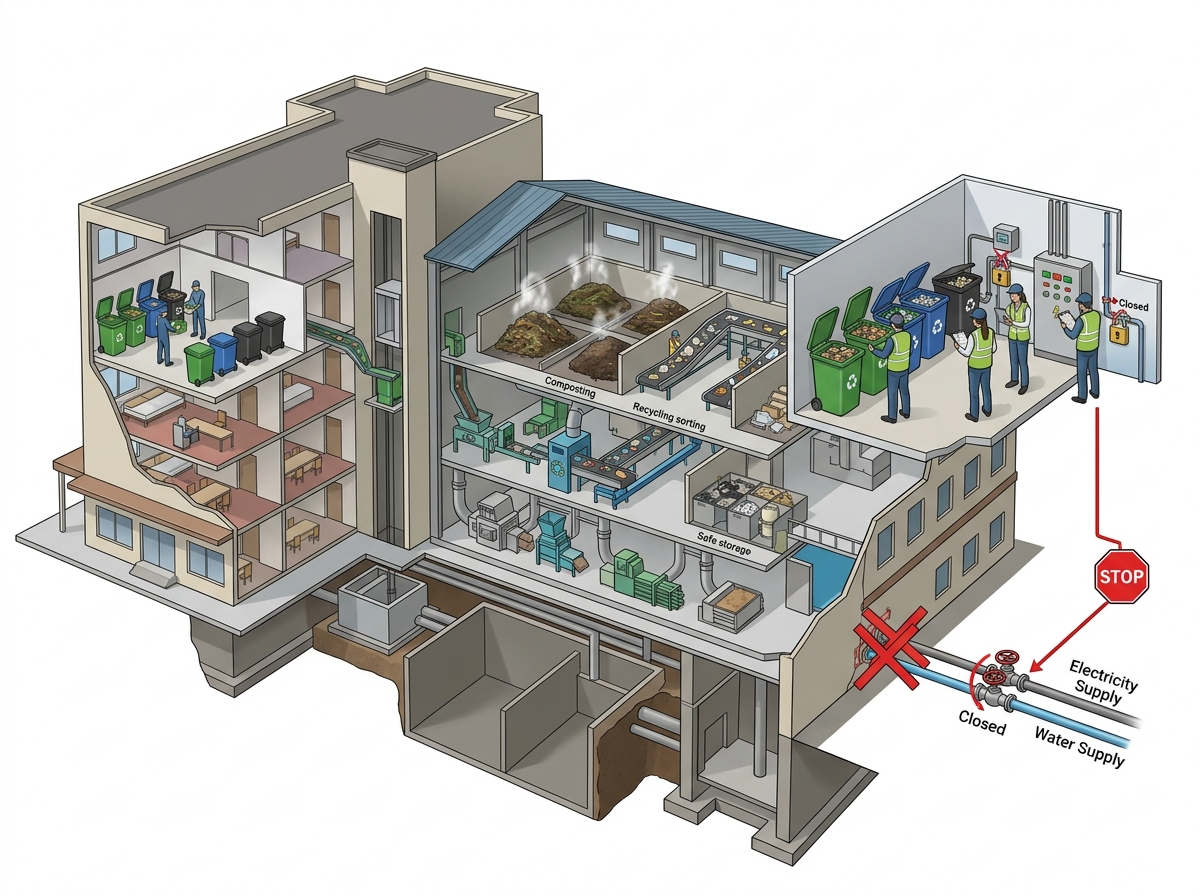
The Himachal Pradesh State Pollution Control Board (HPPCB) has announced strict enforcement measures under the Solid Waste Management Rules, 2026, including the temporary disconnection of electricity and water supply to bulk waste generators failing to comply with source segregation and waste management norms. This initiative, effective from 1 April 2026, underscores the state’s commitment to institutionalising sustainable solid waste management practices, with a focus on accountability at the source and multi-stakeholder coordination.
Background
- The Solid Waste Management Rules, 2026, notified under the Environment Protection Act, 1986, supersede the earlier Solid Waste Management Rules, 2016, introducing stricter provisions for source segregation, extended producer responsibility, and penalties for non-compliance.
- Himachal Pradesh, a Himalayan state with fragile ecosystems, faces significant challenges in solid waste management due to tourism, urbanisation, and limited landfill capacity.
- The Swachh Bharat Mission 2.0 (Urban) and Atal Mission for Rejuvenation and Urban Transformation (AMRUT) 2.0 provide the broader policy framework for urban solid waste management in India.
- State Pollution Control Boards are statutory bodies under the Water (Prevention and Control of Pollution) Act, 1974, and the Air (Prevention and Control of Pollution) Act, 1981, with powers to enforce environmental regulations.
- The concept of ‘bulk waste generators’ includes commercial establishments, institutions, and government offices generating significant quantities of solid waste, necessitating targeted regulatory oversight.
What are the Solid Waste Management Rules, 2026, and their key provisions?
- The Solid Waste Management Rules, 2026, are a set of regulations framed under the Environment Protection Act, 1986, to regulate the generation, segregation, storage, transportation, processing, and disposal of solid waste in India.
- The rules apply to all urban and rural areas, including commercial, institutional, and government establishments, with a focus on source segregation at the point of generation.
- Mandatory segregation of solid waste into four categories: (i) wet waste (biodegradable), (ii) dry waste (recyclable), (iii) sanitary waste (disposable hygiene products), and (iv) special care waste (e-waste, expired medicines, batteries, etc.).
- Extended Producer Responsibility (EPR) for manufacturers and brand owners to ensure safe collection and disposal of sanitary waste through designated pouches or wrappers.
- Prohibition on open burning, landfilling, dumping in water bodies or public spaces, and indiscriminate disposal of waste.
- Penalties for non-compliance include fines, temporary disconnection of essential services (electricity and water supply) for bulk waste generators, and legal action under the Environment Protection Act, 1986.
- Public participation is encouraged through awareness campaigns, school curricula integration, and the appointment of ‘Household Supervisors’.
Key Features
| Feature | Significance |
|---|---|
| Solid Waste Management Rules, 2026 (Himachal Pradesh) | First state-level implementation of the national Solid Waste Management Rules, 2016, with enhanced enforcement mechanisms for bulk waste generators. |
| Categorisation of waste at source | Mandates segregation into four streams—wet, dry, sanitary, and special care waste—aligning with national guidelines for efficient recycling and disposal. |
| Penal provisions for non-compliance | Temporary disconnection of electricity and water supply for bulk waste generators failing to adhere to segregation norms, enforced via local bodies and district authorities. |
| Institutional framework | Formation of state-level and district-level committees to oversee implementation, ensuring multi-stakeholder coordination for enforcement and monitoring. |
| Educational integration | Inclusion of solid waste management modules in school curricula, training students as ‘Household Supervisors’ to propagate segregation practices at the household level. |
Why it Matters
Environmental Governance
- Demonstrates a proactive approach to solid waste management, addressing the critical issue of open dumping and burning, which contributes to air and water pollution.
- Aligns with the constitutional duty under Article 48A (Directive Principles of State Policy) to protect and improve the environment and safeguard forests and wildlife.
- Supports India’s commitment to the United Nations Sustainable Development Goals (SDG 11: Sustainable Cities and Communities and SDG 12: Responsible Consumption and Production).
Institutional Strengthening
- Highlights the role of State Pollution Control Boards (SPCBs) in enforcing environmental regulations, reinforcing their mandate under the Water (Prevention and Control of Pollution) Act, 1974.
- Showcases the integration of local governance (Panchayati Raj Institutions and Urban Local Bodies) in environmental enforcement, ensuring decentralised implementation.
- Emphasises inter-departmental coordination between education, urban development, and environment departments for holistic waste management.
Public Participation
- Leverages educational institutions to foster behavioural change, addressing the root cause of poor waste segregation through grassroots awareness.
- Promotes the concept of ‘Extended Producer Responsibility’ (EPR) by mandating manufacturers to provide pouches for sanitary waste, shifting responsibility to producers.
- Encourages community-led initiatives, with students acting as ‘Household Supervisors’ to influence family-level practices.
Economic Implications
- Potential reduction in healthcare costs associated with pollution-related diseases, benefiting public health expenditure.
- Creation of employment opportunities in the waste management sector, including recycling and segregation units, fostering a circular economy.
- Avoidance of penalties under environmental laws, reducing financial liabilities for bulk waste generators and local bodies.
Challenges
1. Behavioural Resistance
- Lack of public awareness and resistance to change in waste segregation habits, particularly in rural and semi-urban areas.
- Limited participation from bulk waste generators due to perceived inconvenience or cost implications of compliance.
UPSC Link: GS Paper 3: Environmental Pollution
2. Institutional Capacity
- Inadequate infrastructure for processing segregated waste, particularly for special care waste (e.g., expired medicines, batteries).
- Shortage of trained personnel in local bodies and SPCBs to enforce regulations and monitor compliance effectively.
UPSC Link: GS Paper 2: Functions and Responsibilities of Various Constitutional Bodies
3. Financial Constraints
- High capital and operational costs for setting up waste processing facilities, especially for dry and special care waste streams.
- Limited budgetary allocations for waste management in local bodies, leading to delayed or incomplete implementation.
UPSC Link: GS Paper 3: Government Budgets and Financial Management
4. Legal and Procedural Hurdles
- Complexity in identifying and penalising bulk waste generators, particularly in unorganised sectors or informal establishments.
- Legal challenges in enforcing disconnection of utilities (electricity/water) due to constitutional protections and procedural delays.
UPSC Link: GS Paper 2: Judiciary and Judicial Process
5. Monitoring and Enforcement
- Difficulty in real-time monitoring of waste segregation practices across dispersed urban and rural areas.
- Lack of standardised reporting mechanisms for tracking compliance and progress under the rules.
UPSC Link: GS Paper 4: Ethics in Governance
Challenges — UPSC Perspective
| Issue | Concern |
|---|---|
| Public Awareness | Low levels of awareness about waste segregation norms, especially among marginalised communities. |
| Infrastructure Gaps | Insufficient processing facilities for special care waste, leading to improper disposal. |
| Enforcement Bottlenecks | Delays in penalising non-compliant entities due to legal and procedural constraints. |
| Financial Sustainability | High costs of waste management infrastructure, straining local body budgets. |
| Inter-departmental Coordination | Lack of seamless collaboration between education, urban development, and environment departments. |
Way Forward
- Strengthen public awareness campaigns through mass media, community engagement, and school programmes to inculcate waste segregation habits.
- Augment infrastructure for processing segregated waste streams, particularly special care waste, with public-private partnerships.
- Provide financial incentives (e.g., subsidies, tax rebates) to bulk waste generators for adopting segregation and recycling practices.
- Enhance institutional capacity by training local body officials, SPCB staff, and waste collectors in enforcement and monitoring protocols.
- Establish a real-time digital monitoring system for tracking waste segregation compliance, with penalties for non-adherence.
- Promote the development of a circular economy by incentivising recycling industries and creating market linkages for segregated waste.
- Conduct periodic audits of local body performance in waste management, with transparent reporting to the state government.
- Integrate waste management modules into vocational training programmes to create skilled employment in the sector.
UPSC Value Addition
Keywords for Mains Answer-Writing
Solid Waste Management Rules 2026 · Bulk Waste Generators · source segregation of waste · Himachal Pradesh State Pollution Control Board · polluter pays principle · waste-to-energy plants · extended producer responsibility · Swachh Bharat Mission 2.0 · circular economy · environmental governance · municipal solid waste management · disaster risk reduction through waste management
Constitutional & Policy Linkages
- Article 48A: Protection and improvement of environment and safeguarding of forests and wildlife.
- Article 51A(g): Fundamental duty to protect and improve the natural environment.
Concept Flow
Non-compliance with solid waste management norms → Environmental degradation (pollution, health hazards) → State Pollution Control Board enforcement action → Penal provisions (utility disconnection) → Institutional compliance and behavioural change → Sustainable waste management practices.
Prelims Practice Questions
Q1. Consider the following statements regarding the Solid Waste Management Rules, 2026 notified by the Himachal Pradesh State Pollution Control Board:
1. The rules mandate source segregation of waste into four categories: wet, dry, sanitary, and special care waste.
2. Burning of waste in open areas is permitted under these rules.
3. Bulk Waste Generators include commercial, institutional, and government establishments.
4. The rules empower district magistrates to temporarily disconnect electricity and water supply to non-compliant bulk waste generators.
How many of the above statements are correct?
- Only one
- Only two
- Only three
- All four
Answer: Only three — Statements 1, 3, and 4 are correct. Statement 2 is incorrect as the rules explicitly prohibit open burning of waste.
Q2. Assertion (A): The Solid Waste Management Rules, 2026, emphasize the role of educational institutions in promoting household-level waste segregation.
Reason (R): The rules mandate the inclusion of solid waste management modules in school and higher education curricula, training students as ‘Household Supervisors’ to educate their families.
Options:
A. Both A and R are true, and R is the correct explanation of A.
B. Both A and R are true, but R is NOT the correct explanation of A.
C. A is true, but R is false.
D. A is false, but R is true.
Answer: ? — Both Assertion (A) and Reason (R) are true, and Reason (R) correctly explains Assertion (A). The rules explicitly mandate educational interventions to institutionalize source segregation.
Q3. Match the following categories of waste with their correct examples as per the Solid Waste Management Rules, 2026:
Column I (Waste Category) | Column II (Examples)
————————–|————————–
1. Wet Waste | a. Paper, cardboard, plastic
2. Dry Waste | b. Used diapers, sanitary napkins
3. Sanitary Waste | c. Kitchen waste, food scraps
4. Special Care Waste | d. CFL bulbs, expired medicines
Options:
A. 1-c, 2-a, 3-b, 4-d
B. 1-a, 2-b, 3-c, 4-d
C. 1-d, 2-a, 3-b, 4-c
D. 1-c, 2-d, 3-a, 4-b
Answer: ? — The correct pairing is: 1-c (Wet Waste: Kitchen waste, food scraps), 2-a (Dry Waste: Paper, cardboard, plastic), 3-b (Sanitary Waste: Used diapers, sanitary napkins), 4-d (Special Care Waste: CFL bulbs, expired medicines).
Mains Practice Question
✍ The Solid Waste Management Rules, 2026, notified by the Himachal Pradesh State Pollution Control Board, represent a significant shift in India’s municipal solid waste governance framework. Critically examine the legal, institutional, and behavioural dimensions of these rules with reference to the principles of environmental justice and the ‘polluter pays’ doctrine. Also, assess their potential impact on achieving the objectives of the Swachh Bharat Mission 2.0. (15 Marks)
Approach: MODEL-ANSWER SKELETON:
I. Legal and Regulatory Framework:
1. Statutory basis: Solid Waste Management Rules, 2016 (amended 2026) under the Environment Protection Act, 1986.
2. Key provisions: Mandatory source segregation (wet, dry, sanitary, special care), prohibition on open burning/dumping, and Extended Producer Responsibility (EPR) for bulk waste generators.
3. Enforcement mechanism: Role of State Pollution Control Boards (SPCBs), district magistrates, and local bodies; penalties including disconnection of utilities.
II. Institutional Architecture:
1. Multi-level governance: State-level committees, district-level implementation cells, and local body coordination.
2. Role of educational institutions: Integration of waste management modules in curricula and training of students as ‘Household Supervisors’.
3. Inter-sectoral coordination: Linkages with urban local bodies, health departments, and waste-to-energy plants.
III. Behavioural and Social Dimensions:
1. Principle of environmental justice: Equity in burden-sharing between waste generators and municipalities; inclusion of informal sector workers.
2. ‘Polluter pays’ doctrine: Financial and operational accountability of bulk waste generators; incentives vs. penalties.
3. Community participation: Role of students, NGOs, and self-help groups in promoting source segregation.
IV. Challenges and Critique:
1. Implementation gaps: Capacity constraints in local bodies, lack of infrastructure for segregation/recycling.
2. Behavioural resistance: Public apathy, lack of awareness, and cultural practices (e.g., mixed waste disposal).
3. Legal ambiguities: Overlap with other waste-related rules (e.g., Plastic Waste Management Rules); clarity on ‘bulk waste generator’ thresholds.
V. Impact on Swachh Bharat Mission 2.0:
1. Alignment with objectives: Reduction in open dumping, promotion of circular economy, and improved urban sanitation.
2. Synergies with waste-to-energy projects and EPR frameworks.
3. Potential for replication: Lessons for other states in integrating legal, institutional, and behavioural reforms.
VI. Conclusion:
– Balanced assessment of progress vs. challenges.
– Recommendations: Strengthening local governance, enhancing public awareness, and leveraging technological solutions (e.g., AI-based waste tracking).
– Emphasise the need for a rights-based approach to environmental governance, ensuring that marginalised communities are not disproportionately burdened.
Source: amarujala.com
Himachal Pradesh PCS (HPPSC (HAS)) — State PCS Practice
Prelims: As per recent directives by the Himachal Pradesh State Pollution Control Board (HPPCB), what action will be taken against large waste generators in the state for non-compliance with waste management rules?
- Their water and electricity supply will be disconnected
- They will be imposed a fine of ₹1 lakh per day
- Their business licenses will be revoked permanently
- They will be required to pay a one-time penalty of ₹50,000
Answer: Their water and electricity supply will be disconnected — The HPPCB has issued strict directives under the Solid Waste Management Rules, 2016, mandating disconnection of water and electricity supply for non-compliant large waste generators.
Mains: Discuss the role of the Himachal Pradesh State Pollution Control Board (HPPCB) in enforcing waste management regulations in the state. Highlight the recent measures taken by the board to ensure compliance with the Solid Waste Management Rules, 2016, and their impact on urban local bodies and commercial establishments in Himachal Pradesh.
Generated by AanyaAi for educational purpose.
Related guides on our sites
- Current affairs for upsc 2026
- How to prepare for GS paper 1 for UPSC CSE mains exam
- Best UPSC coaching for IFOS exam
- Best geography optional coaching

- महाराष्ट्र में त्योहार जुलूसों पर बॉम्बे हाईकोर्ट का बड़ा फैसला: पटाखे, लेजर और संगीत पर रोक - September 24, 2026
- Bombay HC Bans Firecrackers, Music in Maharashtra Processions: Key UPSC Analysis - September 24, 2026
- तमिलनाडु में महिला कर्मचारियों के लिए सवैतनिक माहवारी अवकाश नीति पर HC का आदेश - September 24, 2026

No Comments