


04 Sep Himachal’s 710 New Glacial Lakes: 9 High-Risk, Centre Issues GLOF Alert
✎ Glacial Lake Outburst Floods (GLOFs) are climate-induced disasters in the Himalayas, requiring integrated monitoring, early warning systems, and community resilience to mitigate risks from rapidly expanding glacial lakes.
Subject Relevance — Where This Topic Fits
- GS Paper III — Environment, Ecology, Biodiversity and Climate Change | GS Paper III — Disaster Management
- Prelims: GLOF, Glacial Lake Outburst Flood, Himalayan glaciers, Disaster risk reduction, Climate change impacts on Himalayas, NDMA guidelines on GLOF, Glacial lake inventory, Himachal Pradesh geography
- Essay: Climate change and its cascading impacts on fragile ecosystems, Disaster risk governance in the Himalayas
Quick Revision: Glacial Lake Outburst Floods (GLOFs) are climate-induced disasters in the Himalayas, requiring integrated monitoring, early warning systems, and community resilience to mitigate risks from rapidly expanding glacial lakes.
Why is this in the news?
The study by IIT Mandi, published in September 2026, highlights a 52% increase in glacial lakes in Himachal Pradesh over a decade, with nine lakes classified as ‘very high risk’ and 435 as ‘highly sensitive’. The Union Government has issued directives to Himalayan states to strengthen monitoring and early warning systems for Glacial Lake Outburst Floods (GLOFs) and avalanches, underscoring the urgency of integrating climate adaptation into disaster risk reduction frameworks.
Background
- Himalayan glaciers are among the most sensitive indicators of climate change, with global temperature rise accelerating their retreat.
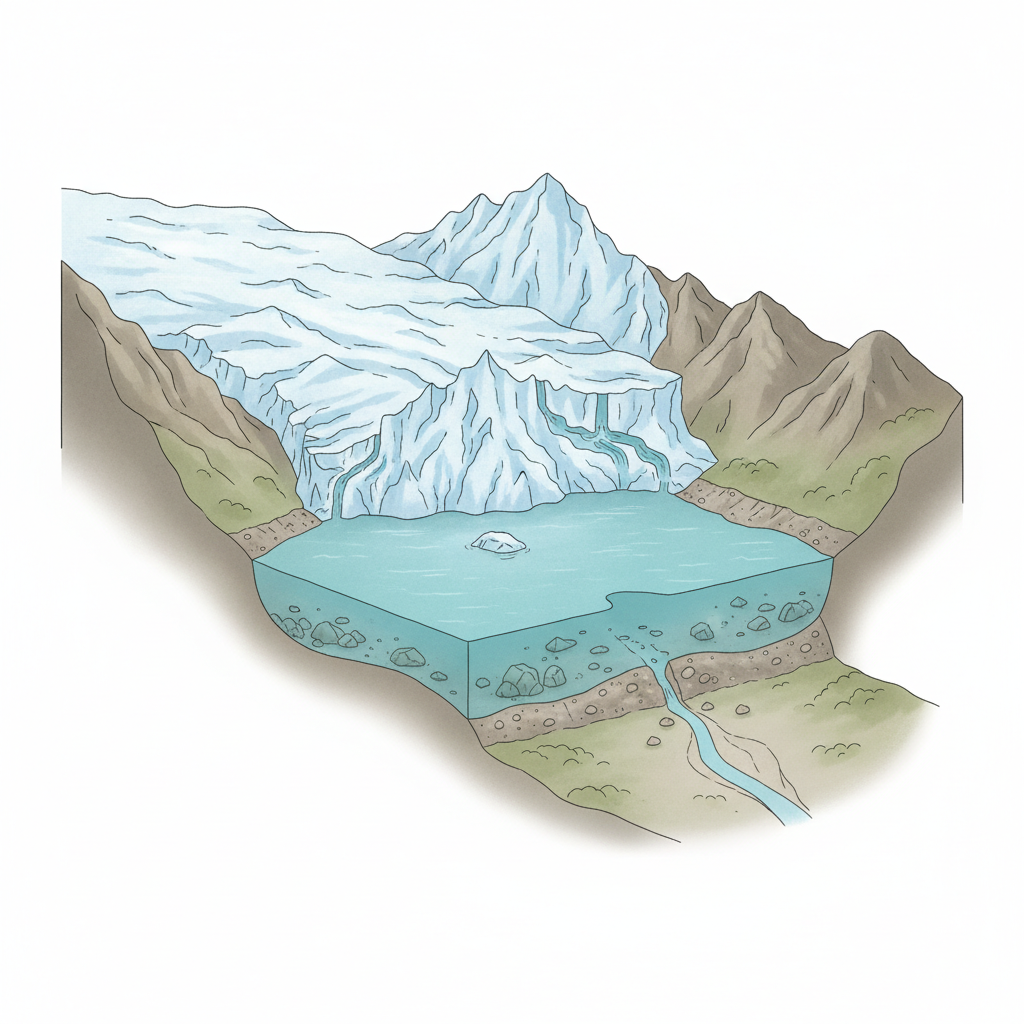
- Glacial lakes form when glaciers melt and water accumulates in depressions; their sudden breach can trigger catastrophic floods downstream.
- Climate projections for the Himalayas indicate a 1.5–2°C temperature rise by 2050, exacerbating glacial melt and increasing GLOF risks.
- Tourism and infrastructure development in fragile mountain ecosystems further amplify anthropogenic pressures on glaciers.
What are Glacial Lake Outburst Floods (GLOFs)?
- GLOFs are sudden releases of large volumes of water from glacial lakes, triggered by the failure of natural dams composed of ice or moraine (glacial debris).
- These events generate high-velocity debris flows that can travel tens of kilometres downstream, causing widespread destruction to settlements, infrastructure, and ecosystems.
- GLOFs are distinct from monsoon floods; they occur independently of seasonal rainfall and are directly linked to glacial dynamics.
- The Himalayas are particularly vulnerable due to the presence of over 200 potentially dangerous glacial lakes, many of which are expanding due to climate change.
- Risk assessment for GLOFs considers factors beyond lake size, including dam stability, downstream topography, and exposure of human settlements.
- Early warning systems (EWS) for GLOFs rely on hydrological sensors, remote sensing, and AI-driven predictive models to issue timely alerts.
- Mitigation strategies include controlled lake drainage, artificial lowering of water levels, and relocation of vulnerable communities.
Key Features
| Feature | Significance |
|---|---|
| Formation of 710 new glacial lakes (2015–2025) | Indicates accelerated glacial retreat due to climate change, increasing hydro-meteorological hazards in Himalayan states. |
| Increase in total glacial lake area by 28.45% | Expansion of water bodies amplifies risk of Glacial Lake Outburst Floods (GLOFs), threatening downstream settlements and infrastructure. |
| Nine lakes classified as ‘highly dangerous’ | These pose imminent GLOF risk, necessitating immediate monitoring and risk-reduction measures. |
| 435 lakes identified as ‘highly sensitive’ | Requires prioritized assessment for structural interventions and early-warning systems to mitigate downstream impact. |
| Role of anthropogenic factors (tourism, dust deposition) | Human activities exacerbate glacial melt, compounding climate-induced risks in fragile Himalayan ecosystems. |
Why it Matters
Environmental
- Demonstrates the tangible impacts of climate change on Himalayan cryosphere, altering hydrological regimes and ecosystem stability.
- Highlights the vulnerability of high-altitude glacial systems to anthropogenic disturbances, including tourism and local pollution.
- Reinforces the need for integrated climate adaptation strategies in ecologically sensitive mountain regions.
Disaster Management
- GLOFs pose severe threats to life, livelihoods, and critical infrastructure in downstream valleys, necessitating robust early-warning systems.
- The classification of lakes by risk level enables targeted mitigation, reducing the potential for catastrophic flooding events.
- Emphasizes the importance of preemptive disaster preparedness in Himalayan states, where geological fragility is compounded by climate variability.
Scientific & Research
- Provides empirical evidence of glacial retreat trends in the Himalayas, supporting long-term climate monitoring and policy formulation.
- Underscores the role of interdisciplinary research (glaciology, hydrology, remote sensing) in assessing climate-induced hazards.
- Highlights the need for sustained funding and collaboration between institutions like IIT Mandi and national agencies for real-time data collection.
Policy & Governance
- Signals the urgency for multi-tiered governance frameworks to address climate-induced disasters, integrating local, state, and central authorities.
- Demonstrates the necessity of inter-state coordination in Himalayan regions, where glacial systems transcend administrative boundaries.
- Illustrates the role of scientific advisory in shaping policy responses to environmental crises.
Challenges
1. Glacial Lake Outburst Floods (GLOFs)
- Sudden release of water from glacial lakes can cause catastrophic flooding, endangering lives, disrupting transportation, and damaging hydropower infrastructure.
- High-risk lakes, such as those in Kullu and Lahaul-Spiti districts, require immediate structural interventions (e.g., controlled drainage, artificial lowering).
- Lack of real-time monitoring in remote Himalayan regions delays early warnings, exacerbating vulnerability.
- Downstream communities often lack awareness of GLOF risks, necessitating public education and evacuation planning.
UPSC Link: GS3: Disaster Management
2. Climate-Induced Glacial Retreat
- Accelerated melting of glaciers due to rising temperatures alters hydrological cycles, affecting water availability for agriculture and hydroelectric projects.
- Increased sediment load in rivers from glacial erosion threatens dam stability and reduces reservoir capacity.
- Permafrost degradation in high-altitude regions may trigger landslides, compounding disaster risks.
- Long-term implications include reduced snow cover, impacting winter tourism and local economies.
UPSC Link: GS3: Environment & Climate Change
3. Anthropogenic Pressures in Himalayan Ecosystems
- Unregulated tourism and infrastructure development (e.g., roads, hotels) accelerate environmental degradation and glacial melt.
- Dust deposition from vehicular traffic and construction activities increases solar radiation absorption, expediting ice melt.
- Waste management challenges in fragile mountain ecosystems exacerbate pollution and ecosystem stress.
- Balancing economic development with environmental conservation remains a policy dilemma for Himalayan states.
UPSC Link: GS3: Environment & Sustainable Development
4. Data Gaps & Monitoring Limitations
- Insufficient long-term glacial data in the Himalayas hinders accurate risk assessment and policy formulation.
- Remote sensing and field-based monitoring are resource-intensive, requiring enhanced technological and financial investments.
- Lack of standardized protocols for classifying glacial lakes by risk level complicates prioritization of mitigation efforts.
- Delayed integration of scientific findings into policy frameworks limits adaptive governance in disaster-prone regions.
UPSC Link: GS3: Science & Technology
5. Inter-State & Centre-State Coordination
- Glacial systems often span multiple states, necessitating coordinated disaster management and resource allocation.
- Divergent state policies on environmental regulations and tourism management create inconsistencies in risk mitigation.
- Central agencies (e.g., NDMA, GSI) must collaborate with state authorities to ensure uniform implementation of early-warning systems.
- Fiscal decentralization challenges may impede equitable distribution of funds for disaster preparedness.
UPSC Link: GS2: Federalism & Governance
Challenges — UPSC Perspective
| Issue | Concern |
|---|---|
| Sudden GLOF events | Catastrophic flooding with minimal warning, threatening lives and infrastructure. |
| Limited real-time monitoring | Delays in early warnings due to logistical and technological constraints in remote areas. |
| Anthropogenic pressures | Tourism, construction, and pollution exacerbate glacial melt and ecosystem degradation. |
| Data scarcity | Insufficient long-term glacial data hinders accurate risk assessment and policy design. |
| Policy fragmentation | Lack of standardized risk classification and inter-state coordination complicates mitigation efforts. |
| Public awareness gaps | Downstream communities often unaware of GLOF risks, delaying evacuation and response. |
Way Forward
- Strengthen multi-hazard early-warning systems for GLOFs and landslides in Himalayan states, leveraging remote sensing and AI-driven analytics.
- Prioritize structural interventions for high-risk glacial lakes, including controlled drainage and artificial lowering to reduce outburst potential.
- Enhance inter-state coordination through a Himalayan Disaster Risk Reduction Framework, ensuring uniform risk assessment and resource allocation.
- Invest in long-term glacial monitoring programs, integrating field studies with satellite data to improve predictive models.
- Implement stricter environmental regulations for tourism and infrastructure development in fragile Himalayan ecosystems.
- Conduct community-based awareness campaigns to educate downstream populations on GLOF risks and evacuation protocols.
- Develop climate-resilient infrastructure standards for hydropower projects and transportation networks in high-altitude regions.
- Foster public-private partnerships to fund research and technological innovation in glacial hazard mitigation.
UPSC Value Addition
Keywords for Mains Answer-Writing
Glacial Lake Outburst Floods (GLOF) · Himalayan glaciers retreat · Disaster risk reduction · Climate change impacts on Himalayas · Early warning systems · Himachal Pradesh glacial lakes · Indian Himalayan Region (IHR) · National Disaster Management Authority (NDMA) · Glacial lake hazard zonation · Sustainable mountain development
Constitutional & Policy Linkages
- [‘Article 21 (Right to Life)’, ‘Protection from environmental hazards as part of fundamental rights.’]
- [‘Article 48A (Directive Principles)’, ‘Protection and improvement of environment and safeguarding forests and wildlife.’]
- [‘Seventh Schedule (State List – Entry 17)’, ‘Water supplies, irrigation and canals, subject to national policies on environment.’]
- [‘Seventh Schedule (Concurrent List – Entry 13)’, ‘Prevention of river pollution and protection of forests and wildlife.’]
Concept Flow
Rising global temperatures → Accelerated glacial retreat in Himalayas → Formation and expansion of glacial lakes → Increased GLOF risk → Classification of lakes by vulnerability (e.g., Kullu, Lahaul-Spiti) → Potential catastrophic flooding downstream → Threat to lives, infrastructure, and livelihoods → Need for early-warning systems and structural interventions → Policy responses at state and central levels → Long-term climate adaptation strategies.
Prelims Practice Questions
Q1. Consider the following statements regarding Glacial Lake Outburst Floods (GLOF):
1. GLOFs are triggered solely by seismic activity.
2. The formation of new glacial lakes increases the risk of GLOFs.
3. The Himalayan region is particularly vulnerable to GLOFs due to rapid glacier retreat.
4. Early warning systems are ineffective in mitigating GLOF risks.
How many of the above statements are correct?
- Only one
- Only two
- Only three
- All
Answer: Only three — Statements 2 and 3 are correct. GLOFs can be triggered by various factors including seismic activity, but not solely. Statement 1 is incorrect. Statement 4 is incorrect as early warning systems are crucial in mitigating GLOF risks.
Q2. Assertion (A): The retreat of glaciers in the Himalayas is primarily driven by anthropogenic climate change.
Reason (R): Increased human activity in glacial regions accelerates glacier melt through dust deposition and black carbon deposition.
Options:
A) Both A and R are true, and R is the correct explanation of A.
B) Both A and R are true, but R is not the correct explanation of A.
C) A is true, but R is false.
D) A is false, but R is true.
Answer: ? — Both A and R are true. The retreat of Himalayan glaciers is driven by anthropogenic climate change, and human activities such as tourism and infrastructure development contribute to glacier melt through dust and black carbon deposition, which accelerates the process.
Q3. Match the following glacial lakes in Himachal Pradesh with their associated risk levels as identified in recent studies:
Column I (Glacial Lake) — Column II (Risk Level)
1. Kashing Lake — a. Very High Risk
2. Gepnang Gath — b. High Risk
3. Kalikund — c. Moderate Risk
4. Samudratapu — d. Low Risk
Options:
A) 1-a, 2-b, 3-c, 4-d
B) 1-b, 2-a, 3-d, 4-c
C) 1-a, 2-b, 3-d, 4-c
D) 1-b, 2-a, 3-c, 4-d
- A
- B
- C
- D
Answer: D — Kashing Lake and Gepnang Gath are identified as very high risk, while Kalikund and Samudratapu are categorized under high risk. The correct match is 1-a, 2-b, 3-d, 4-c.
Mains Practice Question
✍ The formation of 710 new glacial lakes in Himachal Pradesh over the past decade, with nine classified as ‘very high risk’, underscores the escalating threat of Glacial Lake Outburst Floods (GLOFs) in the Indian Himalayan Region. In this context, critically examine the institutional and policy frameworks in India for managing GLOF risks, with specific reference to early warning systems, disaster preparedness, and the role of the National Disaster Management Authority (NDMA). Also, discuss the challenges in implementing these frameworks in the Himalayan states. (15 Marks)
Approach: MODEL-ANSWER SKELETON:
1. **Introduction (2 Marks)**
– Define Glacial Lake Outburst Floods (GLOFs) and their significance in the Himalayan context.
– Briefly state the recent findings from Himachal Pradesh (710 new lakes, 9 very high risk) to set the context.
2. **Institutional and Policy Frameworks for GLOF Risk Management (6 Marks)**
– **National Disaster Management Authority (NDMA) Guidelines (2008, revised 2020)**: Role in issuing SOPs for GLOF risk assessment, monitoring, and early warning systems.
– **National Disaster Response Force (NDRF) and State Disaster Response Forces (SDRF)**: Preparedness and response mechanisms.
– **Indian Space Research Organisation (ISRO) and National Remote Sensing Centre (NRSC)**: Use of satellite data for glacial lake monitoring and hazard zonation.
– **State-level mechanisms**: Role of State Disaster Management Authorities (SDMAs) in Himachal Pradesh and other Himalayan states.
– **Collaboration with academic institutions**: Involvement of IITs, Wadia Institute of Himalayan Geology, and other research bodies in risk assessment.
3. **Early Warning Systems and Disaster Preparedness (4 Marks)**
– **Technological components**: Real-time monitoring of glacial lakes using sensors, automated weather stations, and remote sensing.
– **Community-based early warning systems**: Integration of local knowledge and community participation in risk communication.
– **Preparedness measures**: Evacuation plans, mock drills, and capacity-building initiatives for local communities and disaster responders.
4. **Challenges in Implementation (3 Marks)**
– **Topographical and logistical constraints**: Difficult terrain, limited accessibility, and harsh climatic conditions in the Himalayas.
– **Data gaps and monitoring limitations**: Inadequate long-term glacial lake inventories and lack of standardized risk assessment protocols.
– **Institutional coordination**: Fragmentation of roles between central and state agencies, and inter-state coordination issues.
– **Resource constraints**: Limited funding, technical expertise, and manpower for sustained monitoring and early warning systems.
– **Climate change adaptation**: Need for dynamic risk assessment frameworks to account for accelerating glacier retreat.
5. **Conclusion (2 Marks)**
– Emphasize the need for a multi-stakeholder approach involving government, academia, local communities, and international partners.
– Highlight the importance of integrating traditional knowledge with modern scientific tools for effective GLOF risk management.
– Stress the urgency of scaling up institutional capacities and resource allocation to address the growing threat of GLOFs in the Himalayas.
Source: amarujala.com
Himachal Pradesh PCS (HPPSC (HAS)) — State PCS Practice
Prelims: As per recent reports, how many new glacial lakes have been formed in Himachal Pradesh over the past decade, and how many of them are classified as ‘highly dangerous’ by the central government?
- 710 new lakes, 9 highly dangerous
- 650 new lakes, 12 highly dangerous
- 710 new lakes, 5 highly dangerous
- 680 new lakes, 10 highly dangerous
Answer: 710 new lakes, 9 highly dangerous — The report highlights the formation of 710 new glacial lakes in Himachal Pradesh in the last decade, with 9 classified as ‘highly dangerous’ due to potential glacial lake outburst floods (GLOFs).
Mains: Discuss the implications of the rapid formation of glacial lakes in Himachal Pradesh on the state’s disaster preparedness and environmental sustainability. Suggest measures to mitigate the risks associated with these glacial lakes.
Generated by AanyaAi for educational purpose.
Related guides on our sites
- How to prepare for GS paper 1 for UPSC CSE mains exam
- Best UPSC coaching for IFOS exam
- Best geography optional coaching
- Best geography optional coaching

- India-Australia AUSTRAHIND 2026 Exercise: Key Highlights for UPSC & State PCS - October 22, 2026
- एससीओ बैठक में भारत का आतंकवाद विरोध: क्षेत्रीय सहयोग पर जोर - October 22, 2026
- SEC Directs Strict SC Order Compliance for Andhra ULB Polls - October 22, 2026

No Comments