


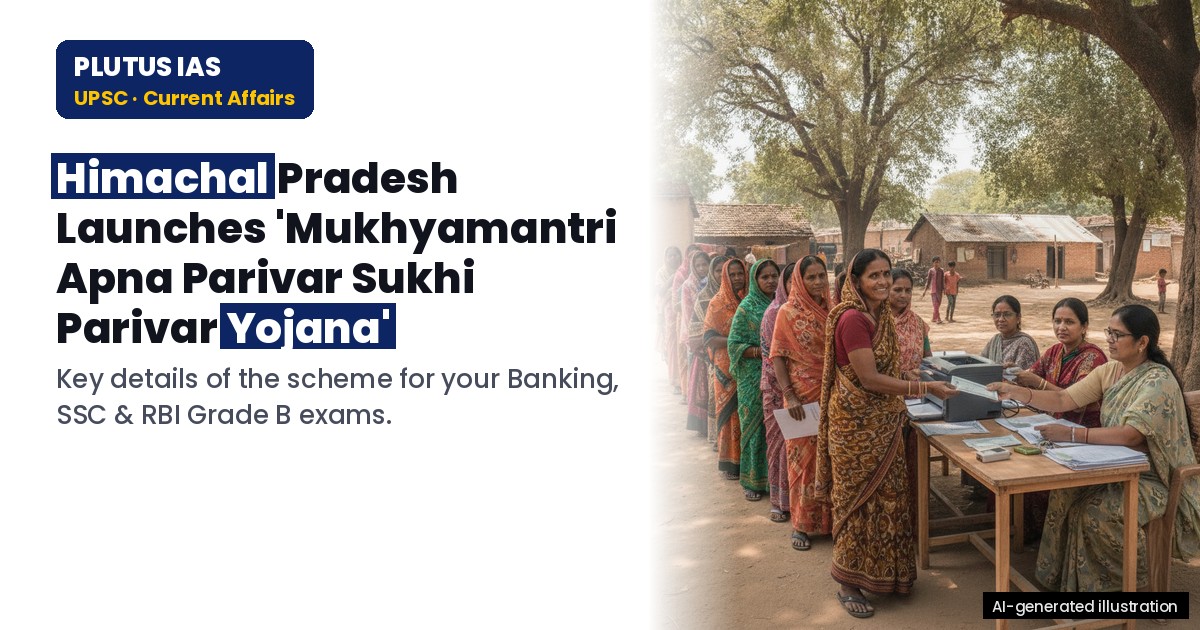
26 Nov Himachal’s Sukhi Parivar Yojana: Key Benefits & Eligibility
✎ The Mukhyamantri Apna Parivar, Sukhi Parivar Yojana is a Himachal Pradesh government initiative providing monthly financial aid to eligible women and free electricity to qualifying rural families, managed through a digital portal…
Subject Relevance — Where This Topic Fits
- GS Paper II — Government Policies and Interventions for Development in various sectors and Issues arising out of their Design and Implementation | GS Paper II — Welfare Schemes for Vulnerable Sections of the Population by the Centre and States and the Performance of these Schemes | GS Paper III — Indian Economy and Issues Relating to Planning, Mobilization of Resources, Growth, Development and Employment
- Prelims: Mukhyamantri Apna Parivar, Sukhi Parivar Yojana, Direct Benefit Transfer (DBT), e-KYC, Aadhaar Payment Bridge, Social Security Schemes, Rural Development
- Essay: The Role of State-Sponsored Welfare Schemes in Achieving Inclusive Growth and Reducing Poverty, Leveraging Technology for Efficient Delivery of Social Welfare Programs: Opportunities and Challenges
Quick Revision: The Mukhyamantri Apna Parivar, Sukhi Parivar Yojana is a Himachal Pradesh government initiative providing monthly financial aid to eligible women and free electricity to qualifying rural families, managed through a digital portal and a structured grievance redressal system.
Why is this in the news?
The Himachal Pradesh government has announced the commencement of the Mukhyamantri Apna Parivar, Sukhi Parivar Yojana from December 11, 2026. This initiative aims to provide financial assistance to eligible women and free electricity to qualifying households, thereby enhancing the economic empowerment and overall well-being of rural families within the state. The scheme’s notification has been issued by the Rural Development Department, outlining the implementation framework and beneficiary criteria.
Background
- Social welfare schemes are crucial instruments for poverty alleviation and equitable development, particularly in rural areas.
- Direct Benefit Transfer (DBT) mechanisms have been increasingly adopted to ensure transparency and efficiency in the delivery of financial assistance, minimizing leakages.
- Energy access and affordability, especially electricity, are significant components of household welfare and economic productivity.
- State governments frequently introduce targeted welfare programs to address specific socio-economic challenges faced by their populations, complementing central government initiatives.
- The integration of digital platforms, such as portals for registration, verification, and monitoring, is a contemporary approach to scheme management, enhancing accountability and data management.
- The emphasis on a ‘development roadmap’ for beneficiary families signifies a holistic approach beyond mere financial aid, aiming for sustainable upliftment through education, skill development, and employment opportunities.
What is the Mukhyamantri Apna Parivar, Sukhi Parivar Yojana?
- The Mukhyamantri Apna Parivar, Sukhi Parivar Yojana is a welfare scheme notified by the Himachal Pradesh government to economically empower rural families.
- It targets approximately 3.50 lakh eligible women in the state, providing them with a monthly financial assistance of ₹1,500.
- Beneficiary women must be between 18 and 59 years of age and possess an active bank account linked with Aadhaar authentication, e-KYC, and Aadhaar Payment Bridge.
- Women already receiving similar regular financial assistance under any other central or state government scheme are ineligible for this benefit.
- The scheme also offers up to 300 units of free electricity per month to eligible families, applicable across a maximum of two domestic electricity meters.
- A ‘development roadmap’ will be formulated for each beneficiary family, encompassing aspects like employment, self-employment, education, health, skill development, and social security.
- The scheme’s administration, including registration, eligibility verification, payments, and monitoring, will be managed through the ‘MMAP’ (Mukhyamantri Apna Parivar) portal, ensuring digital record-keeping.
- A multi-tiered grievance redressal mechanism is established, allowing complaints to be filed at the Block Development Officer (BDO) office or online, with provisions for appeals to the Sub-Divisional Magistrate (SDM).
Key Features
| Feature | Significance |
|---|---|
| Target Beneficiaries | Approximately 3.50 lakh eligible women in Himachal Pradesh. |
| Financial Assistance | INR 1,500 per month to eligible women, disbursed via Direct Benefit Transfer (DBT). |
| Eligibility Criteria (Financial Aid) | Women aged 18-59 years, possessing Aadhaar authentication, e-KYC, and an active Aadhaar Payment Bridge-linked bank account. Excludes beneficiaries of similar regular financial assistance from central or state government schemes. |
| Electricity Subsidy | Up to 300 units of free electricity per month for eligible families, applicable to a maximum of two domestic meters. |
| Development Roadmap | Preparation of a tailored development roadmap for each beneficiary family, encompassing employment, self-employment, education, health, skill development, and social security, linking them to relevant government schemes. |
| Implementation Mechanism | Managed through the MMAP (Mukhyamantri Apna Parivar) portal for registration, eligibility verification, payments, and monitoring, ensuring digital record-keeping. |
Why it Matters
Socio-Economic Empowerment
- Provides direct financial support to women, enhancing household income and potentially improving living standards.
- Aims to reduce economic vulnerability among rural families by offering both monetary aid and essential utility subsidies.
- Facilitates access to various government schemes through a tailored development roadmap, addressing multiple dimensions of poverty.
Governance and Transparency
- Utilises Direct Benefit Transfer (DBT) for financial assistance, reducing leakages and ensuring efficient delivery of funds to beneficiaries.
- Leverages Aadhaar authentication and e-KYC for robust beneficiary identification and verification, enhancing transparency and accountability.
- Establishes a multi-tiered grievance redressal mechanism, ensuring timely resolution of beneficiary concerns and promoting administrative efficiency.
Sustainable Development Goals (SDGs) Alignment
- Contributes to SDG 1 (No Poverty) by providing financial assistance and promoting economic inclusion.
- Supports SDG 5 (Gender Equality) by empowering women through direct financial aid.
- Aligns with SDG 7 (Affordable and Clean Energy) by offering free electricity, potentially easing financial burdens on households.
Challenges
1. Fiscal Sustainability
- The substantial financial outlay for monthly stipends and electricity subsidies may strain state finances, particularly in the long term.
- Ensuring consistent funding without compromising other developmental priorities requires prudent fiscal management.
UPSC Link: Government Budgeting; Fiscal Policy
2. Targeted Beneficiary Identification
- Accurate identification and verification of eligible families through surveys are crucial to prevent inclusion and exclusion errors.
- The effectiveness of the scheme hinges on the integrity of the verification process and the prevention of fraudulent claims.
UPSC Link: Welfare Schemes; Transparency and Accountability
3. Implementation and Monitoring
- Effective coordination across various government departments (Rural Development, Electricity Board) is essential for seamless implementation.
- Ensuring the functionality and accessibility of the MMAP portal, particularly in remote rural areas, is vital for beneficiary registration and grievance redressal.
UPSC Link: e-Governance; Government Policies and Interventions
4. Dependency Syndrome
- While providing immediate relief, over-reliance on direct financial aid might disincentivize active participation in income-generating activities.
- The development roadmap component needs to be robustly implemented to foster self-reliance and skill development, rather than merely creating dependency.
UPSC Link: Poverty Alleviation; Human Resource Development
Challenges — UPSC Perspective
| Issue | Concern |
|---|---|
| Financial Burden | The significant expenditure on subsidies and direct transfers could lead to fiscal stress on the state budget. |
| Exclusion Errors | Risk of genuinely eligible families being left out due to stringent verification processes or lack of awareness. |
| Inclusion Errors | Potential for ineligible individuals to benefit from the scheme due to flawed verification or fraudulent practices. |
| Digital Divide | Challenges in accessing and utilising the MMAP portal for beneficiaries in remote areas with limited internet connectivity or digital literacy. |
| Coordination Gaps | Potential for lack of synergy between different administrative levels and departments involved in scheme implementation. |
| Long-term Impact Assessment | Difficulty in accurately measuring the sustained socio-economic impact and self-reliance fostered by the scheme beyond immediate relief. |
Government Initiatives — Must-Memorise for Prelims
- Mukhyamantri Apna Parivar Sukhi Parivar Yojana
Way Forward
- Implement robust and transparent beneficiary identification and verification mechanisms to minimise inclusion and exclusion errors.
- Ensure the fiscal sustainability of the scheme through regular financial reviews and exploring innovative funding models.
- Strengthen the digital infrastructure and provide adequate digital literacy training to beneficiaries, particularly in rural and remote areas, for effective portal utilisation.
- Enhance inter-departmental coordination and capacity building for field-level functionaries to ensure seamless scheme delivery and grievance redressal.
- Focus on the effective implementation of the ‘development roadmap’ component to foster long-term self-reliance, skill development, and sustainable livelihood opportunities.
- Establish a comprehensive monitoring and evaluation framework to assess the scheme’s impact on poverty reduction, women’s empowerment, and overall socio-economic indicators.
- Regularly review and update eligibility criteria and scheme provisions based on feedback and evolving socio-economic conditions.
UPSC Value Addition
Keywords for Mains Answer-Writing
Direct Benefit Transfer (DBT) · Social welfare schemes · Women empowerment · Financial inclusion · Rural development · Targeted public distribution · Sustainable development goals · Poverty alleviation · Digital governance · Inter-governmental coordination
Constitutional & Policy Linkages
- Article 38: Promotion of welfare of the people
- Article 39: Certain principles of policy to be followed by the State
- Article 46: Promotion of educational and economic interests of weaker sections
Concept Flow
State government announces welfare scheme → Eligibility criteria established for beneficiaries → Beneficiary identification and verification through survey → Direct Benefit Transfer of financial aid and electricity subsidy → Development roadmap prepared for holistic support → Monitoring and grievance redressal via dedicated portal
Prelims Practice Questions
Q1. Consider the following statements regarding the ‘Mukhyamantri Apna Parivar Sukhi Parivar Yojana’:
1. The scheme provides monthly financial assistance to women aged 18-59 years.
2. Beneficiaries are eligible for free electricity up to 300 units per month, applicable across a maximum of two domestic meters.
3. The scheme mandates direct benefit transfer (DBT) to Aadhaar-authenticated bank accounts.
4. Families already receiving similar regular financial assistance from other central or state government schemes are eligible for benefits under this scheme.
How many of the above statements are correct?
- Only one
- Only two
- Only three
- All four
Answer: Only three — Statement 1 is correct: The scheme targets women aged 18-59 years for financial assistance. Statement 2 is correct: Eligible families receive up to 300 units of free electricity per month, which can be distributed across a maximum of two domestic meters. Statement 3 is correct: Financial assistance is disbursed via Direct Benefit Transfer (DBT) to Aadhaar-authenticated, e-KYC compliant, and Aadhaar Payment Bridge-linked active bank accounts. Statement 4 is incorrect: Women already receiving similar regular financial assistance from other central or state government schemes are explicitly excluded from this scheme to prevent duplication of benefits.
Q2. Which of the following is NOT a stated component of the ‘development roadmap’ prepared for beneficiary families under the ‘Mukhyamantri Apna Parivar Sukhi Parivar Yojana’?
- Employment and self-employment opportunities
- Education and skill development
- Health and social security
- Provision of agricultural subsidies for cash crops
Answer: Provision of agricultural subsidies for cash crops — The development roadmap under the scheme includes components such as employment, self-employment, education, health, skill development, and social security. The provision of agricultural subsidies for cash crops is not explicitly mentioned as a component of this specific development roadmap.
Mains Practice Question
✍ Examine the role of Direct Benefit Transfer (DBT) in enhancing the efficiency and transparency of social welfare schemes in India. Discuss how schemes like the ‘Mukhyamantri Apna Parivar Sukhi Parivar Yojana’ leverage DBT to achieve their objectives. (15 Marks)
Approach: MODEL-ANSWER SKELETON:
1. **Introduction (20 words):** Define DBT as a mechanism for direct transfer of subsidies and benefits to beneficiaries’ bank accounts, aiming to reduce leakages and enhance transparency.
2. **Role of DBT in efficiency and transparency (100 words):**
* **Reduced Leakages:** Elimination of intermediaries, curbing corruption and diversion of funds (e.g., ghost beneficiaries).
* **Enhanced Transparency:** Digital trail of transactions, real-time monitoring of fund flows.
* **Improved Targeting:** Accurate identification of beneficiaries through Aadhaar linkage, minimizing inclusion/exclusion errors.
* **Financial Inclusion:** Promotes banking habits and access to formal financial services.
* **Faster Delivery:** Timely disbursement of benefits directly to accounts.
* **Administrative Efficiency:** Simplifies administrative processes, reduces paperwork.
3. **Leveraging DBT in ‘Mukhyamantri Apna Parivar Sukhi Parivar Yojana’ (100 words):**
* **Direct Financial Assistance:** Monthly financial aid of INR 1,500 to eligible women directly into their bank accounts.
* **Aadhaar Authentication:** Mandatory Aadhaar authentication, e-KYC, and Aadhaar Payment Bridge-linked active bank accounts ensure genuine beneficiaries.
* **Exclusion Criteria:** Prevents duplication by excluding those already receiving similar benefits from other government schemes, ensuring targeted support.
* **Digital Monitoring:** Utilisation of the MMAP portal for registration, eligibility verification, payment, and monitoring, maintaining a digital record of all transactions and changes.
* **Accountability:** Clear responsibilities assigned from Panchayat Secretary to Deputy Commissioner for verification, eligibility determination, implementation oversight, and grievance redressal.
4. **Conclusion (30 words):** Reiterate DBT’s critical role in modern welfare delivery, citing its potential to foster inclusive growth and good governance through effective scheme implementation.
Source: amarujala.com
Himachal Pradesh PCS (HPPSC (HAS)) — State PCS Practice
Prelims: Consider the following statements regarding the ‘Sukhi Parivar Yojana’ recently launched in Himachal Pradesh:
1. The scheme provides a monthly financial assistance of ₹1,500 to eligible women.
2. Beneficiaries under this scheme are entitled to 300 units of free electricity per month on a single electricity meter.
Which of the statements given above is/are correct?
- A. 1 only
- B. 2 only
- C. Both 1 and 2
- D. Neither 1 nor 2
Answer: A. 1 only — Statement 1 is correct as the scheme provides ₹1,500 monthly. Statement 2 is incorrect as it provides 300 units of free electricity on two meters, not a single one.
Mains: Discuss the ‘Sukhi Parivar Yojana’ launched by the Himachal Pradesh government, highlighting its key provisions and potential socio-economic impact on women and households in the state.
Generated by AanyaAi for educational purpose.
Related guides on our sites
- Best PSIR optional coaching for upsc
- Best PSIR optional teacher for upsc
- Best teacher of PSIR optional for upsc
- Best PSIR optional coaching in delhi for UPSC

- Himachal’s Sukhi Parivar Yojana: Key Benefits & Eligibility - November 26, 2026
- आरबीआई द्वारा स्वर्ण भंडार को भारत लाने के कारण और निहितार्थ - November 26, 2026
- COP31: End of Climate Compromises & Future Negotiations - November 26, 2026

No Comments