


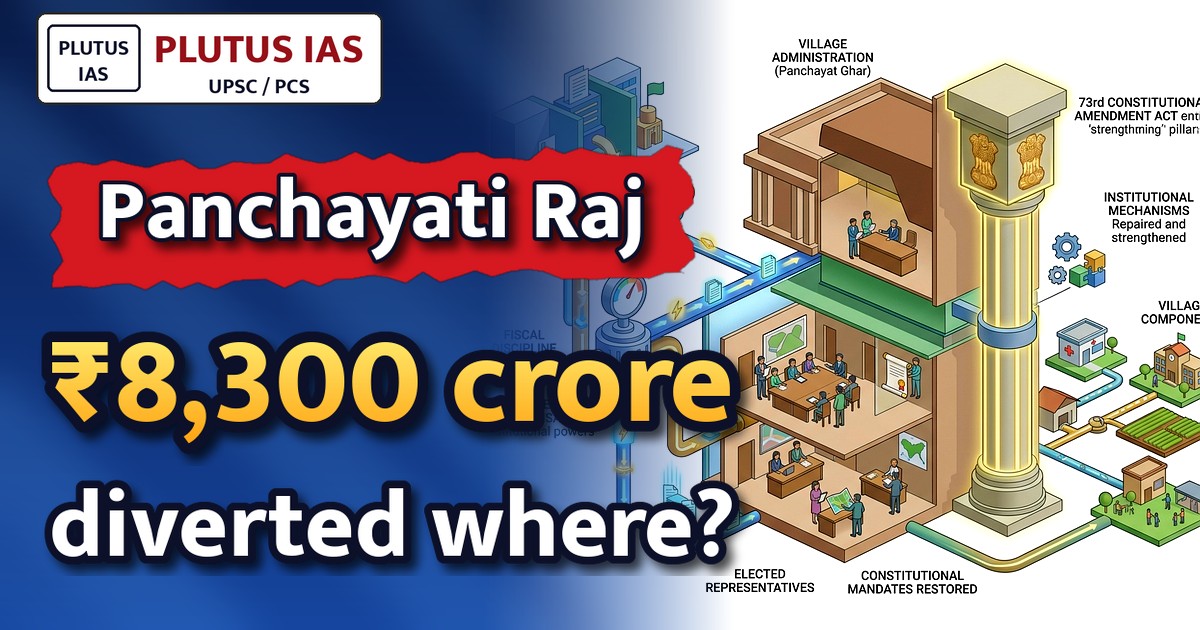
29 Sep How TDP Plans to Strengthen Panchayati Raj After Local Body Polls
✎ The Panchayati Raj system, established by the 73rd Constitutional Amendment Act, 1992, is a three-tier structure of rural local self-government designed to decentralise governance, empower rural communities, and ensure…
Subject Relevance — Where This Topic Fits
- GS Paper II — Constitutional, Statutory, Regulatory and various Quasi-judicial Bodies | GS Paper II — Functions and Responsibilities of the Union and the States, Issues and Challenges Pertaining to the Federal Structure | GS Paper III — Development Processes and the Development Industry — the Role of NGOs, SHGs, Various Groups and Associations, Donors, Charities, Institutional and Other Stakeholders | GS Paper III — Indian Economy and issues relating to Planning, Mobilisation of Resources, Growth, Development and Employment | GS Paper IV — Ethics and Human Interface: Accountability and Ethical Governance
- Prelims: 73rd Constitutional Amendment Act, 1992, Panchayati Raj Institutions (PRIs), 15th Finance Commission, State Finance Commissions, Local Area Development Funds, Constitutional status of PRIs, Functions of Zilla Parishad, Panchayat Samiti, Gram Panchayat, Grants-in-aid to PRIs, Fiscal decentralisation, Constitutional provisions for local self-government, Role of District Planning Committees
- Essay: Decentralisation and participatory governance as pillars of sustainable development, Fiscal federalism and the empowerment of local institutions
Quick Revision: The Panchayati Raj system, established by the 73rd Constitutional Amendment Act, 1992, is a three-tier structure of rural local self-government designed to decentralise governance, empower rural communities, and ensure participatory development through elected representatives and fiscal autonomy.
Why is this in the news?
The statement by the Vice-President of the Andhra Pradesh Panchayat Raj Chamber highlights the proposed administrative strengthening of village governance structures following local body elections, with a focus on fiscal discipline, transparency in fund utilisation, and the restoration of constitutional mandates to elected representatives. This discourse is situated within the broader framework of India’s Panchayati Raj system, fiscal federalism, and the challenges posed by diversion of funds from local bodies, necessitating a re-examination of institutional mechanisms to ensure effective decentralised governance.
Background
- The 73rd Constitutional Amendment Act, 1992, established the Panchayati Raj system to promote decentralised governance and empower rural local bodies, granting them constitutional status and delineating their functions, powers, and responsibilities.
- The 15th Finance Commission (2021–2026) recommended enhanced devolution of funds to local governments, including Panchayati Raj Institutions (PRIs), to strengthen their financial autonomy and operational capacity.
- PRIs are structured hierarchically as Gram Panchayats at the village level, Panchayat Samitis at the block level, and Zilla Parishads at the district level, with elected representatives responsible for local development and service delivery.
- State Finance Commissions are mandated under Article 243-I of the Constitution to review the financial position of PRIs and recommend measures to improve their fiscal health, including the devolution of funds and taxes.
- Fiscal decentralisation aims to empower local bodies to address grassroots development needs, but its effectiveness is contingent on transparent fund flow, utilisation, and accountability mechanisms.
- The issue of fund diversion from PRIs has been a recurring concern, with allegations of misappropriation or reallocation of funds earmarked for local development, undermining the objectives of fiscal federalism and participatory governance.
What is the Panchayati Raj System and its Constitutional Framework?
- The Panchayati Raj system is a three-tier structure of rural local self-government, mandated by the 73rd Constitutional Amendment Act, 1992, to decentralise governance and empower rural communities.
- Constitutional provisions: Articles 243 to 243-O of the Constitution provide the legal framework for PRIs, including their composition, powers, functions, and financial resources.
- Mandatory provisions: The 73rd Amendment made provisions such as regular elections, reservation for women and marginalised groups, and the establishment of State Election Commissions mandatory for all states.
- Functions of PRIs: PRIs are responsible for local development activities such as sanitation, water supply, rural roads, street lighting, health, education, and social welfare, as outlined in the Eleventh Schedule of the Constitution.
- Financial resources: PRIs derive funds from State Finance Commissions, the 15th Finance Commission, and other centrally sponsored schemes, with a focus on fiscal decentralisation and local resource mobilisation.
- Elected representatives: Members of Gram Panchayats, Panchayat Samitis, and Zilla Parishads are directly elected by the people, with provisions for reservation for Scheduled Castes, Scheduled Tribes, and women (minimum one-third representation).
- Role of State Governments: State governments are responsible for implementing the provisions of the 73rd Amendment, including the establishment of PRIs, devolution of funds, and ensuring their functional autonomy.
- Challenges: Despite constitutional guarantees, PRIs often face challenges such as inadequate devolution of funds, lack of functional autonomy, political interference, and weak capacity for implementation of development programmes.
Key Features
| Feature | Significance |
|---|---|
| Direct fund transfer to Panchayats | Enhances financial autonomy of local bodies by bypassing State-level intermediation, ensuring transparency and accountability in fund utilisation. |
| 15th Finance Commission allocations | Provides untied funds to Panchayati Raj Institutions (PRIs) for critical local infrastructure like sanitation, roads, and water facilities, as mandated under constitutional provisions. |
| Constitutional mandate for Panchayati Raj | Establishes a three-tier system of local governance (Gram Panchayat, Panchayat Samiti, Zilla Parishad) to decentralise administration and empower rural communities. |
| Role of Zilla Parishad Territorial Constituencies (ZPTC) and Mandal Parishad Territorial Constituencies (MPTC) | Elected representatives at district and block levels are pivotal for grassroots development, ensuring participatory governance and localised decision-making. |
| Financial devolution under Article 280 | The Finance Commission recommends fiscal transfers to local bodies, reinforcing the constitutional framework for decentralised planning and resource allocation. |
Why it Matters
Institutional Strengthening
- Reinforces the constitutional vision of a robust Panchayati Raj system by ensuring elected representatives exercise genuine administrative and financial powers.
- Facilitates grassroots democracy by empowering local bodies to address rural development needs without undue State-level interference.
- Promotes fiscal federalism by devolving funds directly to PRIs, reducing leakages and enhancing utilisation efficiency for local public goods.
Economic Governance
- Direct fund transfers to Panchayats for sanitation, roads, and water facilities can stimulate rural employment and economic activity through local infrastructure projects.
- Prevents diversion of funds earmarked for rural development, ensuring optimal allocation of resources for welfare-oriented schemes.
- Enhances the efficacy of centrally sponsored schemes (CSS) by ensuring timely and transparent disbursement at the grassroots level.
Constitutional and Legal Framework
- Upholds the 73rd Constitutional Amendment Act (1992), which mandates devolution of powers, functions, and finances to PRIs, ensuring their functional autonomy.
- Aligns with the principle of subsidiarity, where governance decisions are taken at the lowest feasible administrative level to ensure responsiveness and accountability.
Challenges
1. Misutilisation of Funds
- State-level diversion of funds allocated to Panchayats undermines the constitutional intent of financial devolution and local self-governance.
- Lack of transparency in fund flows reduces the ability of PRIs to plan and execute local development projects effectively.
UPSC Link: GS-II: Local Governance & Constitutional Amendments
2. Erosion of Local Autonomy
- Centralised control over elected representatives (e.g., ZPTC/MPTC) can reduce their decision-making authority, turning them into nominal entities rather than functional leaders.
- Political interference in local governance disrupts the participatory ethos enshrined in the Panchayati Raj system.
UPSC Link: GS-II: Panchayati Raj Institutions
3. Capacity Constraints
- Many PRIs lack technical and administrative capacity to utilise funds efficiently, leading to suboptimal project implementation.
- Inadequate training and resource support for elected representatives hampers their ability to discharge constitutional duties effectively.
UPSC Link: GS-II: Decentralised Governance
4. Accountability and Oversight
- Weak monitoring mechanisms allow for fund diversions and misreporting, reducing the efficacy of local governance structures.
- Absence of robust grievance redressal systems diminishes public trust in the Panchayati Raj system.
UPSC Link: GS-II: Constitutional Bodies
Challenges — UPSC Perspective
| Issue | Concern |
|---|---|
| Fund Diversion | State-level misallocation of funds earmarked for Panchayats reduces resource availability for rural development. |
| Political Interference | Centralised control over elected representatives undermines their functional autonomy and decision-making authority. |
| Capacity Gaps | PRIs often lack the technical and administrative skills to utilise funds and implement projects effectively. |
| Transparency Deficits | Opaque fund flows and reporting mechanisms reduce accountability and public trust in local governance. |
| Legal Ambiguities | Unclear delineation of powers between State governments and PRIs can lead to jurisdictional disputes and governance paralysis. |
Way Forward
- Strengthen institutional mechanisms for direct fund transfers to PRIs, ensuring 100% utilisation of allocated resources for designated purposes.
- Enhance capacity-building programmes for elected representatives and officials to improve financial management and project implementation at the grassroots level.
- Establish independent audit systems for PRIs to monitor fund utilisation and prevent diversions, with penalties for non-compliance.
- Promote participatory planning by involving local communities in identifying and prioritising development needs through Gram Sabhas.
- Clarify constitutional provisions on the division of powers between State governments and PRIs to reduce jurisdictional ambiguities.
- Leverage technology (e.g., GIS mapping, e-governance portals) to track fund disbursement and project progress in real time.
- Conduct periodic reviews of the Panchayati Raj system to assess its functional efficacy and recommend structural reforms.
UPSC Value Addition
Keywords for Mains Answer-Writing
Panchayati Raj System · 73rd Constitutional Amendment Act · 15th Finance Commission · decentralisation of governance · local self-governance · Panchayat Raj institutions · funds diversion · constitutional provisions for Panchayats · Zilla Parishad Territorial Constituencies (ZPTC) · Mandal Parishad Territorial Constituencies (MPTC) · direct fund transfer to Panchayats · institutional autonomy of local bodies · constitutional governance · local administration reforms · Panchayat Raj Chamber
Constitutional & Policy Linkages
- Article 40: Directive Principle of State Policy to organise village panchayats and endow them with powers and authority.
- Article 243: Constitutional provisions for Panchayats, including their composition, powers, and functions.
- Article 243G: Empowers Panchayats to prepare plans for economic development and social justice.
- Article 280: Finance Commission’s role in recommending fiscal transfers to local bodies.
Concept Flow
State governments receive funds from the 15th Finance Commission for allocation to PRIs. → Funds are earmarked for specific local development projects (sanitation, roads, water facilities). → State-level diversion of funds reduces the quantum available to PRIs, undermining their autonomy. → Elected representatives (ZPTC/MPTC) become nominal entities due to lack of financial and administrative powers. → Local governance weakens, leading to poor project implementation and reduced public trust. → Strengthening direct fund transfers and institutional capacity revitalises the Panchayati Raj system. → Functional PRIs enhance participatory governance and rural development outcomes.
Prelims Practice Questions
Q1. Consider the following statements regarding the 73rd Constitutional Amendment Act, 1992:
1. It mandates the establishment of a three-tier Panchayati Raj system in every state.
2. It provides for the reservation of seats for women in Panchayati Raj institutions.
3. It empowers the State Election Commission to conduct elections to Panchayati Raj institutions.
4. It grants constitutional status to Panchayati Raj institutions.
How many of the above statements are correct?
- Only one
- Only two
- Only three
- All
Answer: All — Statements 1, 2, and 4 are correct as per the 73rd Constitutional Amendment Act. Statement 3 is incorrect because the State Election Commission is responsible for elections to the State Legislature and Parliament, while elections to Panchayati Raj institutions are conducted by the State Election Commission as per the Act, but the power is derived from the Act itself, not the Constitution.
Q2. Assertion (A): The 15th Finance Commission recommended direct fund transfers to Panchayati Raj institutions for sanitation, internal roads, and water facilities.
Reason (R): Direct fund transfers enhance the autonomy and efficiency of local governance by reducing bureaucratic delays.
Select the correct code:
A. Both A and R are true, and R is the correct explanation of A.
B. Both A and R are true, but R is not the correct explanation of A.
C. A is true, but R is false.
D. A is false, but R is true.
- A
- B
- C
- D
Answer: B — Both Assertion (A) and Reason (R) are true, and Reason (R) correctly explains Assertion (A). The 15th Finance Commission did recommend direct fund transfers to Panchayats, and this measure is intended to enhance local autonomy and efficiency.
Q3. Match the following pairs related to Panchayati Raj institutions in India:
Column I (Institution) | Column II (Function)
————————————|————————————
A. Gram Panchayat | 1. Coordination of developmental plans at district level
B. Panchayat Samiti | 2. Implementation of schemes at village level
C. Zilla Parishad | 3. Supervision of intermediate-level institutions
D. District Planning Committee | 4. Preparation of district development plans
Select the correct match:
A. A-2, B-3, C-1, D-4
B. A-1, B-2, C-3, D-4
C. A-4, B-1, C-2, D-3
D. A-3, B-4, C-2, D-1
- A
- B
- C
- D
Answer: A — The correct matches are: A-2 (Gram Panchayat implements schemes at village level), B-3 (Panchayat Samiti supervises intermediate-level institutions), C-1 (Zilla Parishad coordinates developmental plans at district level), and D-4 (District Planning Committee prepares district development plans).
Mains Practice Question
✍ The 73rd Constitutional Amendment Act, 1992, sought to institutionalise decentralised governance through the Panchayati Raj system. In light of recent discussions on the diversion of funds allocated to Panchayati Raj institutions, critically examine the effectiveness of the constitutional framework in ensuring financial autonomy and functional independence of these institutions. (15 Marks)
Approach: MODEL-ANSWER SKELETON:
1. **Constitutional Framework**:
– Article 243G and 243H: Functions, powers, and finances of Panchayats.
– 11th Schedule: 29 subjects devolved to Panchayats.
– 73rd Amendment Act: Mandated three-tier system, reservation for women and SCs/STs, State Finance Commission (SFC) every 5 years.
2. **Financial Provisions**:
– Article 243I: State Finance Commission to review financial position and recommend devolution of funds.
– 15th Finance Commission: Recommended direct fund transfers to Panchayats for sanitation, roads, water, and street lighting.
– Role of Gram Sabhas: Ensuring transparency and accountability in fund utilisation.
3. **Recent Issues and Challenges**:
– Diversion of funds: Allegations of funds being rerouted away from Panchayats, undermining financial autonomy.
– Lack of functional independence: Elected representatives (ZPTC/MPTC) acting as ‘puppets’ due to administrative overreach.
– Bureaucratic interference: Over-centralisation of decision-making at state level.
4. **Judicial and Institutional Safeguards**:
– Judicial precedents: Supreme Court rulings on autonomy of local bodies (e.g., Rajasthan Panchayat Samitis and Zilla Parishads Act case).
– Role of Election Commission: Ensuring free and fair elections to Panchayati Raj institutions.
5. **Way Forward**:
– Strengthening SFCs: Ensuring timely constitution and implementation of recommendations.
– Direct fund transfers: Expanding the scope of untied funds for Panchayats.
– Capacity building: Training for elected representatives and officials.
– Strengthening Gram Sabhas: Enhancing participatory governance.
6. **Balanced View**:
– While the constitutional framework is robust, implementation gaps persist due to political and administrative constraints.
– Need for political will and institutional reforms to realise the vision of decentralised governance.
Source: The Hindu
Generated by AanyaAi for educational purpose.
Related guides on our sites
- Best PSIR optional coaching for upsc
- Best PSIR optional teacher for upsc
- Best teacher of PSIR optional for upsc
- Best PSIR optional coaching in delhi for UPSC

- Anthropic Warns AI Could Pose Existential Risks in IPO Filing - September 29, 2026
- भारत-अमेरिका संबंधों में सीमापार आतंकवाद की चिंता क्यों है महत्वपूर्ण? जानिए क्या बोले एस. जयशंकर - September 29, 2026
- CAG Flags Rs 1,136 Crore Pending E-Challans in Odisha: Key Audit Findings - September 29, 2026

No Comments