


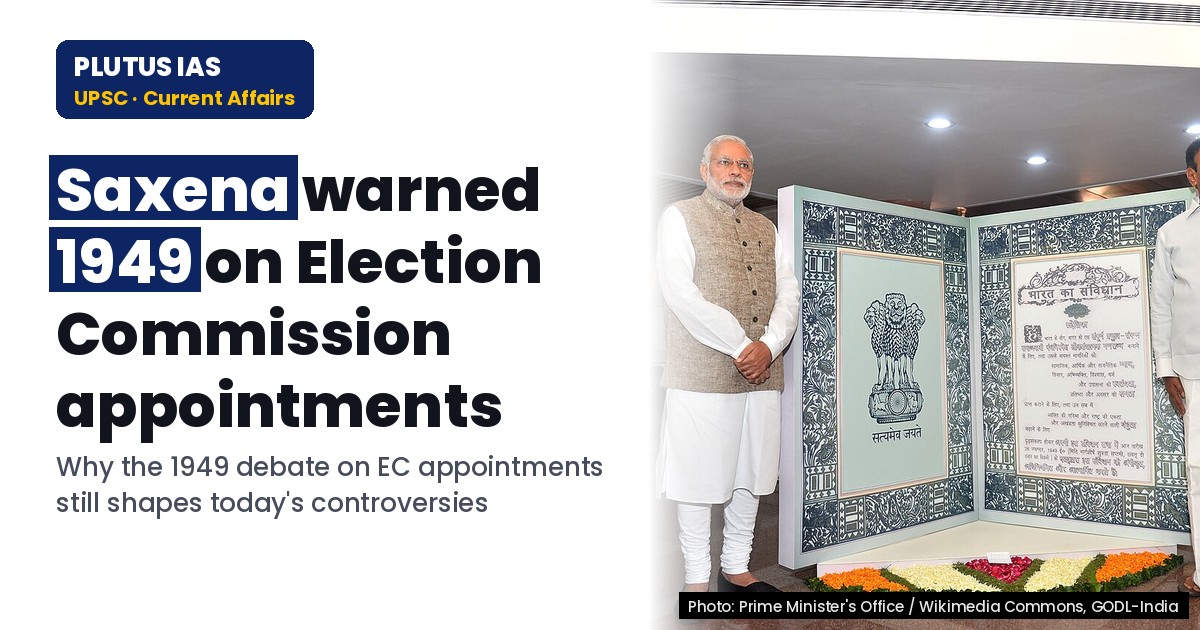
04 Oct How the Constituent Assembly Debated Election Commission Appointments
✎ The independence of the Election Commission of India is constitutionally safeguarded under Article 324, with the appointment process historically debated in the Constituent Assembly and recently formalised by the Supreme Court in…
Subject Relevance — Where This Topic Fits
- GS Paper II — Polity and Governance: Constitutional Bodies, Election Commission of India, Judicial Review, Separation of Powers | GS Paper II — Polity and Governance: Basic Structure Doctrine, Constitutional Amendments
- Prelims: Election Commission of India (ECI), Article 324, Chief Election Commissioner (CEC), Election Commissioners, Anoop Baranwal v. Union of India (2023), The Chief Election Commissioner and Other Election Commissioners (Appointment, Conditions of Service and Term of Office) Act, 2023, Constituent Assembly Debates, Shibban Lal Saxena, H N Kunzru, B R Ambedkar, Judicial Independence, Collegium System, Parliamentary Committees
- Essay: The integrity of democratic institutions as the bedrock of constitutional democracy, Balancing executive accountability and institutional independence in constitutional bodies
Quick Revision: The independence of the Election Commission of India is constitutionally safeguarded under Article 324, with the appointment process historically debated in the Constituent Assembly and recently formalised by the Supreme Court in Anoop Baranwal (2023) and the subsequent parliamentary legislation of 2023.
Why is this in the news?
The appointment process of the Election Commission of India (ECI) has recently come under scrutiny due to concerns over the perceived independence of its members. The historical debates in the Constituent Assembly regarding the safeguards for the ECI’s autonomy, coupled with the Supreme Court’s intervention in Anoop Baranwal v. Union of India (2023) and the subsequent legislative response through The Chief Election Commissioner and Other Election Commissioners (Appointment, Conditions of Service and Term of Office) Act, 2023, highlight the evolving constitutional and legal framework governing the appointment of Election Commissioners. This discourse underscores the tension between executive authority and institutional independence in India’s democratic framework.
Background
- The Election Commission of India (ECI) was established under Article 324 of the Constitution of India to ensure free and fair elections, a fundamental feature of India’s democratic polity.
- During the drafting of the Constitution, members of the Constituent Assembly, including Shibban Lal Saxena and H N Kunzru, raised concerns about the potential for executive bias in the appointment of Election Commissioners, arguing that the government of the day should not control the selection of the ‘referee’ for its own electoral contests.
- The Constituent Assembly debated alternative appointment mechanisms, including a two-thirds majority in Parliament and the involvement of provincial governments, but ultimately deferred the matter to Parliament for legislative action.
- For 74 years, Parliament did not enact a law to regulate the appointment process, leaving the matter subject to executive discretion.
- In 2023, the Supreme Court, in Anoop Baranwal v. Union of India, directed the establishment of a committee comprising the Prime Minister, the Leader of the Opposition, and the Chief Justice of India (CJI) to recommend appointments to the ECI until Parliament enacted a law.
- Parliament subsequently passed The Chief Election Commissioner and Other Election Commissioners (Appointment, Conditions of Service and Term of Office) Act, 2023, which replaced the CJI with a Cabinet Minister in the selection committee, thereby altering the composition of the appointment mechanism.
The Constitutional and Legal Framework for the Appointment of the Election Commission of India
- Article 324 of the Constitution of India establishes the Election Commission of India (ECI) and vests it with the superintendence, direction, and control of elections to Parliament, State Legislatures, the Office of the President, and the Office of the Vice-President.
- The Constitution originally provided for the appointment of the Chief Election Commissioner (CEC) and Election Commissioners by the President of India, without specifying the process, thereby leaving it to executive discretion.
- The Constituent Assembly debated the need for safeguards to ensure the independence of the ECI, with members like Shibban Lal Saxena and H N Kunzru warning against the risks of executive bias in the appointment process.
- B R Ambedkar acknowledged the ‘greatest headache’ of the Drafting Committee in designing a system that would balance executive accountability with institutional independence, ultimately leaving the appointment mechanism to be determined by Parliament.
- The Supreme Court, in Anoop Baranwal v. Union of India (2023), held that the lack of a parliamentary law on the appointment process violated the principles of free and fair elections and directed the formation of a committee for recommendations until Parliament legislated.
- The Chief Election Commissioner and Other Election Commissioners (Appointment, Conditions of Service and Term of Office) Act, 2023, was enacted to formalise the appointment process, replacing the CJI with a Cabinet Minister in the selection committee, thereby altering the balance of power in the appointment mechanism.
- The Act specifies the tenure, salary, and conditions of service of the CEC and Election Commissioners, ensuring a fixed term and protection from arbitrary removal, which are critical for maintaining institutional independence.
- The debate surrounding the appointment process reflects broader constitutional principles, including the separation of powers, judicial independence, and the need to safeguard democratic institutions from executive overreach.
Key Features
| Feature | Significance |
|---|---|
| Constitutional provision (Article 324) | Establishes the Election Commission of India as a constitutional body to ensure free and fair elections, with the President as the appointing authority. |
| Shibban Lal Saxena’s proposal (1949) | Advocated a two-thirds majority in Parliament for appointments to prevent partisan influence, highlighting the need for institutional safeguards over individual integrity. |
| H N Kunzru’s concern (1949) | Questioned the impartiality of the Central Government in appointments, arguing that political bias could undermine the Commission’s independence. |
| B R Ambedkar’s compromise | Balanced the need for independence with practical governance, leaving the appointment mechanism to Parliament via Article 324. |
| Supreme Court intervention (Anoop Baranwal v. Union of India, 2023) | Directed a collegium-based appointment process (PM, Leader of Opposition, CJI) until Parliament legislated, ensuring multi-stakeholder oversight. |
| Parliamentary legislation (2023 Act) | Replaced the CJI with a panel excluding the judiciary, reflecting a shift in institutional trust and political dynamics in appointments. |
Why it Matters
Institutional Integrity
- The Election Commission’s independence is critical to maintaining democratic legitimacy, as it acts as the neutral arbiter in electoral processes.
- Perception of impartiality is as vital as actual independence, ensuring public trust in electoral outcomes and the Commission’s decisions.
- Historical debates in the Constituent Assembly underscore the enduring tension between executive authority and institutional autonomy in constitutional democracies.
Constitutional Governance
- Article 324 vests the Election Commission with constitutional status, but its operational independence hinges on the appointment mechanism.
- The failure of Parliament to legislate for 74 years highlights the need for proactive institutional reforms to address evolving governance challenges.
- Judicial intervention (Anoop Baranwal case) demonstrates the judiciary’s role in filling legislative gaps to uphold constitutional principles.
Democratic Safeguards
- Multi-stakeholder appointment processes (e.g., collegiums) reduce the risk of partisan capture and enhance the Commission’s credibility.
- The exclusion of the judiciary from the 2023 Act reflects a rebalancing of institutional checks, raising questions about the optimal composition of selection panels.
- Safeguards against arbitrary removal (e.g., fixed tenure, stringent impeachment procedures) are essential to insulate the Commission from executive pressure.
Challenges
1. Partisan Influence in Appointments
- The risk of the ruling party appointing Commissioners aligned with its interests undermines the perception of impartiality.
- Historical warnings (e.g., Shibban Lal Saxena, H N Kunzru) highlight the fragility of institutional independence when appointments are politically driven.
- The 2023 Act’s exclusion of the CJI from the selection panel may reduce judicial oversight, potentially increasing executive dominance.
UPSC Link: GS-II: Constitutional and Non-Constitutional Bodies
2. Legislative Inaction and Judicial Overreach
- Parliament’s failure to legislate for 74 years left a constitutional vacuum, necessitating judicial intervention to uphold democratic norms.
- Judicial activism in Anoop Baranwal raises questions about the separation of powers and the appropriate role of courts in governance.
- The judiciary’s limited role in the 2023 Act may reflect a shift in institutional trust, but it also risks politicising judicial appointments.
UPSC Link: GS-II: Separation of Powers
3. Perception vs. Reality of Independence
- Even impartial appointments may face scrutiny if the public perceives bias, particularly in high-stakes electoral contexts.
- The Commission’s decisions (e.g., model code of conduct, electoral reforms) must be seen as neutral to maintain public confidence.
- Media narratives and political rhetoric can distort perceptions, necessitating transparent processes and clear communication.
UPSC Link: GS-II: Electoral Reforms
4. Balancing Institutional Autonomy and Accountability
- The Commission must balance independence with accountability to Parliament and the public, avoiding unchecked power.
- Mechanisms for transparency (e.g., public disclosure of selection criteria, post-appointment audits) can enhance credibility.
- The lack of a fixed tenure for Election Commissioners (unlike the CEC) may create vulnerabilities to political interference.
UPSC Link: GS-II: Constitutional Bodies
Challenges — UPSC Perspective
| Issue | Concern |
|---|---|
| Partisan Appointments | Risk of executive dominance in selecting Commissioners, undermining impartiality. |
| Judicial Exclusion | Reduced oversight in the 2023 Act may weaken checks on executive power. |
| Legislative Inaction | 74-year delay in legislating appointments reflects systemic governance gaps. |
| Perception of Bias | Public trust in the Commission may erode despite impartial processes. |
| Fixed Tenure Gaps | Election Commissioners lack tenure security, making them vulnerable to political pressure. |
Way Forward
- Enact a comprehensive parliamentary law to formalise the appointment process, incorporating multi-stakeholder oversight (e.g., Opposition, judiciary, civil society).
- Introduce fixed tenures for all Election Commissioners to insulate them from arbitrary removal and political interference.
- Establish transparent selection criteria (e.g., experience in election administration, legal expertise, ethical track record) to guide appointments.
- Mandate periodic audits of the Election Commission’s functioning to assess independence and efficiency.
- Strengthen whistle-blower protections for Election Commission officials to encourage reporting of undue influence.
- Enhance public awareness campaigns to educate citizens on the Commission’s role and the importance of electoral integrity.
- Explore constitutional amendments to clarify Article 324’s appointment mechanism, reducing ambiguity in governance.
- Encourage cross-party consensus on electoral reforms to depoliticise the Commission’s functioning.
UPSC Value Addition
Keywords for Mains Answer-Writing
Election Commission of India · Article 324 of the Constitution · constitutional independence of institutions · appointment process of Election Commissioners · Anoop Baranwal v. Union of India (2023) · Chief Election Commissioner and Other Election Commissioners Act, 2023 · perception of impartiality in governance · Constituent Assembly debates on Article 324 · judicial intervention in executive appointments · separation of powers in election administration
Constitutional & Policy Linkages
- Article 324: Establishes the Election Commission of India and its appointment mechanism.
- Article 329: Bars judicial interference in electoral disputes, underscoring the Commission’s autonomy.
- Article 324(5): Provides for the removal of Election Commissioners, highlighting safeguards against arbitrary dismissal.
Concept Flow
Constitutional Assembly debates (1949) → Recognition of need for impartial appointments → Drafting of Article 324 → Parliament’s inaction for 74 years → Judicial intervention (Anoop Baranwal, 2023) → Enactment of 2023 Act → Shift in appointment dynamics → Ongoing challenges in institutional independence → Way forward for reforms.
Prelims Practice Questions
Q1. Consider the following statements regarding the appointment of the Election Commissioners in India:
1. The Constitution originally vested the power of appointment of Election Commissioners solely with the President.
2. The Chief Election Commissioner and Other Election Commissioners Act, 2023, mandates a selection committee comprising the Prime Minister, Leader of the Opposition, and the Chief Justice of India.
3. The Supreme Court in Anoop Baranwal v. Union of India (2023) directed the Parliament to legislate on the appointment process of Election Commissioners.
4. The Constituent Assembly rejected all proposals for a multi-member selection committee for appointing Election Commissioners.
How many of the above statements are correct?
- Only one
- Only two
- Only three
- All four
Answer: Only two — Statement 1 is correct as the original Constitution vested appointment power with the President. Statement 2 is incorrect because the 2023 Act excluded the Chief Justice of India from the selection committee. Statement 3 is incorrect as the Supreme Court directed the appointment process until Parliament legislated, but did not mandate legislation. Statement 4 is incorrect as proposals for a multi-member committee were discussed, though ultimately rejected.
Q2. Assertion (A): The Constituent Assembly debates on Article 324 reflect a deep concern for ensuring the independence of the Election Commission.
Reason (R): Members like Shibban Lal Saxena and H N Kunzru argued that the government of the day should not have the sole authority to appoint Election Commissioners, as it could compromise the perception of impartiality.
In the context of the above two statements, which of the following is correct?
- Both A and R are true, and R is the correct explanation of A.
- Both A and R are true, but R is not the correct explanation of A.
- A is true, but R is false.
- A is false, but R is true.
Answer: Both A and R are true, and R is the correct explanation of A. — Both the Assertion (A) and Reason (R) are true, and the Reason (R) correctly explains the Assertion (A). The debates in the Constituent Assembly underscored the necessity of insulating the Election Commission from executive influence to maintain its perceived independence.
Q3. Match the following provisions with their corresponding constitutional or legal instruments:
Column I
A. Original constitutional provision for appointment of Election Commissioners
B. Supreme Court directive on appointment process
C. Statutory framework for appointment of Election Commissioners
D. Constitutional safeguard for removal of Chief Election Commissioner
Column II
1. Article 324 of the Constitution
2. Chief Election Commissioner and Other Election Commissioners Act, 2023
3. Constituent Assembly debates
4. Anoop Baranwal v. Union of India (2023)
5. Article 324(5) of the Constitution
Answer: ? — A-3 (Original constitutional provision was debated in the Constituent Assembly), B-4 (Supreme Court directive in Anoop Baranwal), C-2 (Statutory framework provided by the 2023 Act), D-5 (Constitutional safeguard for removal under Article 324(5)).
Mains Practice Question
✍ The Constitution framers envisaged the Election Commission as an institution independent of the executive, yet the original constitutional scheme entrusted its appointment solely to the President, creating a potential conflict of interest. Critically examine the evolution of the appointment process of the Election Commissioners in India, with reference to the Constituent Assembly debates, judicial interventions, and legislative responses. Also, analyse the significance of the perception of independence in the functioning of constitutional institutions. (15 Marks)
Approach: MODEL-ANSWER SKELETON:
1. **Constituent Assembly Debates (1949):**
– Highlight concerns raised by Shibban Lal Saxena and H N Kunzru regarding executive dominance in appointments and the need for safeguards to ensure impartiality.
– Mention B R Ambedkar’s acknowledgment of the ‘greatest headache’ and the compromise reached in leaving the appointment mechanism to Parliament.
2. **Original Constitutional Scheme (Article 324):**
– Article 324 establishes the Election Commission but does not specify the appointment process, leaving it to Parliament.
– The Chief Election Commissioner’s protection from arbitrary removal (Article 324(5)) underscores the need for independence.
3. **Judicial Intervention (Anoop Baranwal v. Union of India, 2023):**
– Supreme Court’s direction to adopt a collegium-like system (PM, Leader of Opposition, CJI) until Parliament legislated.
– Emphasise the Court’s focus on the ‘perception of independence’ as critical to democratic legitimacy.
4. **Legislative Response (Chief Election Commissioner and Other Election Commissioners Act, 2023):**
– Parliament’s enactment replacing the CJI with a neutral member (former Supreme Court judge) to dilute executive dominance.
– Analyse the Act’s provisions for a three-member selection committee and the exclusion of the CJI.
5. **Perception of Independence:**
– Define ‘perception of independence’ as the public’s trust in the institution’s impartiality, distinct from actual independence.
– Discuss how executive-dominated appointments can erode trust, citing global best practices (e.g., South Africa’s multi-party committee).
6. **Balancing Views:**
– Argue that while the 2023 Act addresses executive dominance, the exclusion of the CJI may reduce judicial oversight.
– Conclude that the evolution reflects a shift from ‘trust in individuals’ (as in the Constituent Assembly) to ‘institutional safeguards’ (via judicial and legislative interventions).
Key Thinkers/Cases/Provisions to Name:
– Shibban Lal Saxena, H N Kunzru, B R Ambedkar (Constituent Assembly)
– Article 324, Article 324(5)
– Anoop Baranwal v. Union of India (2023)
– Chief Election Commissioner and Other Election Commissioners Act, 2023
Source: The Indian Express
Generated by AanyaAi for educational purpose.
Related guides on our sites
- Best PSIR optional coaching for upsc
- Best PSIR optional teacher for upsc
- Best teacher of PSIR optional for upsc
- Best PSIR optional coaching in delhi for UPSC

- How the Constituent Assembly Debated Election Commission Appointments - October 4, 2026
- आंध्र प्रदेश को 3 लाख पक्के घर: मोदी सरकार की बड़ी सौगात, जानिए कैसे बदलेगी तस्वीर - October 4, 2026
- GST Reform: Arrest Powers of Officers to be Scrapped in Next Big Change - October 4, 2026

No Comments