


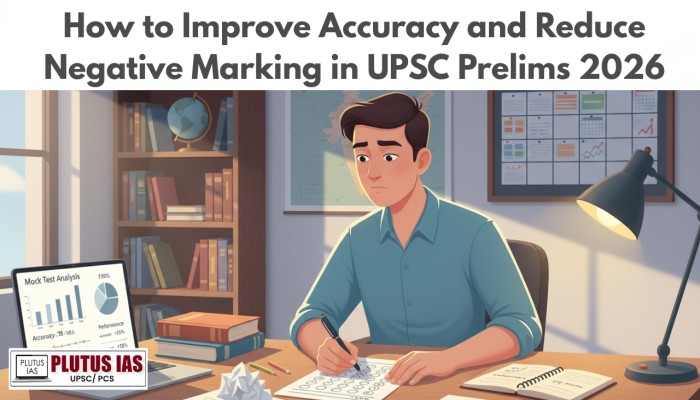
18 Mar How to Improve Accuracy and Reduce Negative Marking in UPSC Prelims 2026
Every year, thousands of brilliant UPSC aspirants walk out of the Preliminary examination hall with a heavy heart. When they check the unofficial answer keys, they realize a painful truth: they knew the answers to enough questions to clear the cutoff, but their negative marking pulled them down. They attempted 85 questions, got 50 right, but 35 wrong. Those 35 wrong answers wiped out nearly 23 marks, leaving them stranded just below the qualifying line.
The UPSC Prelims is not just a test of what you know; it is a test of how accurately you can apply that knowledge under pressure. In an exam where the difference between an IAS officer and a “failed candidate” is often just 1 or 2 marks, accuracy is the ultimate superpower.
If you are targeting UPSC 2026, you must realize that reducing negative marking is a skill that needs to be practiced for months. It is not something that happens by luck on the day of the exam. In this detailed guide, we will explore the science of accuracy, the psychology of guessing, and the exact strategies you need to master to ensure that negative marking does not kill your IAS dream.
1. The Mathematics of the Prelims: Why Every Wrong Answer is a Disaster
In Paper 1 (General Studies), every correct answer gives you +2 marks. Every wrong answer takes away -0.66 marks. This is the “1/3rd Negative Marking” rule. While it sounds small, it has a massive compounding effect.
Consider this: if you get three questions wrong, you lose 2 marks. Those are 2 marks you earned with great effort by getting another question right. Essentially, every three mistakes “eat up” one correct answer. In a competitive environment where the cutoff is hovering around 85 to 95 marks, losing 10 to 15 marks only due to negative marking is a luxury you simply cannot afford.
Must Check :- Best IAS Coaching in Delhi
To improve accuracy, you must first stop viewing the exam as a “numbers game” where you have to attempt 90+ questions to pass. Instead, view it as an “efficiency game” where the goal is to maximize your net score.
2. Why Do We Get Questions Wrong? (Root Cause Analysis)
Before you can fix the problem, you must understand why it happens. Negative marking usually stems from four specific zones of failure:
- Zone 1: The “Silly Mistake” Zone. You knew the answer, but you misread the question. You missed the word “NOT,” or you marked the wrong bubble on the OMR sheet.
- Zone 2: The “Half-Knowledge” Zone. You recognized the topic, but you were confused between two options. You took a “gut-feeling” guess, and it turned out to be wrong.
- Zone 3: The “Trap” Zone. The UPSC purposefully designed the question to lead you to a logical-sounding but incorrect answer. You fell for the “Extreme Word” trap or the “Technical Jargon” trap.
- Zone 4: The “Panic” Zone. Towards the end of the two hours, you realized you had only attempted 60 questions. In a state of panic, you started marking answers randomly just to increase your attempt count.
By identifying which zone you struggle with the most during your mock tests, you can tailor your 2026 strategy to fix that specific weakness.
3. Mastering the Art of “Intelligent Guessing”
Let us be honest: No one—not even the All India Rank 1—knows more than 35 to 40 questions with 100 percent certainty. To clear the cutoff, everyone has to take risks on the remaining 40 to 50 questions. The difference is that successful candidates take Calculated Risks, while others take Blind Risks.
The Power of Elimination
Accuracy is not about finding the “right” answer; it is often about finding the three “wrong” ones. In every UPSC question, try to find a reason why an option must be false. If you can eliminate even one option, your probability of being right jumps from 25 percent to 33 percent. If you eliminate two, you have a 50-50 chance.
The 50-50 Rule
Mathematically, you should always attempt a question if you have eliminated two options. Even if you get half of such questions wrong and half right, your net score will still be positive. However, you should avoid questions where you cannot eliminate a single option unless you have a very strong logical reason.
4. How to Spot “UPSC Traps” in the Question Paper
The UPSC paper setters are masters of psychology. They know how an aspirant’s mind works. To reduce negative marking, you must train your brain to spot these common traps:
Trap A: The Extreme Word Rule
In most (but not all) cases, statements containing extreme words are incorrect. This is because, in the real world, things are rarely “absolute.” Look out for words like:
- Only
- All
- Always
- Never
- Entirely
- Drastically
Example: “All birds in India are protected under the Wildlife Protection Act.” The word “All” is a red flag. There are vermin and common birds that may not have that level of protection.
Trap B: The “Moderate Word” Hint
Conversely, statements that use cautious, moderate language are often correct. Look for words like:
- Can be
- Some
- Generally
- May
- Might
- Often
Example: “Some species of fungi can be used in the production of biofuels.” This is a safe, moderate statement. It is likely to be true because science is constantly discovering new possibilities.
5. The Three-Round Attempt Strategy
One of the biggest causes of negative marking is attempting questions in a single, linear flow (from Question 1 to 100). This creates immense mental pressure. To improve accuracy for UPSC 2026, you should use the Three-Round Method.
Round 1: The “Sure-Shot” Questions (0 to 45 Minutes)
Go through the entire paper and solve only those questions where you are 100 percent certain. Do not spend more than 30 seconds on a confusing question. By the end of this round, you might have marked 30 to 35 questions. This builds your confidence and ensures that you have secured the “easy” marks without making silly mistakes.
Round 2: The “50-50” Questions (45 to 90 Minutes)
Now, go back to the questions where you eliminated two options. Spend time thinking logically. Connect the topic to something you read in the newspaper or another subject. This is where your actual “clearing the cutoff” happens. Aim to attempt another 25 to 30 questions here with high focus.
Round 3: The “Logical Leaps” (Last 30 Minutes)
If your total attempt is still low (below 70), look at questions where you have eliminated only one option. Use “Smart Logic” or “Common Sense.” If your attempt is already around 80 and you feel confident, STOP. Many aspirants ruin their score in the last 15 minutes by marking answers they aren’t sure about just because they feel they haven’t “done enough.”
6. Eliminating “Silly Mistakes”: The 1-Second Pause Rule
Silly mistakes are the most painful form of negative marking. You know the concept, you know the answer, but you still lose marks. This usually happens because your brain is working faster than your eyes.
To fix this, implement the 1-Second Pause Rule:
- Before you mark the bubble on the OMR sheet, look at the question number again.
- Look at the keyword in the question: Does it ask for “Correct” or “Incorrect”?
- Take one deep breath, then fill the bubble.
Also, underline keywords in the question paper itself. Physically circling the word “NOT” or “INCORRECT” with your pen sends a signal to your brain to be extra careful. These tiny habits can save you 4 to 6 marks—marks that are often the difference between success and failure.
7. The Role of Conceptual Clarity Over Rote Learning
UPSC has shifted away from factual questions. They now ask “conceptual” questions. If you have only memorized that “Article 21 is Right to Life,” you might get a question wrong if it asks about the “Due Process of Law” vs. “Procedure Established by Law.”
Negative marking happens when your knowledge is “shaky.” If you only have a 70 percent understanding of a concept, the UPSC will exploit the remaining 30 percent to confuse you. For 2026, focus on building depth. When you study a topic, don’t just ask “What is it?”—ask “How does it work?” and “What are its exceptions?”
When your concepts are crystal clear, the “confusing” options provided by UPSC won’t bother you. You will see the right answer shining through the noise.
8. Analyze Your Mocks: The “Why I Got It Wrong” Diary
Most aspirants solve 50 mock tests but never improve their accuracy. Why? Because they only care about the total score. They see “90 marks,” feel sad for ten minutes, and then move to the next test.
To reduce negative marking, you must become a data scientist of your own mistakes. After every mock test, create a small list of every wrong answer and categorize it:
- Category A: Lack of knowledge (I never read this).
- Category B: Silly mistake (I misread the question).
- Category C: Over-thinking (I had the right answer but changed it at the last minute).
- Category D: Wrong logic (My elimination method was flawed).
If Category B and C are high, you don’t need to read more books; you need to improve your mental discipline and focus. If Category A is high, you need to go back to your basic NCERTs and standard textbooks.
9. Control Your “Risk Appetite”
There is a lot of debate on the “Ideal Number of Questions” to attempt. Some say 90+, some say 75. The truth is, there is no one-size-fits-all number. It depends on your Accuracy Rate.
If you have very high accuracy (you get 9 out of 10 right), you can afford to attempt only 75 questions. If you have a habit of taking risks (you get 6 out of 10 right), you might need to attempt 90 questions to stay in the race.
For UPSC 2026, use your mock tests to find your “Sweet Spot.” Find the number of attempts where your net score is consistently the highest. Once you find that number, stick to it. Do not let the “exam hall pressure” or the “whispers of other candidates” force you to over-attempt.
10. The Psychology of the “Bouncer” Question
UPSC always includes 10 to 15 “Bouncer” questions—questions about obscure facts or weird reports that no one has ever heard of. These are designed to break your confidence and make you panic.
Negative marking often starts here. When an aspirant sees three bouncers in a row, they feel they are failing. To compensate, they start taking wild guesses on the next five questions. You must learn to respect the bouncer. It is okay to leave a question. In fact, leaving a question is often a sign of a very smart and confident aspirant. Remember, you don’t need 200/200; you only need enough to cross the cutoff.
Frequently Asked Questions (FAQs)
Q1: Is it possible to clear UPSC Prelims with 100% accuracy?
No, it is practically impossible due to the nature of the questions. Even the most prepared candidates have an accuracy rate of about 75 to 80 percent on their best days. The goal is not “perfection,” but “optimization”—reducing the number of wrong answers to a level where your correct answers can easily carry you across the cutoff.
Q2: Should I follow my “Gut Feeling” while marking answers?
“Gut feeling” is often just your subconscious memory at work. However, it can be dangerous. Use gut feeling only if you have a logical anchor for it. If you feel an answer is right but cannot find a single logical reason why, it is better to skip it. Gut feelings often lead to Zone 2 negative marking (Half-Knowledge).
Q3: How many mock tests are enough to improve accuracy?
Solving about 40 to 50 quality mock tests is generally recommended. However, the number is less important than the analysis. Solving 20 tests with deep analysis is better than solving 100 tests without looking at your mistakes. The goal is to identify your patterns of error and fix them systematically before 2026.
Q4: Does negative marking apply to the CSAT (Paper 2) as well?
Yes, the 1/3rd negative marking rule applies to the CSAT paper as well. However, since CSAT is only qualifying (you need 33 percent), the strategy there is different. Focus on 100 percent accuracy in your strongest areas (like Math or Reading Comprehension) rather than trying to attempt every question.
Must Check :- Best IAS Coaching in Delhi
Q5: How do I stop changing my right answer to a wrong one at the last minute?
This is a common psychological issue called “Over-thinking.” Usually, your first instinct is based on your deep preparation. Only change an answer if you find a concrete, factual piece of evidence that your first choice was wrong. If you are just “feeling doubtful,” trust your first choice and move on.
Conclusion
Improving accuracy and reducing negative marking is not about a “secret trick.” It is about Discipline, Logic, and Self-Awareness. It is about knowing the limits of your own knowledge and having the courage to stay quiet when you are not sure.
As you prepare for UPSC 2026, treat every mock test as a laboratory to test your accuracy. Underline those keywords, avoid the extreme word traps, follow the three-round strategy, and most importantly, stop making those silly mistakes. If you can master the art of “Not getting it wrong,” the battle for the UPSC Prelims is already half-won.
Related Articles
- Best Economics Optional Coaching in Delhi
- Best History Optional IAS Coaching in Delhi
- Best PSIR Optional Coaching in Delhi
- Best Mathematics Optional Coaching in Delhi
- Best Sociology Optional Coaching in Delhi
- Best Anthropology optional Coaching in Delhi
- Best Anthropology Optional Teacher for UPSC
- Best Teacher for Sociology Optional UPSC
- Best Teacher for Mathematics Optional UPSC Exam
- Best Teacher for UPSC PSIR Optional UPSC
- Best Teacher for History Optional UPSC Exam
- Best Teacher For UPSC Economics Optional

- Best AI Tool for UPSC Preparation - July 27, 2026
- Best UPSC + Diploma Coaching - April 28, 2026
- Best UPSC + MBA Coaching - April 28, 2026

No Comments