


16 Jun How to score 350+ in Anthropology Optional for UPSC
How to Score 350+ in Anthropology Optional for UPSC CSE
Anthropology has emerged as a high-scoring optional that combines scientific precision with social relevance. In recent years, numerous toppers—e.g., AIR-2 Anubhav Singh (2024) and AIR-42 Jyoti Sharma (2023)—have breached the 330–360 mark, proving that a disciplined approach can turn Anthropology into a rank-booster. Yet, many aspirants plateau at the 260–300 range because they overlook subtle but crucial scoring enablers: conceptual clarity, diagrammatic answers, ethnographic case studies, and consistent answer-writing.
This 1,600-plus word guide delivers a granular, step-by-step plan to help you target a 350+ score in Anthropology Optional for UPSC 2026 (and beyond). We cover everything: micro-planning the syllabus, curating concise notes, mastering diagrams, integrating current research, revising efficiently, and acing test series—all while optimising for SEO so that the article ranks prominently for queries like “Anthropology optional strategy,” “best books for Anthropology UPSC,” and “score 350 in Anthropology.”
Table of Contents
- Why Anthropology Optional?
- Syllabus Breakdown & Topic Weightage
- Curated Book-list (Paper I & II)
- Diagram Strategy: Sketch Your Way to Extra Marks
- Smart Note-Making & Revision Cycles
- Answer-Writing Framework for 8, 15 & 20-Mark Questions
- Ethnographic Case Studies & Tribal Examples
- Choosing & Leveraging a Test Series
- Common Mistakes that Cap Scores at 280
- 90-Day Sprint Plan Before Mains
- How Anthropology Helps in the Personality Test
- Final Words: Converting Potential into 350+ Reality
1. Why Anthropology Optional?
- Compact Syllabus: Roughly 12 core units that are finite and predictable.
- Objective + Subjective Mix: Clear theories (easy to memorise) plus socio-cultural narratives (easy to relate).
- Diagram Leverage: Well-labelled skeletal diagrams, tools, or phylogenetic trees fetch instant marks.
- Interview Utility: Anthropology’s human-centric insights improve empathy and analytical depth in the Personality Test.
But the differentiator is scalability. An average aspirant can score 260 with moderate effort; a serious candidate with the right strategies can breach 350 because the examiner rewards precision, neatness, and application of anthropological concepts to contemporary issues.
2. Syllabus Breakdown & Topic Weightage
| Paper | Unit | Avg. Marks (Last 5 Years) | ROI Potential |
|---|---|---|---|
| I | Foundations of Anthropology, Evolution | 40-50 | High |
| Physical Anthropology: Genetics, Primatology | 60-70 | Very High | |
| Archaeological Anthropology | 15-25 | Medium | |
| Socio-Cultural Anthropology | 80-90 | Very High | |
| Economic & Political Organisation | 15-25 | Medium | |
| Research Methods + Statistics | 15-20 | Low-Medium | |
| II | Indian Anthropology: Racial Elements, Tribes | 70-80 | Very High |
| Caste, Class & Village Studies | 40-50 | High | |
| Marriage, Kinship & Family | 25-35 | Medium | |
| Applied Anthropology & Development | 40-50 | High | |
| Anthropology of Religion & Symbolism | 15-25 | Medium | |
| Tribal Issues, PESA, FRA, NGOs | 30-40 | Very High |
Take-away: Prioritise high-ROI units (Physical Anthropology, Socio-Cultural Theories, Indian Anthropology, Tribal Issues) for 70 % of your dedicated study hours.
3. Curated Book-list (Paper I & II)
Too many sources dilute focus. Stick to one core text + one supplement per unit.
- Physical Anthropology: Physical Anthropology by P. Nath + Sharmeena’s colour diagrams booklet.
- Socio-Cultural Theories: Notes by Dr. Huma Hassan + Ember & Ember for cross-culture examples.
- Archaeological Anthropology: Upinder Singh’s Pre-History of India (select chapters).
- Research Methods & Statistics: Research Methods in Anthropology by H. Russell Bernard (skim essentials).
- Indian Anthropology: Nadeem Hasnain’s Indian Anthropology + IGNOU BA Anthropology PDFs.
- Tribal Anthropology & Applied Section: Xavier & Kulke’s Tribal India + annual Tribal Ministry Reports.
Digitise highlights with tools like Notion or Obsidian; tag them by unit and sub-topic (e.g., “Kinship → North-East → Cross-cousin Marriage”).
Best anthropology optional coaching for upsc
Best anthropology optional teacher for upsc
4. Diagram Strategy: Sketch Your Way to Extra Marks
Examiners admit: “A feasible, well-labelled diagram saves reading time and subconsciously signals mastery.”
- Paper I: Skull comparison of Australopithecus, Homo habilis, Homo erectus; dentition patterns; Hardy-Weinberg curve.
- Paper II: India’s racial classification map, tribal distribution heat map, kinship charts (Descent vs Alliance models).
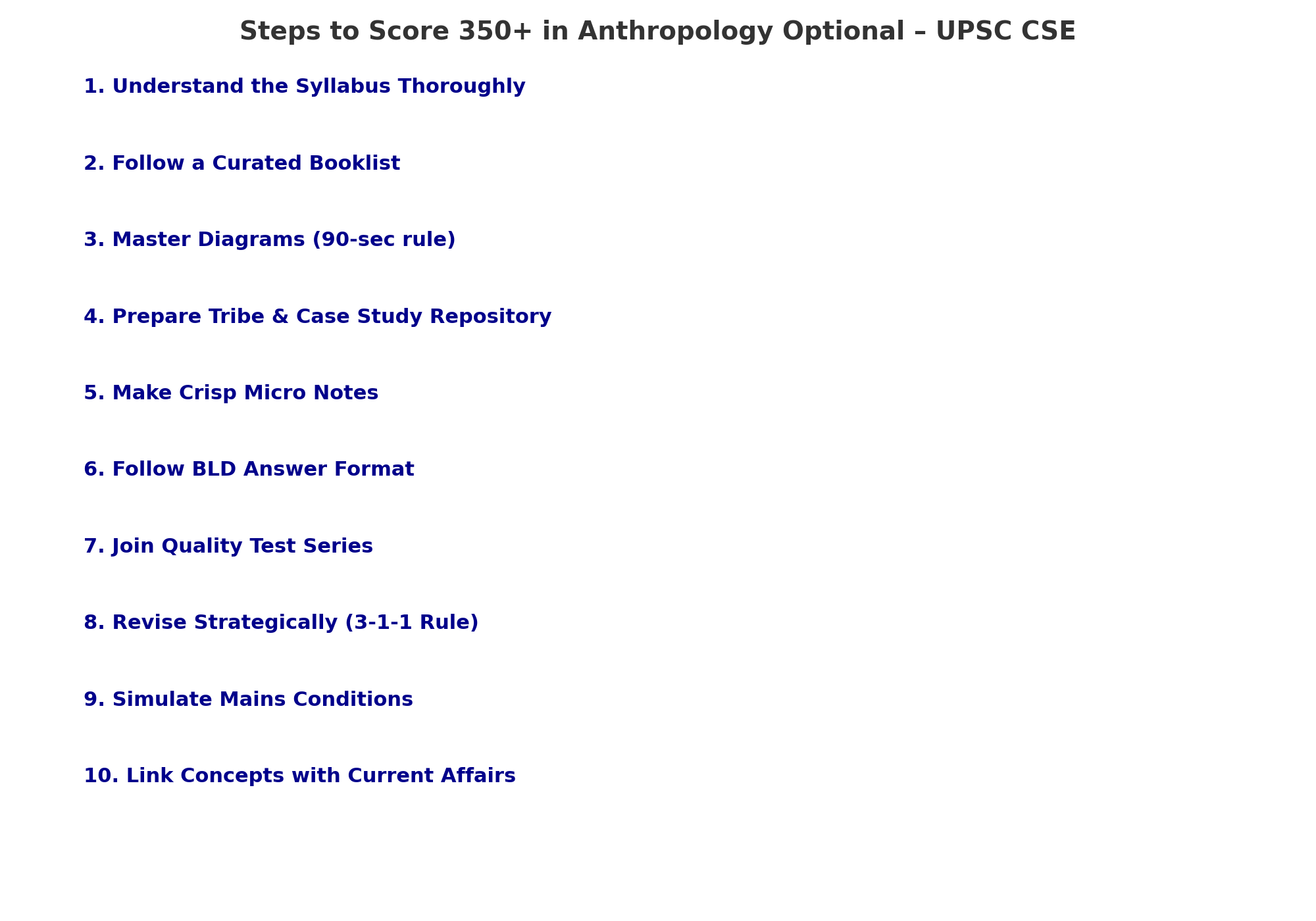
Rule of 90 Seconds: Every diagram must be drawable and label-ready under 90 seconds. Maintain a Diagrams Deck—flashcards with blank backsides for speed drills.
5. Smart Note-Making & Revision Cycles
- First Read: Highlight core definitions, theories, thinkers.
- Second Read: Convert highlights into Question-Answer format. Example: “Explain Genetic Drift with suitable examples (200 words).”
- Third Read: Condense into one-page micro-notes per sub-topic (bullet-points + diagram thumbnails + case studies).
Follow a Revision 3-1-1 Rule: Revisit each micro-note after 3 days, 1 week, and 1 month; active recall accelerates long-term retention.
Anthropology optional test series
Anthropology or Sociology which is better optional
6. Answer-Writing Framework for 8, 15 & 20-Mark Questions
B.L.D. Formula: Brief Introduction → Logical Body → Defined Conclusion.
- Introduction (30–40 words): Define the concept and contextualise with PYQ pointer.
- Body: Use sub-headings, bullet lists, diagrams, and case snippets.
- Conclusion (15-20 words): Summarise significance + contemporary relevance (e.g., SDGs, NEP).
Time Management:
- 8-Markers: 6 minutes each.
- 15-Markers: 9 minutes each.
- 20-Markers: 12 minutes each (ensure two diagrams).
Practise with a stopwatch until muscle memory kicks in.
7. Ethnographic Case Studies & Tribal Examples
Anthropology rewards specificity. Memorise 15 high-yield tribes & 10 classic studies:
| Tribal Group | Key Facts / Issues |
|---|---|
| Toto (West Bengal) | Endangered language, PVTG, man-animal conflict |
| Konyak (Nagaland) | Headhunting legacy, Baptist conversion, village councils |
| Irula (Tamil Nadu) | Snake-catchers, ST rights, forest livelihood |
| Sahariya (Madhya Pradesh) | Malnutrition, FRA implementation gaps |
| Bonda (Odisha) | Distinct headdress, matriarchy, eco-tourism impact |
Classic studies: “Nuer” by E.E. Evans-Pritchard, “Rituals among Todas” by M.N. Srinivas, “Coming of Age in Samoa” by Margaret Mead. Quote them judiciously.
8. Choosing & Leveraging a Test Series
- Credibility Check: Prefer mentors like Dr. Huma Hassan (PlutusIAS) or Sapiens IAS for diagram-oriented evaluation.
- Frequency: Minimum 8 sectional + 4 full-length tests.
- TAT (Turn-Around-Time): Copies must return within 72 hours with line-by-line comments.
- One-to-One Discussion: 15-minute feedback calls fix structural issues quickly.
Action Plan: After each test, rewrite only the poorest 30 % answers within 48 hours. This transforms feedback into higher marks rapidly.
9. Common Mistakes that Cap Scores at 280
- Ignoring Diagrams: Losing 15–25 marks per paper.
- Over-theorising in Paper II: Examiner wants Indian context, not Western jargon.
- Poor Statistics: Quoting 1911 Census facts in a 2026 paper shows outdated prep.
- No Current Linkages: Failing to connect PVTG issues with 2025 budget allocations.
- Handwriting & Presentation: Dense paragraphs deter the evaluator.
10. 90-Day Sprint Plan Before Mains
| Day Range | Focus |
|---|---|
| Day 1–30 | Finish last PYQ backlog + diagram drills (30/day) |
| Day 31–60 | Test series: 1 paper every 5 days + micro-note revision |
| Day 61–75 | Full-length simulation every 3 days, peer evaluation |
| Day 76–90 | Flashcard blitz + enhance opening/closing lines for FAQs |
Integrate Pomodoro bursts (45-10-45) to keep focus razor-sharp.
11. How Anthropology Helps in the Personality Test
Panelists love culturally grounded answers. Anthropology equips you to discuss tribal insurgency in North-East, gender fluidity in Indian tribes, or the ethics of genome editing with authority. Many candidates score 190+ in the interview by weaving anthropological insights into policy-oriented replies.
12. Final Words: Converting Potential into 350+ Reality
Scoring 350+ in Anthropology Optional is neither luck nor legend—it’s disciplined art. The pillars are:
- Focused Sources → Read twice, revise thrice.
- Diagram Mastery → 90 seconds per sketch.
- Contextual Case Studies → 15 tribe profiles on your fingertips.
- Answer Craftsmanship → B.L.D. formula + time drills.
- Actionable Feedback Loops → Test, review, rewrite.
Combine these with unwavering consistency, and the 350+ target morphs from ambition to routine. As anthropologist Claude Lévi-Strauss said, The scientific mind does not so much provide the right answers as ask the right questions.
Let your preparation echo that wisdom—ask, analyse, annotate, and ascend.
May your diagrams be sharp, your theories concrete, and your marks exponential!

- Mangrove Revival Mission in Keralam’s Mayyanad: Lessons from Past Failures - October 3, 2026
- एल नीनो से निपटने के लिए पारिस्थितिकी तंत्र निगरानी जरूरी क्यों? - October 3, 2026
- Gujarat UCC Bill: Key Features for UPSC & State PCS Exam - October 3, 2026

No Comments