


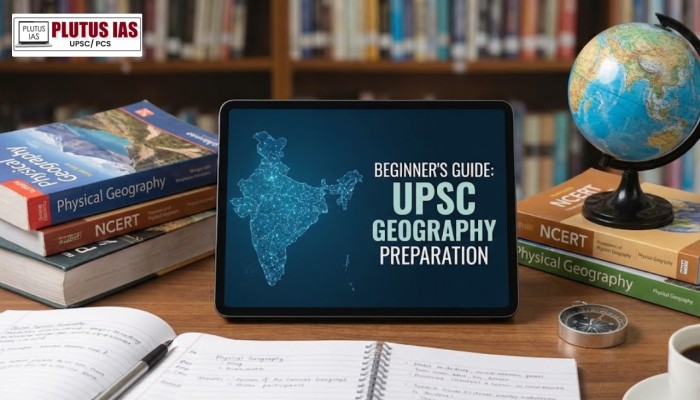
23 Feb How to Start Geography Preparation for UPSC 2026 from Scratch (Beginner’s Guide)
Geography is one of the most vital, scoring, and fascinating subjects in the UPSC Civil Services Examination (CSE). Whether you are analyzing the monsoon patterns that affect the Indian economy, understanding the geopolitical significance of a strait, or studying the impact of climate change, Geography is the foundational canvas upon which many other UPSC subjects are built. For a beginner targeting UPSC CSE 2026, starting Geography from scratch can feel like navigating an ocean without a compass. The syllabus is vast, covering physical phenomena, human populations, and economic resources across India and the world.
However, with a structured approach, Geography transitions from being a daunting subject to a highly logical and scoring one. This comprehensive beginner’s guide provides a step-by-step roadmap to build your Geography preparation from ground zero for the UPSC 2026 examination. We will break down the syllabus, identify the right resources, and reveal the secrets of map reading and answer writing.
Why Geography is a Game-Changer in UPSC Preparation
Before diving into the “how,” it is crucial to understand the “why.” Geography is not just an isolated subject; it is a highly integrated discipline that heavily influences your overall UPSC score:
- High Weightage in Prelims: Every year, 10 to 15 questions in General Studies Paper I directly stem from Geography, mapping, and agriculture.
- Core of Mains GS Paper I: A significant portion of the GS Paper I syllabus comprises Physical Geography, Indian Geography, and the distribution of key natural resources across the world.
- Massive Syllabus Overlap: A strong grip on Geography naturally strengthens your preparation for Environment and Ecology (GS-3), Disaster Management (GS-3), Internal Security (GS-3), and International Relations (GS-2).
- Objective and Logical: Unlike highly subjective topics, Physical Geography is rooted in science and logic. Once you understand the concepts (like wind systems or ocean currents), you don’t easily forget them, ensuring high accuracy in exams.
Phase 1: Decoding the Syllabus and the “Three Pillars”
The very first step for any beginner is to print the UPSC syllabus and break it down. Do not blindly pick up a heavy textbook. Geography for UPSC is broadly divided into three distinct pillars. You must approach them in sequence:
1. Physical Geography
This is the science behind the subject. It includes Geomorphology (study of landforms, earthquakes, volcanoes), Climatology (atmosphere, wind systems, monsoons, cyclones), and Oceanography (ocean currents, tides, salinity). Rule of thumb: Never start Indian Geography without mastering Physical Geography first. You cannot understand the Indian Monsoon if you do not understand global pressure belts.
Must Check :- Best IAS Coaching in Delhi
2. Indian Geography
This covers the physical layout of India (mountains, rivers, plateaus), its climate, soils, natural vegetation, and agriculture. It also includes the human and economic aspects, such as demographics, industries, and transportation networks in India.
3. World Geography
This involves understanding the physical features of different continents, major climatic zones of the world, and the distribution of primary, secondary, and tertiary industries globally.
Phase 2: Building the Foundation (The NCERT Mastery)
As a beginner preparing for UPSC 2026, you have the luxury of time. Use it to build an unshakeable foundation. Your best friends for the next two months should be the NCERT textbooks. Do not touch any advanced reference books until you have mastered these.
The Essential NCERT Reading List:
- Class 11: Fundamentals of Physical Geography. (This is the most important book for Geography. Read it multiple times. It builds your core concepts of climatology and geomorphology.)
- Class 11: India – Physical Environment. (The ultimate guide for Indian physical geography. Crucial for Prelims and Mains.)
- Class 12: Fundamentals of Human Geography. (Provides a global perspective on population, migration, and human development.)
- Class 12: India – People and Economy. (Essential for understanding agriculture, resources, and industries in India.)
How to Read NCERTs Effectively:
First Reading: Read them like a storybook. Do not underline, do not make notes. Just understand the flow of concepts. Keep an atlas open beside you.
Second Reading: Now, start highlighting key concepts, definitions, and geographical phenomena. Try to solve the questions given at the end of each chapter.
Third Reading: Make crisp, short notes. Draw rough diagrams (e.g., the structure of the atmosphere, types of rainfall) in your notes. Visual memory works best for Geography.
Phase 3: Advancing to Standard Reference Books
Once your NCERT foundation is rock solid, you need to elevate your knowledge to the UPSC Mains level. You do not need a mountain of books; you just need one or two standard references.
- Certificate Physical and Human Geography by Goh Cheng Leong: This is an absolute masterpiece for Physical Geography and World Climatic zones. The language is slightly old, but the concepts and diagrams are unmatched. Focus heavily on Part 2 (Weather, Climate, and Vegetation).
- Geography of India by Majid Husain or Comprehensive Geography of India by Khullar: Choose either one. You do not need to read these books cover to cover. Use them selectively as reference manuals to add depth to your NCERT notes, especially for topics like Indian Agriculture, Resources, and Industrial locations.
Phase 4: The Art of Mapping (Your Secret Weapon)
Mapping is the soul of Geography. In UPSC Prelims, 3 to 5 questions are purely map-based. In Mains, drawing a quick, neat map can fetch you extra half-marks per question, which eventually compounds into a massive lead.
How to Master Maps for UPSC 2026:
- Buy a Good Atlas: Get the Oxford Student Atlas for India or Orient BlackSwan School Atlas. Keep it on your desk permanently.
- The Daily 15-Minute Rule: Dedicate 15 minutes every single day just to look at the atlas. Do not try to memorize everything in one day. Pick one continent or one Indian state per week.
- Static Mapping: Learn the major mountain ranges, rivers (with their left and right bank tributaries), straits, seas, and deserts. Pay special attention to the physical map of India, the Middle East, Southeast Asia, and regions surrounding the Mediterranean Sea and the Black Sea.
- Dynamic (Current Affairs) Mapping: Whenever a place is in the news (e.g., a conflict zone, a newly inaugurated dam, an earthquake epicenter, or a COP summit location), immediately locate it in your atlas. Mark it with a highlighter. UPSC loves asking map questions based on places that were in the news over the past year.
- Practice Drawing India: Practice drawing a recognizable map of India in under 15 seconds. You will need this skill to illustrate your answers in GS Paper 1 and GS Paper 3.
Phase 5: Integrating Current Affairs
Geography is not a purely static subject. The UPSC is increasingly linking static geographical concepts with dynamic current affairs. You must train your mind to connect the dots.
When you read the newspaper (The Hindu or Indian Express), keep an eye out for geographical news:
- Climate Anomalies: News about El Niño, La Niña, sudden droughts, or unseasonal floods. Link these back to your climatology concepts.
- Disasters: Earthquakes, landslides in the Himalayas, or glacial lake outbursts. Understand the geographical reasons behind them.
- Economic Geography: Discovery of new lithium reserves, semiconductor plant locations, or agricultural distress due to monsoon failure.
Make a separate section in your notes for “Geography in News” and update it regularly. This will provide you with contemporary examples to enrich your Mains answers.
Phase 6: Answer Writing and PYQ Analysis
Your preparation is incomplete until you can reproduce your knowledge on paper within a time limit. For UPSC 2026, start your answer writing practice after you have completed your NCERTs and one standard book.
Previous Year Questions (PYQs):
PYQs are the guiding light of UPSC preparation. Buy a topic-wise PYQ booklet for the last 10 years of Prelims and Mains. After finishing a topic (e.g., Earthquakes), solve all the past Prelims and Mains questions related to it. This helps you understand the depth of knowledge UPSC expects and the phrasing of questions.
The Anatomy of a Geography Mains Answer:
- Introduction: Start with a clear definition, a recent context, or relevant geographical data.
- Body: Use headings and bullet points. Explain the ‘Why’ and ‘How’. For example, if the question is about the location of the iron and steel industry, explain the factors (raw material, transport, market) clearly.
- Diagrams and Maps: This is non-negotiable in Geography. Draw block diagrams for physical features (like tectonic plate boundaries) and sketch maps for distribution questions (like the distribution of monsoonal rainfall).
- Conclusion: Conclude with a futuristic approach, linking the geographical phenomenon to human impact, climate change, or sustainable development.
Common Mistakes Beginners Must Avoid
- Ignoring the Atlas: Reading Geography without an atlas is like learning to swim by reading a book. It does not work. Visualize everything.
- Getting Stuck in PHD-level Research: You are preparing for a generalist exam, not a master’s degree in Geography. Do not read thick university-level books. Stick to the syllabus.
- Memorizing Without Understanding: Do not try to rote-learn ocean currents or wind directions. Understand the Coriolis force and temperature gradients, and you will naturally know which way the currents flow.
- Separating Geography from Environment: These two subjects are highly intertwined. Study them in tandem. For example, studying natural vegetation in Geography perfectly complements studying biomes in Ecology.
Must Check :- Best IAS Coaching in Delhi
Conclusion
Starting Geography preparation from scratch for UPSC CSE 2026 requires patience, visualization, and a step-by-step approach. Begin by falling in love with the NCERTs and the Atlas. Build a strong conceptual base in Physical Geography before moving on to Indian and World Geography. Connect your static knowledge with daily current affairs, and practice incorporating maps and diagrams into your answer writing. Geography is a highly rewarding subject; the effort you put into understanding the mechanics of our planet will pay massive dividends in your journey to becoming a civil servant. Stay consistent, stay curious, and enjoy the process of exploring the world from your study desk.

- Best AI Tool for UPSC Preparation - July 27, 2026
- Best UPSC + Diploma Coaching - April 28, 2026
- Best UPSC + MBA Coaching - April 28, 2026

No Comments