


12 Jun IAS vs IFS vs IPS
IAS vs IFS vs IPS – Power, Role, Salary & Career Comparison
Introduction
The UPSC Civil Services Examination opens doors to various prestigious services like IAS (Indian Administrative Service), IFS (Indian Foreign Service), and IPS (Indian Police Service). All three are Group A services and command immense respect and responsibility. But how do they differ? Which service is more powerful, and which one should you aim for?
This article provides a comprehensive comparison of IAS vs IFS vs IPS in terms of power, roles, salary, training, work-life balance, career growth, and more to help aspirants make an informed decision.
Best ias coaching in hindi medium
What is IAS?
The Indian Administrative Service (IAS) is the most sought-after service for civil service aspirants. IAS officers hold administrative authority and implement government policies at the district, state, and national levels. They also play a key role in budget planning, development projects, and internal governance.
What is IFS?
The Indian Foreign Service (IFS) is India’s diplomatic service, responsible for representing the country globally. IFS officers serve in Indian embassies, consulates, and missions abroad, and also handle foreign relations, trade negotiations, and diplomacy under the Ministry of External Affairs.
What is IPS?
The Indian Police Service (IPS) ensures internal security, law and order, and crime prevention. IPS officers serve in various law enforcement roles in the states and center, and also work with elite agencies like CBI, NIA, RAW, and IB.
IAS vs IFS vs IPS – Key Differences
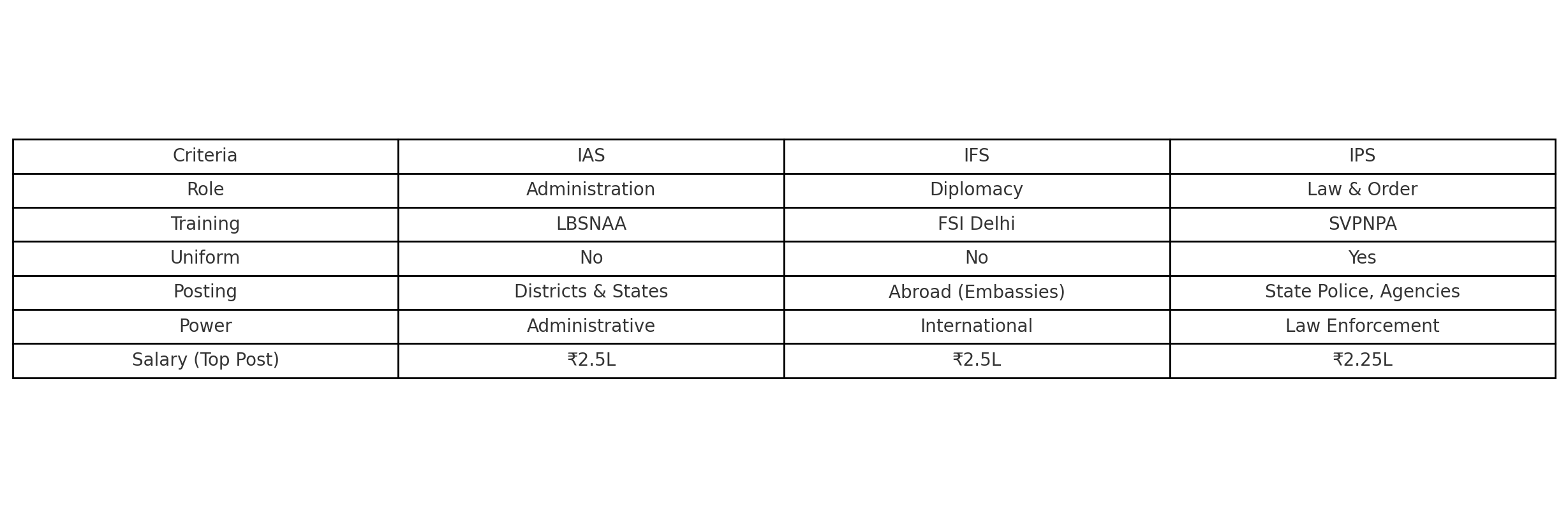
| Criteria | IAS | IFS | IPS |
|---|---|---|---|
| Full Form | Indian Administrative Service | Indian Foreign Service | Indian Police Service |
| Controlling Ministry | Ministry of Personnel | Ministry of External Affairs | Ministry of Home Affairs |
| Main Function | Administration, governance | Diplomacy, international relations | Law & order, security |
| Work Location | India (Districts, States, Ministries) | Mostly abroad (Embassies, Missions) | India (Police Departments, Agencies) |
| Training | LBSNAA, Mussoorie | FSI, New Delhi | SVPNPA, Hyderabad |
| Uniform | No | No | Yes (Police Uniform) |
| Power | Administrative authority | Diplomatic authority | Law enforcement authority |
| Posting Type | Frequent transfers in India | 3-4 year foreign postings | Frequent transfers within India |
| Family Life | Stable if posted in home state | Depends on foreign postings | Challenging due to law & order duties |
| Top Post | Cabinet Secretary | Foreign Secretary | Director General of Police |
Training for IAS, IFS, and IPS
- IAS: Begins at LBSNAA, Mussoorie with field training in districts.
- IFS: Foundation at LBSNAA followed by training at Foreign Service Institute (FSI), with foreign language immersion and internships in Indian missions abroad.
- IPS: Physical and tactical training at SVPNPA, Hyderabad, including forensic science, investigation, and internal security operations.
Power and Influence
IAS: Considered the most powerful due to administrative control over all departments at the district and state level. They can direct police, development authorities, and are closest to political leadership.
IFS: Enjoy high prestige internationally. While they don’t control local administration, they influence India’s global image and international negotiations.
IPS: Control police forces and internal security operations. In matters of law and order, they exercise immense field-level power.
Salary and Perks Comparison
Basic Salary (7th Pay Commission)
- All start at Level 10: ₹56,100 per month + allowances
Perks
- IAS: Official residence, staff, vehicle, government-paid travel.
- IFS: Free housing abroad, international schooling for children, paid travel, diplomatic immunity.
- IPS: Police vehicle with beacon, personal security, residence, staff.
Top-Level Salary
- Cabinet Secretary (IAS): ₹2.5 lakh/month
- Foreign Secretary (IFS): ₹2.25–2.5 lakh/month
- DGP/Agency Head (IPS): ₹2.25 lakh/month
Work-Life Balance
- IAS: Work hours are long and responsibilities are high, but lifestyle may be stable if posted in administrative departments.
- IFS: Best lifestyle and family life abroad. However, frequent re-postings and diplomatic stress are common.
- IPS: Demanding lifestyle due to emergencies, crime management, law and order duties. Transfers are frequent and stress levels are high.
Promotion and Career Growth
IAS Career Path:
- Sub-Divisional Magistrate (SDM)
- District Collector / DM
- Divisional Commissioner
- Principal Secretary
- Chief Secretary
- Cabinet Secretary
IFS Career Path:
- Under Secretary
- First Secretary / Consul
- Ambassador / High Commissioner
- Joint Secretary, MEA
- Foreign Secretary
IPS Career Path:
- Assistant SP
- SP / SSP
- DIG
- IG
- ADGP
- DGP / Intelligence Head
Which Service Should You Choose?
- Choose IAS if you want administrative control, public service within India, and policymaking roles.
- Choose IFS if you have interest in global affairs, diplomacy, and an international lifestyle.
- Choose IPS if you’re passionate about security, justice, and action-oriented roles.
Your personal goals, temperament, and values will determine the right path for you. Each service offers unique opportunities to serve the nation.
Conclusion
IAS, IFS, and IPS are elite services of India, each with its own prestige and responsibilities. The IAS dominates national administration, the IFS handles India’s global diplomacy, and the IPS safeguards internal security.
Whatever you choose, your role as a civil servant will shape the future of the country. UPSC gives you the power to lead. Choose wisely, and serve with honor.

- Piyush Goyal Attends G20 Trade Ministers’ Meeting in Milwaukee - October 1, 2026
- विशेष अभियान-6: कोल इंडिया लिमिटेड की तैयारी पर केंद्र सरकार की निगरानी - October 1, 2026
- ECL’s Action Plan for Special Campaign 6: A UPSC Governance Case Study - October 1, 2026

No Comments