


19 Jul IGNOU July 2026 Admissions: Deadline Extended for ODL & Online Programs
Subject Relevance — Where This Topic Fits
- GS Paper II — Social Justice: Issues relating to development and management of Social Sector/Services relating to Health, Education, Human Resources. | GS Paper II — Government Policies and Interventions for Development in various sectors and Issues arising out of their Design and Implementation. | GS Paper III — Indian Economy and issues relating to planning, mobilization of resources, growth, development and employment.
- Prelims: IGNOU, Open and Distance Learning (ODL), Online Learning, National Education Policy (NEP) 2020, Gross Enrolment Ratio (GER), Digital India, Skill India, Higher Education, Flexible Learning, Lifelong Learning
- Essay: Education as an enabler of socio-economic transformation: The role of accessible learning models., Leveraging technology for inclusive growth: The Indian experience in higher education.
Quick Revision: Open and Distance Learning (ODL), championed by institutions like IGNOU, is pivotal for democratising higher education, enhancing GER, and fostering skill development in India, despite facing challenges related to digital access and quality assurance.
Why is this in the news?
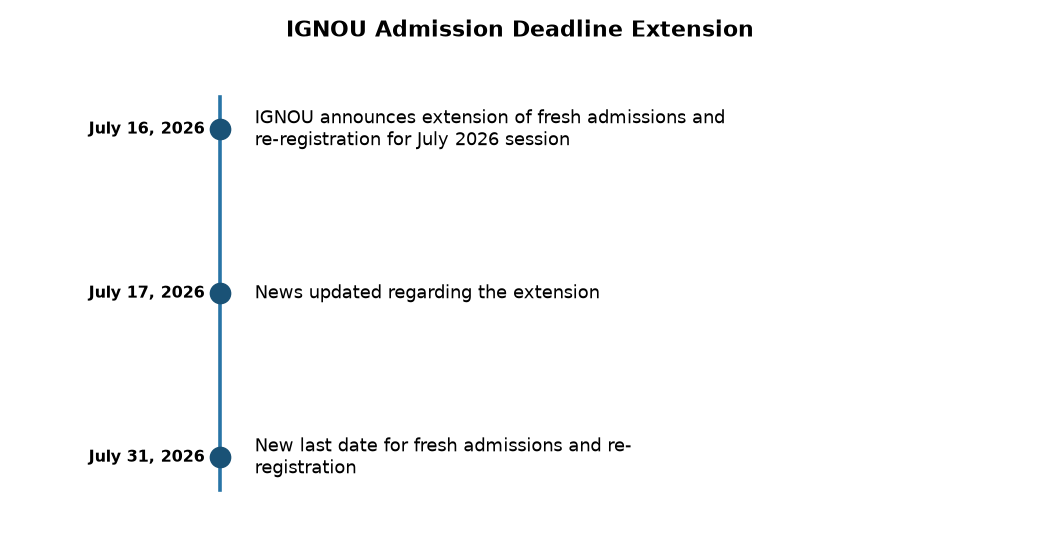
The Indira Gandhi National Open University (IGNOU) has extended the deadline for fresh admissions for its July 2026 session until July 31, 2026. This extension applies to all notified programmes offered through Open and Distance Learning (ODL) and online modes, providing an additional opportunity for aspiring students to register for a wide array of academic programmes, ranging from undergraduate and postgraduate degrees to diploma and certificate courses, thereby reinforcing IGNOU’s commitment to expanding access to higher education.
Background
- IGNOU, established in 1985 by an Act of Parliament, is a central university and the world’s largest university in terms of student enrolment, serving as a pioneer in distance education in India.
- The university was founded with the primary objective of democratising higher education, making it accessible to all segments of society, especially those in remote areas, working professionals, and disadvantaged groups.
- It offers a diverse range of academic programmes, catering to various educational needs and professional aspirations, through a flexible and learner-centric approach.
- The ODL system, championed by IGNOU, allows students to pursue education without the constraints of traditional classroom settings, offering flexibility in terms of time, place, and pace of learning.
- The recent extension of the admission deadline underscores the continuous demand for flexible learning options and IGNOU’s role in achieving the National Education Policy (NEP) 2020’s goals of increasing Gross Enrolment Ratio (GER).
- IGNOU leverages technology extensively, offering both ODL and fully online programmes, thereby aligning with the Digital India initiative to enhance digital literacy and access to education.
What is Open and Distance Learning (ODL)?
- Open and Distance Learning (ODL) refers to a system of education where students are not required to be physically present in a classroom for instruction.
- It encompasses various modes of delivery, including self-instructional print materials, audio-visual aids, online resources, and technology-mediated interactions.
- Key characteristics include flexibility in terms of entry requirements, pace of study, and geographical location, making education accessible to a wider demographic.
- ODL systems often employ a blended learning approach, combining self-study with periodic contact classes, counselling sessions, and practical workshops.
- The primary objective of ODL is to democratise education, extend its reach to underserved populations, and promote lifelong learning opportunities.
- It plays a crucial role in skill development, professional upskilling, and providing second chances for individuals who missed out on conventional education.
- In India, the University Grants Commission (UGC) regulates ODL programmes, ensuring quality and standardisation across institutions.
- The National Education Policy (NEP) 2020 strongly advocates for the expansion and quality enhancement of ODL and online education to achieve a GER of 50% by 2035.
Key Features
| Feature | Significance |
|---|---|
| Flexible Admission Deadlines | Allows a broader window for prospective students, accommodating diverse schedules and circumstances, thereby enhancing accessibility. |
| Dual Mode Offerings (ODL & Online) | Caters to different learning preferences and technological access, ensuring inclusivity for learners in varied geographical and socio-economic contexts. |
| Wide Range of Programmes | Offers UG, PG, Diploma, and Certificate courses across disciplines, facilitating skill development, career advancement, and lifelong learning. |
| Self-Paced Learning | Empowers learners to study at their own convenience, balancing education with work, family, or other commitments, reducing dropout rates. |
| Pan-India Reach | Through a vast network of regional centres and study centres, education reaches remote and rural areas, bridging urban-rural educational disparities. |
| Affordable Education | Generally lower fee structures compared to conventional universities, making higher education economically viable for a larger population. |
Why it Matters
Enhancing Educational Access and Equity
- ODL, particularly through institutions like IGNOU, serves as a vital instrument for democratising higher education, reaching individuals who cannot access traditional full-time courses due to geographical, financial, or social constraints.
- It provides opportunities for working professionals, homemakers, individuals with disabilities, and those in remote areas to pursue higher education, thereby promoting social equity and inclusion.
- By offering flexible learning pathways, ODL helps in reducing disparities in educational attainment across different socio-economic strata and regions.
Boosting Gross Enrolment Ratio (GER)
- The expansion of ODL and online learning is crucial for India to achieve its ambitious target of increasing the Gross Enrolment Ratio (GER) in higher education to 50% by 2035, as envisioned in the National Education Policy (NEP) 2020.
- It significantly contributes to accommodating the large youth population seeking higher education, which traditional brick-and-mortar institutions alone cannot fully cater to.
- The flexibility and reach of ODL programmes enable a larger number of individuals to enrol, thereby directly impacting national GER figures.
Skill Development and Lifelong Learning
- ODL programmes are instrumental in offering skill-based, vocational, and professional courses that are essential for enhancing employability and meeting industry demands.
- They facilitate continuous professional development and upskilling, allowing individuals to adapt to evolving job markets and technological advancements.
- The concept of lifelong learning is inherently supported by ODL, enabling individuals to acquire new knowledge and skills at any stage of their lives, fostering a culture of continuous improvement.
Leveraging Technology for Education
- The shift towards online learning modes, as seen with IGNOU’s offerings, aligns with the Digital India initiative, promoting digital literacy and the use of technology in education.
- It allows for the creation and dissemination of high-quality digital learning resources, making education more engaging and interactive.
- Technology-enabled ODL facilitates scalable education solutions, capable of reaching millions of learners simultaneously, thereby maximising resource utilisation.
Challenges
1. Quality Assurance and Credibility
- Ensuring the quality and academic rigour of ODL programmes to match conventional education remains a persistent challenge.
- Perceptions regarding the credibility and acceptance of ODL degrees in the job market can sometimes be a barrier for students.
UPSC Link: Quality of Higher Education
2. Digital Divide and Infrastructure
- Unequal access to reliable internet connectivity, digital devices, and electricity, especially in rural and remote areas, creates a significant digital divide.
- Lack of adequate digital infrastructure and technical support can hinder effective participation in online learning modes.
UPSC Link: Digital Infrastructure; Inclusive Growth
3. Learner Engagement and Support
- Maintaining high levels of learner engagement and motivation in a self-directed learning environment can be difficult for some students.
- Providing timely and effective academic and administrative support, including counselling and grievance redressal, to a large and dispersed student body is complex.
UPSC Link: Student Support Services
4. Faculty Training and Development
- Training faculty members in developing engaging online content, using digital pedagogies, and effectively mentoring distance learners is crucial.
- Adapting traditional teaching methods to the unique requirements of ODL and online environments requires continuous professional development.
UPSC Link: Teacher Education; Capacity Building
5. Assessment and Evaluation
- Designing robust and fair assessment methods that prevent malpractice and accurately evaluate learning outcomes in a remote setting is a challenge.
- Ensuring the integrity and security of online examinations requires advanced technological solutions and proctoring mechanisms.
UPSC Link: Examination Reforms
Challenges — UPSC Perspective
| Issue | Concern |
|---|---|
| Accreditation & Recognition | Ensuring all ODL programmes meet UGC standards and are recognised by employers and other educational institutions. |
| Technological Access | Bridging the gap for students lacking stable internet, devices, or digital literacy, particularly in underserved regions. |
| Student Retention | Higher dropout rates in ODL due to lack of direct interaction, self-discipline issues, or inadequate support. |
| Curriculum Relevance | Regularly updating ODL curricula to align with industry demands and emerging skill requirements. |
| Language Barriers | Providing quality content and support in multiple regional languages to cater to India’s linguistic diversity. |
| Proctoring & Malpractice | Developing secure and scalable online examination systems to prevent cheating and ensure academic integrity. |
Government Initiatives — Must-Memorise for Prelims
- SWAYAM (Study Webs of Active–Learning for Young Aspiring Minds)
- SWAYAM PRABHA (34 DTH Channels for high-quality educational programmes)
- National Digital Library of India (NDLI)
- National Education Policy (NEP) 2020
- PM eVIDYA (One Nation, One Digital Platform)
- Digital India Programme
- Skill India Mission
- National Programme on Technology Enhanced Learning (NPTEL)
- National Mission on Education through Information and Communication Technology (NMEICT)
- Unified National Academic Credit Bank (ABC)
Way Forward
- Strengthen digital infrastructure and ensure equitable access to high-speed internet and affordable digital devices, especially in rural and remote areas, to bridge the digital divide.
- Invest in continuous faculty training and development programmes focused on digital pedagogy, content creation for online learning, and effective learner support strategies.
- Implement robust quality assurance mechanisms and accreditation processes for ODL and online programmes to enhance their credibility and ensure parity with conventional degrees.
- Develop innovative and engaging digital learning content, leveraging multimedia, AI, and adaptive learning technologies to improve learner experience and outcomes.
- Establish comprehensive student support services, including online counselling, mentorship, and grievance redressal systems, to address the unique needs of distance learners.
- Promote public-private partnerships to leverage resources, expertise, and technology for the development and delivery of high-quality, industry-relevant ODL programmes.
- Integrate ODL with the Academic Bank of Credits (ABC) system to facilitate credit transfer and promote flexible learning pathways, aligning with NEP 2020.
- Conduct regular research and evaluation to assess the effectiveness of ODL models, identify best practices, and continuously refine policies and programmes.
UPSC Value Addition
Keywords for Mains Answer-Writing
Democratisation of Education · Gross Enrolment Ratio (GER) · National Education Policy (NEP) 2020 · Lifelong Learning · Skill Development · Digital Divide · Inclusive Education · Quality Assurance · Flexible Learning Pathways · Technology-Enabled Learning · Human Resource Development · Educational Equity
Constitutional & Policy Linkages
- Article 21A: Right to Education (Fundamental Right)
- Article 45: Provision for early childhood care and education to children below the age of six years (DPSP)
- Article 46: Promotion of educational and economic interests of Scheduled Castes, Scheduled Tribes and other weaker sections (DPSP)
- Seventh Schedule (List III – Concurrent List): Education, including technical education, medical education and universities.
- UGC Act, 1956: Establishment and regulation of universities and standards of higher education.
- IGNOU Act, 1985: Establishment of IGNOU for promotion of distance education.
Concept Flow
Demand for Higher Education > → Constraints of Traditional System > → Emergence of ODL/Online Learning > → Increased Access & Flexibility > → Enhanced GER & Skill Development > → Socio-Economic Empowerment > → National Development
Prelims Practice Questions
Q1. Consider the following statements regarding Open and Distance Learning (ODL) in India:
1. The National Education Policy (NEP) 2020 aims to achieve a Gross Enrolment Ratio (GER) of 50% by 2035, with ODL playing a significant role.
2. SWAYAM PRABHA is an initiative that provides 34 DTH channels for high-quality educational programmes, supporting ODL.
3. The University Grants Commission (UGC) is the sole regulatory body for all ODL programmes offered by central and state universities in India.
- A. 1 and 2 only
- B. 2 and 3 only
- C. 1 and 3 only
- D. 1, 2 and 3
Answer: A. 1 and 2 only — Statement 1 is correct. NEP 2020 indeed targets a GER of 50% by 2035, with ODL being a key enabler. Statement 2 is correct. SWAYAM PRABHA provides 34 DTH channels for educational content. Statement 3 is incorrect. While UGC is the primary regulator, other bodies like AICTE also regulate specific professional ODL programmes, and IGNOU itself has a unique statutory status.
Q2. Which of the following is NOT a primary objective behind the establishment of Indira Gandhi National Open University (IGNOU)?
- A. To democratise higher education.
- B. To promote skill development and vocational training.
- C. To provide education primarily through traditional classroom-based instruction.
- D. To offer flexible learning opportunities to diverse sections of society.
Answer: C. To provide education primarily through traditional classroom-based instruction. — IGNOU was established specifically to provide education through Open and Distance Learning (ODL) modes, not primarily through traditional classroom-based instruction. Its core mission is to democratise education, promote skill development, and offer flexible learning opportunities, making option C the incorrect statement regarding its primary objectives.
Mains Practice Question
✍ The extension of IGNOU’s admission deadline highlights the continuing relevance of Open and Distance Learning (ODL) in achieving India’s educational goals. Critically analyse the potential of ODL in democratising higher education and skill development, while also discussing the significant challenges that need to be addressed for its effective implementation in the context of the National Education Policy (NEP) 2020. (250 words)
Approach: Begin by acknowledging the significance of IGNOU’s role and the broader context of ODL in India. Discuss the potential of ODL in democratising higher education by enhancing access, promoting equity, and boosting GER, linking it to NEP 2020’s vision. Elaborate on its role in skill development and lifelong learning. Subsequently, critically analyse the challenges such as the digital divide, quality assurance, learner engagement, and faculty training. Conclude with a forward-looking perspective, suggesting policy measures and technological interventions to overcome these challenges and fully harness ODL’s potential for inclusive growth and human resource development.
Source: The Indian Express
Generated by AanyaAi for educational purpose.

- ग्राम पंचायत ने शुरू किया बाघ-हाथी जैसे वन्य जीवों से फसलों की सुरक्षा का अभियान, जानिए कैसे मिलेगा लाभ - October 23, 2026
- Swachhata Abhiyaan 6.0: ARI’s Waste Management & Sustainable Gardening Model - October 23, 2026
- बंगाल की खाड़ी में चक्रवात बन सकता है, 28 अक्टूबर तक ओडिशा-आंध्र तट पार करेगा - October 23, 2026

No Comments