


19 Jul IGNOU July 2026 Admissions: Deadline Extended for ODL & Online Programs
Subject Relevance — Where This Topic Fits
- GS Paper II — Social Justice: Issues relating to development and management of Social Sector/Services relating to Health, Education, Human Resources. | GS Paper II — Government Policies and Interventions for Development in various sectors and Issues arising out of their Design and Implementation. | GS Paper III — Indian Economy and issues relating to Planning, Mobilization of Resources, Growth, Development and Employment.
- Prelims: IGNOU, Open and Distance Learning (ODL), National Education Policy (NEP) 2020, Gross Enrolment Ratio (GER), Digital India, Skill India Mission, Samarth Portal, Higher Education Commission of India (HECI), National Digital University (NDU), e-Vidya
- Essay: Education as an enabler of social mobility and economic development: The role of flexible learning pathways., Leveraging technology for inclusive and equitable education: Opportunities and challenges in the Indian context.
Quick Revision: Open and Distance Learning (ODL), spearheaded by institutions like IGNOU, is crucial for democratizing higher education, enhancing GER, and fostering skill development in India, despite facing challenges related to quality, digital divide, and student support.
Why is this in the news?
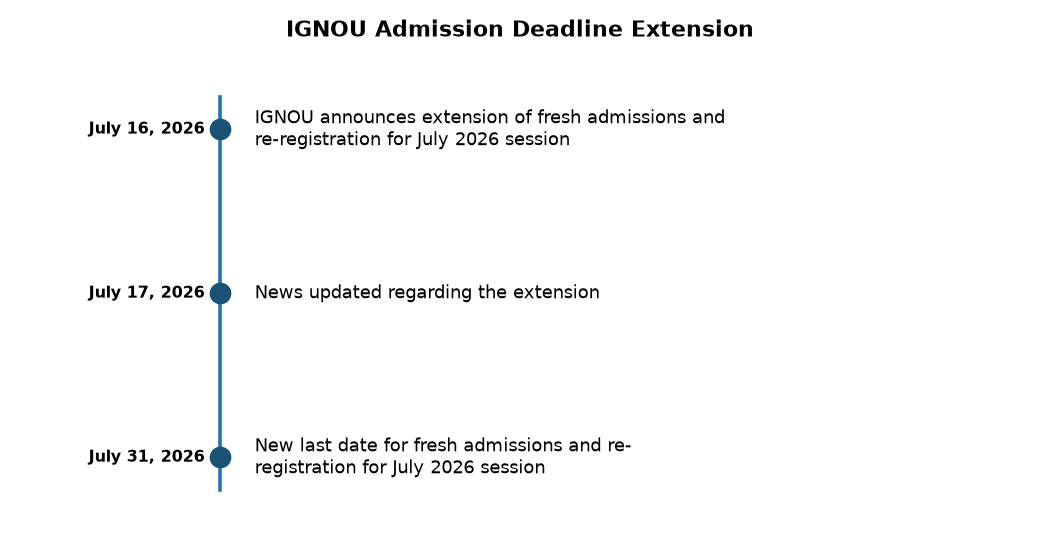
The Indira Gandhi National Open University (IGNOU) has extended the deadline for fresh admissions for the July 2026 session until July 31, 2026. This extension applies to all notified programmes offered in both Open and Distance Learning (ODL) and online modes, facilitating greater access for prospective students to various undergraduate, postgraduate, diploma, and certificate courses through its dedicated admission portals.
Background
- India’s higher education system is one of the largest globally, catering to a diverse student population.
- The National Education Policy (NEP) 2020 emphasizes increasing the Gross Enrolment Ratio (GER) in higher education to 50% by 2035.
- Open and Distance Learning (ODL) has emerged as a crucial modality to achieve this target, especially for those unable to pursue conventional full-time education.
- IGNOU, established in 1985, is a pioneer and the largest ODL institution globally, playing a pivotal role in democratizing higher education.
- The COVID-19 pandemic significantly accelerated the adoption of online learning, highlighting the resilience and potential of digital education platforms.
- Government initiatives like Digital India and Skill India further underscore the importance of accessible and skill-oriented education.
What is Open and Distance Learning (ODL)?
- Open and Distance Learning (ODL) refers to a system of education that provides flexible learning opportunities to students, often without the constraints of time and place associated with conventional classroom-based learning.
- It encompasses various modes including correspondence courses, online learning, blended learning, and self-study materials, utilizing diverse media like print, audio, video, and digital platforms.
- Key characteristics include learner-centricity, flexibility in admission criteria, pace of study, and geographical location, making education accessible to a wider demographic.
- ODL institutions leverage technology to deliver content, facilitate interaction, and conduct assessments, thereby overcoming barriers of physical infrastructure and faculty shortages.
- It caters to working professionals, homemakers, individuals in remote areas, and those seeking to upgrade skills or pursue lifelong learning without disrupting their existing commitments.
- In India, ODL is regulated by the University Grants Commission (UGC) and specialized bodies like the Distance Education Bureau (DEB) under UGC, ensuring quality and standards.
- IGNOU is the flagship institution for ODL in India, offering a vast array of academic programs from certificate to doctoral levels across diverse disciplines.
- The Samarth e-Gov platform, mentioned in the news, is a unified, open-source, open-standard, and interoperable academic automation solution for universities and Higher Education Institutions (HEIs) in India, facilitating admissions and other administrative processes.
Key Features
| Feature | Significance |
|---|---|
| Flexible Admission Deadlines | Allows individuals with varied schedules and circumstances to enroll, promoting inclusivity and continuous learning. |
| Diverse Program Offerings | Catters to a wide range of academic and professional needs, from foundational degrees to specialized skill enhancement courses. |
| Online and ODL Modes | Provides choice and accessibility, leveraging both traditional distance learning materials and modern digital platforms for delivery. |
| Pan-India Reach | Overcomes geographical barriers, making higher education available even in remote and underserved regions. |
| Affordable Education | Generally more cost-effective than conventional education, reducing financial burden on students and promoting equity. |
| Lifelong Learning Opportunities | Enables working professionals and adults to upskill, reskill, or pursue new academic interests without career interruption. |
Why it Matters
Enhancing Access and Equity
- ODL democratizes higher education by reaching underserved populations, including those in rural areas, working professionals, and individuals with disabilities, who might face barriers to conventional schooling.
- It significantly contributes to improving India’s Gross Enrolment Ratio (GER) in higher education, aligning with NEP 2020 goals for inclusive growth.
Skill Development and Employability
- ODL programs, particularly certificate and diploma courses, are often designed to be skill-oriented, bridging the gap between academic knowledge and industry requirements.
- It facilitates continuous professional development and lifelong learning, enabling individuals to adapt to evolving job markets and enhance their employability.
Economic and Social Development
- By expanding educational opportunities, ODL contributes to human capital formation, which is crucial for economic growth and innovation.
- It empowers individuals, fosters social mobility, and can lead to improved living standards and greater civic participation.
Leveraging Technology for Education
- ODL platforms, especially online modes, drive the adoption of digital tools and pedagogies in education, aligning with the Digital India initiative.
- It promotes the development of robust e-learning infrastructure and content, making education more resilient and future-ready.
Challenges
1. Quality Assurance and Accreditation
- Ensuring the quality and credibility of ODL programs is crucial to maintain their value and acceptance in the job market.
- Vigilant regulatory oversight by bodies like UGC-DEB is essential to prevent substandard offerings.
UPSC Link: Education standards and regulation
2. Digital Divide and Infrastructure
- Unequal access to reliable internet connectivity, digital devices, and electricity, particularly in rural and remote areas, creates a significant barrier to effective online learning.
- Lack of digital literacy among some learners further exacerbates this challenge.
UPSC Link: Digital infrastructure; Social justice
3. Student Support and Engagement
- ODL learners often require robust academic and administrative support, including counselling, doubt clarification, and peer interaction, which can be challenging to provide remotely.
- Maintaining student motivation and preventing high dropout rates in a self-paced learning environment is a persistent concern.
UPSC Link: Human resource development
4. Assessment and Evaluation Integrity
- Ensuring the fairness and integrity of examinations and assessments in ODL and online modes poses unique challenges, requiring innovative proctoring and evaluation methods.
- The shift to online examinations necessitates robust technological solutions to prevent malpractices.
UPSC Link: Examination reforms; Governance
5. Faculty Training and Development
- Educators in ODL institutions need specialized training in developing online content, facilitating virtual discussions, and using digital tools effectively.
- Transitioning from traditional pedagogy to online instruction requires significant capacity building.
UPSC Link: Teacher education; Capacity building
Challenges — UPSC Perspective
| Issue | Concern |
|---|---|
| Recognition of ODL Degrees | Perception issues and varying acceptance of ODL qualifications by employers and conventional institutions. |
| Technological Obsolescence | Rapid changes in technology necessitate continuous updating of platforms, content, and faculty skills. |
| Quality of Study Material | Ensuring high-quality, engaging, and regularly updated self-learning materials across diverse programs. |
| Plagiarism and Academic Integrity | Challenges in monitoring and preventing academic dishonesty in online assignments and projects. |
| Funding and Resources | Adequate financial allocation for developing and maintaining advanced ODL infrastructure, content, and support services. |
Government Initiatives — Must-Memorise for Prelims
- SWAYAM (Study Webs of Active–Learning for Young Aspiring Minds)
- SWAYAM Prabha (34 DTH channels for high-quality educational programmes)
- National Digital Library of India (NDLI)
- National Education Policy (NEP) 2020
- Digital India Programme
- Skill India Mission
- National Programme on Technology Enhanced Learning (NPTEL)
- e-Pathshala
- National Education Technology Forum (NETF)
- PM e-VIDYA
Way Forward
- Strengthen the regulatory framework for ODL, ensuring robust quality assurance, accreditation, and recognition of degrees.
- Invest in digital infrastructure, including affordable internet access and devices, to bridge the digital divide and promote equitable access.
- Develop high-quality, interactive, and localized e-content, leveraging AI and adaptive learning technologies to personalize the learning experience.
- Enhance student support services, including online counselling, mentorship, and peer learning platforms, to improve engagement and reduce dropout rates.
- Provide continuous professional development and training for ODL faculty in digital pedagogy, content creation, and online assessment methods.
- Promote blended learning models that combine online instruction with occasional face-to-face interactions for enhanced learning outcomes.
- Foster industry-academia collaboration to design skill-oriented ODL programs that align with market demands and improve graduate employability.
- Implement robust and secure online assessment mechanisms, including AI-powered proctoring, to ensure examination integrity and credibility.
UPSC Value Addition
Keywords for Mains Answer-Writing
Open and Distance Learning (ODL) · Gross Enrolment Ratio (GER) · National Education Policy (NEP) 2020 · Digital Divide · Lifelong Learning · Skill Development · Inclusive Education · Quality Assurance · Human Capital Formation · e-Governance in Education · Blended Learning · Educational Technology
Constitutional & Policy Linkages
- Article 21A: Right to Education
- Article 45: Provision for early childhood care and education to children below the age of six years
- Article 46: Promotion of educational and economic interests of Scheduled Castes, Scheduled Tribes and other weaker sections
- Seventh Schedule (List III – Concurrent List): Education, including technical education, medical education and universities
- UGC Act, 1956: Establishment and regulation of universities
- IGNOU Act, 1985: Establishment and functions of IGNOU
Concept Flow
Need for inclusive higher education → ODL as a flexible learning pathway → IGNOU’s role in expanding access → Leveraging digital platforms (Samarth) → Increased GER and skill development → Challenges of quality and digital divide → Policy interventions and way forward
Prelims Practice Questions
Q1. With reference to Open and Distance Learning (ODL) in India, consider the following statements:
1. The National Education Policy (NEP) 2020 aims to increase the Gross Enrolment Ratio (GER) in higher education to 50% by 2035, with ODL playing a significant role.
2. The University Grants Commission (UGC) is the sole regulatory body for all ODL institutions in India, including IGNOU.
3. The Samarth e-Gov platform is primarily used by IGNOU for managing its online admission processes.
- A. 1 only
- B. 1 and 2 only
- C. 1 and 3 only
- D. 1, 2 and 3
Answer: C. 1 and 3 only — Statement 1 is correct. NEP 2020 indeed targets a 50% GER by 2035, with ODL being crucial. Statement 2 is incorrect. While UGC regulates ODL, IGNOU was established by an Act of Parliament (IGNOU Act, 1985) and has a unique statutory position, though it operates under UGC’s broad regulatory framework for ODL. Statement 3 is correct. The Samarth e-Gov platform is a unified portal used by many HEIs, including IGNOU, for admission and other administrative functions.
Q2. Which of the following government initiatives are directly aimed at promoting digital education and skill development in India?
1. SWAYAM
2. National Digital Library of India
3. PM e-VIDYA
4. National Programme on Technology Enhanced Learning (NPTEL)
Select the correct answer using the code given below:
- A. 1 and 2 only
- B. 2, 3 and 4 only
- C. 1, 3 and 4 only
- D. 1, 2, 3 and 4
Answer: D. 1, 2, 3 and 4 — All four initiatives listed are directly aimed at promoting digital education and skill development in India. SWAYAM offers online courses, NDLI provides a vast repository of digital learning resources, PM e-VIDYA unifies digital education efforts, and NPTEL offers online courses from IITs/IISc.
Mains Practice Question
✍ The extension of IGNOU’s admission deadline underscores the pivotal role of Open and Distance Learning (ODL) in achieving India’s higher education goals. Critically analyze the significance of ODL in democratizing education and skill development in India, while also discussing the key challenges it faces in ensuring quality and equitable access. Suggest measures to strengthen the ODL ecosystem in line with the National Education Policy 2020. (250 words)
Approach: Begin by briefly introducing the context of IGNOU’s role and the NEP 2020’s vision for higher education. In the first part, elaborate on the significance of ODL in enhancing access, promoting equity, fostering skill development, and leveraging technology. In the second part, critically analyze challenges such as quality assurance, the digital divide, student support, and assessment integrity. Conclude by suggesting concrete measures for strengthening the ODL ecosystem, drawing from policy recommendations and technological advancements, to ensure it effectively contributes to India’s human resource development.
Source: The Indian Express
Generated by AanyaAi for educational purpose.

- Indian Navy to Host Indo-Pacific Dialogue 2026: Security - October 23, 2026
- विशेष अभियान 6: जल संसाधन विभाग की उपलब्धियाँ, गंगा पुनरुद्धार सहित - October 23, 2026
- Shivraj Singh Chouhan launches ‘Khet Bachao Abhiyan’ to save farmland - October 23, 2026

No Comments