


05 Sep IIT Madras Unveils AI Models in Indian Languages for UPSC & State PCS
✎ Foundational AI models in Indian languages enable sovereign, multilingual digital public infrastructure, reducing dependence on foreign technologies and enhancing accessibility in governance and education through speech…
Subject Relevance — Where This Topic Fits
- GS Paper II — Governance, Constitution, Polity, Social Justice and International Relations (Digital Governance, Language Technology) | GS Paper III — Science and Technology (Artificial Intelligence, Digital Infrastructure)
- Prelims: AI Foundational Models, Optical Character Recognition (OCR), Machine Translation, Speech Recognition, Speech Synthesis, Multilingual Digital Public Infrastructure, Bodhan AI, AI4Bharat, Union Ministry of Education, IIT Madras
- Essay: The Role of Artificial Intelligence in Bridging Linguistic Divides in India, Digital Public Infrastructure as a Catalyst for Inclusive Governance
Quick Revision: Foundational AI models in Indian languages enable sovereign, multilingual digital public infrastructure, reducing dependence on foreign technologies and enhancing accessibility in governance and education through speech recognition, speech generation, machine translation, and OCR.
Why is this in the news?
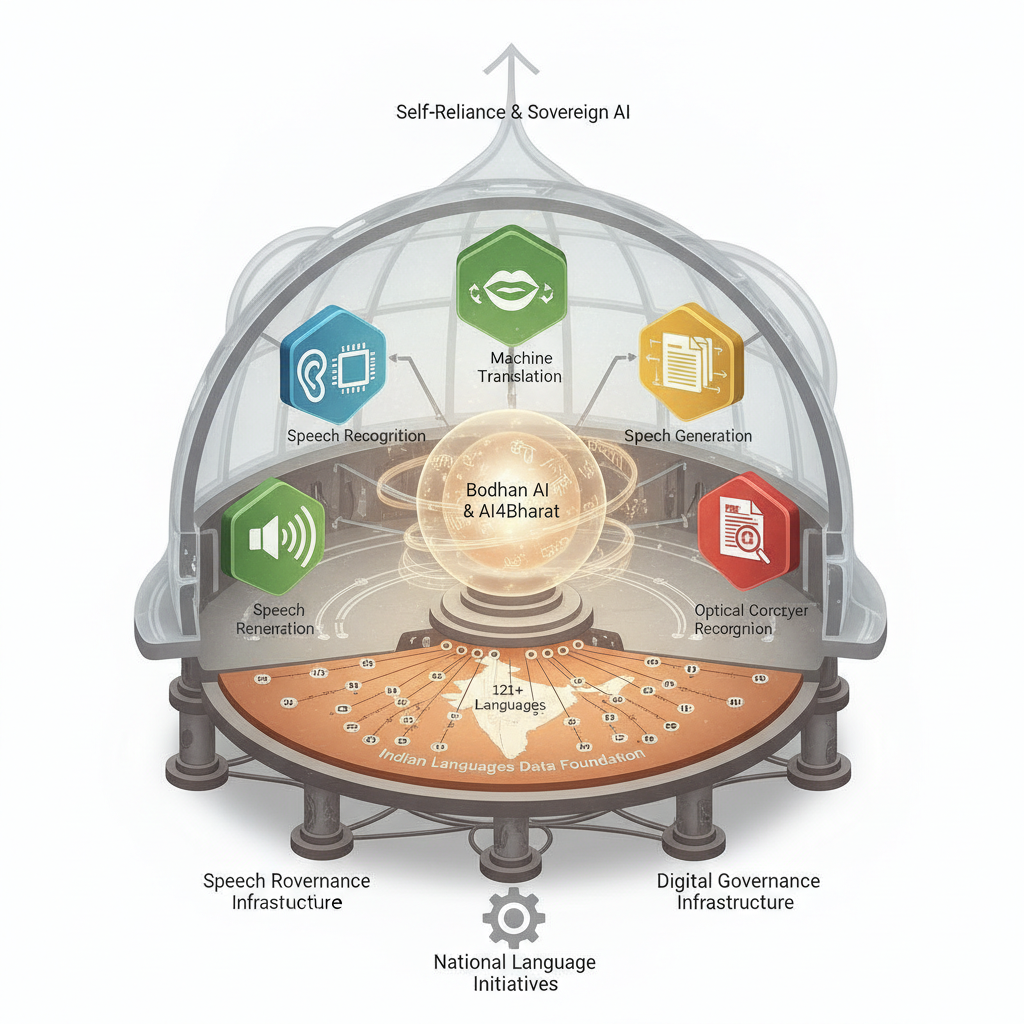
The launch of four foundational AI models in Indian languages by the Centre of Excellence in AI for Education (Bodhan AI) and AI4Bharat, incubated at IIT Madras, marks a significant milestone in India’s digital governance landscape. These models—spanning speech recognition, speech generation, machine translation, and optical character recognition—enable sovereign deployment of multilingual AI capabilities, reducing dependence on proprietary foreign technologies and fostering self-reliance in AI-driven public service delivery.
Background
- India’s linguistic diversity presents a critical challenge for digital inclusion, with over 121 languages spoken by more than 10,000 people each, as per the 2011 Census.
- The Union Government has prioritised the development of indigenous AI capabilities under initiatives such as the National Language Translation Mission (NLTM) and the National AI Mission, aiming to integrate AI into governance and education.
- IIT Madras has been a key institutional partner in India’s AI ecosystem, hosting multiple Centres of Excellence funded by the Union Ministry of Education, including Bodhan AI and AI4Bharat.
- The adoption of open-weight AI models and hosted APIs aligns with the Government of India’s push for ‘Aatmanirbhar Bharat’ in technology, particularly in the context of Digital Public Infrastructure (DPI).
- Public institutions and EdTech platforms face high costs and technical barriers in developing foundational AI models for Indian languages, necessitating collaborative and open-access solutions.
- The Union Ministry of Education’s support for such initiatives underscores the intersection of education policy, digital infrastructure, and AI-driven innovation in India’s developmental agenda.
What are Foundational AI Models in Indian Languages?
- Foundational AI models are large-scale, pre-trained neural networks designed to perform core tasks such as speech recognition, speech generation, machine translation, and optical character recognition (OCR) across multiple languages.
- These models are trained on vast datasets of text, speech, and images to enable generalised capabilities that can be fine-tuned for specific applications, reducing the need for task-specific training from scratch.
- The four models launched by Bodhan AI and AI4Bharat are tailored for Indian languages, addressing the unique linguistic and phonetic characteristics of the country’s diverse linguistic landscape.
- Speech recognition models convert spoken language into written text, enabling applications such as voice-based governance services, transcription of public speeches, and accessibility tools for the hearing impaired.
- Speech generation models (text-to-speech) convert written text into natural-sounding speech, supporting multilingual public announcements, educational content delivery, and assistive technologies.
- Machine translation models facilitate real-time translation between Indian languages, aiding cross-linguistic communication in government services, education, and digital platforms.
- Optical character recognition (OCR) models extract text from scanned documents or images, enabling digitisation of legacy records, vernacular documentation, and automated data entry in public offices.
- The models are released as open-weight resources, allowing developers, government agencies, and EdTech firms to integrate them into their systems without proprietary restrictions, while hosted APIs provide scalable access for deployment.
Key Features
| Feature | Significance |
|---|---|
| Speech Recognition | Enables real-time transcription and voice-based interaction in Indian languages, facilitating inclusive digital education and public service delivery. |
| Speech Generation | Converts text to natural-sounding speech in multiple Indian languages, supporting accessibility for visually impaired and illiterate populations. |
| Machine Translation | Provides high-fidelity translation between Indian languages and between Indian languages and English, reducing language barriers in governance and education. |
| Optical Character Recognition (OCR) | Digitises printed or handwritten text in Indian scripts, enabling archival, retrieval, and analysis of historical and administrative documents. |
| Open-Weight Releases & APIs | Promotes interoperability and innovation by allowing third-party developers to integrate AI capabilities without proprietary constraints, fostering a competitive ecosystem. |
Why it Matters
Technological Sovereignty
- Reduces dependence on foreign AI models for foundational capabilities in Indian languages, aligning with the National Strategy for Artificial Intelligence (2018) and Atmanirbhar Bharat initiatives.
- Leverages sovereign infrastructure to ensure data security and compliance with domestic regulations, particularly for sensitive public-sector applications.
- Strengthens India’s position in the global AI landscape by contributing to multilingual AI research and development.
Educational Inclusion
- Facilitates the creation of AI-driven educational tools in regional languages, supporting the National Education Policy (NEP) 2020’s emphasis on multilingual and inclusive education.
- Enables EdTech platforms to develop content in local languages, bridging the digital divide between urban and rural learners.
- Supports adaptive learning systems that personalise education based on linguistic and cognitive needs.
Governance & Public Service Delivery
- Enhances the accessibility of government services (e.g., welfare schemes, health advisories) by enabling multilingual interfaces and automated translation.
- Improves the efficiency of public institutions through AI-assisted document processing and citizen engagement in regional languages.
- Supports the Digital India initiative by providing language-agnostic digital infrastructure for e-governance.
Economic & Industrial Impact
- Stimulates innovation in the Indian AI ecosystem by lowering entry barriers for startups and SMEs to develop language-centric products.
- Creates opportunities for job creation in AI development, training, and maintenance, particularly in tier-2 and tier-3 cities.
- Encourages investment in language technology, positioning India as a hub for multilingual AI solutions.
Research & Development
- Accelerates academic and industry collaboration in AI for Indian languages, fostering a talent pool aligned with global standards.
- Provides a benchmark for evaluating and improving AI models for low-resource languages, addressing the linguistic diversity of India.
- Supports interdisciplinary research in linguistics, computer science, and cognitive science.
Challenges
1. Data Scarcity for Low-Resource Languages
- Many Indian languages lack sufficient annotated datasets for training robust AI models, leading to lower accuracy and performance.
- Addressing this requires collaborative efforts between government, academia, and industry to curate and standardise language resources.
UPSC Link: GS-III: Science & Tech
2. Computational Resource Constraints
- Training and deploying large AI models demand significant computational power, which may be a bottleneck for public institutions.
- Solutions include leveraging cloud infrastructure, optimising model architectures, and exploring federated learning techniques.
UPSC Link: GS-III: Science & Tech
3. Ethical & Bias Mitigation
- AI models trained on biased or unrepresentative data may perpetuate linguistic or cultural biases, particularly for marginalised communities.
- Requires rigorous auditing, transparency in dataset composition, and inclusive design practices.
UPSC Link: GS-IV: Ethics
4. Interoperability & Standardisation
- Ensuring seamless integration of AI models across diverse platforms and languages poses technical and governance challenges.
- Standardisation of APIs, data formats, and evaluation metrics is critical for scalability and adoption.
UPSC Link: GS-III: Science & Tech
5. Public Awareness & Adoption
- Limited awareness among end-users (e.g., students, government officials) about the capabilities and limitations of AI models may hinder uptake.
- Requires targeted outreach, training programmes, and demonstration projects to build trust and familiarity.
UPSC Link: GS-II: Governance
Challenges — UPSC Perspective
| Issue | Concern |
|---|---|
| Data Availability | Insufficient high-quality, annotated datasets for many Indian languages, particularly low-resource ones. |
| Computational Costs | High infrastructure requirements for training and deploying large-scale AI models. |
| Bias & Fairness | Risk of perpetuating linguistic, regional, or caste-based biases in AI outputs. |
| Regulatory Compliance | Need to align with data protection laws (e.g., DPDP Act 2023) and ethical AI frameworks. |
| Skill Gaps | Shortage of experts in AI for Indian languages, especially in public institutions. |
| User Trust | Skepticism among end-users regarding accuracy, reliability, and privacy of AI-driven services. |
Way Forward
- Establish a national repository for annotated datasets in Indian languages, with contributions from government, academia, and industry.
- Develop public-private partnerships to co-fund computational infrastructure for training and deploying AI models.
- Implement bias auditing frameworks and ethical guidelines for AI development, aligned with global best practices.
- Launch pilot programmes in education, healthcare, and governance to demonstrate the utility of multilingual AI models.
- Expand digital literacy initiatives to familiarise users with AI tools and their applications in regional languages.
- Encourage open-source contributions and hackathons to foster innovation in language-centric AI solutions.
- Integrate AI models into existing government schemes (e.g., DIKSHA, e-Shram) to enhance accessibility and reach.
- Promote international collaborations to benchmark Indian AI models against global standards and share best practices.
UPSC Value Addition
Keywords for Mains Answer-Writing
Artificial Intelligence · Natural Language Processing · Digital Public Infrastructure · Sovereign AI · Multilingual AI models · AI for Education · Open-source AI · Public-Private Partnership in AI · Digital India Mission · AI governance · Language Technology · AI in Public Services · IIT Madras · Ministry of Education · AI4Bharat · Foundational AI models · API-based AI integration · Optical Character Recognition · Speech-to-text · Text-to-speech
Concept Flow
Rise in demand for multilingual digital services in governance and education → Identification of gaps in foundational AI capabilities for Indian languages → Incubation of Bodhan AI and AI4Bharat under IIT Madras with Ministry of Education support → Development of four foundational AI models (speech recognition, speech generation, translation, OCR) → Release of open-weight models and APIs for ecosystem integration → Deployment in public services and EdTech platforms for scalable impact → Iterative improvement through user feedback and data augmentation
Prelims Practice Questions
Q1. Consider the following statements regarding the AI models launched by IIT Madras incubated centre Bodhan AI and AI4Bharat:
1. The models include capabilities for speech recognition, speech generation, machine translation, and optical character recognition.
2. The models are released under closed-source licensing to restrict access to government partners only.
3. The initiative is supported by the Union Ministry of Education.
4. The models are designed exclusively for English language applications.
How many of the above statements are correct?
- Only one
- Only two
- Only three
- All four
Answer: Only three — Statements 1 and 3 are correct. Statement 2 is incorrect as the models are released under open-weight licensing. Statement 4 is incorrect as the models are designed for Indian languages, not exclusively English.
Q2. Assertion (A): The launch of AI models in Indian languages by IIT Madras incubated centres aims to enhance digital public infrastructure.
Reason (R): The models are designed to be integrated into public-service applications using sovereign infrastructure, thereby reducing dependence on foreign AI technologies.
In the context of the above two statements, which one of the following is correct?
- Both A and R are true, and R is the correct explanation of A.
- Both A and R are true, but R is not the correct explanation of A.
- A is true but R is false.
- A is false but R is true.
Answer: Both A and R are true, and R is the correct explanation of A. — Both A and R are true, and R correctly explains A. The models are intended to strengthen digital public infrastructure by enabling sovereign, multilingual AI capabilities for public services.
Q3. Match the following AI capabilities with their respective applications:
| Column I (AI Capability) | Column II (Application) |
|———————————-|———————————————|
| A. Speech Recognition | 1. Converting printed text into digital text |
| B. Speech Generation | 2. Translating text from one language to another |
| C. Machine Translation | 3. Converting spoken words into written text |
| D. Optical Character Recognition | 4. Converting written text into spoken words |
Select the correct match:
- A-3, B-4, C-2, D-1
- A-1, B-2, C-3, D-4
- A-4, B-3, C-1, D-2
- A-2, B-1, C-4, D-3
Answer: A-3, B-4, C-2, D-1 — The correct matches are: A (Speech Recognition) with 3 (Converting spoken words into written text), B (Speech Generation) with 4 (Converting written text into spoken words), C (Machine Translation) with 2 (Translating text from one language to another), and D (Optical Character Recognition) with 1 (Converting printed text into digital text).
Mains Practice Question
✍ The deployment of foundational AI models in Indian languages represents a significant stride toward building a sovereign digital public infrastructure. Critically analyse the potential benefits and challenges associated with this initiative, with reference to India’s Digital India Mission and the broader discourse on AI governance. (15 Marks)
Approach: MODEL-ANSWER SKELETON:
1. **Introduction (2 marks)**: Define foundational AI models and their role in digital public infrastructure. Contextualise within India’s Digital India Mission and the need for multilingual AI capabilities.
2. **Benefits (5 marks)**:
– **Accessibility and Inclusivity**: Enabling digital services in regional languages for diverse linguistic populations (e.g., Scheduled Languages of India).
– **Sovereign AI and Data Privacy**: Reducing dependence on foreign AI technologies, ensuring data sovereignty, and aligning with the ‘Atmanirbhar Bharat’ vision.
– **Public Service Delivery**: Enhancing efficiency in education, healthcare, and governance through multilingual AI tools (e.g., AI-powered translation for government documents, speech-to-text for rural interfaces).
– **Economic and Educational Impact**: Facilitating EdTech integration, upskilling, and digital literacy in regional languages.
– **Open-Weight Releases and APIs**: Promoting innovation by enabling startups and public institutions to build on these models without reinventing foundational capabilities.
3. **Challenges (5 marks)**:
– **Data Quality and Bias**: Ensuring training datasets are representative of India’s linguistic diversity and free from biases.
– **Infrastructure and Scalability**: Addressing computational and storage requirements for large-scale deployment, particularly in rural and remote areas.
– **Regulatory and Ethical Concerns**: Navigating issues of misinformation, deepfakes, and the ethical use of AI in public services.
– **Interoperability and Standardisation**: Ensuring compatibility with existing digital systems and adherence to national standards (e.g., India’s AI Stack).
– **Human Oversight and Accountability**: Balancing automation with human intervention to address errors and ensure accountability in critical applications.
4. **Policy and Governance Framework (3 marks)**:
– **Role of Government**: Highlight the Union Ministry of Education’s support and the need for a coordinated approach with MeitY, NITI Aayog, and other stakeholders.
– **AI Governance Principles**: Reference India’s AI strategy (e.g., National AI Portal, AI for All) and global best practices (e.g., UNESCO’s Recommendation on the Ethics of AI).
– **Public-Private Partnerships**: Discuss the collaboration between IIT Madras, AI4Bharat, and EdTech companies to democratise AI access.
5. **Conclusion (2 marks)**: Summarise the transformative potential of sovereign AI models while emphasising the need for robust governance, ethical safeguards, and inclusive deployment to realise the Digital India Mission’s goals.
Source: The Hindu
Generated by AanyaAi for educational purpose.
Related guides on our sites
- Current affairs for upsc 2026
- How to prepare for GS paper 1 for UPSC CSE mains exam
- Best UPSC coaching for IFOS exam
- Best mentorship programme for upsc

- केरल में बच्चों की कुपोषण और उपेक्षा से मृत्यु रोकने की तैयारी, जानिए कैसे - October 24, 2026
- Liechtenstein Prince’s India Visit: Key Agreements & Bilateral Focus - October 24, 2026
- 19वें ‘अर्बन मोबिलिटी इंडिया सम्मेलन 2026’ का उद्घाटन: भुवनेश्वर में हुआ आयोजन - October 24, 2026

No Comments