


06 Jul India and Japan Did Well to Ring-Fence Their Ties from Multilateral Accords
Amid US–China rivalry, Russia–West tensions and Indo-Pacific competition, New Delhi and Tokyo have chosen to protect a decades-long bilateral partnership from the fault lines of the groupings they separately belong to.
Why is this in the News? 01
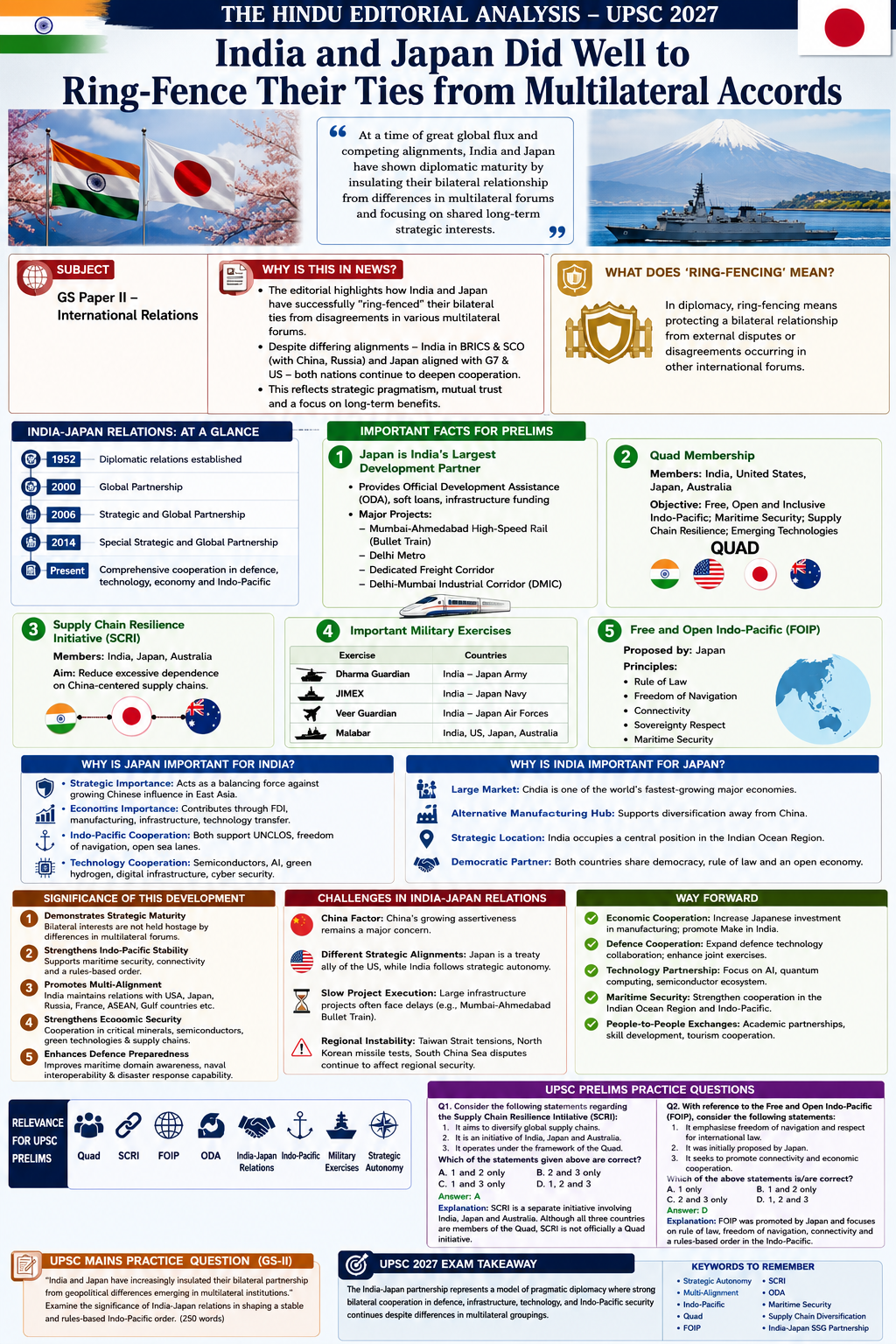
The editorial highlights how India and Japan have successfully insulated their bilateral relationship from differences arising in various multilateral forums. At a time when global geopolitics is witnessing US–China rivalry, Russia–West tensions, Taiwan Strait concerns and Indo-Pacific competition, both countries have chosen to prioritise their long-term strategic partnership rather than allowing disagreements in international groupings to spill over into bilateral cooperation. This reflects diplomatic maturity and strategic pragmatism on both sides.
What Does “Ring-Fencing” Mean? 02
|
DEFINITION In diplomacy, ring-fencing means protecting a bilateral relationship from external disputes or disagreements occurring in other international forums. India participates in BRICS and the SCO alongside China and Russia, while Japan is closely aligned with the G7 and the United States. Despite these differing alignments, India and Japan continue to deepen cooperation in defence, technology, infrastructure, trade and maritime security. |
India–Japan Relations: At a Glance 03
1952 — Diplomatic relations established
2000 — Elevated to a Global Partnership
2006 — Upgraded to Strategic and Global Partnership
2014 — Elevated further to Special Strategic and Global Partnership
Present — Comprehensive cooperation across defence, technology, economy and the Indo-Pacific
Important Facts for UPSC Prelims 04
Japan — India’s Largest Development Partner
Japan provides Official Development Assistance (ODA), soft loans and infrastructure funding. Major projects include:
• Mumbai–Ahmedabad High-Speed Rail (Bullet Train)
• Delhi Metro
• Dedicated Freight Corridor
• Delhi–Mumbai Industrial Corridor (DMIC)
|
Quad Membership — India, US, Japan, Australia • Free, Open and Inclusive Indo-Pacific • Maritime security • Supply chain resilience • Emerging technologies |
|
Supply Chain Resilience Initiative (SCRI) — India, Japan, Australia • Aim: Reduce excessive dependence on China-centred supply chains |
|
Free and Open Indo-Pacific (FOIP) — Proposed by Japan • Rule of law • Freedom of navigation • Connectivity • Sovereignty and maritime security |
Important Military Exercises
|
Exercise |
Countries Involved |
|
Dharma Guardian |
India–Japan (Army) |
|
JIMEX |
India–Japan (Navy) |
|
Veer Guardian |
India–Japan (Air Forces) |
|
Malabar |
India, US, Japan, Australia |
Why Each Matters to the Other 05
|
WHY JAPAN MATTERS TO INDIA • Strategic: Balances growing Chinese influence in East Asia • Economic: FDI, manufacturing, infrastructure, technology transfer • Indo-Pacific: Joint support for UNCLOS, freedom of navigation, open sea lanes • Technology: Semiconductors, AI, green hydrogen, digital infrastructure, cyber security |
WHY INDIA MATTERS TO JAPAN • Large market: One of the world’s fastest-growing major economies • Manufacturing hub: Supports diversification away from China • Strategic location: Central position in the Indian Ocean Region • Shared values: Democracy, rule of law, open economy |
Significance of This Development 06
|
01 |
Demonstrates Strategic Maturity Bilateral interests are kept from becoming victims of multilateral disagreements. |
|
02 |
Strengthens Indo-Pacific Stability Supports maritime security, regional connectivity and a rules-based order. |
|
03 |
Promotes Multi-Alignment India’s foreign policy maintains simultaneous relations with the US, Japan, Russia, France, ASEAN and Gulf countries. |
|
04 |
Strengthens Economic Security Cooperation in critical minerals, semiconductors, green technologies and supply chains reduces vulnerabilities. |
|
05 |
Enhances Defence Preparedness Improves maritime domain awareness, naval interoperability and disaster response capability. |
Challenges in India–Japan Relations 07
|
! |
The China Factor China remains a major shared concern for both countries. |
|
! |
Different Strategic Alignments Japan is a treaty ally of the United States, while India follows Strategic Autonomy. |
|
! |
Slow Project Execution Large infrastructure projects often face delays — e.g. the Mumbai–Ahmedabad Bullet Train. |
|
! |
Regional Instability Taiwan Strait tensions, North Korean missile tests and South China Sea disputes continue to affect regional security. |
Way Forward 08
• Economic Cooperation: Increase Japanese investment in manufacturing; promote Make in India.
• Defence Cooperation: Expand defence technology collaboration and enhance joint exercises.
• Technology Partnership: Focus on AI, quantum computing and the semiconductor ecosystem.
• Maritime Security: Strengthen cooperation across the Indian Ocean Region, East China Sea and the Indo-Pacific.
• People-to-People Exchanges: Academic partnerships, skill development and tourism cooperation.
Relevance for UPSC Prelims 09
Directly important topics: Quad · SCRI · FOIP · ODA · India–Japan Relations · Indo-Pacific · Military Exercises · Strategic Autonomy
Keywords to Remember
Strategic Autonomy • Multi-Alignment • Indo-Pacific • Quad • FOIP • SCRI • ODA • Maritime Security • Supply Chain Diversification • India–Japan Special Strategic and Global Partnership
UPSC Prelims Practice Questions 10
|
QUESTION 1 Consider the following statements regarding the Supply Chain Resilience Initiative (SCRI): (1) It aims to diversify global supply chains. (2) It is an initiative of India, Japan and Australia. (3) It operates under the framework of the Quad. Which of the statements given above are correct? 1. 1 and 2 only 2. 2 and 3 only 3. 1 and 3 only 4. 1, 2 and 3 Answer: A. SCRI is a separate initiative involving India, Japan and Australia. Although all three countries are members of the Quad, SCRI is not officially a Quad initiative. |
|
QUESTION 2 With reference to the Free and Open Indo-Pacific (FOIP), consider the following statements: (1) It emphasizes freedom of navigation and respect for international law. (2) It was initially proposed by Japan. (3) It seeks to promote connectivity and economic cooperation. Which of the above statements is/are correct? 5. 1 only 6. 1 and 2 only 7. 2 and 3 only 8. 1, 2 and 3 Answer: D. FOIP was promoted by Japan and focuses on rule of law, freedom of navigation, connectivity, and a rules-based order in the Indo-Pacific. |
UPSC Mains Practice Question (GS-II) 11
|
250 WORDS “India and Japan have increasingly insulated their bilateral partnership from geopolitical differences emerging in multilateral institutions.” Examine the significance of India–Japan relations in shaping a stable and rules-based Indo-Pacific order. |
ONE-LINE TAKEAWAY
The India–Japan partnership represents a model of pragmatic diplomacy — strong bilateral cooperation in defence, infrastructure, technology, and Indo-Pacific security continues despite differences in multilateral groupings, making it highly relevant for both UPSC Prelims and GS-II Mains.


- Before New Taxes, Make Every Rupee Count: Fiscal Discipline and Outcome-Based Governance in Tamil Nadu - August 20, 2026
- A Palestinian State as the Foundation for Regional Peace - August 20, 2026
- A Vision for an Inclusive Bangladesh: Democracy, Minority Rights and India’s Neighbourhood - August 19, 2026

No Comments