


12 Nov India at the G7: Strengthening Strategic Ties and Championing the Global South
This article covers “Daily Current Affairs” and From India at the G7: Strengthening Strategic Ties and Championing the Global South
SYLLABUS MAPPING
GS-2-International Relations- India at the G7: Strengthening Strategic Ties and Championing the Global South
FOR PRELIMS
What challenges does India face while working with G7 countries?
FOR MAINS
What are the key areas of cooperation India discussed with G7 countries?
Why in the News?
External Affairs Minister (EAM) Dr. S. Jaishankar participated in the G7 Foreign Ministers’ Meeting held at Niagara, Canada, as an invited partner under the Canadian presidency.
On the sidelines of the summit, he held a series of bilateral meetings with his counterparts from France, Brazil, the United Kingdom, and Germany, focusing on strengthening strategic partnerships, multilateral cooperation, and global governance reforms.
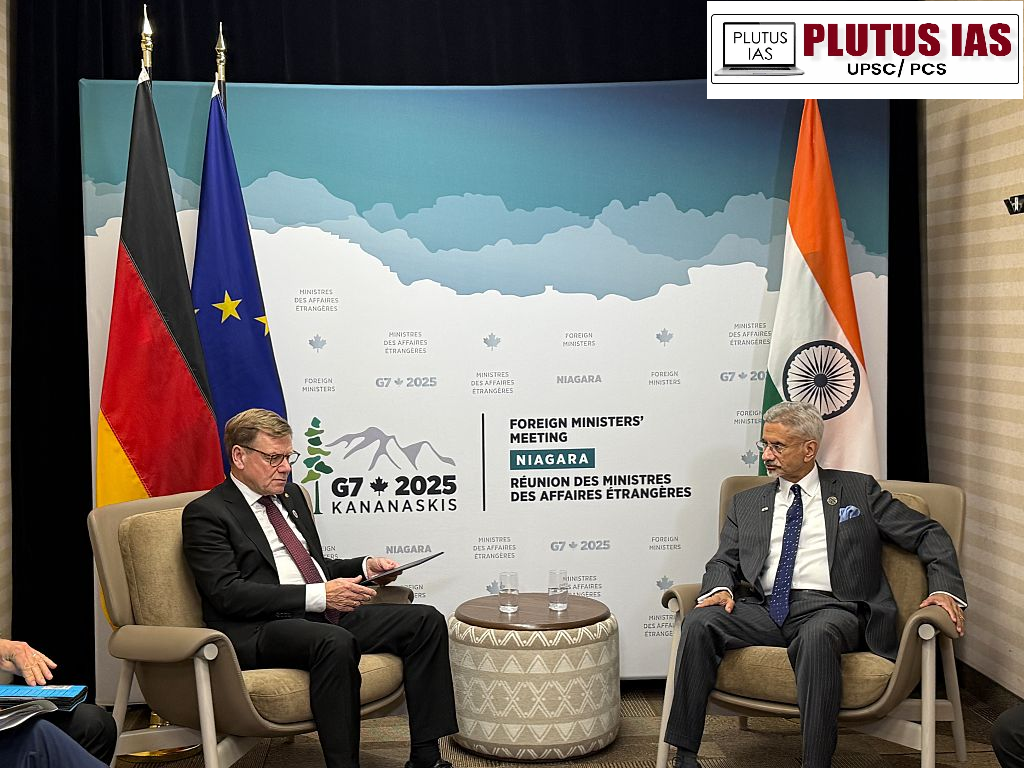
About the G7 Meeting 2025
1. Host Country: Canada
2. Focus Areas: Global security, economic resilience, energy cooperation, Indo-Pacific partnerships, and sustainable development.
3. Participating Invitees: India, Brazil, Australia, and South Korea.
India’s presence at G7 underscores its growing influence as a key voice of the Global South and an emerging pillar in global governance.
Key Bilateral Engagements
1. India–France Strategic Partnership
EAM met French Foreign Minister Jean-Noël Barrot, reaffirming the strength of the India–France Strategic Partnership, which marks 25 years in 2023.
Discussions Covered:
Deepening cooperation in defence, technology, clean energy, and digital innovation.
Collaboration in Indo-Pacific initiatives and multilateral forums (UNSC, G20, IORA).
Follow-up on the Horizon 2047 roadmap and the Defence Industrial Roadmap signed earlier.
“Took stock of our Strategic Partnership. Discussed deepening our cooperation in multilateral and plurilateral formats.” — EAM Jaishankar on X.
Key Bilateral Engagements of EAM S. Jaishankar at G7 Foreign Ministers’ Meeting (Niagara, Canada – 2025)
| Partner Country | Counterpart | Main Focus / Themes | Key Areas of Cooperation | Notable Outcomes / Quotes |
|---|---|---|---|---|
| France | Jean-Noël Barrot (Foreign Minister) | Strengthening the India–France Strategic Partnership (25 years milestone) | – Defence and technology cooperation – Clean energy and digital innovation – Collaboration in Indo-Pacific and multilateral forums (UNSC, G20, IORA) – Review of Horizon 2047 Roadmap and Defence Industrial Roadmap |
“Took stock of our Strategic Partnership. Discussed deepening our cooperation in multilateral and plurilateral formats.” — Jaishankar |
| Brazil | Mauro Vieira (Foreign Minister) | Enhancing South–South cooperation within BRICS, IBSA, and G20 frameworks | – Trade, investment, and health cooperation – Joint work in pharmaceuticals, bioeconomy, and sustainable agriculture – Strengthening Global South representation in global institutions |
India and Brazil share a mutual vision for multipolarity and inclusive development, vital for Global South diplomacy |
| United Kingdom (UK) | Yvette Cooper (Foreign Secretary) | Reaffirming India–UK Vision 2035 for comprehensive partnership | – Progress in India–UK FTA talks – Collaboration in defence, AI, semiconductors, climate action – Enhanced mobility and student exchanges under Young Professionals Scheme |
“Acknowledged the positive momentum in our relations and reaffirmed the India–UK Vision 2035 for further deepening cooperation across key areas.” — Jaishankar |
| Germany / European Union | Johann Wadephul (Foreign Minister) | Advancing India–Germany & India–EU Strategic Partnership | – Energy transition and green hydrogen – Digital public infrastructure cooperation – Geopolitical discussions on Middle East, Indo-Pacific, and Afghanistan – Engagement under India–EU Trade and Technology Council (TTC) |
“Discussed advancing our Strategic Partnership and India–EU ties. Exchanged views on the Middle East, Indo-Pacific, and Afghanistan.” — Jaishankar |
🇮🇳 India’s Broader Diplomatic Objectives at G7
1. Voice of the Global South: Representing developing nations on issues like climate finance, debt relief, and inclusive global governance.
2. Reform of Global Institutions: Advocating for fair representation of the Global South in bodies like the UN, IMF, and WTO.
3. Strategic Partnerships: Deepening cooperation with major economies in defence, clean energy, innovation, and technology.
4. Indo-Pacific Cooperation: Promoting a free, open, and rules-based Indo-Pacific with a focus on maritime security and regional stability.
5. Economic & Energy Security: Strengthening ties for clean energy, resilient supply chains, and sustainable infrastructure.
6. Global Peace & Stability: Supporting dialogue and diplomacy in conflict zones while upholding international law and India’s “One Earth, One Family, One Future” vision.
Significance of India’s Participation
| Dimension | Significance |
|---|---|
| Diplomatic | Strengthens India’s global outreach and multilateral credibility. |
| Strategic | Enhances defence, cyber, and maritime collaboration with key partners. |
| Economic | Advances FTA discussions and access to high-tech investments. |
| Technological | Promotes cooperation in AI, quantum computing, and green technologies. |
| Geopolitical | Reinforces India’s role as a balancing power in the Indo-Pacific and Global South. |
Challenges in Engagement
1. Trade Negotiation Delays: Ongoing FTA talks with the UK and EU face hurdles over tariffs, services access, and standards alignment.
2. Geopolitical Divergences: Differing stances on the Russia–Ukraine conflict and Western sanctions affect strategic convergence.
3. China Factor: Partners’ cautious China policies sometimes contrast with India’s security-driven Indo-Pacific approach.
4. Slow Global Governance Reforms: Despite shared intent, progress on UN Security Council and WTO reforms remains limited.
5. Regulatory and Standards Barriers: Stringent EU sustainability and data norms pose challenges for Indian exporters and tech companies.
6. Domestic Political Transitions: Leadership or policy shifts in partner nations (UK, France, EU) can delay long-term commitments.
7. Resource and Coordination Constraints: Overlapping forums (G7, G20, IPEF, Quad) demand sustained diplomatic capacity and coordination.
Way Forward
1. Fast-Track Trade Agreements: Finalize FTAs with the UK and EU to boost exports, investment, and supply chain integration.
2. Deepen Defence and Tech Collaboration: Co-develop advanced systems in space, AI, semiconductors, and cybersecurity to enhance strategic autonomy.
3. Strengthen Climate and Energy Partnerships: Expand cooperation in green hydrogen, renewables, and climate finance under Just Energy Transition frameworks.
4. Promote People-to-People Ties: Leverage the global Indian diaspora for investment, innovation, and cultural diplomacy.
5. Align Indo-Pacific Strategies: Intensify joint naval exercises, logistics sharing, and resilient maritime supply chains.
6. Enhance Multilateral Cooperation: Coordinate positions in G20, BRICS, and UN to amplify Global South priorities in global decision-making.
7. Institutionalize Strategic Dialogues: Establish regular 2+2 and Track 1.5 dialogues with key partners for sustained engagement and policy continuity.
Conclusion
EAM S. Jaishankar’s participation in the G7 Foreign Ministers’ Meeting in Canada showcases India’s rising diplomatic clout and its strategic balancing between the Global North and South.
By engaging with major economies like France, Brazil, the UK, and Germany, India reinforced its role as a bridge-builder in global governance, a champion of inclusive development, and a responsible stakeholder in shaping a peaceful and sustainable international order.
This engagement reflects India’s long-term vision of “Vasudhaiva Kutumbakam” — One Earth, One Family, One Future.
Prelims question:
Q. India’s participation in the G7 Foreign Ministers’ Meeting 2025 highlights which of the following objectives of its foreign policy?
1. Strengthening engagement with major global economies.
2. Advocating for the Global South in international forums.
3. Promoting Indo-Pacific cooperation and maritime security.
4. Pursuing military alliances with G7 member states.
Select the correct answer using the code below:
(a) 1, 2 and 3 only
(b) 2 and 4 only
(c) 1 and 3 only
(d) 1, 2, 3 and 4
Answer: A
Mains Question:
Q. Discuss the significance of India’s participation in the G7 Foreign Ministers’ Meeting 2025 for strengthening its role in global governance and multilateral diplomacy.
(250 words)

- RBI’s Shrinking Real-Rate Cushion Amid Rising Inflation and Strong Demand - September 21, 2026
- India’s NGOs at a New Funding Crossroads - September 21, 2026
- Deep-Sea Discovery, Environmental Responsibility - September 19, 2026

No Comments