


04 Sep India-France Virtual Meet: Key Focus on Space Summit & Expo Participation
✎ India-France space cooperation is a six-decade-old strategic alliance between ISRO and CNES, now evolving to include human spaceflight, advanced technologies, and industry alignment, with the International Space Summit and…
Subject Relevance — Where This Topic Fits
- GS Paper II — International Relations: Bilateral and Regional Groupings involving India and/or affecting India’s interests | GS Paper III — Science and Technology: Developments and their Applications and Effects in Everyday Life, Awareness in the fields of IT, Space, Computers, Robotics, Nano-technology, Bio-technology
- Prelims: INSAT, GSAT series, ISRO, CNES, Human Spaceflight Programme (Gaganyaan), Low Earth Orbit (LEO), International Space Station (ISS), Space Economy, Frequency Management, ITU
- Essay: The Role of International Cooperation in Advancing Space Technology for Societal Benefit, Emerging Paradigms in Global Space Governance: Collaboration, Competition and Sustainability
Quick Revision: India-France space cooperation is a six-decade-old strategic alliance between ISRO and CNES, now evolving to include human spaceflight, advanced technologies, and industry alignment, with the International Space Summit and Bengaluru Space Expo serving as key platforms for multilateral engagement and commercial partnerships.
Why is this in the news?
The virtual bilateral meeting between Dr. Jitendra Singh, Union Minister of State (Independent Charge) for Science & Technology, Earth Sciences, PMO, Personnel, Public Grievances, Pensions, Atomic Energy and Space, and Professor Philippe Baptiste, French Minister for Higher Education, Research and Space, underscores the strategic importance of India-France collaboration in space. The discussion, held ahead of the International Space Summit in Paris (9–10 September 2026) and the Bengaluru Space Expo (7–9 September 2026), focused on accelerating cooperation in human spaceflight, advanced space technologies, and industry alignment, reflecting the evolving architecture of global space governance and the commercialisation of space activities.
Background
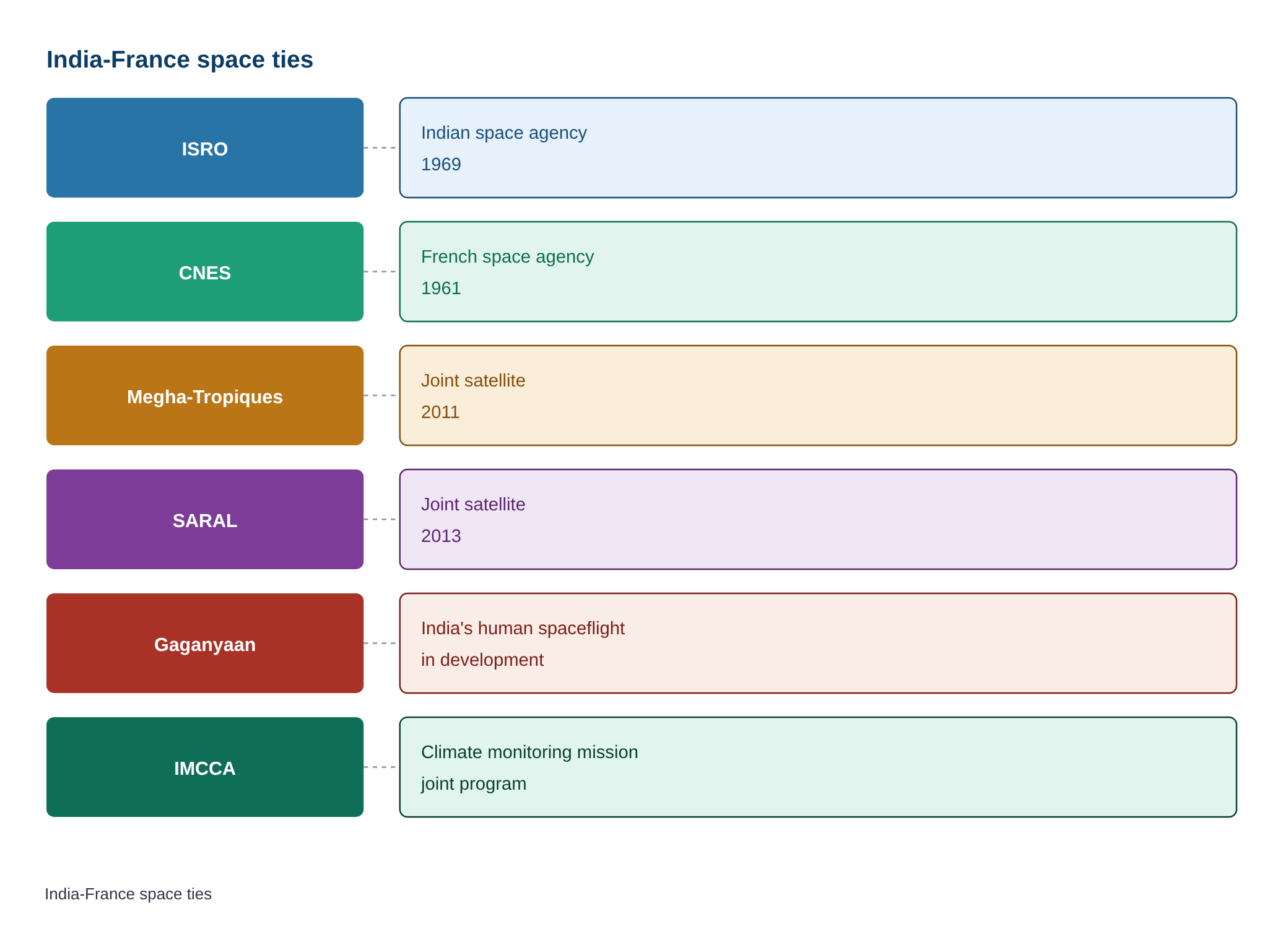
- India and France share a long-standing partnership in space, formalised through the 1964 establishment of the Indian Space Research Organisation (ISRO) and the French space agency Centre National d’Études Spatiales (CNES), marking nearly six decades of collaboration.
- The bilateral space cooperation has yielded joint satellite missions such as Megha-Tropiques (2011) for tropical weather and climate studies and SARAL (2013) for oceanography and climate research, demonstrating complementary technological strengths.
- France has been a key partner in India’s Earth observation and climate monitoring initiatives, contributing to programmes like the Indo-French Joint Mission for Climate Change Monitoring and Adaptation (IMCCA).
- The collaboration aligns with India’s vision of a self-reliant yet globally integrated space programme, as articulated in the Space Policy 2023 and the Draft Space Policy Framework.
- The International Space Summit in Paris and the Bengaluru Space Expo are emerging platforms for multilateral dialogue on space governance, technology transfer, and commercial partnerships, reflecting the growing commercialisation of space activities.
What is India-France Space Cooperation?
- The India-France space partnership is a strategic alliance between ISRO and CNES, formalised through inter-governmental agreements and joint working groups, aimed at advancing scientific, technological, and industrial capabilities in space.
- The collaboration spans satellite missions, human spaceflight, planetary exploration, and Earth observation, with a focus on climate science, disaster management, and sustainable development.
- Human spaceflight cooperation includes joint research on life support systems, crew health monitoring, and training protocols, with France providing expertise in orbital mechanics and re-entry technologies.
- Advanced space technologies under discussion include propulsion systems, satellite miniaturisation, and in-situ resource utilisation for lunar and Martian missions, aligning with India’s lunar exploration goals.
- Industry synergy is a key pillar, with French aerospace firms like Airbus Defence and Space and Thales Alenia Space exploring joint ventures in satellite manufacturing, launch services, and ground segment development in India.
- The partnership also addresses regulatory frameworks for space traffic management, frequency allocation, and debris mitigation, in line with international best practices and ITU guidelines.
- The upcoming International Space Summit in Paris and Bengaluru Space Expo serve as platforms to showcase joint innovations, sign new agreements, and foster public-private partnerships in the space economy.
- Both nations are committed to ensuring equitable access to space-based data, promoting open science, and supporting global initiatives for sustainable space utilisation under the UN Outer Space Treaty.
Key Features
| Feature | Significance |
|---|---|
| Virtual Bilateral Meeting | Demonstrates the institutional mechanism of high-level diplomatic engagement in space cooperation between India and France, leveraging digital platforms for strategic dialogue. |
| India-France Space Partnership | Represents a long-standing (six decades) bilateral cooperation in space technology, with joint missions like Megha-Tropiques and SARAL, now transitioning to advanced domains such as human spaceflight. |
| International Space Summit (Paris, 9-10 Sep 2026) | A multilateral platform for shaping global space governance, focusing on sustainable use of outer space, space-based data access, and regulatory frameworks under ITU. |
| Bengaluru Space Expo (7-9 Sep 2026) | A key industry-focused event in India’s space calendar, facilitating collaboration between ISRO, French agencies, and private sector entities in space technologies. |
| Human Spaceflight Collaboration | Signals India’s progress toward Gaganyaan and potential future joint missions with France, including participation in International Space Station (ISS) exploration. |
Why it Matters
Strategic Diplomacy
- Enhances India’s global standing in space technology by deepening ties with a technologically advanced partner like France, a founding member of ESA and a key player in European space policy.
- Strengthens India’s position in multilateral space governance forums, particularly in advocating for equitable access to space-based data and sustainable space practices.
- Demonstrates India’s commitment to open and inclusive international cooperation in space, aligning with global norms such as the Artemis Accords and ITU regulations.
Technological Advancement
- Accelerates India’s indigenous capabilities in human spaceflight (Gaganyaan) through knowledge-sharing and potential joint R&D with France’s CNES, which has expertise in astronaut training and life-support systems.
- Facilitates collaboration in advanced propulsion, satellite miniaturization, and space medicine, areas where France has demonstrated leadership.
- Provides a platform for Indian space startups and industries to integrate with global supply chains, particularly in satellite manufacturing and space-based services.
Economic Cooperation
- Expands market access for Indian space startups in Europe, particularly in Earth observation, satellite communication, and space-derived services.
- Encourages joint ventures and technology transfers between ISRO, CNES, and private sector entities, fostering innovation and cost-efficiency in space missions.
- Positions India as a preferred partner for international space missions, potentially leading to increased foreign direct investment in the space sector.
Institutional Strengthening
- Reinforces the role of ISRO as a global leader in space technology, with opportunities to host international delegations and participate in high-profile summits.
- Strengthens bilateral mechanisms such as the India-France Joint Working Group on Space, ensuring sustained dialogue and project execution.
- Promotes capacity-building in emerging space-faring nations through collaborative training programs and knowledge dissemination.
Challenges
1. Regulatory Harmonization
- Divergent national regulations on space activities, particularly in human spaceflight and satellite licensing, may impede seamless collaboration.
- Need for alignment with international treaties such as the Outer Space Treaty and the Artemis Accords to ensure compliance and avoid geopolitical friction.
UPSC Link: GS-II: International Treaties
2. Technology Transfer Constraints
- Restrictions on transfer of critical technologies (e.g., cryogenic engines, life-support systems) due to export controls and strategic sensitivities.
- Balancing indigenous development with international partnerships to avoid over-reliance on foreign systems.
UPSC Link: GS-III: Science & Tech
3. Funding and Resource Allocation
- Limited budgetary allocations for joint space missions, particularly in human spaceflight, where costs are prohibitive for single-nation funding.
- Need for innovative financing models, including public-private partnerships, to sustain long-term collaborations.
UPSC Link: GS-III: Budget
4. Industry Integration
- Fragmented private sector participation in India’s space ecosystem, with limited large-scale manufacturing and R&D capabilities compared to global peers.
- Ensuring equitable involvement of French and Indian industries in joint ventures to prevent monopolization by larger firms.
UPSC Link: GS-III: Industrial Policy
5. Geopolitical Considerations
- Potential tensions between India’s strategic autonomy and alignment with Western partners like France, particularly in sensitive technologies.
- Balancing engagement with multiple space-faring nations (e.g., USA, Russia, Japan) to avoid over-dependence on a single partner.
UPSC Link: GS-II: Foreign Policy
Challenges — UPSC Perspective
| Issue | Concern |
|---|---|
| Technology Transfer | Export controls and strategic sensitivities may restrict the flow of critical space technologies between India and France. |
| Regulatory Divergence | Differences in national space laws and international treaty obligations could create compliance challenges. |
| Funding Gaps | Limited budgetary support for joint missions may delay or scale down proposed collaborations. |
| Industry Readiness | India’s private space sector lacks the scale and expertise of global counterparts, hindering effective collaboration. |
| Geopolitical Balancing | India must navigate its strategic partnerships without compromising its autonomous space program. |
Way Forward
- Finalize the agenda and deliverables for the International Space Summit (Paris) and Bengaluru Space Expo, ensuring alignment with India’s long-term space policy goals.
- Establish a joint task force comprising ISRO, CNES, and private sector representatives to identify high-impact collaboration areas in human spaceflight and advanced technologies.
- Accelerate the development of indigenous capabilities in critical areas such as life-support systems and re-entry technologies to reduce reliance on foreign systems.
- Leverage the Bengaluru Space Expo to showcase India’s space startups and foster B2B partnerships with French and global firms.
- Strengthen India’s participation in multilateral space governance forums by advocating for equitable access to space-based data and sustainable space practices.
- Develop a roadmap for phased technology transfer and joint R&D, prioritizing areas where France has demonstrated expertise (e.g., satellite miniaturization, space medicine).
- Enhance public-private partnerships to mobilize additional funding for joint missions, including crowdfunding and international investment initiatives.
- Conduct joint workshops and training programs to build capacity in emerging space-faring nations, positioning India as a knowledge hub.
UPSC Value Addition
Keywords for Mains Answer-Writing
India-France space cooperation · ISRO-CNES collaboration · Human spaceflight missions · Low Earth Orbit (LEO) · International Space Summit · Bengaluru Space Expo · Sustainable space utilisation · Space-based scientific data · Regulatory frameworks for space · Space economy · Space technology transfer · Earth observation and climate applications
Concept Flow
Diplomatic Engagement → Virtual Bilateral Meeting → Strategic Dialogue on Space Cooperation → Alignment with International Space Governance Frameworks → Participation in Multilateral Summits (Paris, Bengaluru) → Joint Mission Planning (Human Spaceflight, Advanced Technologies) → Technological Advancement & Economic Integration → Enhanced Global Standing in Space Sector
Prelims Practice Questions
Q1. Consider the following statements regarding India-France space cooperation:
1. The collaboration between ISRO and CNES includes joint satellite missions such as Megha-Tropiques and SARAL.
2. ISRO’s Gaganyaan mission is focused on human spaceflight to Low Earth Orbit (LEO).
3. The Bengaluru Space Expo is an annual event exclusively organised by ISRO for domestic stakeholders.
4. The International Space Summit in Paris aims to promote dialogue on space economy and sustainable space utilisation.
How many of the above statements are correct?
- Only one
- Only two
- Only three
- All
Answer: Only three — Statements 1, 2, and 4 are correct. Statement 3 is incorrect as the Bengaluru Space Expo is an international event with global participation, not exclusively domestic.
Q2. Assertion (A): The International Space Summit in Paris, scheduled for September 2026, will focus on space economy, sustainable utilisation of outer space, and regulatory frameworks for space activities.
Reason (R): The summit aligns with India’s proposal to support open access to space-based scientific data and adherence to ITU’s regulatory framework for frequency management.
Options:
A. Both A and R are true, and R is the correct explanation of A.
B. Both A and R are true, but R is NOT the correct explanation of A.
C. A is true but R is false.
D. A is false but R is true.
Answer: ? — Both A and R are true, and R correctly explains the thematic focus of the summit as outlined in the PIB release.
Q3. Match the following space missions with their respective space agencies:
Column I (Mission) Column II (Space Agency)
A. Megha-Tropiques 1. ISRO
B. SARAL 2. CNES
C. Gaganyaan 3. NASA
D. JWST 4. ESA
Options:
A. A-2, B-1, C-1, D-4
B. A-1, B-2, C-1, D-3
C. A-2, B-2, C-1, D-4
D. A-1, B-1, C-2, D-3
Answer: ? — Megha-Tropiques and SARAL are joint missions between ISRO and CNES. Gaganyaan is an ISRO mission, and JWST is a NASA mission in collaboration with ESA.
Mains Practice Question
✍ The bilateral meeting between India and France in September 2026 underscored the strengthening of their space partnership, particularly in human spaceflight, advanced space technologies, and industry collaboration. Critically analyse the significance of India-France space cooperation for India’s space programme and global space governance. (15 Marks)
Approach: MODEL-ANSWER SKELETON:
1. **Strategic Significance of India-France Space Cooperation**
– Historical context: Six-decade partnership between ISRO and CNES, including joint missions like Megha-Tropiques and SARAL.
– Alignment with India’s space ambitions: Gaganyaan mission (human spaceflight to LEO) and ISRO’s broader goals under the Space Vision 2030.
2. **Key Areas of Collaboration**
– Human spaceflight: France’s expertise in life-support systems and India’s Gaganyaan mission.
– Advanced technologies: Joint development in satellite platforms, propulsion systems, and space medicine.
– Industry collaboration: Bengaluru Space Expo as a platform for fostering public-private partnerships and technology transfer.
3. **Contribution to Global Space Governance**
– Sustainable utilisation of outer space: India’s proposal for open access to space-based scientific data and adherence to ITU’s regulatory framework.
– Space economy: Focus on regulatory frameworks, frequency management, and international cooperation as outlined in the International Space Summit.
4. **Challenges and Way Forward**
– Balancing national security imperatives with international collaboration.
– Ensuring equitable access to space-based technologies and data for developing nations.
– Strengthening institutional mechanisms for long-term cooperation, including joint research and capacity-building initiatives.
5. **Conclusion**
– India-France space cooperation exemplifies a model of strategic partnership that advances both national space programmes and global space governance. The collaboration must be leveraged to address emerging challenges such as space debris, climate monitoring, and equitable resource utilisation.
Source: PIB (Press Information Bureau)
Karnataka PCS (KPSC) — State PCS Practice
Prelims: Which of the following is a key focus area of the upcoming ‘International Space Summit’ and ‘Bengaluru Space Expo’ as discussed in the virtual meeting between Dr. Jitendra Singh and France’s Minister Prof. Philippe Baptiste?
- A. Enhancing India-France collaboration in lunar missions
- B. Promoting private sector participation in India’s space sector
- C. Establishing a joint space station with international partners
- D. Launching a dedicated satellite for Karnataka’s agricultural monitoring
Answer: B. Promoting private sector participation in India’s space sector — The meeting emphasized strengthening India-France space cooperation, particularly in areas like satellite launches and technology sharing, aligning with India’s push for private sector involvement in space activities.
Mains: Analyze the significance of Karnataka’s role in India’s space sector, particularly in the context of upcoming international space summits like the ‘Bengaluru Space Expo’. Discuss how such events can contribute to the state’s technological and economic growth.
Generated by AanyaAi for educational purpose.

- India-Australia AUSTRAHIND 2026 Exercise: Key Highlights for UPSC & State PCS - October 22, 2026
- एससीओ बैठक में भारत का आतंकवाद विरोध: क्षेत्रीय सहयोग पर जोर - October 22, 2026
- SEC Directs Strict SC Order Compliance for Andhra ULB Polls - October 22, 2026

No Comments