India International Science Festival, launched in 2015 under the vision of Hon’ble PM Shri Narendra Modi, has grown into one of India’s largest platforms for promoting scientific temper and public participation in science. It aims to highlight India’s growing position as a global science and technology leader, strengthen India’s science culture, expand public engagement, and support national goals in research, innovation and talent development. IISF functions as a platform bringing together scientists, innovators, educators, students, industry leaders, science communicators and policymakers to collaborate, exchange innovations through large-scale exhibitions and outreach activities
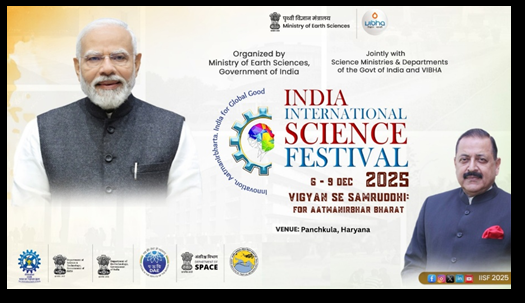
11th India International Science Festival (IISF) 2025
Event Details:
Venue: Panchkula, Haryana
Dates: 06–09 December 2025
Flagship national science outreach festival connecting laboratories, industries, academia and society.
Includes exhibitions, B2B meetings, scientific competitions, cultural programmes, and public engagement events.
Theme of IISF 2025
“Vigyan Se Samruddhi: for Aatmanirbhar Bharat”
Emphasises science-led economic growth.
Places science and technology at the core of national development, productivity, and self-reliance.
Highlights scientific applications in strengthening Aatmanirbhar Bharat, innovation, and sustainable development.
Vision and Mission
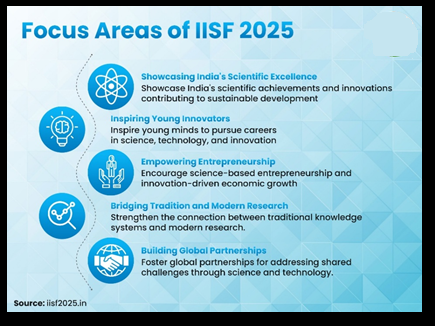
Bridge traditional knowledge systems with modern scientific research, integrating India’s indigenous knowledge heritage with contemporary scientific inquiry.
Promote public engagement in science, inspire youth, and celebrate India’s scientific achievements.
Strengthen linkages between science, society, and industries through knowledge exchange.
Key Focus Areas
1. Science, Technology and Ecology of North-West India and the Himalayan Region: Emphasis on climate resilience, biodiversity, ecological sustainability.
2. Science for Society and Education: Promoting scientific temper, STEM education, and community-oriented science.
3. Aatmanirbhar Bharat through Science and Technology: Highlighting innovation, R&D, startups, and indigenous technologies.
4. Biotechnology and Bio-economy: Advancing biotech solutions, health technologies, and agricultural biotech.
5. Integration of Traditional Knowledge with Modern Science: Fostering evidence-based validation and scientific utilisation of traditional practices.
Programmes and Key Components
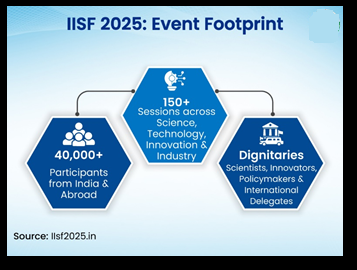
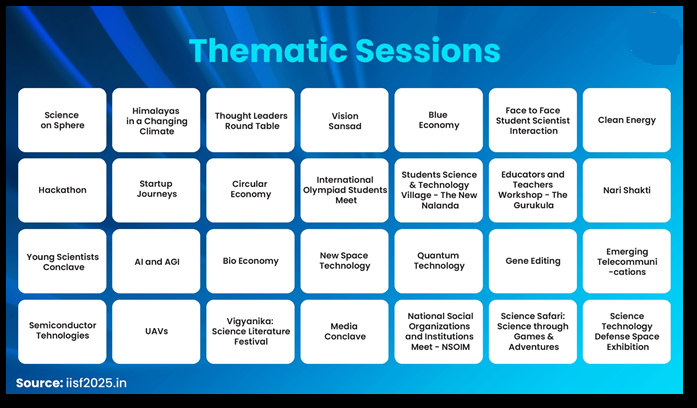
IISF 2025 is expected to bring together more than 40,000 participants from India and abroad. The festival features over 150 technical and thematic sessions across science, technology, innovation and industry. The programme highlights priority domains such as Artificial Intelligence (AI) and Artificial General Intelligence (AGI), Bio-Economy, New Age Technology, Quantum Technology and Gene Editing, supported by activities for students, youth, women scientists and community outreach. It also includes sessions on the Himalayas and regional climate science, along with tracks on satellites, launch systems and space applications. These tracks feature experts from national research institutions and focus on advances shaping India’s science and technology landscape.
Participation Overview
IISF 2025 is designed as a multi-stakeholder platform. It will bring together:
1. Scientists and researchers from national laboratories, universities and R&D institutions
2. School and college students, teachers and young innovators
3. Startups, incubators, industry leaders and investors
4. Science communicators, writers and media professionals
5. Women scientists and researchers from under-represented groups
6. Policy-makers from the Union and State governments
Institutions Involved in the IISF 2025
This year IISF 2025 will be organised by the Ministry of Earth Sciences (MoES) and coordinated by Indian Institute of Tropical Meteorology (IITM) Pune, aligning thematic areas with national science priorities and coordinating participation from key government agencies, research institutions and academic partners.
Partner Ministries
1. The Department of Science and Technology (DST) leads major thematic tracks and provides researchers for expert sessions, drawing on frontier technologies such as quantum technologies, advanced materials, AI systems and national deep-tech programmes.
2. The Department of Biotechnology (DBT) brings inputs from national bio-missions and research facilities, demonstrating current work in genomics, bio-manufacturing, health technologies and emerging areas of industrial biotechnology.
3. Council of Scientific and Industrial Research (CSIR) participates through its laboratories and domain specialists, demonstrating technologies across aerospace, clean energy, chemicals, materials, sensors, environmental solutions and applied engineering.
4. The Department of Space exhibits frontier R&D on satellites, launch vehicles and space applications.
5. The Department of Atomic Energy provides specialists and scientific material, demonstrating ongoing work in nuclear science, radiation technologies, medical isotopes, advanced instrumentation and research infrastructure.
6. Vijnana Bharati (VIBHA) serves as the outreach partner, facilitating public engagement, student participation and linkages with schools, colleges and community-based science groups.
Previous Editions of IISF: Key Highlights
IISF, launched in 2015, has grown into one of the country’s largest platforms for promoting scientific temper and enhancing public participation in science. Conceived under the guidance of Hon’ble Prime Minister Shri Narendra Modi, IISF was envisioned as a national celebration of India’s scientific and technological achievements, engaging students, innovators, craftsmen, farmers, scientists, and technocrats from India and abroad.
IISF aims to bring together people and the scientific community both nationally and internationally to collaborate, interact, and experience the joy of doing science for the wellbeing of India and humanity, guided by the spirit of swadeshi. Over the years, IISF has evolved through innovative programme designs that connect science with various aspects of everyday life.
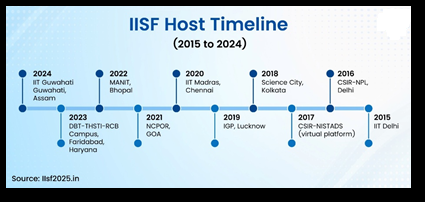
Since its inception, the festival has been hosted across major cities in India—2015 and 2016 in Delhi, 2018 in Kolkata, 2019 in Lucknow, 2020 in Chennai, 2021 in Goa, 2022 in Bhopal, 2023 in Faridabad, and 2024 in Assam. During the COVID-19 pandemic, IISF was conducted in a virtual format, ensuring continuity despite global disruptions.
Over the years, IISF has witnessed a steady rise in participation from across India and abroad, and consistently expanding its reach and impact. Each edition has strengthened its mission i.e. bridging traditional knowledge systems with modern scientific research, strengthening the link between India’s indigenous knowledge heritage and contemporary scientific inquiry.
India International Science Festival (IISF)
| Edition (Year) |
Venue & Dates |
Nodal Agency |
Theme |
Key Highlights |
| 10th Edition (2024) |
IIT Guwahati, Assam (30 Nov–3 Dec 2024) |
CSIR–NIIST |
Transforming India into an S&T-driven Global Manufacturing Hub |
35,000 visitors; 7,000 delegates; 10,000 students; MoU for LSCC technology; new events: Sagarika, Science Odyssey of NE, Vigyanika; 10-metre Moon replica. |
| 9th Edition (2024) |
Faridabad, Haryana (17–20 Jan 2024) |
DST |
Science and Technology, Public Outreach in Amrit Kaal |
1 lakh visitors; participation from 21 countries; announcement of 50-acre Science City; expo with 100+ stalls. |
| 8th Edition (2023) |
MANIT, Bhopal (21–24 Jan 2023) |
Regional Centre for Biotechnology, DBT |
Marching Towards Amrit Kaal with STI |
2,500 school students; 1,500 young scientists; 600 startups; 8,000 delegates; biotech/agritech displays; Artisan’s Technology Village; Vigyanika. |
| 7th Edition (2021) |
Panaji, Goa (10–13 Dec 2021) – Hybrid |
NCPOR, MoES |
Azadi Ka Amrit Mahotsav: Creativity in STI for Prosperous India |
10,000 physical & 20,000 virtual participants; 12 programmes; 100 films screened; Science Village; 200 artisans; 3 Guinness World Records. |
| 6th Edition (2020) |
Virtual (22–25 Dec 2020) |
CSIR–NISTADS |
Science for Self-Reliant India & Global Welfare |
10,000 researchers; 41 events across 9 verticals; 5 Guinness World Records (sundials, hygiene, masks, nutrition). |
| 5th Edition (2019) |
Biswa Bangla Convention Centre, Kolkata (5–8 Nov 2019) |
DST |
RISEN India – Research, Innovation, and Science Empowering the Nation |
28 events; 700 women scientists; Vigyanika science literature festival; CSIR-NISCAIR participation. |
| 4th Edition (2018) |
Indira Gandhi Pratishthan, Lucknow (5–8 Oct 2018) |
National Institute of Immunology |
Science for Transformation |
10 lakh+ visitors; 20,000 delegates; large S&T expo on innovation and institutional achievements. |
| 3rd Edition (2017) |
IIT Madras & Anna University, Chennai (13–16 Oct 2017) |
National Institute of Immunology |
Science for New India |
5 lakh visitors; 7,000 delegates; Guinness World Record for Largest Biology Lesson (1,049 students). |
| 2nd Edition (2016) |
CSIR–NPL, New Delhi (7–11 Dec 2016) |
CSIR |
Science for the Masses |
5 lakh visitors; 10,000 delegates; participation of 300+ institutions; launch of Student’s Science Village (1900 students). |
| 1st Edition (2015) |
IIT Delhi (4–8 Dec 2015) |
DST |
Think Science, Live Science |
10,000 delegates; Guinness World Record for catalyst-based practical session with 2,000 students. |
Conclusion
IISF 2025 continues a decade-long national effort to place science at the centre of India’s development agenda. Since its inception in 2015, the festival has grown into a major platform for scientific exchange, innovation, outreach and public engagement, consistently expanding its scale through diverse programmes, wide participation and landmark initiatives across each edition. The 2025 festival builds on this legacy by aligning science, technology and innovation with national priorities, strengthening cooperation among ministries, research institutions, academia, industry and civil society. With its focus on frontier technologies, regional knowledge, traditional wisdom and inclusive participation, IISF 2025 reinforces India’s commitment to science-led progress and supports the country’s broader vision of Aatmanirbhar Bharat.
Prelims question:





No Comments