


09 Feb India Semiconductor Mission (ISM) 2.0: Strategic Decoupling and the Quest for Digital Sovereignty
This article covers “Daily Current Affairs” and India Semiconductor Mission (ISM) 2.0: Strategic Decoupling and the Quest for Digital Sovereignty
SYLLABUS MAPPING:
GS-3- Science & Technology- India Semiconductor Mission (ISM) 2.0: Strategic Decoupling and the Quest for Digital Sovereignty
FOR PRELIMS
Why is semiconductor self-reliance important for India? Explain with reference to ISM 2.0.
FOR MAINS
What is the significance of India Semiconductor Mission (ISM) 2.0 for India’s technological and economic development?
Why in the News?
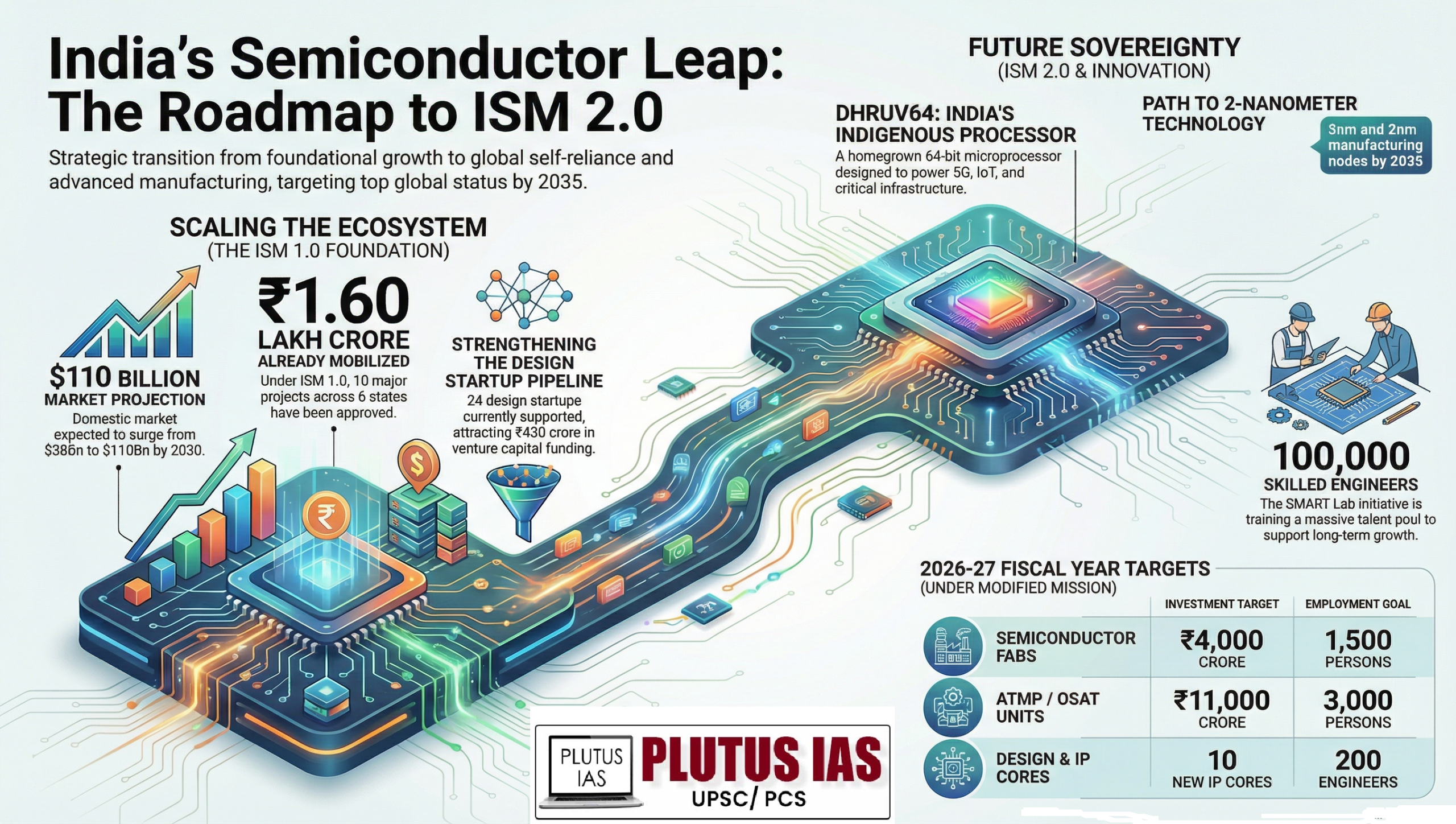
The Union Budget 2026–27 marks a significant turning point in India’s technological ambitions with the launch of India Semiconductor Mission (ISM) 2.0. Backed by a fiscal allocation of ₹1,000 crore for FY 2026–27, this phase aims to move beyond initial ecosystem building toward consolidation, capacity strengthening, and deeper global integration. The initiative comes at a crucial time when India is striving to reduce its vulnerability to global supply chain disruptions and position itself as a reliable partner in the global high-technology value chain.
Defining the Concept: The Semiconductor Imperative
Semiconductors are often described as the “invisible brain” and the backbone of modern electronics. They are the fundamental components powering everything from mobile devices and telecommunications to artificial intelligence (AI), defense systems, and aerospace. ISM 2.0 is a refined policy framework designed to deepen domestic capabilities in semiconductor equipment, materials, and Indian Semiconductor Intellectual Property (IP). Unlike its predecessor, ISM 2.0 focuses on “production readiness” and achieving technological depth in advanced manufacturing nodes.
Background and Contextual Evolution
The genesis of this mission lies in ISM 1.0, approved in December 2021 with a massive incentive framework of ₹76,000 crore. This initial phase offered up to 50% fiscal support for silicon fabs and design, leading to the approval of 10 major projects with a cumulative investment of ₹1.60 lakh crore by late 2025. Historically, the push for semiconductor self-reliance was accelerated by the COVID-19 pandemic, which exposed the extreme vulnerability of global supply chains. Currently, the industry is highly concentrated; Taiwan alone produces over 60% of the world’s semiconductors and nearly 90% of the most advanced chips. This geographical concentration poses a significant risk to India’s economic stability, especially as India consumes nearly 20% of the global microprocessor output. In response, India is joining global peers like the US, EU, and Japan in launching domestic chip manufacturing initiatives to ensure technological sovereignty.
Significance and Strategic Importance
• Economic Resilience: As highlighted in the Economic Survey 2025–26, semiconductors are critical for the continuity of energy networks, financial markets, and healthcare.
• Strategic Autonomy: By developing indigenous microprocessors like DHRUV64 (a 64-bit indigenous processor), India reduces its long-term dependence on imported chips for critical infrastructure.
• Global Positioning: India is positioning itself as a “trusted and reliable partner” in a more resilient global semiconductor network, offering an alternative to the current narrow set of suppliers.
• Technological Leadership: The mission provides a roadmap to move beyond assembly to achieve 3-nanometre and 2-nanometre technology nodes by 2029–2035.
Economic and Social Impact
• Market Growth: The domestic semiconductor market, valued at $38 billion in 2023, is projected to surge to $100–$110 billion by 2030.
• Employment Generation: For FY 2026–27, projects under the Modified Scheme for Semiconductor Fabs and ATMP (Assembly, Testing, Marking, and Packaging) are expected to generate 4,500 direct jobs.
• Startup Ecosystem: The Design Linked Incentive (DLI) Scheme has already nurtured 24 startups, which have attracted ₹430 crore in venture capital funding.
• Academic Innovation: Over 75 patents have been filed by academic institutions, and 122 designs have been taped out, reflecting a growing culture of indigenous R&D.
Governance and Institutional Aspects
1. Nodal Oversight: The Ministry of Electronics and Information Technology (MeitY) drives the policy, while C-DAC leads the development of indigenous microprocessors under the Microprocessor Development Programme (MDP).
2. Human Capital Development: The “Chips to Startup” programme provides 397 universities access to Electronic Design Automation (EDA) tools.
3. Skill Alignment: The AICTE has introduced specialized B.Tech and diploma courses in VLSI design to align academia with industry needs.
4. Training Infrastructure: The SMART Lab at NIELIT Calicut and the FutureSkills PRIME (a MeitY-NASSCOM initiative) are training over one lakh engineers in semiconductor technologies.
Key Issues and Challenges
• Global Subsidy Wars: Major economies are offering “aggressive incentives,” making it necessary for India to constantly recalibrate its financial support to remain competitive.
• Technological Lag: While India is making strides, achieving parity with the 3nm and 2nm nodes dominated by global giants remains a steep climb.
• Capital Intensity: Semiconductor manufacturing is exceptionally capital-intensive. The projected investment for compound semiconductors and ATMP units for just one year (2026–27) is ₹11,000 crore.
• Supply Chain Dependencies: India still relies on global partners for high-end manufacturing equipment and raw materials, a focus area for ISM 2.0.
Constitutional and Legal Dimensions
The India Semiconductor Mission aligns with the Directive Principles of State Policy (Article 38), which mandates the State to secure a social order for the promotion of the welfare of the people through sustainable economic growth. Furthermore, the push for indigenous R&D and microprocessor development (e.g., DIR-V Program) resonates with the Fundamental Duty (Article 51A) to develop the scientific temper, humanism, and the spirit of inquiry. The focus on Digital Sovereignty is also a legal imperative to protect national security and data integrity in an increasingly digitized global order.
Global Comparison
India’s strategy differs from the established models of Taiwan or South Korea. While those nations focus on high-volume manufacturing, India is leveraging its design talent—India already consumes 20% of global microprocessors and has a massive pool of design engineers. By using the RISC-V open-source architecture for its SHAKTI and AJIT processors, India is avoiding the high license costs associated with traditional architectures, creating a more collaborative and cost-effective innovation model than many Western counterparts.
Way Forward
1. Scaling the Fabless Ecosystem: The goal should be to expand from 24 supported startups to at least 50 fabless companies to create a robust domestic IP base.
2. Deepening Value Chains: Move beyond assembly and testing (ATMP/OSAT) toward the domestic production of semiconductor equipment and materials, as envisioned in ISM 2.0.
3. Sustaining the Talent Pipeline: Expand the partnership with global leaders like Lam Research to train 60,000 professionals in specialized nanofabrication over the next decade.
4. Strategic International Partnerships: Continue positioning India as a “trusted hub” to attract diversified global investments away from geographically concentrated zones.
Conclusion
India Semiconductor Mission 2.0 represents a decisive move toward Aatmanirbhar Bharat and the realization of Viksit Bharat 2047. By integrating indigenous microprocessor design (DHRUV64) with advanced fabrication targets, India is not just seeking to be a manufacturing base but a global leader in innovation. This mission is central to India’s long-term vision of inclusive growth—creating high-value jobs—and sustainable development, as chips are the catalysts for the smart energy and transport systems of the future. Ultimately, ISM 2.0 is the foundation upon which India’s digital infrastructure and technological sovereignty will be built in the coming decade.
Q. With reference to the India Semiconductor Mission (ISM) 2.0 and indigenous microprocessor development, consider the following statements:
1. DHRUV64 is an indigenous 64-bit microprocessor developed by C-DAC under the Microprocessor Development Programme (MDP).
2. The Digital India RISC-V (DIR-V) Programme utilizes proprietary architectures to ensure global compatibility and high licensing revenues for the government.
3. By 2029, India aims to have the capability to design and manufacture chips required for nearly 70–75% of domestic applications.
4. The ISM 2.0 specifically targets the development of advanced manufacturing nodes, including 3-nanometre and 2-nanometre technology.
Which of the statements given above are correct?
(a) 1, 2, and 3 only
(b) 1, 3, and 4 only
(c) 2 and 4 only
(d) 1, 2, 3, and 4
Answer: B
Mains Questions
Q. The transition from India Semiconductor Mission (ISM) 1.0 to 2.0 reflects a strategic shift from ecosystem creation to ecosystem consolidation and digital sovereignty.” In light of this statement, discuss the significance of ISM 2.0 in the context of global supply chain vulnerabilities and examine the challenges India must overcome to become a leading semiconductor nation by 2035
(250 words, 15 marks)

- RBI’s Shrinking Real-Rate Cushion Amid Rising Inflation and Strong Demand - September 21, 2026
- India’s NGOs at a New Funding Crossroads - September 21, 2026
- Deep-Sea Discovery, Environmental Responsibility - September 19, 2026

No Comments