


16 Jul India-UK CETA & Social Security Pact: A New Era in Bilateral Trade
Subject Relevance — Where This Topic Fits
- GS Paper II — International Relations: Bilateral, Regional and Global Groupings and Agreements involving India and/or affecting India’s interests | GS Paper III — Economy: Indian Economy and issues relating to Planning, Mobilization of Resources, Growth, Development and Employment; Liberalization; Infrastructure: Energy, Ports, Roads, Airports, Railways etc.; Investment Models
- Prelims: India-UK CETA, Social Security Agreement, Double Contribution Convention (DCC), Free Trade Agreement (FTA), Rules of Origin, eCoO 2.0 platform, Trade in Goods, Trade in Services, Non-Tariff Barriers, MSMEs
- Essay: The Evolving Landscape of India’s Global Trade Engagements: Opportunities and Challenges, Economic Diplomacy as a Pillar of India’s Foreign Policy: Assessing the Impact of Bilateral Trade Agreements
Quick Revision: The India-UK CETA provides zero-duty market access for 99% of India’s exports to the UK, complemented by a Social Security Agreement exempting Indian professionals from dual contributions for up to five years, marking a new era in bilateral economic partnership.
Why is this in the news?
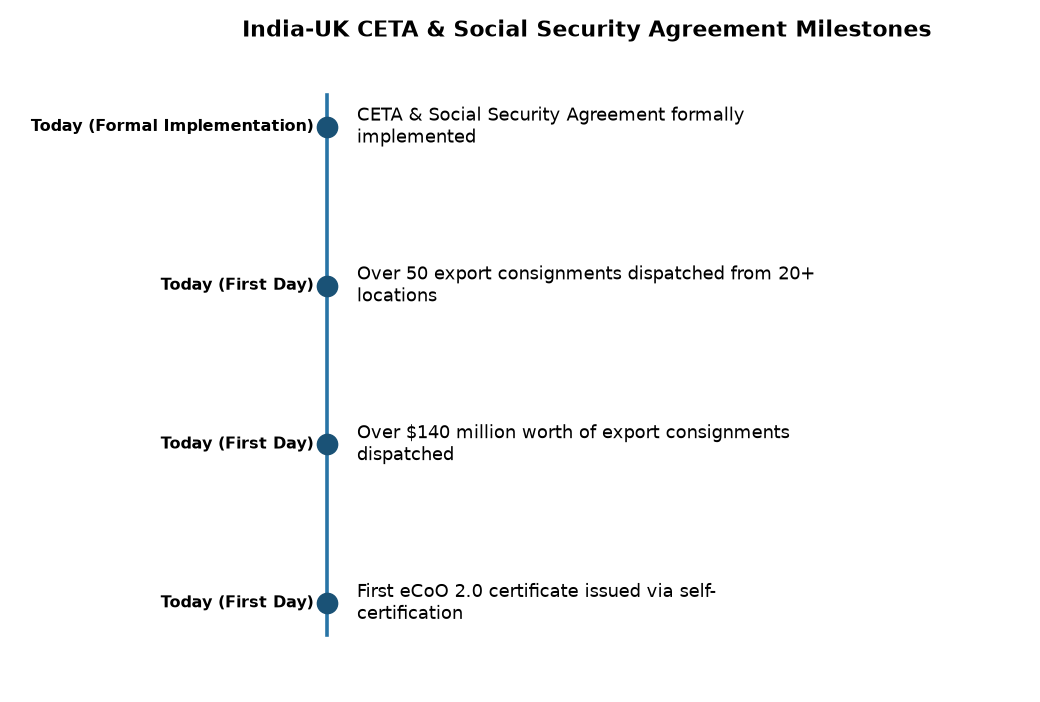
The India-United Kingdom Comprehensive Economic and Trade Agreement (CETA) and the Social Security Agreement (also known as the Double Contribution Convention – DCC) formally entered into force on July 15, 2026. This significant development, marked by an inaugural ceremony at Vanijya Bhawan, New Delhi, signifies a crucial milestone in deepening the economic partnership between the two nations, providing zero-tariff market access for nearly 99% of India’s exports to the UK and addressing social security concerns for professionals.
Background
- India and the UK formally launched negotiations for a Free Trade Agreement (FTA) in January 2022, aiming to significantly boost bilateral trade and investment.
- The negotiations were extensive and complex, involving 14 formal rounds and over 800 technical sessions, reflecting the comprehensive nature of the proposed agreement.
- The UK is one of India’s oldest and most significant trading partners, with historical ties influencing contemporary economic relations.
- Post-Brexit, the UK has been actively seeking new trade agreements globally, with India identified as a key strategic partner for its Indo-Pacific tilt.
- India has been pursuing a strategy of forging FTAs with major economies to diversify its export markets and integrate into global value chains.
- The Social Security Agreement (DCC) was negotiated concurrently to address the issue of dual social security contributions for professionals working temporarily in either country, a common feature in modern trade pacts involving significant movement of natural persons.
What are the India-UK CETA and Social Security Agreement?
- The India-UK Comprehensive Economic and Trade Agreement (CETA) is a Free Trade Agreement (FTA) designed to liberalize and facilitate trade in goods and services between India and the United Kingdom.
- It aims to eliminate or reduce tariffs on a wide range of products, address non-tariff barriers, and establish robust frameworks for trade in services, investment, intellectual property, and other trade-related areas.
- A key feature of CETA is the provision of zero-duty market access for approximately 99% of India’s exports to the UK, covering nearly 100% of trade value.
- The agreement is expected to create unprecedented opportunities across various sectors, including textiles, leather, gems & jewellery, engineering products, marine products, chemicals, and processed foods.
- It also seeks to open new avenues for India’s IT, professional, financial, education, and business service sectors, enhancing the mobility of Indian talent.
- The Social Security Agreement, also known as the Double Contribution Convention (DCC), is an ancillary pact that exempts Indian professionals working temporarily in the UK from making dual social security contributions for up to five years.
- This exemption significantly reduces the financial burden on Indian professionals and enhances their global competitiveness, aligning with similar agreements India has with other nations.
- The agreement is described as going beyond India’s previous FTAs in terms of its breadth and depth, reflecting the complementary nature of the two economies.
Key Features
| Feature | Significance |
|---|---|
| Zero-Duty Market Access | India’s 99% exports (by value) to UK will face zero tariffs, boosting competitiveness for sectors like textiles, leather, gems, engineering goods. |
| Social Security Agreement (DCC) | Exempts Indian professionals in UK from dual social security contributions for up to 5 years, enhancing their global competitiveness and reducing costs. |
| Services Liberalization | Opens new opportunities for India’s IT, professional, financial, education, and business service sectors, facilitating mobility of Indian talent. |
| Rules of Origin (eCoO 2.0) | First Certificate of Origin (eCoO 2.0) issued on self-certification basis, streamlining trade processes and ensuring preferential treatment. |
| MSME and Farmer Benefits | Specifically designed to benefit Micro, Small, and Medium Enterprises (MSMEs), farmers, and manufacturers by expanding market access and value chains. |
| Comprehensive Scope | Covers a wide range of areas beyond traditional goods trade, including investment, intellectual property, and digital trade, reflecting a modern FTA. |
Why it Matters
Economic Boost and Market Diversification
- Provides Indian exporters with preferential access to the UK market, one of the world’s largest economies, potentially increasing export volumes and value.
- Reduces input costs for Indian industries by facilitating cheaper imports of certain raw materials and intermediate goods from the UK.
- Attracts foreign direct investment (FDI) from the UK into India, particularly in sectors where the UK has a comparative advantage, fostering job creation and technological transfer.
- Diversifies India’s export basket and reduces reliance on traditional markets, enhancing economic resilience against global shocks.
Strategic Partnership and Geopolitical Alignment
- Strengthens the ‘Comprehensive Strategic Partnership’ between India and the UK, reinforcing their shared commitment to a rules-based international order.
- Aligns with India’s broader foreign policy objectives of deepening engagement with major global powers and enhancing its strategic autonomy.
- Positions India as a crucial player in the Indo-Pacific region, with the UK’s ’tilt’ towards the region finding a strong economic anchor in India.
- Enhances India’s negotiating leverage in other multilateral and bilateral trade discussions by demonstrating its capacity to conclude complex agreements.
Benefits for Services and Human Capital
- Facilitates greater movement of natural persons, particularly skilled professionals, benefiting India’s services sector, which is a significant contributor to its GDP.
- The Social Security Agreement reduces the financial burden on Indian professionals, making the UK a more attractive destination for temporary work and enhancing India’s ‘brain circulation’.
- Promotes collaboration in education, research, and development, potentially leading to joint ventures and knowledge sharing.
- Enhances the global competitiveness of India’s workforce by providing exposure to international best practices and advanced technologies.
Institutional and Regulatory Framework
- Establishes a robust institutional framework for dispute resolution and ongoing cooperation, ensuring smooth implementation and adaptation of the agreement.
- Promotes regulatory convergence and mutual recognition of standards, reducing technical barriers to trade and improving ease of doing business.
- The use of eCoO 2.0 platform for self-certification of origin streamlines customs procedures, reducing transaction costs and time for exporters.
- Sets a precedent for future comprehensive trade agreements India might pursue, showcasing its commitment to high-standard trade liberalization.
Challenges
1. Non-Tariff Barriers (NTBs)
- Despite tariff reductions, NTBs such as complex regulatory requirements, sanitary and phytosanitary (SPS) measures, and technical barriers to trade (TBT) can still impede market access.
- Ensuring mutual recognition of standards and certifications remains a complex task, requiring continuous dialogue and harmonization efforts.
UPSC Link: GS Paper III — Economy: Trade Policy
2. Rules of Origin (RoO) Compliance
- While self-certification is introduced, strict adherence to RoO criteria is crucial to prevent trade deflection and ensure that only goods genuinely originating from either country benefit from preferential tariffs.
- Complex RoO requirements can sometimes be challenging for MSMEs to navigate, potentially limiting their full utilization of the agreement.
UPSC Link: GS Paper III — Economy: International Trade
3. Impact on Domestic Industries
- Increased competition from UK imports in certain sensitive sectors could potentially affect domestic industries, necessitating measures for adjustment and competitiveness enhancement.
- Careful monitoring is required to ensure that the agreement does not lead to a surge in imports that could harm nascent or vulnerable Indian industries.
UPSC Link: GS Paper III — Economy: Industrial Policy
4. Services Sector Challenges
- While opportunities are created, challenges remain in areas like visa regimes, recognition of professional qualifications, and data localization policies, which can impact the full potential of services trade.
- Ensuring equitable access and addressing protectionist tendencies in the services sector will be an ongoing negotiation point.
UPSC Link: GS Paper II — International Relations: Bilateral Relations
5. Implementation and Monitoring
- Effective implementation requires robust institutional mechanisms, continuous monitoring, and timely resolution of disputes.
- The success of the agreement hinges on the political will and administrative efficiency of both nations to address emerging issues and adapt to changing trade dynamics.
UPSC Link: GS Paper II — Governance: Policy Implementation
Challenges — UPSC Perspective
| Issue | Concern |
|---|---|
| Non-Tariff Barriers | Regulatory divergences, SPS/TBT measures can still restrict market access despite tariff cuts. |
| Rules of Origin | Complexity in proving origin, potential for trade deflection, compliance burden for MSMEs. |
| Domestic Industry Impact | Increased competition from UK imports in sensitive sectors, requiring adjustment support. |
| Services Mobility | Visa restrictions, recognition of professional qualifications, data localization issues persist. |
| Dispute Resolution | Ensuring timely and effective resolution of trade disputes to maintain agreement integrity. |
| Global Economic Volatility | External economic shocks (recession, geopolitical events) can impact trade flows, regardless of agreement. |
Government Initiatives — Must-Memorise for Prelims
- Make in India
- Production Linked Incentive (PLI) Scheme
- Niryat Rin Vikas Yojana (NIRVIK)
- Remission of Duties and Taxes on Exported Products (RoDTEP)
- Startup India
- Skill India Mission
- National Logistics Policy
- Ease of Doing Business Initiative
- District as Export Hubs Initiative
- Trade Infrastructure for Export Scheme (TIES)
Way Forward
- Establish a robust joint working group for continuous monitoring and review of CETA implementation, addressing emerging challenges proactively.
- Invest in capacity building for Indian MSMEs to understand and comply with UK’s regulatory standards and Rules of Origin, maximizing their utilization of preferential access.
- Actively pursue mutual recognition agreements for professional qualifications and standards in services to fully unlock the potential of services trade and talent mobility.
- Strengthen India’s domestic manufacturing capabilities and competitiveness through targeted PLI schemes and infrastructure development to withstand increased competition.
- Leverage the CETA framework to promote greater collaboration in research and development, innovation, and green technologies, aligning with shared climate goals.
- Explore avenues for further liberalization in areas not fully covered, such as investment protection and digital trade, in future reviews of the agreement.
- Enhance public awareness and outreach programs to inform businesses, especially smaller enterprises, about the benefits and procedures of the CETA and Social Security Agreement.
- Utilize the agreement to deepen strategic cooperation beyond trade, including in defence, security, and multilateral forums, reinforcing the comprehensive partnership.
UPSC Value Addition
Keywords for Mains Answer-Writing
Comprehensive Economic and Trade Agreement (CETA) · Social Security Agreement (DCC) · Bilateral Trade Liberalization · Market Access · Services Trade · Mobility of Natural Persons · Rules of Origin (RoO) · Non-Tariff Barriers (NTBs) · Economic Diplomacy · Strategic Partnership · Global Value Chains · MSME Empowerment
Constitutional & Policy Linkages
- Article 253: Legislation for giving effect to international agreements
- Seventh Schedule (Union List): Foreign Affairs, Treaties and Agreements
- Foreign Trade (Development and Regulation) Act, 1992: Governs India’s foreign trade policy
- Trade Policy Review Mechanism (WTO): India’s commitments under multilateral trade
- Double Taxation Avoidance Agreements (DTAAs): Analogous to DCC for taxation
Concept Flow
Negotiations for CETA & Social Security Pact → Formal Entry into Force (July 15, 2026) → Zero-Duty Access for 99% Indian Exports to UK → Exemption from Dual Social Security Contributions → Increased Bilateral Trade & Investment Flows → Enhanced Economic Growth & Job Creation → Strengthened India-UK Strategic Partnership
Prelims Practice Questions
Q1. With reference to the India-UK Comprehensive Economic and Trade Agreement (CETA) and Social Security Agreement, consider the following statements:
1. The CETA provides zero-duty market access for approximately 99% of India’s exports to the UK.
2. The Social Security Agreement exempts Indian professionals working temporarily in the UK from dual social security contributions for an indefinite period.
3. The first Certificate of Origin under CETA was issued through the eCoO 2.0 platform on a self-certification basis.
- A. 1 only
- B. 1 and 2 only
- C. 1 and 3 only
- D. 1, 2 and 3
Answer: C. 1 and 3 only — Statement 1 is correct as per the news. Statement 2 is incorrect because the exemption is for a maximum of five years, not an indefinite period. Statement 3 is correct, as the eCoO 2.0 platform for self-certification was used for the first Certificate of Origin.
Q2. Which of the following sectors are specifically mentioned as beneficiaries of the India-UK CETA in terms of creating unprecedented opportunities?
1. Textiles
2. Leather
3. Gems & Jewellery
4. Engineering Products
5. IT and Professional Services
- A. 1, 2 and 3 only
- B. 2, 3 and 4 only
- C. 1, 2, 3, 4 and 5
- D. 3, 4 and 5 only
Answer: C. 1, 2, 3, 4 and 5 — All the listed sectors – textiles, leather, gems & jewellery, engineering products, and IT & professional services – are explicitly mentioned in the news as areas that will benefit from unprecedented opportunities created by the India-UK CETA.
Mains Practice Question
✍ The India-UK Comprehensive Economic and Trade Agreement (CETA) and Social Security Pact mark a significant milestone in bilateral relations. Critically analyze the potential economic and strategic implications of these agreements for India, while also discussing the key challenges that need to be addressed for their successful implementation. (250 words)
Approach: Begin by briefly introducing the CETA and Social Security Pact and their recent entry into force. In the first part, discuss the economic implications, focusing on market access for goods, services liberalization, investment flows, and benefits for MSMEs and professionals. Follow with strategic implications, such as strengthening geopolitical ties, enhancing India’s global trade position, and aligning with the Indo-Pacific strategy. In the second part, critically analyze the challenges, including non-tariff barriers, Rules of Origin compliance, potential impact on domestic industries, and issues related to services mobility. Conclude with a forward-looking statement on the importance of effective implementation and continuous engagement to realize the full potential of these agreements.
Source: PIB (Press Information Bureau)

- UPSC Alert: India Launches National Action Plan for Inland Small Fisheries - October 24, 2026
- विशेष अभियान 6: कपड़ा आयुक्त कार्यालय ने सफाई और दक्षता में बढ़ाया योगदान - October 24, 2026
- Inter-Caste Marriage Scheme: UPSC Exam Polity & Governance Insight - October 24, 2026

No Comments