


31 Dec India AI Mission: Powering Inclusive, Sovereign and Citizen-Centric Artificial Intelligence for Viksit Bharat 2047
This article covers “Daily Current Affairs” and From IndiaAI Mission: Powering Inclusive, Sovereign and Citizen-Centric Artificial Intelligence for Viksit Bharat 2047
SYLLABUS MAPPING
GS-3 – Science and Technology- IndiaAI Mission: Powering Inclusive, Sovereign and Citizen-Centric Artificial Intelligence for Viksit Bharat 2047
FOR PRELIMS
What is AIKosh? How does it help in strengthening India’s AI ecosystem?
FOR MAINS
What is the IndiaAI Mission? Discuss its key objectives and significance for India’s technological development.
Why in the News?
India is in the news for accelerating inclusive and citizen-centric AI adoption through the IndiaAI Mission, backed by ₹10,300+ crore investment and large-scale GPU deployment. Initiatives like Bhashini, BharatGen, and AIKosh highlight India’s focus on affordable, multilingual, and sovereign AI, integrating AI into governance, agriculture, healthcare, and education in line with Viksit Bharat 2047.

IndiaAI Mission: Building the Foundations of Sovereign AI
Approved in March 2024, the IndiaAI Mission (₹10,371.92 crore) aims to position India as a global leader in responsible and inclusive AI.
What is a GPU?
A Graphics Processing Unit (GPU) is a high-performance chip that accelerates AI workloads such as model training, image processing, and large-scale data analysis.
Understanding Artificial Intelligence
Artificial Intelligence refers to the capability of machines to perform tasks that traditionally require human intelligence, such as learning, reasoning, perception, decision-making, and language understanding. AI systems rely on:
Large datasets
Advanced algorithms
Machine Learning (ML) and Deep Learning
Large Language Models (LLMs)
Over time, AI systems continuously improve through feedback loops, enabling them to generate insights, automate processes, and deliver personalised services at scale.
India’s AI Ecosystem: Current Landscape
Overall AI Ecosystem Snapshot
| Indicator | Status / Data |
|---|---|
| Tech Sector Revenue | USD 280+ billion |
| Global Capability Centres (GCCs) | 1,800+ total |
| AI-focused GCCs | 500+ |
| Total Startups | ~1.8 lakh |
| Startups leveraging AI | ~89% of new startups |
| Firms with AI maturity at scale (BCG) | 26% |
| Enterprises actively adopting AI | 87% |
| NASSCOM AI Index Score | 2.45 / 4 |
Sectoral Leaders in AI Adoption
| Sector | Role in AI Adoption |
|---|---|
| BFSI | AI-driven risk assessment, fraud detection, customer analytics |
| Healthcare | Diagnostics, telemedicine, drug discovery |
| Industrial & Automotive | Predictive maintenance, automation, smart manufacturing |
| Retail & Consumer Goods | Demand forecasting, personalization, supply-chain optimization |
Global Standing: India as an AI Powerhouse
According to the Stanford Global AI Vibrancy Tool 2025, India ranks 3rd worldwide in AI competitiveness, driven by:
- A strong STEM talent pool
- Expanding research and startup ecosystem
- Robust digital public infrastructure
- Progressive AI governance frameworks
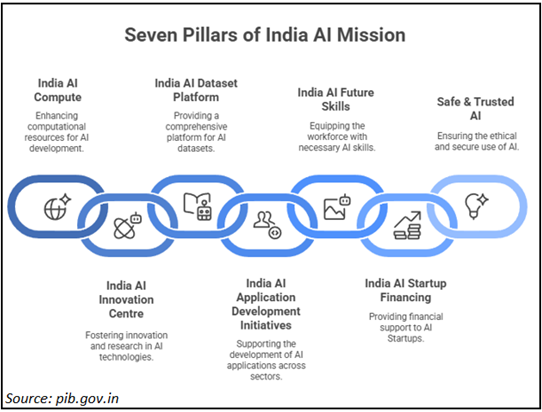
Seven Pillars of the IndiaAI Mission
| Pillar | Key Features & Achievements |
|---|---|
| 1. IndiaAI Compute | • 38,000 GPUs onboarded (vs initial target of 10,000) • Subsidised access at ~₹65/hour • Enables low-cost AI innovation for startups, academia, and MSMEs |
| 2. IndiaAI Application Development | • AI solutions for healthcare, agriculture, climate, governance, education • 30 applications approved (by July 2025) • Sectoral hackathons like CyberGuard AI |
| 3. AIKosh – National AI Dataset Platform | • 5,500+ datasets, 251 AI models across 20 sectors • 3.85 lakh+ visits and 26,000 downloads • Lowers entry barriers for AI developers |
| 4. IndiaAI Foundation Models | • Indigenous Large Multimodal Models (LMMs) in Indian languages • Key players: Sarvam AI, BharatGen (IIT Bombay), Gnani AI • Ensures data sovereignty and cultural contextualisation |
| 5. IndiaAI Future Skills | • Fellowships for 13,500 scholars (UG, PG, PhD) • AI & Data Labs in Tier 2/3 cities • 570-lab national network under development |
| 6. IndiaAI Startup Financing | • IndiaAI Startups Global Programme • Supports international expansion • Europe partnerships with Station F and HEC Paris |
| 7. Safe and Trusted AI | • Emphasis on bias mitigation, explainability, privacy, and AI auditing • Establishment of the IndiaAI Safety Institute |
AI in Governance, Economy, and Daily Life
1. Healthcare: AI-enabled diagnostics, telemedicine, disease prediction. Collaborations with ICMR, UK, Singapore. Ethical AI through HealthAI participation
2. Agriculture: AI-driven pest surveillance, weather forecasting, crop advisories, Tools like Kisan e-Mitra Boosts farmer income and climate resilience
3. Education & Skilling: AI curriculum under NEP 2020 AI modules from Class VI onwards DIKSHA, YUVAi programmes enhance inclusivity
4. Governance & Justice: AI in e-Courts Phase III, Multilingual translation of judgments, Enhanced transparency and access to justice
5. Climate & Disaster Management: AI-based cyclone prediction (Advanced Dvorak Technique), MausamGPT for real-time climate advisories
Employment and the AI Debate
Contrary to fears, AI is reshaping—not replacing—jobs:
1. AI workforce projected to grow from 6.5 lakh to 12.5 lakh by 2027
2. Strong demand for data scientists, AI engineers, model trainers
3. FutureSkills PRIME: 18.5 lakh registrations
AI for Inclusive Societal Development (India)
| Aspect | Key Details |
|---|---|
| Policy Anchor | NITI Aayog – AI for Inclusive Societal Development (October 2025) |
| Target Group | ~490 million informal workers |
| Objective | Leverage AI to enhance livelihoods, social security, and economic inclusion |
Key AI Enablers
| Tool / Mechanism | Role in Inclusion |
|---|---|
| Voice-first Interfaces | Overcomes literacy and language barriers |
| Micro-credentials | Enables skill recognition and employability |
| Smart Contracts | Ensures transparent and timely payments |
| Digital Payments | Expands financial inclusion and formalisation |
Digital ShramSetu Mission (Proposed)
| Feature | Description |
|---|---|
| Nature | National mission for informal sector digitisation |
| Technologies | AI, blockchain, digital public infrastructure |
| Goal | Scalable deployment of frontier technologies for worker empowerment |
Implementation Roadmap
| Phase | Timeline | Focus |
|---|---|---|
| Phase I | 2025–26 | Mission design & stakeholder alignment |
| Phase II | 2026–27 | Governance and institutional setup |
| Phase III | 2027–29 | Pilot projects and impact evaluation |
| Phase IV | 2029 onwards | Nationwide rollout |
Q. Artificial Intelligence is emerging as a key enabler of inclusive growth and digital governance in India. In this context, examine the objectives and significance of the IndiaAI Mission and evaluate how it contributes to India’s vision of Viksit Bharat 2047
(250 words)

- RBI’s Shrinking Real-Rate Cushion Amid Rising Inflation and Strong Demand - September 21, 2026
- India’s NGOs at a New Funding Crossroads - September 21, 2026
- Deep-Sea Discovery, Environmental Responsibility - September 19, 2026

No Comments