


23 Jul India’s 2030 Plan for Debris-Free Space Missions: Key for UPSC & State PCS
Subject Relevance — Where This Topic Fits
- GS Paper III — Science and Technology — Developments and their Applications and Effects in Everyday Life | GS Paper III — Environment — Conservation, Environmental Pollution and Degradation
- Prelims: Space debris, Inter-Agency Space Debris Coordination Committee (IADC), Post-Mission Disposal (PMD), Zero Debris Policy, ISRO System for Safe and Sustainable Space Operations Management (IS4OM), Orbital Sustainability, Controlled Re-entry, De-orbiting, Orbital Collision Avoidance
- Essay: The Ethical Imperative of Space Sustainability: Balancing Exploration and Stewardship for Future Generations, Technological Sovereignty and Global Leadership: India’s Role in Ensuring the Commons of Outer Space
Quick Revision: India’s Debris-Free Space Missions (DFSM) initiative, targeting zero debris generation by 2030, mandates stringent Post-Mission Disposal (PMD) protocols, collision avoidance, and capacity building, positioning India as a global leader in sustainable space operations.
Why is this in the news?
The announcement of India’s Debris-Free Space Missions (DFSM) initiative by ISRO Chairman S. Somanath at the 42nd Annual Meet of the Inter-Agency Space Debris Coordination Committee (IADC) in Bengaluru on April 16, 2024, underscores India’s proactive stance on ensuring long-term sustainability of outer space activities. This initiative, targeting zero debris generation by all Indian space actors by 2030, aligns with global efforts to mitigate space debris and reflects India’s commitment to preserving the outer space environment for future generations.
Background
- The proliferation of space debris in Low Earth Orbit (LEO) and Geosynchronous Orbit (GSO) poses significant risks to operational satellites, including those critical for communication, navigation, and Earth observation, thereby threatening the safety and sustainability of space activities.
- The Inter-Agency Space Debris Coordination Committee (IADC), established in 1993, is an international governmental forum for the worldwide coordination of activities related to the issues of man-made and natural debris in space, with 13 member agencies, including ISRO.
- India’s space program has witnessed exponential growth, with over 120 operational satellites in orbit as of 2024, necessitating robust mechanisms to manage space debris and ensure the safety of its assets.
- The 2019 Anti-Satellite (ASAT) test by India, while demonstrating technological capability, highlighted the need for stringent debris mitigation measures to prevent long-term contamination of orbital regimes.
- The United Nations Office for Outer Space Affairs (UNOOSA) has emphasized the importance of the Space Debris Mitigation Guidelines (2007) and the Long-Term Sustainability Guidelines (2018) to ensure the safe and sustainable use of outer space.
- The European Space Agency’s (ESA) Space Debris Office estimates that there are over 36,500 objects larger than 10 cm, 1 million objects between 1 cm and 10 cm, and 130 million objects between 1 mm and 1 cm in orbit, underscoring the urgency of debris mitigation.
What is the Debris-Free Space Missions (DFSM) Initiative?
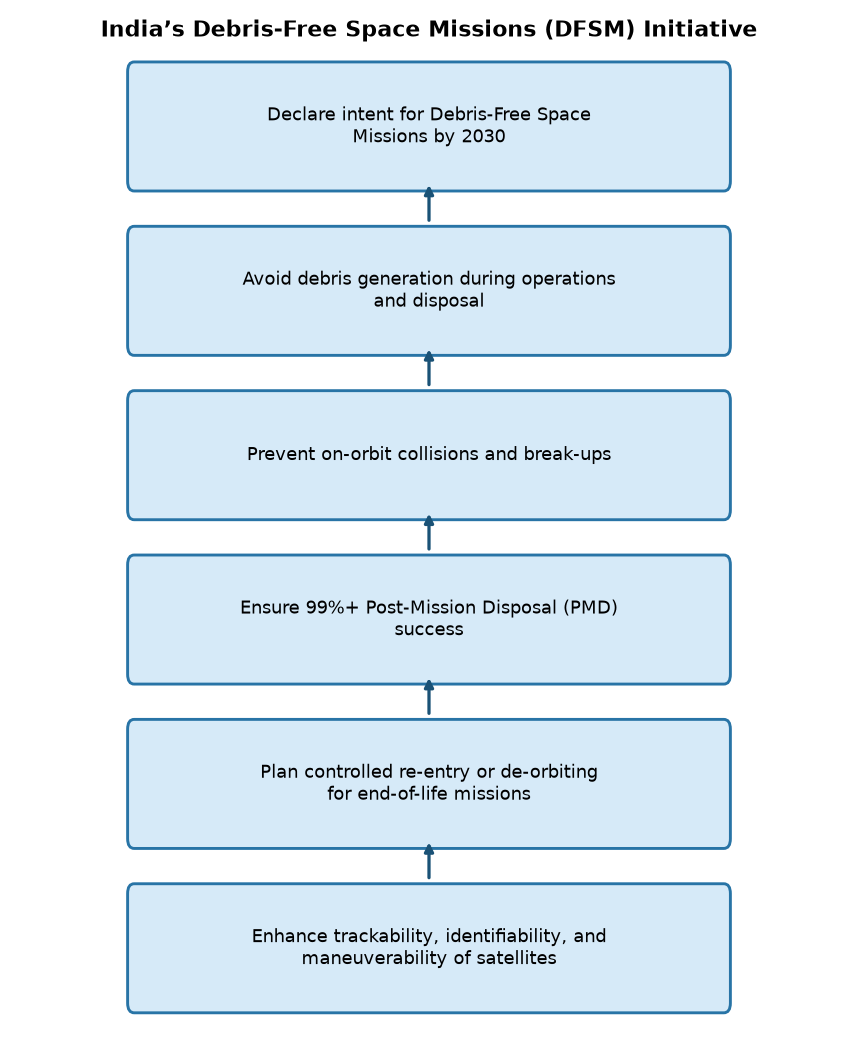
- The DFSM initiative is a strategic framework announced by ISRO to ensure that all space missions conducted by Indian governmental and non-governmental entities are debris-free by 2030, thereby aligning with global efforts for the long-term sustainability of outer space.
- The initiative mandates adherence to stringent guidelines during the operational life of satellites and launch vehicles, including measures to avoid debris generation, on-orbit collisions, and intentional break-ups, with a focus on reliability and redundancy in mission design.
- Post-Mission Disposal (PMD) is a cornerstone of the DFSM, requiring that spent orbital stages and satellites achieve a success probability of over 99% in controlled re-entry or de-orbiting to orbits with less than 5 years of remaining orbital life.
- The initiative incorporates special considerations for human spaceflight safety, particularly in the 400 km +/- 30 km orbital band, by avoiding minimum orbital transfers and ensuring trackability, identifiability, and maneuverability of all satellites throughout their mission phases.
- Capacity building for space object tracking and monitoring, as well as research on innovative debris mitigation techniques, are integral components of the DFSM, ensuring India’s leadership in sustainable space operations.
- The ISRO System for Safe and Sustainable Space Operations Management (IS4OM) will serve as the nodal agency for implementing the DFSM, coordinating with other entities under the Department of Space to ensure compliance and progress.
- The DFSM initiative is aligned with the global theme of ‘Join Together for a Safe, Secured and Sustainable Space,’ emphasizing the preservation of the outer space environment as a common heritage for future generations.
- By 2030, all satellite and launch vehicle missions will be planned with critical consideration of system health, safety, and readiness for post-mission disposal, ensuring that mission extensions do not compromise orbital sustainability.
Key Features
| Feature | Significance |
|---|---|
| Debris-Free Space Missions (DFSM) by 2030 | Establishes a binding timeline for all Indian space actors to eliminate debris generation, aligning with global sustainability goals. |
| Post-Mission Disposal (PMD) with >99% success probability | Ensures controlled re-entry or de-orbiting of satellites and launch vehicles, reducing long-term orbital debris risks. |
| Collision Avoidance Measures | Incorporates failure mode studies, redundant systems, and high-reliability mission design to prevent on-orbit break-ups and collisions. |
| Human Spaceflight Safety Considerations | Mandates avoidance of the 400 km ± 30 km orbital band for non-human missions to ensure safety for future crewed missions. |
| Trackability, Identifiability, and Maneuverability | Requires all satellites to maintain operational control and maneuverability throughout their mission lifecycle for debris mitigation. |
Why it Matters
Strategic Autonomy and Leadership
- Positions India as a global leader in space sustainability, complementing its existing role in space exploration and satellite deployment.
- Enhances India’s soft power by advocating for international adherence to debris-free norms, aligning with the ‘Space for all’ ethos.
- Strengthens India’s negotiating position in multilateral forums like the UNCOPUOS and IADC for shaping future space governance.
Long-Term Space Security
- Reduces the risk of Kessler Syndrome—a cascading debris collision scenario—thereby safeguarding critical satellite infrastructure.
- Ensures the longevity of India’s space assets, including communication, navigation, and remote sensing satellites.
- Mitigates the economic costs of debris-related damage to satellites, which can disrupt services worth billions.
Scientific and Technological Advancement
- Accelerates research in debris tracking, collision avoidance, and innovative disposal techniques, fostering indigenous capabilities.
- Promotes collaboration between ISRO, academia, and private sector for developing cost-effective debris mitigation technologies.
- Supports India’s human spaceflight program (Gaganyaan) by ensuring a safer orbital environment for crewed missions.
Economic and Commercial Benefits
- Enhances the commercial viability of India’s space sector by attracting international partnerships and satellite launch contracts.
- Reduces insurance premiums for Indian space missions due to lower debris-related risks, improving cost competitiveness.
- Encourages private sector participation in debris monitoring and mitigation, creating new avenues for innovation and revenue.
Global Environmental Responsibility
- Aligns with the UN’s Sustainable Development Goals (SDG 12: Responsible Consumption and Production) by promoting sustainable space activities.
- Contributes to the preservation of the ‘common heritage of humankind’ in outer space for future generations.
- Supports the global effort to maintain the orbital environment for scientific research and exploration.
Challenges
1. Technological and Operational Challenges
- Achieving >99% success in post-mission disposal requires advanced propulsion systems and precise trajectory planning, which may be resource-intensive.
- Ensuring trackability and maneuverability of all satellites, including legacy systems, demands retrofitting and upgrades.
- Balancing mission objectives with debris mitigation constraints may increase operational costs and complexity.
UPSC Link: GS-III: Science & Tech
2. International Cooperation and Compliance
- Convincing other space-faring nations, particularly those with less stringent debris regulations, to adopt DFSM standards may face resistance.
- Ensuring equitable access to debris tracking data and mitigation technologies without compromising national security interests.
- Harmonizing DFSM with existing international frameworks like the Outer Space Treaty and the Liability Convention.
UPSC Link: GS-II: International Relations
3. Resource Allocation and Capacity Building
- Developing indigenous capabilities for debris tracking, collision prediction, and mitigation requires sustained investment in R&D and infrastructure.
- Training and retaining skilled personnel in space debris management to meet the 2030 deadline.
- Ensuring adequate funding for ISRO and affiliated entities to implement DFSM without diverting resources from other critical missions.
UPSC Link: GS-III: Science & Tech
4. Regulatory and Governance Hurdles
- Formulating and enforcing national regulations that mandate DFSM compliance for all space actors, including private entities.
- Establishing a robust legal framework for liability and compensation in case of debris-related incidents.
- Integrating DFSM principles into India’s domestic space policy and aligning them with global best practices.
UPSC Link: GS-II: Governance
5. Public and Private Sector Coordination
- Encouraging private space companies to adopt DFSM standards without stifling innovation or increasing costs disproportionately.
- Ensuring that startups and MSMEs in the space sector have access to necessary technologies and funding for compliance.
- Balancing the interests of commercial space ventures with the long-term sustainability goals of DFSM.
UPSC Link: GS-III: Economy
Challenges — UPSC Perspective
| Issue | Concern |
|---|---|
| High Cost of Compliance | Retrofitting existing satellites and launch vehicles with debris mitigation technologies may be financially prohibitive. |
| Technological Limitations | Current propulsion systems may not always enable precise de-orbiting or controlled re-entry, especially for high-altitude missions. |
| Data Sharing Constraints | National security concerns may limit the sharing of debris tracking data with international partners. |
| Private Sector Resistance | Smaller space companies may view DFSM compliance as an additional burden, potentially slowing innovation. |
| International Non-Adherence | Without universal adoption, DFSM may have limited impact, as debris from non-compliant nations can still threaten Indian assets. |
| Human Spaceflight Risks | Ensuring safety in the 400 km ± 30 km band while avoiding collisions with debris requires meticulous planning and real-time monitoring. |
Way Forward
- Establish a dedicated national fund for R&D in debris mitigation technologies, including propulsion, tracking, and collision avoidance systems.
- Develop a phased roadmap for retrofitting legacy satellites and launch vehicles with DFSM-compliant systems by 2030.
- Strengthen international collaborations through bilateral and multilateral agreements to promote global adherence to DFSM standards.
- Enhance the IS4OM (ISRO System for Safe and Sustainable Space Operations Management) with advanced AI-driven debris tracking and prediction tools.
- Mandate DFSM compliance as a prerequisite for all future satellite and launch vehicle missions, including those by private entities.
- Launch public-private partnerships to accelerate the development of cost-effective debris mitigation technologies.
- Conduct annual audits of India’s space debris footprint and publish progress reports to ensure transparency and accountability.
- Integrate DFSM principles into India’s National Space Policy and align them with global frameworks like the UN Space Debris Mitigation Guidelines.
UPSC Value Addition
Keywords for Mains Answer-Writing
Space Debris · Debris-Free Space Missions (DFSM) · Inter-Agency Space Debris Coordination Committee (IADC) · Post-Mission Disposal (PMD) · Long-term Sustainability of Outer Space · Space Traffic Management · Controlled Re-entry of Satellites · Orbital Collision Avoidance · Indian Space Research Organisation (ISRO) · Department of Space (DOS) · Space Object Tracking and Monitoring · Capacity Building in Space Debris Research
Concept Flow
Space Debris Accumulation → Risk of Kessler Syndrome → Threat to Satellite Infrastructure → Economic and Strategic Vulnerabilities → ISRO’s DFSM Initiative → Binding Timeline (2030) → Post-Mission Disposal (>99% Success) → Controlled Re-Entry/De-Orbiting → Collision Avoidance Measures → Failure Mode Studies → Redundant Systems → High-Reliability Mission Design → Human Spaceflight Safety → Orbital Band Avoidance (400 km ± 30 km) → Ensuring Crewed Mission Safety → Trackability & Maneuverability → Operational Control Throughout Mission Lifecycle → Debris Mitigation Compliance → Global Leadership → Advocacy for DFSM Adoption → Strengthening India’s Soft Power → Enhancing Space Governance Role → Technological Advancement → Indigenous R&D in Debris Tracking → Collaboration with Private Sector → Cost-Effective Solutions
Prelims Practice Questions
Q1. Consider the following statements regarding India’s Debris-Free Space Missions (DFSM) initiative:
1. The initiative aims to achieve debris-free space missions by all Indian space actors by 2030.
2. The initiative mandates controlled re-entry or de-orbiting of satellites with less than 5 years remaining orbital life.
3. The initiative is limited to governmental space actors only.
4. The initiative encourages international collaboration for long-term sustainability of outer space.
Which of the above statements are correct?
- 1 and 2 only
- 1, 2, and 4 only
- 2, 3, and 4 only
- 1, 2, 3, and 4
Answer: 1, 2, and 4 only — Statement 1 is correct as the DFSM initiative targets all Indian space actors, including non-governmental entities, to achieve debris-free missions by 2030. Statement 2 is correct as it specifies the requirement for controlled re-entry or de-orbiting for satellites with less than 5 years of orbital life. Statement 3 is incorrect because the initiative includes both governmental and non-governmental actors. Statement 4 is correct as the initiative encourages global participation for sustainable space operations.
Q2. Which of the following is NOT a guideline under India’s Debris-Free Space Missions (DFSM) initiative?
- Avoiding intentional break-ups of satellites to prevent long-lived debris
- Ensuring post-mission disposal with a success probability of more than 99%
- Mandating human spaceflight missions to operate within the 400 km +/- 30 km orbital band
- Complying with controlled re-entry or de-orbiting for rocket bodies and spacecraft
Answer: Mandating human spaceflight missions to operate within the 400 km +/- 30 km orbital band — The DFSM initiative mandates avoiding the 400 km +/- 30 km orbital band for human spaceflight missions to minimize collision risks, rather than mandating operations within this band. The other options are explicitly mentioned as guidelines under the initiative.
Mains Practice Question
✍ Evaluate the significance of India’s Debris-Free Space Missions (DFSM) initiative in the context of global efforts for the long-term sustainability of outer space. Discuss the key operational guidelines prescribed under this initiative and their implications for India’s space programme.
Approach: The answer should begin by contextualizing the DFSM initiative within the broader discourse on space debris management and the long-term sustainability of outer space activities. Highlight India’s proactive stance by committing to debris-free missions by 2030, encompassing all space actors. Discuss the operational guidelines such as avoidance of debris generation, collision mitigation, post-mission disposal protocols, and human spaceflight safety considerations. Analyze the implications for India’s space programme, including technological advancements, international collaboration, and capacity building in space debris research. Conclude by emphasizing the strategic importance of this initiative in ensuring a sustainable and secure space environment for future generations.
Source: ISRO
Generated by AanyaAi for educational purpose.


No Comments