


26 Mar India’s 7th Biodiversity Report: Progress Made, Challenges Persist
This article covers “Daily Current Affairs” and From India’s 7th Biodiversity Report: Progress Made, Challenges Persist
SYLLABUS MAPPING
GS-3- Environment – India’s 7th Biodiversity Report: Progress Made, Challenges Persist
FOR PRELIMS
What are the main challenges in biodiversity conservation in India?
FOR MAINS
What are the key features of the Kunming-Montreal Global Biodiversity Framework?
Why in the News?
India has submitted its 7th National Report to the Convention on Biological Diversity (CBD), assessing its progress under the Kunming-Montreal Global Biodiversity Framework (KMGBF). The report presents a mixed picture: institutional and digital infrastructure has improved significantly, but ground-level outcomes in biodiversity conservation remain uncertain due to persistent challenges of land degradation, limited protected area coverage, and weak regulatory enforcement.
Background: CBD and Global Biodiversity Commitments
The CBD, adopted at the Rio Earth Summit, rests on three pillars: conservation, sustainable use, and equitable benefit-sharing. India, a megadiverse country, ratified it in 1994 and has since aligned national policies accordingly.
The KMGBF (2022), often termed the “30×30 framework,” sets ambitious global targets, including:
1. Protection of 30% of land and oceans by 2030
2. Restoration of 30% of degraded ecosystems
3. Mobilisation of $200 billion annually for biodiversity
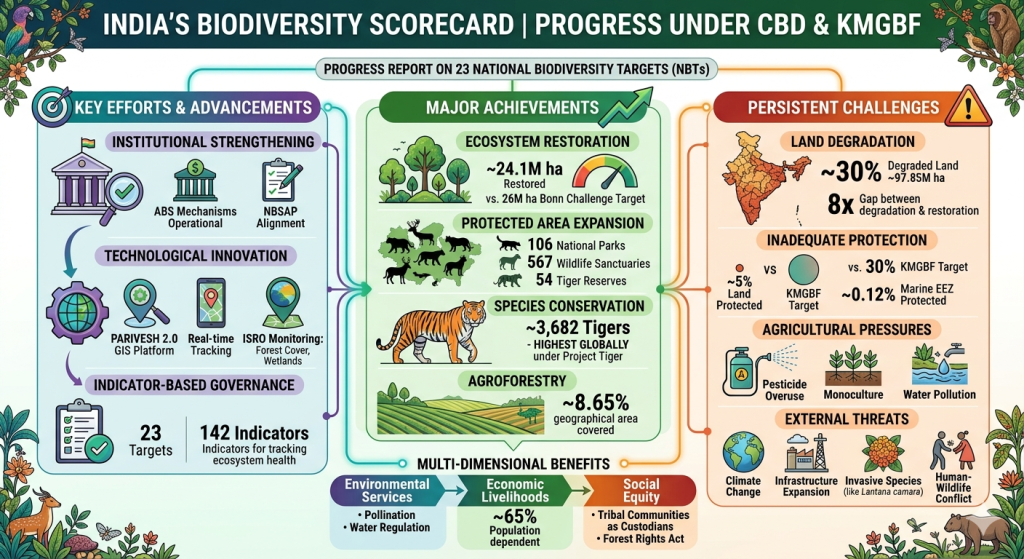
India’s updated National Biodiversity Strategy and Action Plan (2024–30) reflects this alignment through 23 National Biodiversity Targets (NBTs) and 142 indicators, marking a shift toward measurable governance.
Institutional and Technological Advancements
1. PARIVESH 2.0 Platform: Integrated GIS-based system for environmental, forest, wildlife, and coastal clearances.
2. Improved Governance: Enhances transparency, real-time tracking, and centralized land-use data.
3. Faster Decision-Making: Reduces delays and promotes biodiversity-sensitive planning.
4. ISRO’s Contribution: Advanced monitoring via forest cover mapping, wetlands inventory, and desertification atlas by Indian Space Research Organisation
5. Coastal & Ecosystem Monitoring: Enables data-driven conservation and restoration strategies.
6. Indicator-Based Framework: 142 indicators across 23 National Biodiversity Targets help track ecosystem health, species trends, and policy effectiveness.
Progress Achieved
| Area | Key Points |
|---|---|
| Ecosystem Restoration | ~24.1 million ha restored (target: 26 million ha under Bonn Challenge) |
| Major Initiatives | Green India Mission, MISHTI, National Afforestation Programme |
| Protected Areas Expansion | 106 National Parks, 567 Wildlife Sanctuaries, 54 Tiger Reserves |
| Tiger Conservation | Project Tiger → ~3,682 tigers (highest globally) |
| Agroforestry | Covers ~8.65% of India’s geographical area |
| Institutional Strengthening | ABS mechanisms operational, Biodiversity Heritage Sites notified, improved coordination |
Persistent Challenges
| Challenge Area | Key Issues |
|---|---|
| Land Degradation | ~30% land degraded (≈97.85 million ha); causes: soil erosion, salinisation, mining, urbanisation; ~8× gap between degradation and restoration |
| Protected Area Coverage | Only ~5% land protected vs 30% target; fragmented corridors, poor management, weak eco-sensitive zones; marine protection ~0.12% of EEZ |
| Data & Monitoring Gaps | Lack of standardised data; fragmented databases; weak species-level monitoring; limited citizen science integration |
| Agricultural Pressures | Pesticide overuse harms pollinators; monoculture reduces diversity; nutrient runoff causes water pollution; groundwater depletion |
| External Pressures | Climate change, infrastructure expansion, urbanisation, invasive species (e.g., Lantana camara), human-wildlife conflict |
Multi-Dimensional Analysis
1. Environmental Dimension: Biodiversity underpins ecosystem services such as pollination, water regulation, and climate stability. Regions like the Western Ghats are critical for water security, while mangroves protect coastal populations.
2. Economic Dimension: Around 65% of India’s population depends on biodiversity for livelihoods. Sectors like fisheries, forestry, and pharmaceuticals rely heavily on biological resources, making biodiversity central to economic sustainability.
3. Social Dimension: Tribal communities act as custodians of biodiversity. Legal frameworks like the Forest Rights Act recognise their role, but implementation gaps persist, particularly in benefit-sharing.
Way forward
1. Expand Conservation Scope: Promote OECMs, protect sacred groves & community forests, integrate biodiversity into urban planning.
2. Sustainable Agriculture: Encourage Integrated Pest Management, traditional crop varieties, organic farming & agroforestry.
3. Strengthen Data Systems: Develop unified biodiversity database, standardise indicators, promote citizen science.
4. Better Regulation: Strengthen EIA processes, enhance role of National Green Tribunal, ensure accountability in projects.
5. Mobilise Finance: Promote biodiversity bonds, strengthen ESG compliance, align subsidies with conservation goals.
Conclusion
India’s biodiversity governance reflects a shift from intent to structured action. The development of robust frameworks, digital platforms, and monitoring systems demonstrates strong institutional progress. However, ecological outcomes remain uncertain due to persistent challenges such as land degradation, inadequate protection, and weak enforcement. The central task ahead is to mainstream biodiversity across sectors—agriculture, infrastructure, urban planning, and finance. Conservation can no longer remain confined to protected areas; it must become an integral part of development planning.
Best ias coaching in delhi Best ias coaching in chandigarh
Prelims question:
Q. With reference to the Convention on Biological Diversity and the Kunming-Montreal Global Biodiversity Framework, consider the following statements:
1. The CBD was adopted during the Rio Earth Summit.
2. The KMGBF aims to protect 30% of land and oceans by 2030.
3. India has already achieved more than 30% protected area coverage of its geographical area.
4. The KMGBF includes targets related to biodiversity finance mobilisation.
Which of the statements given above are correct?
(a) 1, 2 and 4 only
(b) 1 and 3 only
(c) 2 and 4 only
(d) 1, 2, 3 and 4
Answer: A
Q. “India’s biodiversity governance has improved in terms of institutional frameworks and monitoring systems, but outcomes on the ground remain uncertain.” Critically examine in the context of India’s recent biodiversity report
(250 words)

- RBI’s Shrinking Real-Rate Cushion Amid Rising Inflation and Strong Demand - September 21, 2026
- India’s NGOs at a New Funding Crossroads - September 21, 2026
- Deep-Sea Discovery, Environmental Responsibility - September 19, 2026

No Comments