Mission Components
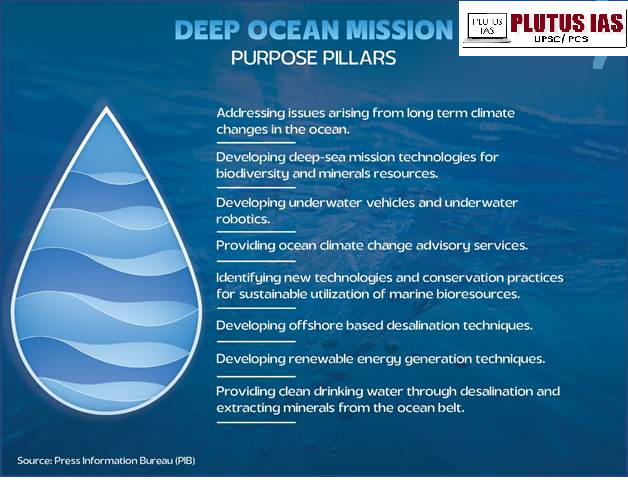
1. Development of Technologies for Deep Sea Mining, and Manned Submersible: India is building a manned submersible to take three people down to 6000 meters in the ocean. Alongside, an Integrated Mining System will be developed to extract polymetallic nodules from the deep sea in the Central Indian Ocean. These efforts will support future commercial mineral exploration, once global rules are set by the International Seabed Authority.
2. Development of Ocean Climate Change Advisory Services: An observations and model suite will be developed to study and forecast key climate variables from seasonal to decadal scales. This proof-of-concept initiative aims to enhance understanding of climate trends and contribute to the Blue Economy focusing on promoting coastal tourism.
3. Technological innovations for exploration and conservation of deep-sea biodiversity: The core focus is on bio-prospecting deep-sea flora, fauna, and microbes, alongside research into the sustainable use of deep-sea biological resources. This initiative will advance the Blue Economy priority area of marine fisheries and allied services.
4. Deep Ocean Survey and Exploration: This initiative focuses on identifying multi-metal hydrothermal sulphide sites along the Indian Ocean mid-oceanic ridges and supports deep-sea resource exploration under the Blue Economy.
5. Energy and freshwater from the Ocean: This proof-of-concept proposes studies and engineering design for an offshore Ocean Thermal Energy Conversion (OTEC) powered desalination plant, supporting the Blue Economy focus on offshore energy development.
6. Advanced Marine Station for Ocean Biology: This component focuses on building talent and innovation in ocean biology and engineering, turning research into industrial products via on-site incubators. It supports marine biology, blue trade, and manufacturing under the Blue Economy.
Project Samudrayaan – The Deep-Sea Leap
India launched the Samudrayaan Project, under the umbrella of Deep Ocean Mission, to work on its first component of deep-sea exploration through a manned submersible.
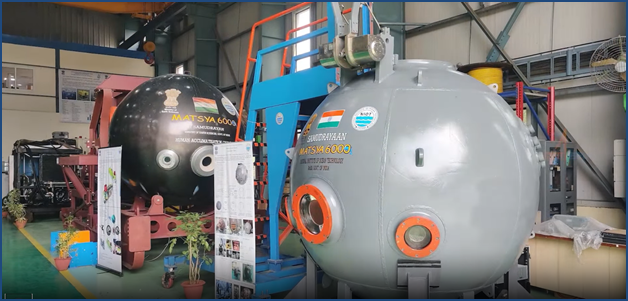
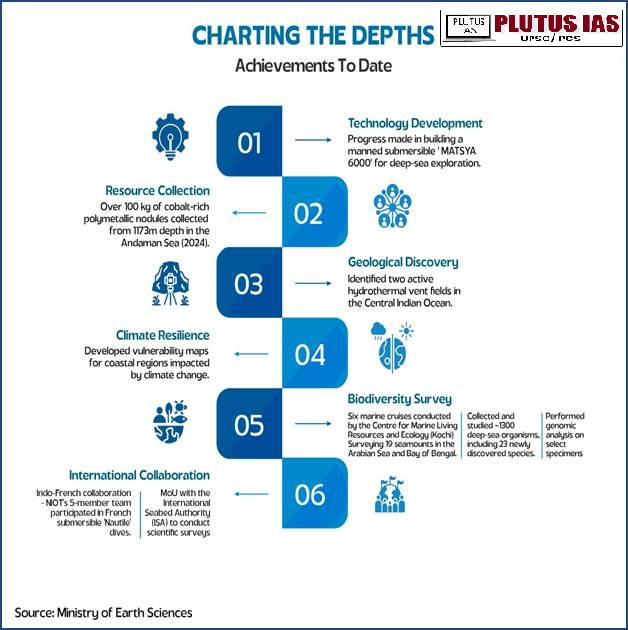
MATSYA 6000, a self-propelled manned submersible capable of transporting three individuals to depths of up to 6,000 meters beneath the ocean surface, is being developed under this project. Equipped with a comprehensive array of scientific instruments and exploration tools, this advanced vehicle will enable extensive deep-sea research. The submersible is built to work for 12 hours of operational period and sustain up to 96 hours in emergency scenarios. It features advance systems like a high-density Li-Po battery, underwater acoustic telephone, drop-weight emergency escape mechanisms, and bio-vests for crew safety and health monitoring.
The Technology
1. The vehicle is a spherical titanium-alloy vessel (Ti6Al4V – ELI grade) with a diameter of 2260 mm and wall thickness of 80 mm, designed to withstand 600 bar pressure and temperatures as low as -3°C.
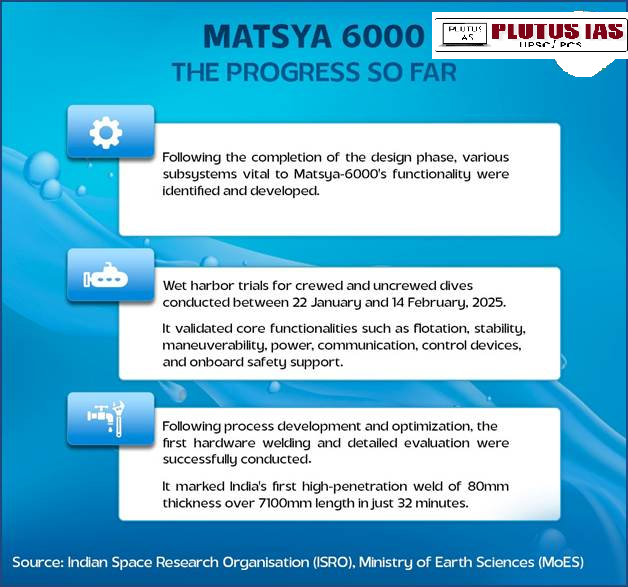
2. The titanium vessel has been constructed by a special welding process called high-penetration Electron Beam Welding (EBW) process developed by the Liquid Propulsion Systems Centre (LPSC) of Indian Space Research Organisation (ISRO). Perfection of the process was achieved after 700 trials.
3. The welding quality has been further tested by very advanced techniques like a combination of Non-Destructive Evaluation (NDE) methods such as Time-of-Flight Diffraction (TOFD) and Dual Linear Array (DLA) Phased Array Ultrasonic Testing (PAUT)
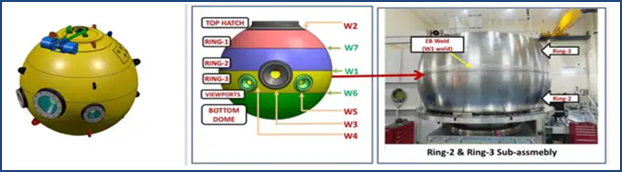
This Human Occupied Vehicle (HOV), is being developed through a collaboration between National Institute of Ocean Technology (NIOT), MoES and Vikram Sarabhai Space Centre (VSSC), ISRO. Significant progress has been achieved so far in this initiative.
The Trials: Voyage of Validation
1. Dry and Wet Trials of Matsya 6000
Integrated Dry Tests: Matsya first underwent integrated dry tests across a 500-meter operational range, ensuring smooth system integration within its exo-structure.
Wet Trials (Jan–Feb 2025): Conducted at L&T Shipyard, Kattupalli Port, Chennai, these trials validated power and control systems, flotation and stability, navigation, communication, forward–reverse motion, and human safety mechanisms.
Scientific Payload Testing: Advanced oceanographic sensors were tested and confirmed functional.
Demonstration Phase: Eight dives were carried out – five unmanned dives followed by five manned dives, each rigorously qualifying the life support system.
2. India’s First-Ever 5000 m Deep-Sea Venture
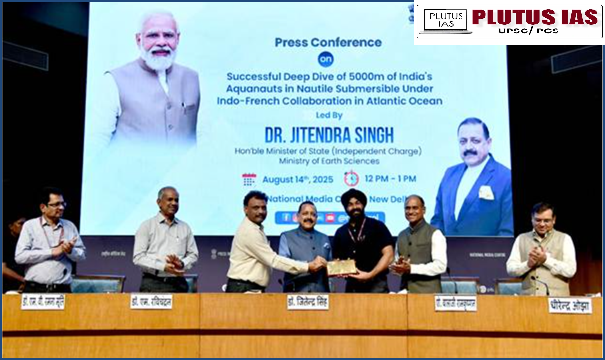
Date & Collaboration: On 5–6 August 2025, India achieved a major milestone in collaboration with IFREMER (French Marine Research Institute).
Location: The expedition was conducted in the Atlantic Ocean using IFREMER’s submersible Nautile.
Indian Aquanauts: Senior Scientist Shri Raju Ramesh and Cdr. Jatinder Pal Singh (Retd) from NIOT, Chennai, completed seven-hour dives to a depth of 5000 m, placing India among an elite group of fewer than half a dozen nations with such capability.
3. Key Outcomes and Learnings
Pre-dive preparation and piloting operations.
Habitability and buoyancy management.
Manipulator-based interventions (flag placement, sample collection).
Deployment and retrieval during dives.
Trajectory tracking and onboard system management.
Operating acoustic communication systems.
End-to-end planning and execution of deep-sea operational procedures.
This Indo-French research expedition supports ‘MATSYA – 6000’ development highlighting milestones like realisation and testing of the titanium hull, syntactic foam, VBS, and drop-weight mechanism, open ocean testing of subsystems and certification, shallow water demonstration up to 500 meters by early 2026, research vessel augmentation with LARS, integration and deep-water tests by mid-2027 and scientific explorations using MATSYA-6000 during 2027–28.
Deep Ocean Mission: Story Till Now
India has made notable strides in developing indigenous deep-sea technologies, including vehicles and pressure-resistant materials, with successful trials already in progress. In December 2022, the Ocean Mineral Explorer (OMe 6000), an autonomous vehicle, explored mineral-rich zones at a depth of 5,271 meters in the Central Indian Ocean Basin Polymetallic Manganese Nodule (PMN) site. Using the research vessel SagarNidhi, it surveyed 14 sq. km and mapped a detailed 1 km × 0.5 km area to assess polymetallic nodule distribution and deep-sea biodiversity, laying the groundwork for future exploration and resource mapping.
Conclusion
The Deep Ocean Mission, with its pioneering Samudrayaan Project, marks a transformative leap in India’s scientific and strategic capabilities. By venturing into the depths of the ocean, India is not only unlocking vast reserves of minerals, biodiversity, and energy, but also positioning itself among the few nations with advanced deep-sea exploration technology as enshrined in Prime Minister’s vision of ‘Samudra Manthan’. The development of a manned submersible reflects India’s growing expertise in marine engineering and innovation. This initiative supports key pillars of the Blue Economy and also fosters indigenous technology, boosts marine-based industries, and creates new opportunities for research, enterprise, and employment. The Deep Ocean Mission is not just a dive into the unknown – it’s a bold stride toward a resilient, resource-rich, and future-ready India.
Prelims Questions





No Comments