


20 Nov India’s Defence Reforms and Export Expansion: A Fact-Based Evaluation
This article covers “Daily Current Affairs” and From India’s Defence Reforms and Export Expansion: A Fact-Based Evaluation
SYLLABUS MAPPING
GS-3- Internal Security- India’s Defence Reforms and Export Expansion: A Fact-Based Evaluation
FOR PRELIMS
What are the key features of the Defence Acquisition Procedure (DAP) 2020?
FOR MAINS
What steps has the Government of India taken in recent years to promote self-reliance in defence production?
Why in the News?
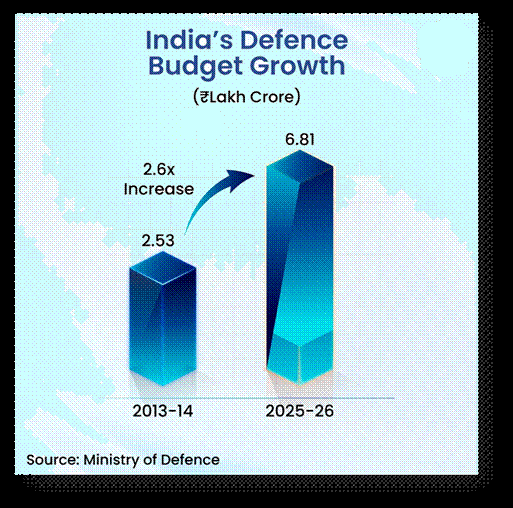
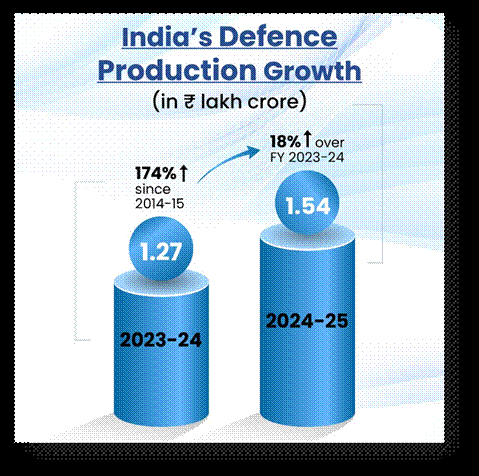
India’s indigenous defence production has reached an all-time high of ₹1,27,434 crore in FY 2023-24, marking a remarkable 174% increase from FY 2014-15. This surge reflects the success of the government’s Atmanirbhar Bharat initiative and the sustained push for defence indigenisation over the past decade. The rise in defence production comes alongside significant budgetary expansion, with India’s defence budget increasing from ₹2.53 lakh crore (2013-14) to ₹6.81 lakh crore (2025-26). Policy reforms, ease of doing business, and growing private-sector participation have further strengthened the domestic defence ecosystem. India now exports defence equipment to over 100 countries, and defence exports grew by 12.04% in FY 2024-25. The government has set ambitious targets of ₹3 lakh crore in defence manufacturing and ₹50,000 crore in exports by 2029, reinforcing India’s emergence as a global defence manufacturing hub.
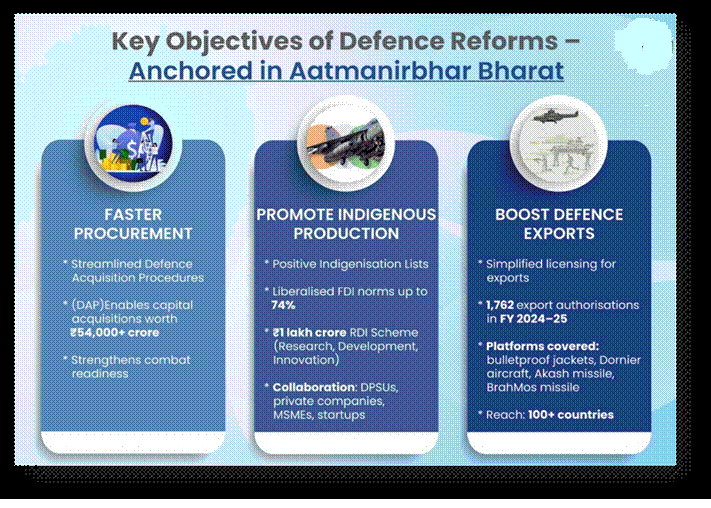
Objectives of Reforms
Anchored in the Government’s vision of Aatmanirbhar Bharat, a series of reforms were launched to transform India’s defence sector into a self-reliant, innovation-driven, and globally competitive industry. The major objectives include:
1. Faster and Transparent Procurement: Streamlining the Defence Acquisition Procedure (DAP) to reduce delays, enhance transparency, and promote time-bound procurement. The Defence Acquisition Council (DAC) plays a crucial role in approving capital acquisitions and ensuring quicker decision-making.
2. Boosting Indigenous Manufacturing: Promoting domestic production through Positive Indigenisation Lists, encouraging Indian companies to manufacture items earlier imported. Liberalised FDI norms allow 74% automatic route and up to 100% via government approval, attracting global investment and technology transfer.
3. Strengthening R&D and Innovation: Launching the ₹1 lakh crore Research, Development and Innovation (RDI) Scheme to support cutting-edge defence technologies, fostering synergy among DPSUs, private industry, MSMEs, academia, and startups.
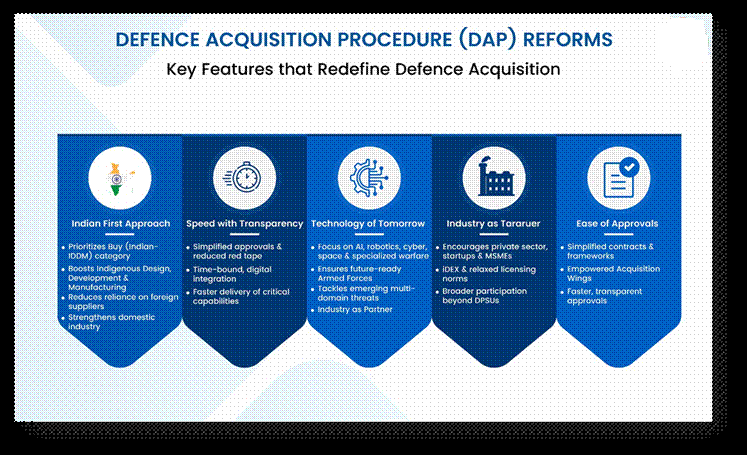
DAP 2020: The Strategic Roadmap for Self-Reliant Acquisition
The Defence Acquisition Procedure (DAP) 2020 is a forward-looking policy framework that functions not merely as a procedural rulebook but as a strategic blueprint for transforming India’s defence acquisition ecosystem. Introduced to resolve traditional challenges such as long procurement cycles, heavy import dependence, and procedural complexity, DAP 2020 introduces clarity, innovation, and a strong domestic-first orientation at every stage of the procurement process.
Building on the reforms introduced under DAP 2020, the Defence Procurement Manual (DPM) 2025 was launched by Raksha Mantri Shri Rajnath Singh in October 2025. The policy marks a major leap towards simplifying, standardising, and modernising revenue procurement across the Ministry of Defence (MoD). Effective from 1 November 2025, DPM 2025 aims to support the Armed Forces in procuring goods and services—valued at nearly ₹1 lakh crore annually—that are essential for operational preparedness.
The DPM 2025 introduces a wide range of industry-friendly reforms designed to ensure fairness, transparency, accountability, and greater participation from domestic enterprises, particularly MSMEs and start-ups.
Key Highlights of DPM 2025
1. Ease of Doing Business: Establishes standardised procedures across all Armed Forces and MoD organisations, reducing procedural ambiguity and delays. Simplifies documentation and rationalises approval workflows to ensure faster procurement cycles. Enhances predictability and uniformity, thereby strengthening industry confidence.
2. Support for Innovation and Indigenisation: Encourages deeper collaboration between the Armed Forces, private industry, MSMEs, and academia. Promotes indigenous solutions for revenue procurements, supporting long-term self-reliance. Complements initiatives like iDEX and Positive Indigenisation Lists.
3. Industry-Friendly Provisions: Lower liquidated damages (0.1% per week) for indigenisation projects, promoting a more facilitative environment. Offers guaranteed orders for up to five years for indigenously developed products, encouraging long-term investment in R&D. Removes outdated requirements like the No Objection Certificate (NoC) from the erstwhile Ordnance Factory Board, reducing unnecessary bureaucratic hurdles.
4. Digital Integration and Transparency: Strengthens e-procurement systems, ensuring seamless, paperless transactions. Integrates real-time data-driven monitoring to enhance accountability and improve decision-making.
Promotes transparent vendor selection and contract management. An Integrated Procurement Framework for the Future
1. From Dependence to Dominance: India achieved its highest-ever defence production of ₹1.54 lakh crore in FY 2024–25, reflecting strong progress under Aatmanirbhar Bharat. The country is moving toward ₹1.75 lakh crore production this year and targets ₹3 lakh crore by 2029, signalling its emergence as a global defence manufacturing hub.
2. Defence Industrial Corridors – New Growth Arteries: The UPDIC and TNDIC have become major centres of defence investment, together attracting ₹9,145 crore, with 289 MoUs unlocking ₹66,423 crore in potential opportunities (as of October 2025). These corridors are driving cluster-based manufacturing, innovation, and supply-chain development.
3. Expanding the Defence Ecosystem: DRDO is now at the heart of India’s defence innovation. A new ₹500 crore corpus under TDF is supporting deep-tech, cutting-edge R&D, technology transfers, and 15 DIA-CoEs linking academia, startups, and industry. The restructuring of Ordnance Factories into seven new defence companies has improved efficiency and autonomy. A vibrant private sector and 16,000 MSMEs are strengthening the defence supply chain—from UAVs to electronics—marking India’s shift toward a broad-based, innovation-driven ecosystem.
4. Opening New Horizons – Defence Investments: India is becoming a top destination for defence investments with 788 industrial licences issued to 462 companies.
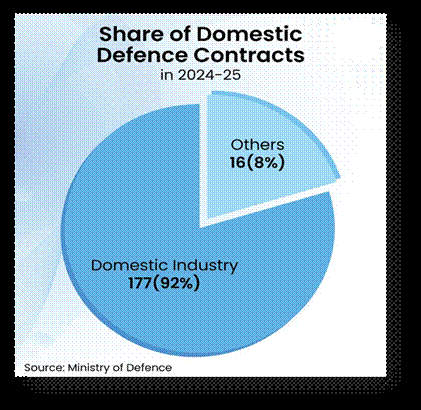
The fully digital export authorization system enabled 1,762 approvals in 2024–25, a 16.9% growth, alongside a 17.4% rise in exporters. In 2024–25, the MoD signed a record 193 contracts worth ₹2,09,050 crore, including 177 domestic contracts (₹1,68,922 crore)—the highest ever—boosting indigenous procurement, employment, and technological advancement.
Defence Export Promotion: India s Rising Profile
A New Export Story: Numbers That Speak
What was once a trickle is now a steady stream: India s defence exports reached a record ₹23,622 crore in FY 2024 25 registering a 12.04% growth over FY 2023 24 s ₹21,083 crore. Private sector exports contributed ₹15,233 crore, while DPSUs accounted for ₹8,389 crore, whereas the corresponding figures for FY 2023-24 were Rs 15,209 crore and Rs 5,874 crore respectively. In a major boost to defence exports, India has supplied a wide spectrum of products – including ammunition, arms, sub-systems, complete systems, and critical components – to around 80 countries during the 2024-25, reaffirming its role as a reliable partner in the global defence supply chain. The Defence Public Sector Undertakings (DPSUs) have shown a significant increase of 42.85% in their exports in the FY 2024-25 reflecting the growing acceptability of Indian products in the global market and the ability of the Indian defence industry to be a part of the global supply chain.
1. Faster, Simpler, Digital Policies that Open Doors: The Government has actively simplified the export pathway, standard operating procedures for the export of Munitions List items have been rationalised, and a fully end-to-end online portal now processes export authorisations digitally, cutting time and paperwork for exporters. Open General Export Licences (OGEL) and a digital authorisation system have further eased routine exports.
2. Defence Exports as Diplomacy: Exports are more than commerce: they build trust, interoperability and long-term partnerships. India s expanding export basket, supplied to friendly countries, is an instrument of outreach, seen in defence cooperation, logistics support, training and spares packages that accompany sales. The widening list of importers signals growing global confidence in Indian platforms.
3. Successful Indigenous Platforms & the Export Basket: India s exports today are broad and practical, from bulletproof jackets, patrol boats and helicopters, to radars and lightweight torpedoes, showcasing the depth and diversity of India s defence manufacturing. While combat aircraft programmes like Tejas continue on the path to operational maturity and export discussions, India s current strength lies in a wide range of proven, operational systems and components.
Q. “India’s recent defence reforms—from procurement modernisation to export promotion—are reshaping the country’s strategic autonomy and industrial capabilities.” Critically evaluate the impact of these reforms on self-reliance, defence preparedness, and global competitiveness.
(250 words)

- RBI’s Shrinking Real-Rate Cushion Amid Rising Inflation and Strong Demand - September 21, 2026
- India’s NGOs at a New Funding Crossroads - September 21, 2026
- Deep-Sea Discovery, Environmental Responsibility - September 19, 2026

No Comments