


10 Nov India’s Fiscal Slippage Risk: Tax Growth Slows, Subsidies Rise
✎ The government's fiscal position is a critical indicator of its financial health, influenced by revenue generation, expenditure patterns, and adherence to fiscal deficit targets, with potential slippages necessitating prudent…
Subject Relevance — Where This Topic Fits
- GS Paper III — Indian Economy and issues relating to Planning, Mobilization of Resources, Growth, Development and Employment | GS Paper III — Government Budgeting
- Prelims: Fiscal Deficit, Revenue Deficit, Capital Expenditure, Revenue Receipts, Fiscal Slippage, Disinvestment, Subsidies, Controller General of Accounts
- Essay: The imperative of fiscal prudence for sustainable economic growth in India, Balancing welfare expenditure with fiscal consolidation: Challenges and opportunities for India
Quick Revision: The government’s fiscal position is a critical indicator of its financial health, influenced by revenue generation, expenditure patterns, and adherence to fiscal deficit targets, with potential slippages necessitating prudent fiscal management.
Why is this in the news?
The Union government’s fiscal position is currently under scrutiny due to a combination of factors including subdued gross tax collections, a deceleration in capital expenditure growth, and the projected increase in the subsidy bill. These trends collectively raise concerns regarding potential fiscal slippage, indicating a deviation from the budgeted fiscal deficit targets and necessitating a careful assessment of expenditure rationalisation measures in the coming months.
Background
- The Union Budget outlines the government’s estimated receipts and expenditures for a financial year, serving as a critical policy document for fiscal management.
- Fiscal deficit represents the total borrowing requirements of the government, calculated as the difference between total expenditure and total receipts (excluding borrowings).
- Capital expenditure refers to government spending on creating assets like infrastructure, which has long-term economic benefits and multiplier effects.
- Revenue receipts comprise tax revenues (direct and indirect taxes) and non-tax revenues (e.g., dividends, interest receipts), forming the primary sources of government income.
- Subsidies are financial assistance provided by the government to individuals or businesses to reduce the cost of certain goods or services, often aimed at welfare or economic support.
- Disinvestment involves the government selling its stake in public sector undertakings (PSUs) to generate revenue and improve efficiency.
Understanding Key Fiscal Concepts and Their Implications
- Fiscal Slippage: This term denotes a situation where the government’s actual fiscal deficit exceeds its budgeted target, often due to lower-than-expected revenues or higher-than-anticipated expenditures.
- Gross Tax Collections: These represent the total tax revenues collected by the government before any devolution to states or refunds, comprising direct taxes (income tax, corporate tax) and indirect taxes (GST, customs, excise duties).
- Capital Expenditure Deceleration: A slowdown in the growth rate of capital expenditure can impact economic growth, as such spending is crucial for infrastructure development and enhancing productive capacity.
- Subsidy Bill Overruns: When actual expenditure on subsidies exceeds the budgeted allocation, it puts additional pressure on the government’s finances and can contribute to a higher fiscal deficit.
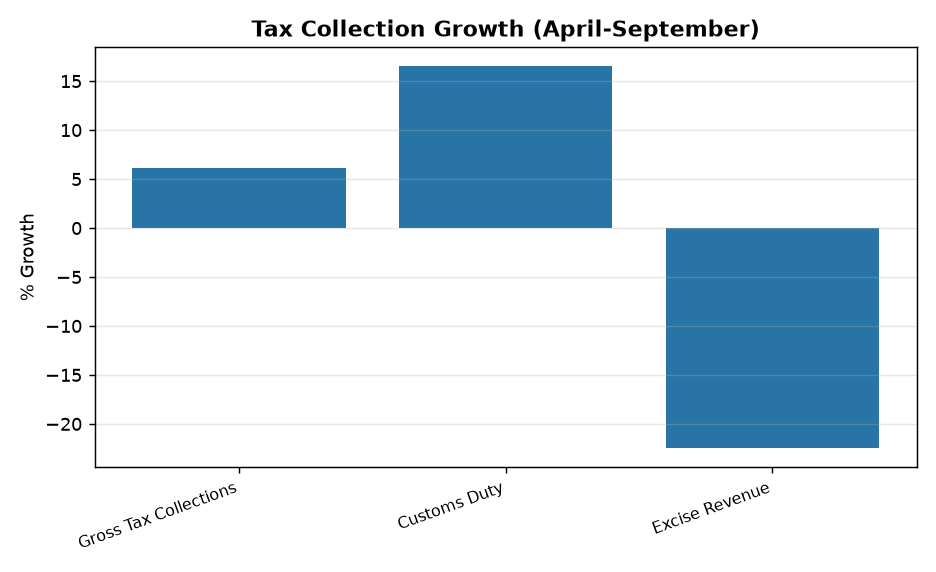
- Excise Duty Cuts: Reductions in excise duties on commodities like petrol and diesel directly lead to a decrease in government revenue, impacting the overall tax collection figures.
- Customs Duty Collections: These are taxes levied on goods imported into the country, and robust growth in customs duty can partially offset shortfalls in other tax revenues.
- Disinvestment Proceeds: Revenue generated from the sale of government assets, such as stakes in public sector enterprises, contributes to non-debt capital receipts and can help bridge the fiscal gap.
- Expenditure Rationalisation: This involves reviewing and potentially reducing government spending in certain areas to align with fiscal targets, often implemented when revenue generation is constrained or expenditure exceeds projections.
Key Features
| Feature | Significance |
|---|---|
| Subdued Gross Tax Collections | Indicates a potential shortfall in government revenue, impacting fiscal targets. |
| Slowdown in Capital Expenditure Growth | Suggests a deceleration in government investment in infrastructure and asset creation, which can affect long-term economic growth. |
| Rising Subsidy Bill | Increased expenditure on subsidies, particularly fertiliser, exerts pressure on the government’s fiscal deficit. |
| Expected Exceedance of Disinvestment Proceeds | Provides a partial offset to revenue shortfalls, contributing positively to non-tax revenue. |
| Excise Duty Cuts on Petrol and Diesel | Leads to a significant reduction in excise revenue, necessitating alternative revenue generation or expenditure adjustments. |
| Customs Duty Growth | Strong performance in customs duty collections offers a compensatory mechanism for other revenue shortfalls. |
Why it Matters
Economic Implications
- Potential for fiscal slippage, where the actual fiscal deficit exceeds the budgeted target, leading to increased government borrowing.
- Impact on capital formation and long-term economic growth due to a slowdown in capital expenditure.
- Inflationary pressures if increased government borrowing crowds out private investment or if subsidies lead to higher demand.
- Sovereign credit rating implications if fiscal discipline is perceived to be weakening over an extended period.
- Resource allocation distortions if a significant portion of the budget is diverted to subsidies, potentially at the expense of productive investments.
Governance and Policy Framework
- Necessity for expenditure rationalisation to manage fiscal pressures, which may involve prioritising certain spending areas over others.
- Challenges in achieving fiscal consolidation targets, which are crucial for macroeconomic stability.
- Importance of robust revenue forecasting and expenditure management mechanisms to prevent future fiscal surprises.
- Policy dilemma between providing essential subsidies to support vulnerable populations and maintaining fiscal prudence.
- Enhanced scrutiny of disinvestment policies and asset monetisation strategies as critical tools for non-debt capital receipts.
Social Impact
- Potential for reduced public services or welfare spending if expenditure rationalisation becomes extensive.
- Impact on agricultural sector stability due to changes in fertiliser subsidy policy, affecting input costs for farmers.
- Consumer impact from potential adjustments in fuel prices or other essential goods if subsidy rationalisation occurs.
- Employment implications from slower capital expenditure, which can affect job creation in infrastructure and related sectors.
Challenges
1. Fiscal Slippage Risk
- The Union government faces a risk of exceeding its budgeted fiscal deficit due to a combination of slower tax growth and rising expenditure.
- This deviation from fiscal targets can lead to increased government borrowing and potential macroeconomic instability.
UPSC Link: Government Budgeting; Fiscal Policy
2. Revenue Shortfall
- Gross tax collections have grown at a subdued rate, particularly due to a sharp fall in excise revenue from duty cuts on petrol and diesel.
- This necessitates reliance on other revenue streams like customs duty and disinvestment proceeds to meet targets.
UPSC Link: Government Revenue; Taxation
3. Expenditure Pressures
- The subsidy bill, especially for fertilisers, is projected to significantly exceed budget estimates.
- While capital expenditure growth has slowed, the overall expenditure burden remains high, contributing to fiscal stress.
UPSC Link: Government Expenditure; Subsidies
4. Balancing Growth and Prudence
- The government must navigate the delicate balance between stimulating economic growth through capital expenditure and maintaining fiscal discipline.
- Decisions on expenditure rationalisation need to consider both short-term fiscal stability and long-term developmental goals.
UPSC Link: Economic Growth; Fiscal Prudence
Challenges — UPSC Perspective
| Issue | Concern |
|---|---|
| Subdued Tax Growth | Potential shortfall in overall revenue, impacting fiscal deficit targets. |
| Reduced Excise Revenue | Significant decline in collections due to fuel duty cuts, requiring compensatory measures. |
| Rising Subsidy Bill | Increased expenditure, particularly on fertilisers, exerting upward pressure on the fiscal deficit. |
| Slowdown in Capital Expenditure | Deceleration in government investment, potentially affecting long-term economic growth. |
| Fiscal Deficit Exceeding Estimates | Risk of higher government borrowing, impacting interest payments and macroeconomic stability. |
| Expenditure Rationalisation | Necessity to cut or reallocate spending, potentially affecting public services or developmental projects. |
Way Forward
- Implement robust expenditure rationalisation measures, prioritising essential social and developmental spending while curbing non-priority expenditures.
- Enhance tax compliance and broaden the tax base to improve revenue buoyancy and reduce reliance on indirect taxes.
- Strategically accelerate disinvestment and asset monetisation initiatives to generate non-debt capital receipts and meet revenue targets.
- Review and rationalise subsidy policies to ensure their targeted delivery and minimise fiscal leakages, while safeguarding vulnerable sections.
- Strengthen fiscal transparency and accountability mechanisms to ensure prudent financial management and public trust.
- Explore innovative financing mechanisms for infrastructure projects to sustain capital expenditure without solely relying on budgetary allocations.
- Conduct regular and comprehensive fiscal reviews to anticipate potential challenges and implement timely corrective actions.
UPSC Value Addition
Keywords for Mains Answer-Writing
Fiscal slippage · Fiscal deficit · Capital expenditure · Revenue expenditure · Tax buoyancy · Disinvestment · Subsidies · Fiscal consolidation · Budgetary estimates · Macroeconomic stability
Constitutional & Policy Linkages
- Article 112: Annual Financial Statement (Budget)
- Article 265: Taxes not to be imposed save by authority of law
- Article 292: Borrowing by the Government of India
Concept Flow
Subdued Tax Growth → Increased Subsidy Bill → Fiscal Deficit Pressure → Increased Government Borrowing → Potential Expenditure Rationalisation → Impact on Economic Growth and Stability
Prelims Practice Questions
Q1. Consider the following statements regarding the Union Government’s fiscal position:
1. A decrease in capital expenditure growth typically indicates a reduction in long-term asset creation.
2. Fiscal slippage occurs when the actual fiscal deficit exceeds the budgeted estimate.
3. Disinvestment proceeds are classified as non-tax revenue for the government.
How many of the above statements are correct?
- Only one
- Only two
- All three
- None
Answer: All three — Statement 1 is correct: Capital expenditure is crucial for infrastructure development and long-term economic growth. A slowdown in its growth implies reduced investment in these areas. Statement 2 is correct: Fiscal slippage is precisely defined as the deviation of actual fiscal indicators, particularly the deficit, from their budgeted targets. Statement 3 is correct: Disinvestment involves the sale of government assets and is a one-time receipt, hence categorised under non-tax revenue.
Q2. Assertion (A): A significant increase in the subsidy bill can exert pressure on the government’s fiscal deficit.
Reason (R): Subsidies are typically a component of revenue expenditure, which does not create productive assets.
- Both A and R are true and R is the correct explanation of A.
- Both A and R are true but R is not the correct explanation of A.
- A is true but R is false.
- A is false but R is true.
Answer: Both A and R are true and R is the correct explanation of A. — Assertion (A) is true: Higher subsidies directly increase government spending without a corresponding increase in revenue, thereby widening the fiscal deficit. Reason (R) is true: Subsidies are indeed a form of revenue expenditure, meaning they are consumed within the current fiscal year and do not lead to the creation of physical or financial assets, thus contributing to the deficit without direct productive returns. R correctly explains A because the nature of subsidies as revenue expenditure directly impacts the fiscal deficit.
Q3. Which of the following is NOT typically considered a measure to address fiscal slippage?
- Increasing capital expenditure significantly
- Rationalising revenue expenditure
- Enhancing tax compliance and collection efficiency
- Accelerating disinvestment of public sector undertakings
Answer: Increasing capital expenditure significantly — Increasing capital expenditure, while beneficial for long-term growth, typically adds to immediate government spending and can exacerbate fiscal slippage if not financed sustainably. Measures to address fiscal slippage usually involve controlling expenditure (both revenue and capital, but especially non-productive revenue expenditure) and boosting revenue (tax and non-tax). Rationalising revenue expenditure, enhancing tax compliance, and accelerating disinvestment are all direct measures aimed at improving the fiscal position.
Mains Practice Question
✍ Critically examine the factors contributing to fiscal slippage in India, particularly in the context of recent economic trends. Discuss the potential implications of such slippage on macroeconomic stability and long-term growth. (15 Marks)
Approach: MODEL-ANSWER SKELETON:
1. **Introduction:** Define fiscal slippage as the deviation of actual fiscal deficit from budgeted targets, highlighting its significance for economic health.
2. **Factors Contributing to Fiscal Slippage (Contextualised to News):**
* **Revenue Side:**
* Subdued gross tax collections (e.g., slower growth than budget estimates).
* Specific revenue shortfalls (e.g., excise duty cuts on petrol/diesel).
* Dependence on non-tax revenues like disinvestment (e.g., IDBI stake sale, asset monetisation) which, while potentially exceeding targets, are often volatile and one-off.
* **Expenditure Side:**
* Slowdown in capital expenditure growth after initial buoyancy.
* Likelihood of subsidy bill overshooting estimates (e.g., fertiliser subsidy). This is a key driver of increased revenue expenditure.
3. **Potential Implications on Macroeconomic Stability:**
* **Inflationary Pressures:** Increased government borrowing to finance deficit can lead to higher money supply.
* **Crowding Out Effect:** Government borrowing may reduce funds available for private investment, leading to higher interest rates.
* **Sovereign Credit Rating:** Adverse impact on India’s credit rating, increasing borrowing costs.
* **Exchange Rate Volatility:** Investor concerns can lead to capital outflows and rupee depreciation.
* **Debt Sustainability:** Higher deficits contribute to increasing public debt, raising concerns about inter-generational equity.
4. **Potential Implications on Long-Term Growth:**
* **Reduced Productive Investment:** If slippage is due to higher revenue expenditure (subsidies) at the cost of capital expenditure, it hinders long-term asset creation and productivity growth.
* **Fiscal Space Constraints:** Limited ability for the government to undertake counter-cyclical fiscal measures during future economic downturns.
* **Uncertainty for Investors:** A volatile fiscal environment can deter both domestic and foreign investment.
5. **Conclusion:** Summarise the need for prudent fiscal management, expenditure rationalisation, and sustainable revenue generation to ensure macroeconomic stability and foster long-term inclusive growth, referencing the importance of adhering to fiscal responsibility frameworks.
Source: The Indian Express
Generated by AanyaAi for educational purpose.
Related guides on our sites
- Best economics services coaching
- Best economics optional coaching
- Best economics optional coaching for upsc
- best teacher of economics optional

- COP31: Relevance of UN Climate Summits Amid Missed Targets - November 10, 2026
- गूगल की स्कूलों के लिए विवादित सर्च और एआई नीति: एक विश्लेषण - November 10, 2026
- Delhi’s Post-Diwali Pollution: ICCC’s War Room Efforts - November 10, 2026

No Comments